

Levent Kenez/Stockholm
Turkey’s controversial Religious Affairs Directorate (Diyanet), which oversees mosques, trains imams and funds religious programs at home and abroad, will receive 229.1 billion lira ($4.73 billion) in 2027, according to budget figures published this month, giving it more government money than the ministries of interior, foreign affairs, energy, trade, culture and industry each receive.
The figure, included in Turkey’s Medium-Term Economy Program announced on September 6, 2026, marks a 31.4 percent increase over the Diyanet’s 2026 allocation of 174.4 billion lira ($3.60 billion). It puts the agency’s budget above the interior ministry’s 158.4 billion lira ($3.27 billion), the trade ministry’s 104.2 billion lira ($2.15 billion), the culture and tourism ministry’s 69.7 billion lira ($1.44 billion), the foreign ministry’s 64.4 billion lira ($1.33 billion) and the energy ministry’s 27 billion lira ($558 million), whose budget is roughly one-eighth that of the Diyanet.
A separate document, the Diyanet’s own mid-year financial and outlook report covering January through June 2026, shows how the agency is spending its current budget and offers a rare, detailed look at the scale of its operations.
The figures show that personnel costs dominate the agency’s spending. The report’s 2026 year-end estimate puts total Diyanet spending at about 177.5 billion lira ($3.66 billion), of which 150.7 billion lira ($3.11 billion) is allocated to personnel expenses. That means roughly 85 percent of the agency’s projected spending is expected to go to staff alone.
The scale of the workforce is also considerable. Diyanet officials said in September that the institution and the Türkiye Diyanet Foundation together have about 150,000 employees serving religious functions at home and abroad. A recent parliamentary record separately put Diyanet’s domestic network at about 93,000 mosques, along with Quran courses, religious education centers, family and youth centers and other facilities.
The size of the workforce has been a recurring subject of debate. Former Diyanet president Ali Erbaş argued in 2024 that the Diyanet did not have excess staff, pointing instead to what he described as a shortage of personnel and thousands of mosques without imams. The latest figure cited by Diyanet officials suggests that the workforce remains at roughly that level.
The Diyanet’s July 2026 Financial Status and Expectations Report shows personnel expenses as its largest spending category:
The mid-year report also shows the heavy concentration of spending within its religious services structure. In the first six months of 2026, the Diyanet reported spending 88.9 billion lira ($1.84 billion). Personnel and social security costs accounted for the overwhelming majority of that spending.
The same report provides a detailed picture of the Diyanet’s overseas operations, showing that its activities extend well beyond the administration of Turkey’s mosques and religious services. In Germany, for example, the agency works through the Turkish-Islamic Union for Religious Affairs (DITIB), which operates more than 900 mosque communities and has longstanding institutional ties to the Diyanet. The Diyanet also maintains religious officials and attachés abroad, runs theology and religious education programs and organizes religious and charitable activities involving Turkish citizens and Muslim communities in dozens of countries. Its overseas network gives the agency a role that extends beyond its domestic mandate and requires a substantial institutional and personnel structure outside Turkey.
The report also documents the Diyanet’s activities related to Islamophobia and its monitoring of developments involving Muslims abroad. It says the agency held an overseas strategy workshop on Islamophobia in March and an interagency meeting on the issue in April with representatives of other Turkish public institutions. The Diyanet also prepares an annual report on Islamophobia for restricted internal circulation and distributes a weekly bulletin tracking religious, social and cultural developments around the world to its central, provincial and overseas units. The report says both publications are intended for internal use.
The Diyanet is also expanding and reorganizing its network of religious officials abroad. It plans to establish or staff religious attaché posts in Boston, Miami, Montreal, Kandahar in Afghanistan and Turkistan in Kazakhstan, while closing its post in Barcelona and transferring responsibility to an office attached to the Turkish Embassy in Madrid. Seven religious services counselors and four attachés were appointed during the first half of 2026, according to the agency. Turkey’s Sister City Project has linked all 81 Turkish provinces with 208 cities in 93 countries for religious and educational cooperation.
The agency’s international education programs are another part of its overseas activities. Its International Theology Program, which provides religious education to foreign nationals and members of the Turkish diaspora, conducted admission interviews in Ankara, Almaty and Bishkek during the first half of the year. Fifty-six applicants were accepted and 387 students were enrolled in the program as of the last academic year.
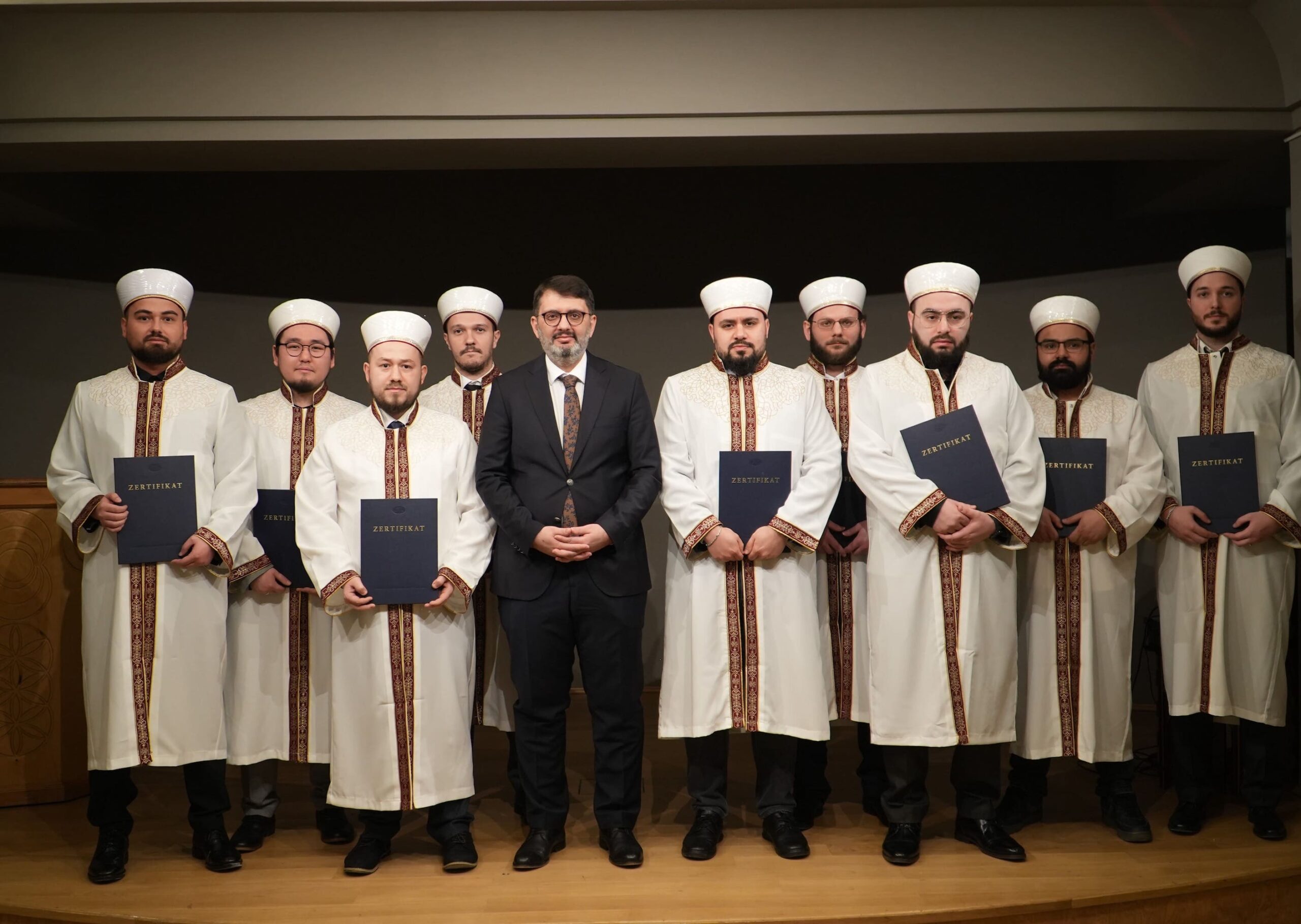
The report also says 183 theology students studying in Istanbul, Konya, Bursa and Ankara traveled to Mecca and Medina, while 51 students from a theology college in Cyprus took part in a youth program in Konya. Diyanet records also show that groups of new Muslim converts from Canada and the Netherlands were brought to Konya under a program called “Feel the Spirit of Islam.” The agency held a workshop in February on religious outreach to converts in Europe.
The Diyanet also organizes an annual sacrifice program during the Muslim holiday of Eid al-Adha, allowing Muslims to purchase a portion of a sacrificial animal, with the meat then distributed to people in need. According to the report, the program operated in 84 countries and 420 areas outside Turkey, as well as in all 81 Turkish provinces. A total of 882,044 sacrificial portions were provided, with the resulting meat distributed to more than 36.6 million people.
Nordic Monitor previously reported that Turkish imams sent abroad under Diyanet programs have in past years been investigated in Germany, France, the Netherlands and Lithuania on suspicion of surveilling critics of the Turkish government in diaspora communities, allegations Turkish officials have denied, describing them as unfounded and accusing Western governments of discrimination against Turkish and Muslim communities. Germany announced in 2023 it would gradually stop accepting Turkey-trained imams in favor of clergy trained domestically, while France stopped accepting Turkish government-paid imams starting in January 2024.
Turkey’s 2027 budget figures are proposals contained in the Medium-Term Program rather than a finalized budget law. Turkey’s parliament, where President Recep Tayyip Erdogan’s ruling alliance has a majority, is expected to take up the full budget bill later this year.