

Levent Kenez/Stockholm
The number of foreigners having a residence permit in Turkey has climbed back toward its historic peak, according to figures released by the Presidency of Migration Management, reversing a two-year decline and confirming a broader upward trend in the number of foreign residents.
According to data compiled by the Presidency of Migration Management as of August 27, 2026, a total of 1,274,988 foreigners currently have a valid Turkish residence permit. Since that figure covers only the first eight months of the year, it is not directly comparable to the full-year totals for prior years, and the final 2026 count is expected to be higher once the remaining months are added. Even so, the partial-year figure already exceeds the complete 2025 total of 1,151,969 by more than 123,000 people, and is approaching the all-time annual high of 1,354,094 reached in 2022.
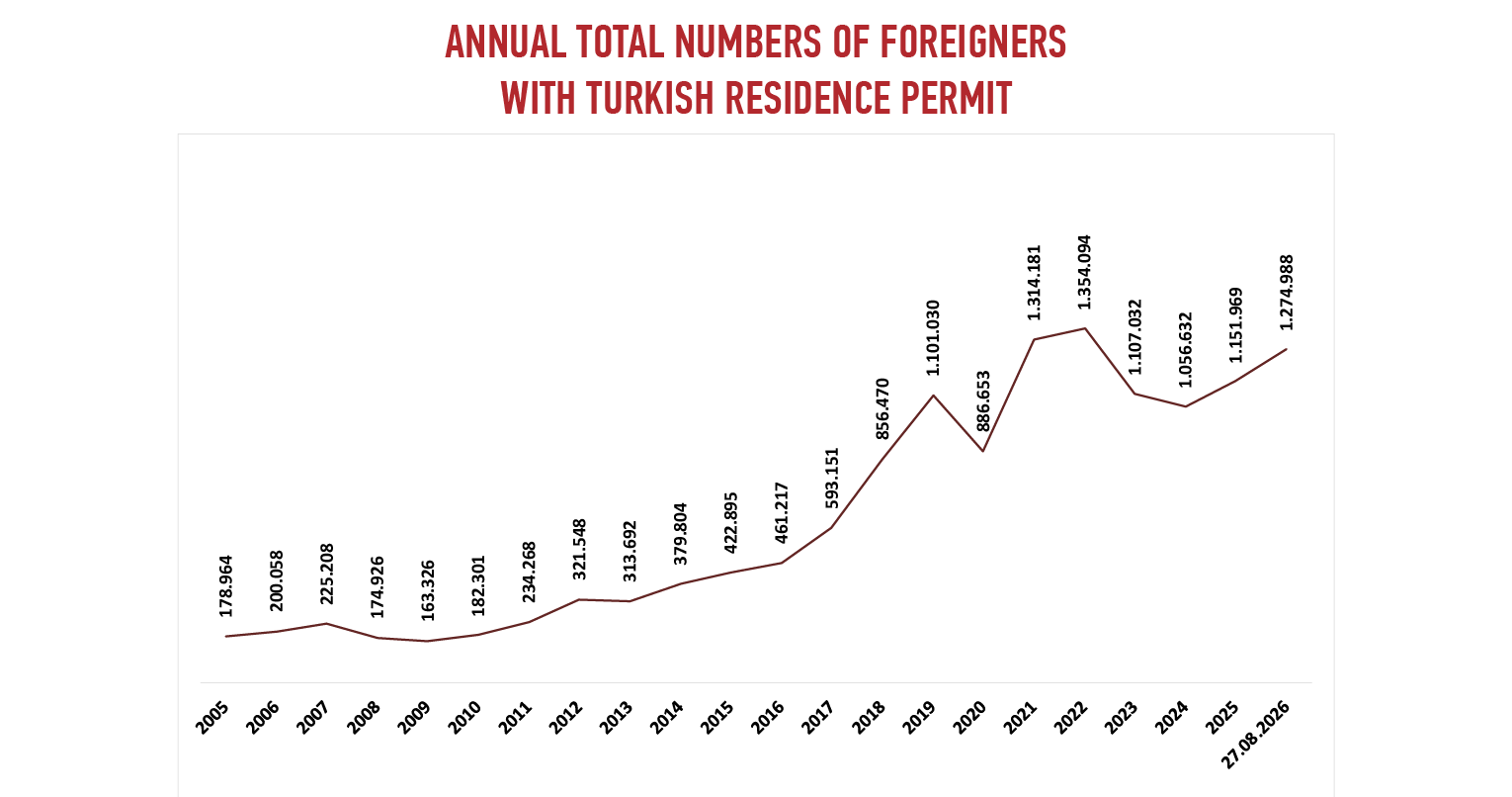
The renewed growth follows two consecutive annual declines, to 1,107,032 in 2023 and 1,056,632 in 2024, according to the same dataset, which tracks permit numbers back to 2005, when just 178,964 foreigners had Turkish residence status. If the pace recorded through late August continues, 2026 could end up setting a new record, surpassing 2022’s peak.
The breakdown by permit category shows short-term residence permits, the most common type and typically used by property buyers, retirees and long-term visitors, accounting for 451,817 holders so far in 2026, the largest single category. A broader “other” category, which includes permits tied to property ownership and additional legal grounds, followed closely at 426,598. Student residence permits totaled 222,429, while family residence permits, issued to relatives of foreign residents or Turkish citizens, stood at 174,144, according to the migration authority’s figures, all as of the same August 27 cutoff.
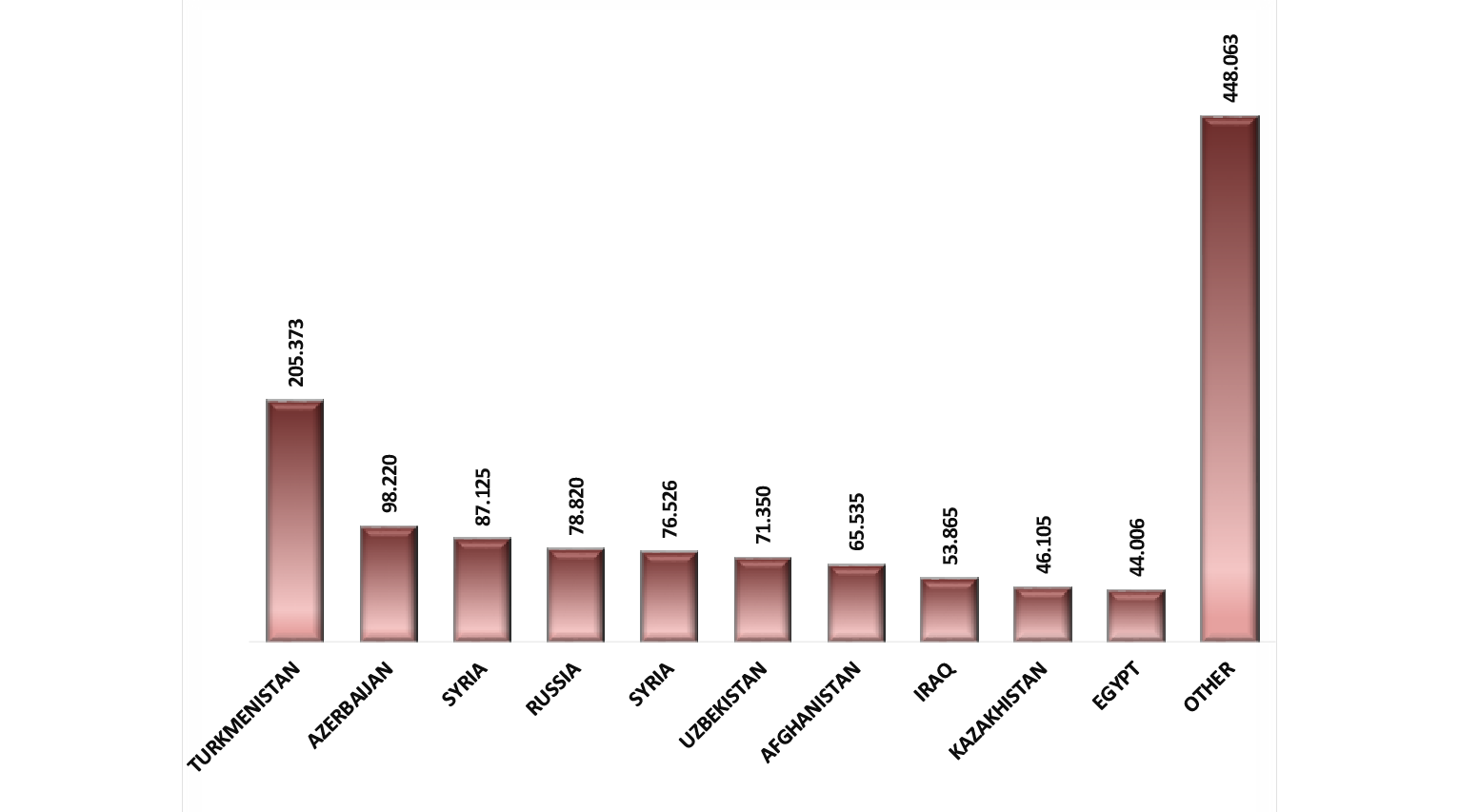
By nationality, Turkmen citizens lead the overall resident population with 205,373 permit holders, followed by Azerbaijan with 98,220 and Syria with 87,125. Russia, Iran, Uzbekistan, Afghanistan, Iraq, Kazakhstan and Egypt round out the top 10 nationalities, together accounting for hundreds of thousands more, while a large residual group of smaller nationalities totals 448,063 people, according to the migration authority’s 2026 breakdown.
The nationality mix shifts depending on permit type. Among short-term residence permit holders, Syrian nationals rank first with 64,513, ahead of Turkmenistan with 53,523, followed by Iraq, Russia, Azerbaijan, Egypt, Iran, Ukraine, Palestine and Afghanistan. It is worth noting that these figures do not include Syrians who fled their country’s civil war and remain under Turkey’s temporary protection status, a separate legal category tracked independently by the Presidency of Migration Management and not counted among standard residence permit holders.
For student permits, Turkmenistan dominates by a wide margin with 59,372 holders, more than double the next largest group, Iran, at 26,147, followed by Azerbaijan, Uzbekistan, Kazakhstan, Egypt, Pakistan, Iraq, Syria and Afghanistan. Family residence permits show yet another pattern, led by Uzbekistan with 19,854 and Turkmenistan close behind at 19,285, followed by Russia, Azerbaijan, Morocco, Iran, Syria, Ukraine, Afghanistan and Kyrgyzstan.
Several concrete factors help explain the renewed climb. Chief among them is a set of tax provisions designed to draw foreign income and remote workers into the Turkish system. Under Article 23/14 of Turkey’s Income Tax Law, wages paid in foreign currency to an employee working remotely from Turkey are exempt from Turkish income tax, provided the employer has no taxable presence in Turkey and does not record the payment as a domestic expense. That exemption means qualifying remote employees of foreign companies pay no domestic tax on that income at all. A separate provision, combining Article 89/13 with Article 10 of the same law, offers a reduced tax base for income earned in Turkey from software development, engineering, product design, medical reporting, accounting and other services exported abroad, provided earnings are brought into the country in foreign currency. Freelancers and small companies serving overseas clients from Turkish soil can apply the same discount, though it generally requires forming a sole proprietorship or limited company.
A newer and more sweeping measure took effect in 2026. Under a provision added to the Income Tax Law and published in the Official Gazette, foreign nationals and returning Turkish citizens who had no residence or tax registration in Turkey during the three years before settling in the country are exempt from Turkish income tax on their foreign-sourced earnings and investment income for 20 years after establishing residence.

The Revenue Administration’s implementing communiqué, published in July 2026, requires applicants to obtain an exemption certificate from their local tax office and sets out separate rules covering inheritance transfers during the exemption period, which are taxed at a reduced 1 percent rate.
Lawmakers described the measure, in the bill’s stated justification, as aimed at attracting expatriate Turks, internationally mobile professionals, digital nomads and investors. A further rule, effective from the start of 2026, lowered the effective tax rate on certain overseas subsidiary earnings and cross-border service income to as low as 5 percent, according to a bulletin published by the Union of Chambers of Certified Public Accountants of Turkey. Together, the provisions have turned Turkey into one of the more favorable jurisdictions in the region for people who can perform their jobs from anywhere, particularly software developers, consultants and other remote professionals whose income originates abroad.
Property purchases are a second major driver. Foreigners who buy real estate worth at least $200,000 qualify for a short-term residence permit tied to the property, renewable annually so long as the buyer retains ownership, under rules published by Turkish immigration authorities. That permit does not by itself lead to citizenship, but time spent in Turkey under it can count toward the eight years of residence required for long-term permit status, and family members with an ownership interest in the property can apply for permits as well. A separate and higher threshold applies to citizenship: Foreigners who purchase property worth $400,000 or more and agree in writing not to sell it for three years can apply directly for Turkish citizenship, a route introduced in 2018 and adjusted several times since, most recently raising the minimum property purchase price from $250,000 to $400,000 in 2022. The minimum for the residence-only route was separately raised from $75,000 to $200,000 that same year.

The growth in permits has also attracted the attention of organized crime networks exploiting the application process. In June 2026 Istanbul police detained 64 suspects in coordinated raids across eight provinces after uncovering what prosecutors described as an organized migrant-smuggling ring that used forged notarized documents and false declarations to obtain residence permits for large numbers of foreign nationals.
The network operated through companies posing as immigration consultancies, manipulating online accounting records to process fraudulent applications. Suspects faced charges including forming a criminal organization, bribery, migrant smuggling, forgery of official documents and submitting false declarations in official filings.
In a separate case the same month Istanbul police detained 18 suspects accused of running a scheme that used forged notarized declarations to secure residence permits for foreigners who had entered the country illegally, according to police statements. That investigation began after officers tracked a single foreign national found to have entered Turkey unlawfully before expanding into a larger network. Seven suspects were jailed pending trial after an earlier phase of the operation in January 2026.