
Abdullah Bozkurt/Stockholm
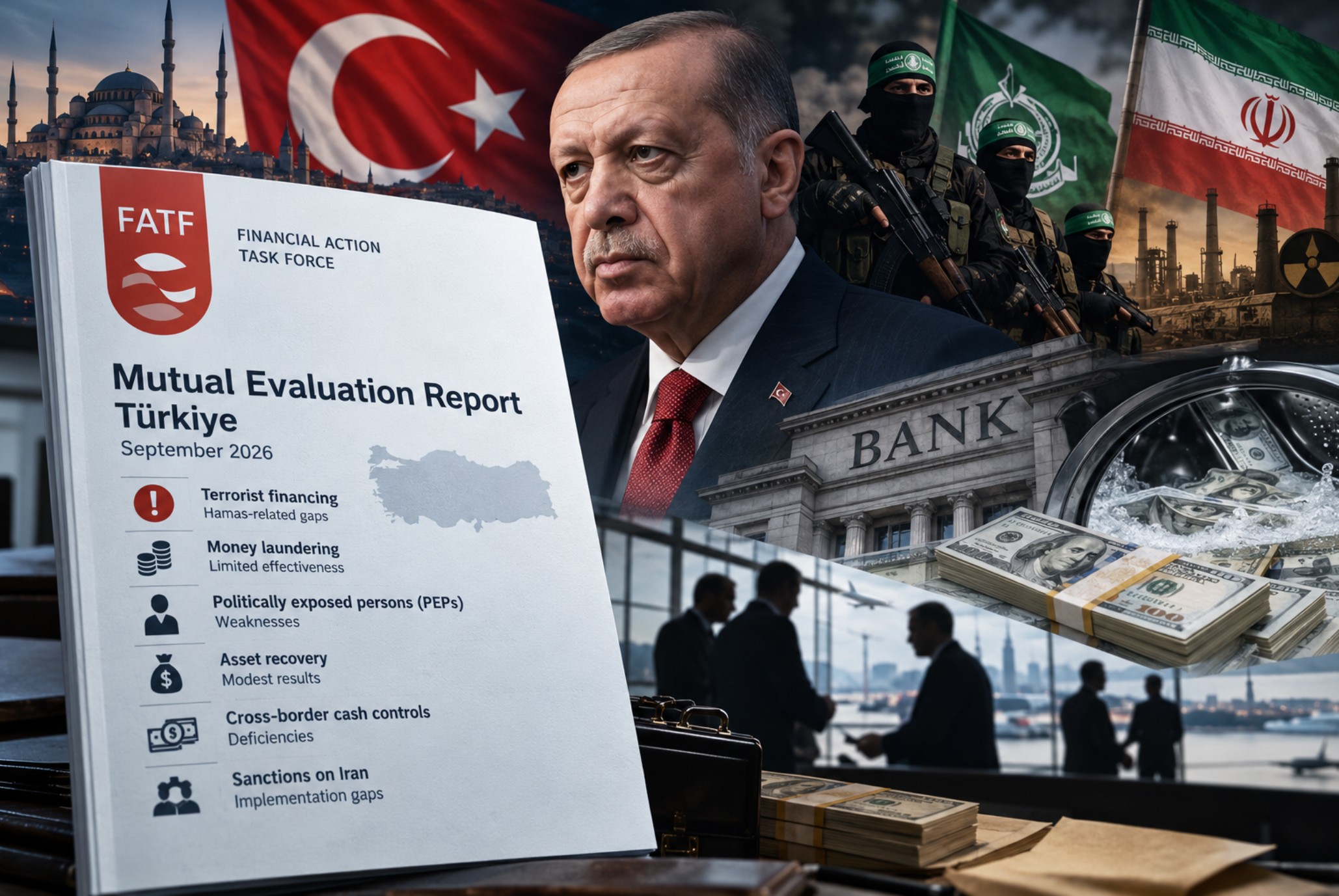
While the government of President Recep Tayyip Erdogan has highlighted Turkey’s improved technical compliance in the latest assessment by the Financial Action Task Force (FATF), the global standard-setting body on money laundering and terrorist financing identified a series of shortcomings in the actual effectiveness of the Turkish system, ranging from terrorist financing investigations and politically exposed persons to asset recovery, cross-border cash controls and sanctions on Iran.
Turkey’s Treasury and Finance Ministry responded to the September 2026 report by emphasizing that the country was rated compliant or largely compliant with 38 of FATF’s 40 technical recommendations. The ministry said the findings confirmed that Turkey had no strategic deficiency that would justify a return to FATF’s so-called grey list.
But the 337-page report offers a far less reassuring picture once the focus shifts from the existence of laws and regulations to whether those rules actually produce results.
FATF, an intergovernmental body that sets global standards for combating money laundering, terrorist financing and proliferation financing, draws a clear distinction between technical compliance — whether the required laws, regulations and institutions exist — and effectiveness — whether they work in practice. FATF itself describes effectiveness as the central component of a mutual evaluation.
On that second measure, Turkey received only a “Moderate” effectiveness rating in eight of the 11 areas examined. Just three — risk assessment and policy coordination, international cooperation and financial intelligence — were rated “Substantial.” Money laundering investigations, asset recovery, terrorist financing investigations, terrorist financing sanctions, beneficial ownership and financial-sector supervision were among the areas rated only moderately effective.
FATF consequently placed Turkey in enhanced follow-up and adopted a time-bound roadmap for further improvements. That process is separate from the grey list, which Turkey exited in June 2024. FATF’s plenary adopted the new mutual evaluation in June 2026 and gave Ankara a three-year roadmap of priority measures.
One of the most significant findings concerns terrorist financing and Hamas, which Ankara does not designate as a terrorist organization.
FATF said Turkish authorities demonstrated more than 11,000 terrorist financing investigations, 2,500 prosecutions and over 400 convictions between 2021 and 2025, particularly in cases involving organizations designated under Turkey’s domestic sanctions regime or to some extent listed by the UN Security Council.
In other words, Turkey’s heavy reliance on terrorism-financing cases tied to the Gülen movement — which Ankara designates as FETÖ — contributed substantially to the headline enforcement figures presented to FATF. The movement has been subjected to a sweeping government crackdown since 2014, including large-scale asset seizures in tens of billions of dollars, over its opposition to President Erdogan’s government. FATF found that Turkey’s more complex terrorist-financing enforcement remained heavily concentrated on Gülen-related cases and specifically called on Ankara to demonstrate effective action against a broader range of terrorist-financing threats and commercial structures beyond those cases.
At the same time, FATF identified a significant enforcement gap involving organizations that fall outside Turkey’s own designation regime, explicitly citing Hamas. FATF found that Turkey had failed to demonstrate terrorist-financing investigations, prosecutions or convictions involving such organizations, saying the only activity shown in this category consisted of two responses to foreign requests for information. The watchdog described this as a “significant effectiveness gap,” making clear that Turkey’s failure to demonstrate enforcement against Hamas-linked financing had not escaped its scrutiny.
FATF told Turkey to improve its identification and investigation of terrorist financing involving the “full range” of threats in its current risk profile and specifically called for action extending beyond formally designated organizations. The watchdog also urged the government to strengthen specialized training, case-handling standards and investigations involving trade-based terrorist financing, procurement networks and layered cross-border structures.
The report further suggests that much of Turkey’s demonstrated terrorist financing enforcement remains concentrated on relatively simple transactions rather than sophisticated financing structures.
FATF said a significant share of cases involved small donations, ATM micro-transfers and minor facilitation, while Turkey needed to show more effective cases involving trade-based financing, exchange houses, money-transfer systems, large procurement networks and complicated corporate structures.
Another major set of deficiencies concerns money laundering investigations and prosecutions.
Turkey opened 23,184 money laundering investigations, but FATF found that investigations involving high-risk areas other than fraud — including professional money laundering, misuse of companies and cross-border currency movements — were comparatively limited.
Nordic Monitor has reported over the years that money-laundering investigations involving senior government officials or their associates were often obstructed by political interference from the Erdogan government. According to its reporting, this pattern allowed major figures allegedly involved in sophisticated laundering schemes to avoid meaningful scrutiny, while lower-level actors were prosecuted or sacrificed to create the appearance of enforcement rather than a genuine effort to pursue the principal organizers and beneficiaries.
Although authorities increased prosecutions and convictions in recent years, FATF pointed to a substantial judicial backlog and continuing difficulties in turning complex investigations into final court outcomes. The executive summary records 7,248 pending prosecutions and notes that complex cases involving professional facilitators represented only a limited share of prosecutions and convictions.
FATF therefore urged authorities to put greater priority on money laundering connected to drug trafficking, smuggling and illegal betting, particularly cases involving professional money launderers, cross-border movement of goods and currency and misuse of legal persons. It also called for more effective sanctions in cases involving public officials, professional money launderers and organized crime.
The report also exposes a striking disparity between the value of transactions temporarily stopped by Turkish authorities and the amount ultimately converted into actual seizures or confiscations. Between 2021 and 2025 MASAK, Turkey’s Financial Crimes Investigation Board, postponed 19,276 transactions worth approximately €1.138 billion while they were reviewed. Only 612, or 3.2 percent, resulted in asset seizure.
FATF described the conversion rate as “extremely low,” saying it could point either to excessive reliance on temporary transaction postponements or to significant weaknesses in the judicial process for authorizing seizures.
The gap is even more pronounced at the confiscation stage. FATF’s own table shows only 28 confiscations worth approximately €1.99 million arising from postponed transactions during the five-year period. More broadly, Turkey recorded around €147 million in seized assets and €93 million in confiscated assets, totals FATF described as modest in light of the country’s financial and criminal-risk profile.
FATF also noted that even Turkey’s relatively modest record of asset seizures and confiscations was largely driven by high-value, complex cases triggered by international cooperation requests. The finding suggests that Turkish authorities have been more responsive when cases originated abroad or carried the prospect of international scrutiny, rather than consistently initiating and pursuing comparable asset-recovery proceedings on their own.
Cross-border cash movements emerged as another area of concern. FATF recorded approximately €87.9 billion in incoming cash declarations, compared with €25.4 billion outbound.
Despite substantial investment in technology at customs checkpoints, most funded by the European Union, FATF said detections and seizures remained limited. The watchdog said the figures were inconsistent with Turkey’s identified cash-smuggling exposure and highlighted weaknesses in enforcement and risk management at border entry points.
Customs statistics cited in the report show 506 cash-seizure cases between 2020 and 2025 involving approximately €85.2 million, with 463 notifications sent to MASAK. FATF recommended more intensive screening of inbound cash, improved use of data analytics and closer coordination between customs officers, law enforcement agencies and MASAK.

FATF also identified notable weaknesses involving politically exposed persons, or PEPs, a category that includes senior public officials and others whose positions may expose them to heightened corruption and money-laundering risks.
Nordic Monitor has long reported that these weaknesses are not merely technical shortcomings but form part of a broader system in which politically connected figures enjoy protection from meaningful financial scrutiny. Its investigative coverage has documented allegations of public-tender manipulation, kickbacks and favoritism in licensing and regulatory decisions involving members of President Recep Tayyip Erdogan’s family, his inner political circle and associated business figures, with benefits extending to lower-level participants in such schemes.
Only about half of Turkey’s exchange offices said they had procedures for identifying PEPs, according to the report. The problem is particularly significant because Group B exchange offices, which make up approximately 78 percent of all such offices, are not required to establish formal written procedures for identifying and reviewing politically exposed customers. FATF said the absence of standardized procedures “significantly weakens” the sector’s capacity to identify higher-risk customers and consistently carry out enhanced due diligence.
The assessment team also found that none of the institutions it met with reported directly asking customers whether they themselves were politically exposed persons or relatives of one. Some institutions had only a limited understanding that close associates can include individuals with professional or social ties to public officials, not merely family members.
Enforcement against financial institutions was another weak point. FATF found a relatively high number of continuing violations among exchange offices, money-transfer services and virtual asset providers, while Turkey had not sufficiently demonstrated that the most serious systemic shortcomings resulted in sanctions strong enough to deter future violations.

Serious structural failures — including weak internal controls, inadequate risk-management systems or the absence of institution-wide money laundering risk assessments — can initially result simply in written warnings and a period for remediation. Because institutions often correct the shortcomings during that period, FATF said the deficiencies frequently do not result in punitive sanctions.
The report additionally noted that Turkey does not publish AML/CFT sanctions and remedial measures, reducing their deterrent effect.
Corporate ownership transparency, another core element in detecting money laundering and sanctions evasion, also drew criticism. Although Turkey operates a beneficial ownership registry and several company databases, FATF found that the system relies heavily on self-reported ownership information and lacks systematic verification against independent sources.
Cross-checking can take place through MASAK analysis, tax inspections and interagency cooperation, but FATF said such verification remains ad hoc rather than embedded in a systematic process.
The government’s MERSİS corporate database is also not systematically used to detect classic money laundering indicators such as multiple companies registered at the same address, recurring directors or shareholders across numerous businesses or rapidly changing and complex ownership structures, FATF found.
Notaries, meanwhile, generally check whether documents comply with formal requirements rather than independently verifying whether the underlying ownership information is actually accurate.
The report also raises concerns about Turkey’s implementation of renewed UN financial sanctions against Iran. Following the reactivation, or “snapback,” of previous UN Security Council sanctions on September 27, 2025, FATF found that Turkey had not amended its regulations and presidential decrees to implement the relevant targeted financial sanctions under UNSCR 1737 and successor resolutions.
As a result the watchdog concluded that by the end of the onsite assessment in November 2025, Turkey could not be considered to be implementing targeted proliferation-financing sanctions on Iran in accordance with the relevant UN resolutions or FATF standards.
FATF further noted that Turkey had identified no proliferation-financing assets belonging to sanctioned individuals or entities during the reporting period. Given Turkey’s position as a major regional financial and trading hub, the watchdog questioned whether the absence of detected cases was consistent with the country’s actual exposure.
It said limited understanding of sophisticated sanctions-evasion techniques, combined with weaknesses in identifying beneficial owners behind complicated or foreign corporate structures, reduces Turkey’s ability to detect schemes involving people acting on behalf of sanctioned individuals or entities.
The findings underscore the central distinction running through the FATF assessment: Turkey has substantially strengthened its formal legal and regulatory framework, but FATF found considerably less evidence that those rules are consistently generating effective results in many of the country’s highest-risk areas.
The Turkish government has focused its public response on the first part of that equation. The Treasury and Finance Ministry said the 38 compliant or largely compliant technical ratings showed the level Turkey had reached and confirmed that there was no basis for renewed grey-list monitoring.
FATF’s own roadmap, however, concentrates heavily on the second part: improving outcomes. It calls on Ankara to pursue more sophisticated money laundering and terrorist financing networks, recover criminal assets, strengthen scrutiny of politically exposed persons and beneficial owners, tighten cross-border cash controls and implement financial sanctions more effectively.