
Abdullah Bozkurt/Stockholm
Armenian court documents have provided yet another detailed account of a modus operandi developed under the Islamist government of Turkish President Recep Tayyip Erdogan for advancing Ankara’s regional interests through jihadist fighters, showing how men recruited from Turkish-backed armed factions were moved across Turkey and deployed to Azerbaijan after similar networks had already been used in Syria and Libya.
The long-running criminal case against two Syrian nationals captured during the 2020 Armenia-Azerbaijan war offers an unusually granular look at the infrastructure behind that policy, apparently sanctioned by President Erdogan and carried out by his intelligence agency MIT and the Turkish military.
According to information entered into Armenia’s judicial database, recruiters linked to the Turkish-backed Sultan Suleiman Shah Brigade, a jihadist group that has been built by Turkey in Syria, enlisted hundreds Syrians, trained them in northern Syria, moved them across the Turkish border in a clandestine operation, transported them between Turkish airports on civilian aircraft and eventually flew them to Azerbaijan, where Turkish and Azerbaijani military personnel helped organize their deployment.
The Armenian prosecution went further, alleging that Muhammad al-Jasim, better known as Abu Amsha, the commander of the Sultan Suleiman Shah Brigade, had previously been recruited by Turkish intelligence services and was acting on instructions to recruit fighters for Azerbaijan’s planned military campaign against Armenian forces in and around Nagorno-Karabakh.
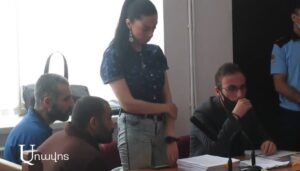
The allegations were laid out in the cases of Syrian nationals Muhrrab Muhammad al-Shkheri (51) and Yousef Alaabet al-Hajji (38), who were captured during the 44-day war that erupted on September 27, 2020, and ended with major Azerbaijani territorial gains.
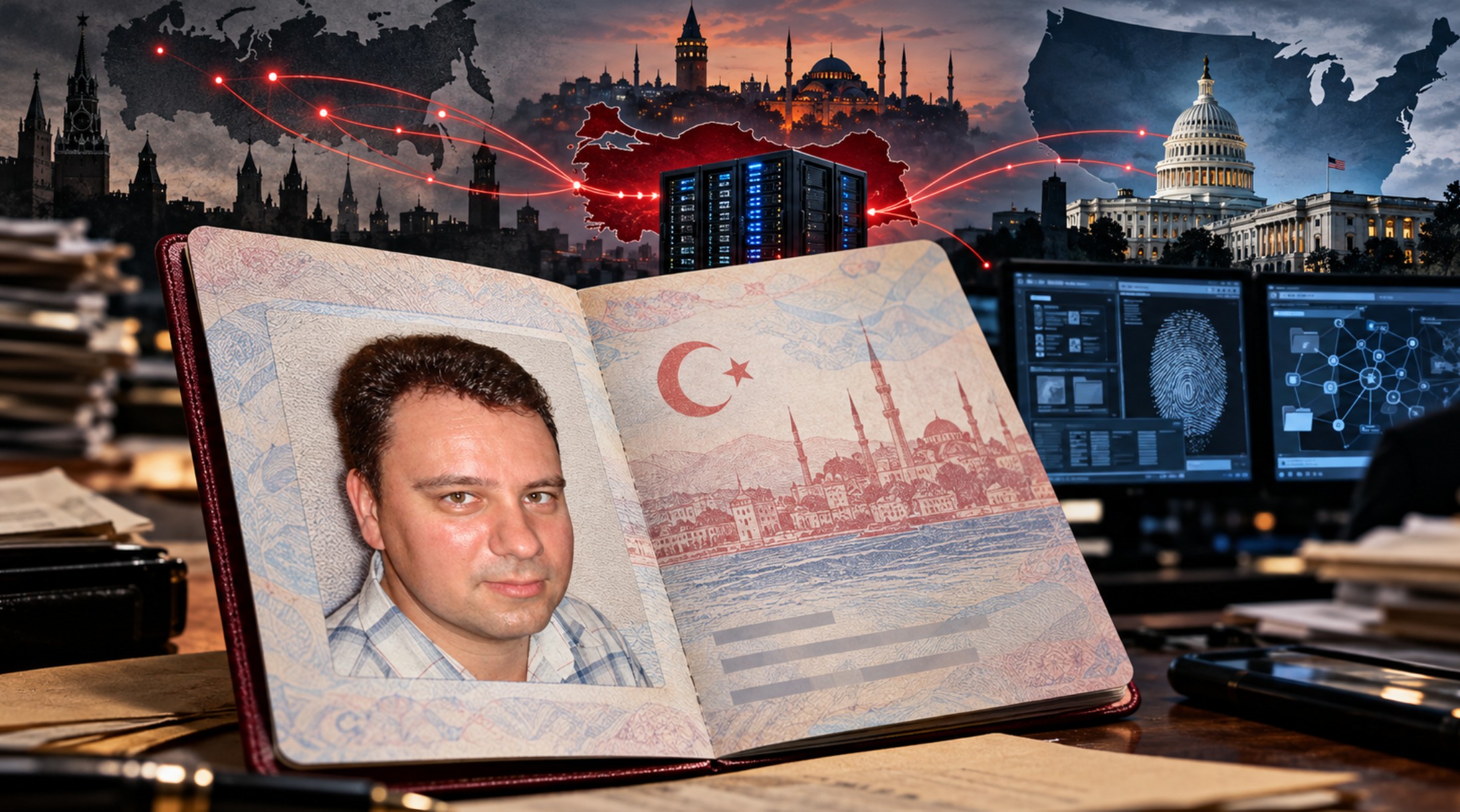
The two Syrian fighters captured during the 2020 Armenia-Azerbaijan war were included on Armenia’s list of designated persons pursuant to UN Security Council Resolution 1373. The list was approved at the 36th session of Armenia’s Interagency Committee on Combating Money Laundering, Terrorism Financing and Proliferation Financing on October 18, 2021:
Nagorno-Karabakh was internationally recognized as part of Azerbaijan, although it had for decades been controlled by ethnic Armenian authorities backed by Armenia. Azerbaijan regained much of the territory it had lost in the first Karabakh war during its 2020 offensive.
The importance of the Armenian criminal files lies less in the eventual convictions of the two Syrians than in what investigators said they uncovered about the mechanism that delivered them to the battlefield.
According to the Armenian court files, which were also covered in the ocal media, Abu Amsha had been recruited by Turkey’s special services, meaning the notorious Turkish intelligence agency MIT, and received instructions to recruit Syrians willing to fight on Azerbaijan’s side for money.
The indictment said Abu Amsha and his associates targeted men struggling financially in areas of northern Syria under the influence of Turkish-backed armed groups. One of the defendants, Muhrrab Muhammad al-Shkheri, was allegedly approached in June 2020 by a representative of Abu Amsha identified as “Abu Hussein 23.”
He was offered $2,000 a month to undergo military training and then travel to Azerbaijan to participate in the anticipated fighting against Armenian forces. Similar sums were also offered for Syrian jihadists who were transported to Libya to fight alongside the Libyan Islamist factions that were backed by Turkey in the post-Gaddafi period as well.
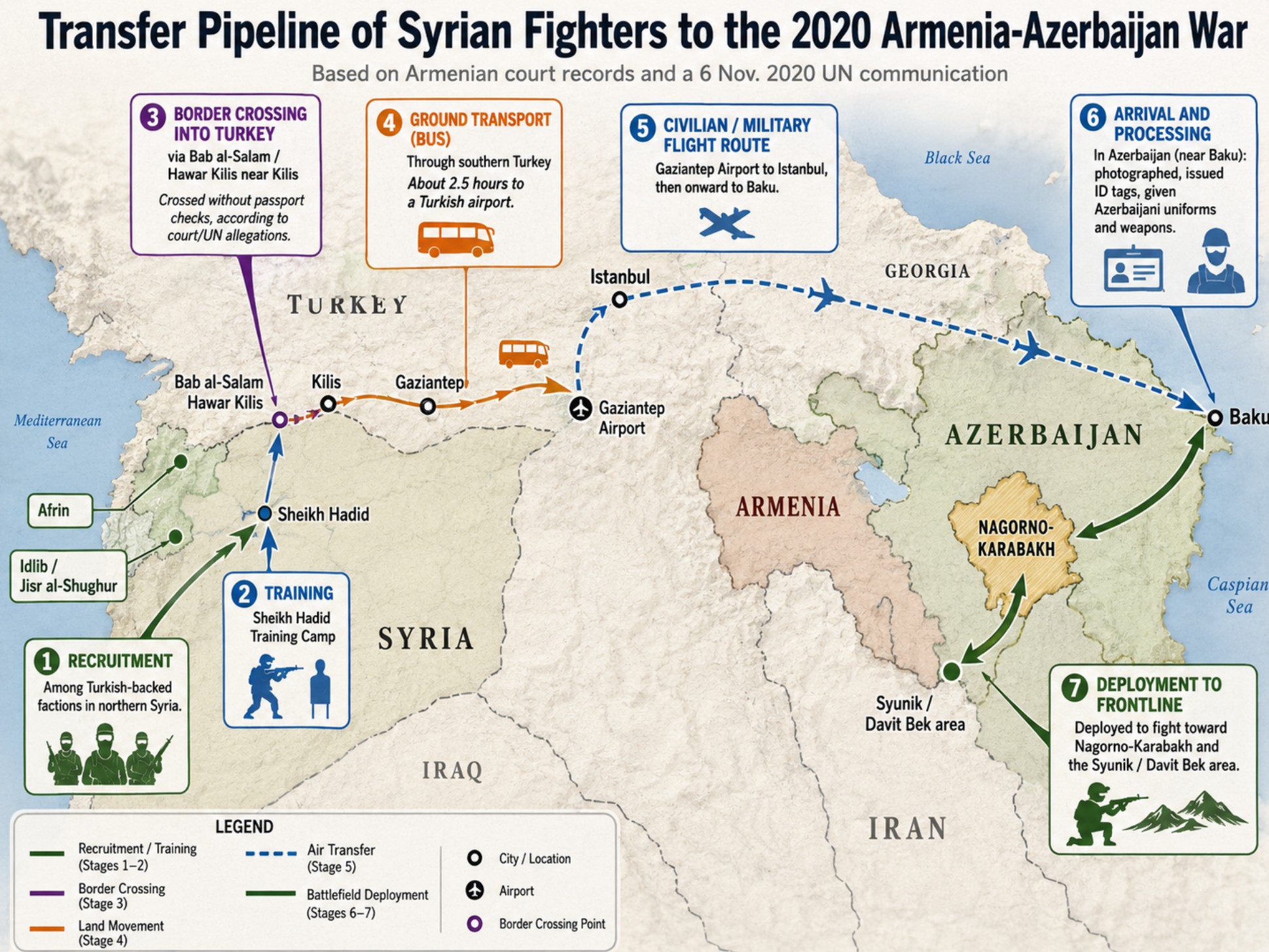
After accepting, al-Shkheri was taken to Sheikh Hadid in northern Syria, a stronghold associated with the Sultan Suleiman Shah Brigade. Armenian prosecutors said approximately 500 recruits underwent physical and military training there for three months between June and September 2020.
A November 6, 2020, UN communication to the Turkish government raised concerns over allegations that Turkey recruited, financed and transported Syrian fighters to Azerbaijan for deployment in the Nagorno-Karabakh conflict, including through Turkish territory and on military and commercial flights:
The Armenian investigation placed recruitment and training months before the large-scale Azerbaijani offensive began on September 27, suggesting that the deployment was organized in advance rather than improvised after hostilities started.
On October 17, al-Shkheri and 17 other recruits were transported by truck to a crossing point where approximately 250 fighters had assembled. They were subsequently taken toward the Turkish border near Kilis.
Commanders from the Suqour and Hamza factions were also present, according to the indictment, and were operating under Abu Amsha’s authority. A commander identified as Colonel Mahmoud selected 250 men and divided them into five groups.
At about 11 p.m. the fighters crossed from Syria into Turkey. What followed is one of the most revealing allegations in the Armenian court record. Prosecutors said Turkish officials guarding the border did not request passports or other identification, did not question the purpose of the fighters’ travel and knowingly allowed the entire group to cross.
That would mean Turkish border guards had been instructed to stand down and that the operation was being coordinated by MIT. During the Syrian civil war, MIT carried out similar cross-border operations, moving not only heavy weapons but also jihadist fighters through Turkish territory. Militants were extracted from one part of Syria, transported across Turkish border provinces, including Kilis, and then inserted at other points along the frontier to reinforce armed groups engaged in ongoing fighting.
MIT also facilitated the movement of hundreds, if not thousands, of foreign fighters from around the world who traveled to Turkey and then crossed into Syria to join jihadist groups operating there.
On several occasions MIT’s clandestine activities were exposed, prompting local prosecutors in Turkey in 2014 to open terrorism investigations targeting intelligence officials over secret assistance to jihadist groups. Those investigations were abruptly shut down after intervention by President Erdogan, shielding MIT personnel from potential prosecution over serios allegations that they had aided and abetted designated terrorist organizations.
Similar methods were apparently used in 2020 to move jihadist fighters to Azerbaijan for deployment against Armenian forces. The Armenian indictment therefore portrayed the Turkish state not merely as having failed to detect the clandestine movement of armed men across its territory but as actively facilitating and enabling the operation.
Once inside Turkey, the 250 Syrians were transported between civilian airports aboard aircraft bearing the Turkish flag, according to the case file. At the second airport they were allegedly met by about 50 Turkish military personnel. Under Turkish military escort, the fighters then boarded an aircraft displaying the Azerbaijani flag and flew to Azerbaijan on the morning of October 18, 2020.
There, more than 30 Azerbaijani servicemen allegedly met the recruits and transported them to a military installation. During the following seven days, Armenian prosecutors alleged, Abu Amsha participated in repeated discussions with Turkish and Azerbaijani military personnel concerning the upcoming combat operations. The Syrian fighters were given Azerbaijani military uniforms and weapons, including Kalashnikov rifles, PKS machine guns and RPG anti-tank grenade launchers.
The second defendant, Yousef Alaabet al-Hajji, was fed through much the same pipeline. His recruiter was identified as Ibrahim Rab al-Ayal, known as Abu Ahmad, from the Jisr al-Shughur area of Syria’s Idlib Province. Al-Hajji also underwent training at Sheikh Hadid along with hundreds of other prospective fighters.
On September 25, 2020 — two days before the outbreak of the war — he was taken to the Bab al-Salam crossing in northern Syria. There, according to the court record, Abu Amsha’s brother, identified as Seif, selected approximately 500 Syrian men between the ages of 20 and 40 and told them they would receive $2,000 a month.
The 500 men then crossed into Turkey without Turkish border officers requesting passports or identification documents, prosecutors alleged.
According to al-Hajji’s testimony, the bus journey from the Turkish-Syrian border to a Turkish airport took approximately two-and-a-half hours, suggesting that the fighters may have boarded their flight at Gaziantep Oğuzeli International Airport (GZT). They were eventually transported to Azerbaijan, where each fighter was photographed, issued an individual identification tag and provided with an Azerbaijani uniform, weapons and ammunition.
That sequence is important because it describes a logistical chain requiring access to border crossings, civilian aviation and military installations — infrastructure that would be extremely difficult for an autonomous militia to arrange without state-level assistance.
The Armenian allegations did not emerge in isolation. While the 2020 war was still underway, United Nations special rapporteurs formally confronted the Turkish government with reports of substantially the same system.
In a November 6, 2020, communication to Ankara, UN experts said they had received information concerning Turkey’s involvement in recruiting Syrian fighters for deployment to Azerbaijan in support of military operations in Nagorno-Karabakh.
The UN communication specifically named the Hamza Division, Sultan Murad Division, Al-Amshat faction and Sultan Suleiman Shah Brigade — some of the same Turkish-backed formations appearing in the Armenian criminal file.
According to the information received by the UN experts, recruitment began in August 2020, when commanders of Syrian National Army factions were allegedly instructed to use intermediaries to enlist fighters for Azerbaijan. The recruits were reportedly offered up to $2,500 per month, significantly more than they could earn in war-ravaged Syria.
A related UN communication to Azerbaijan said an estimated 1,500 to 2,000 Syrian fighters had been deployed by late September 2020, with more under recruitment. It said their recruitment, payment and transfer had reportedly been undertaken by Turkey and that fighters were moved to Baku on military and commercial flights from Turkish territory.
The description tracks remarkably closely with the route later laid out in Armenia’s court records.
As expected, Turkey rejected the UN allegations. In its January 2021 response, Ankara called the allegations “unfounded,” “baseless” and based on Armenian disinformation. Azerbaijan likewise denied allegations that it had relied on foreign mercenaries.
The Armenian court documents therefore represent one side of a highly contested interstate conflict. Yet the details contained in the criminal file substantially overlap with information independently collected by UN special procedures while the fighting was taking place.
The deployment to Azerbaijan was also not the first time Turkey had been accused by the UN of moving Syrian fighters to another country to pursue Ankara’s strategic objectives. Months earlier, UN experts had confronted Turkey over the recruitment and deployment of Syrian fighters to Libya.
A June 10, 2020, UN special procedures communication said information had been received alleging that Turkey recruited, deployed and paid fighters, including children, from several Syrian armed groups to participate in military operations around Tripoli on behalf of Libya’s internationally recognized Government of National Accord.
The UN experts characterized the operation as the effective deployment of mercenaries to an armed conflict. Several of the Syrian factions implicated in Libya would later surface in allegations surrounding Azerbaijan.
Most strikingly, Abu Amsha himself provides a direct personnel link between the two theaters. In August 2023 the US Treasury Department sanctioned Abu Amsha, his Sultan Suleiman Shah Brigade and the Hamza Division for serious human rights abuses in northern Syria.
Treasury said the Sultan Suleiman Shah Brigade had engaged in abductions, extortion and forced displacement, particularly against Kurdish residents of Afrin. The US government also noted that Abu Amsha’s brother Walid Hussein al-Jasim took command of the brigade when Abu Amsha left Syria to fight in Libya.
The same US sanctions notice revealed another important Turkish connection: Abu Amsha owned Al-Safir Oto, an automobile dealership headquartered in Istanbul with locations in southern Turkey operated by commanders of the Sultan Suleiman Shah Brigade. Treasury described the company as an outlet through which Abu Amsha invested income generated by his militia activities.
The picture that emerges is therefore of a militia leader operating inside Turkish-backed Syrian security architecture, maintaining business interests in Turkey, fighting in Libya and later appearing in an Armenian criminal case as the principal organizer of Syrians sent through Turkey to Azerbaijan.
Turkey’s cultivation of Syrian armed groups dates to the uprising against then-president Bashar al-Assad in 2011. Ankara became one of the most important foreign sponsors of the Syrian opposition and eventually assembled a large number of factions under the umbrella of what became known as the Syrian National Army.
Those groups served Turkish objectives inside Syria, particularly during Turkish military operations that established Ankara-backed zones along the border and displaced Kurdish-led forces from areas Turkey considered strategically important.
Over time, however, the fighters also acquired a value beyond Syria. The Libya and Azerbaijan deployments demonstrated how forces originally cultivated for the Syrian conflict could function as an expeditionary proxy pool, supplying Ankara and its allies with relatively inexpensive, deniable manpower for operations elsewhere.
The system offered several advantages. Local commanders handled recruitment. Desperate economic conditions supplied willing manpower. Turkish-controlled territory in northern Syria provided staging areas. Turkey provided access to transport infrastructure, funding and arms. Fighters could then be integrated with allied local forces while Ankara maintained a formal distance from their battlefield conduct.
That structure also reduced the political cost of sending larger numbers of Turkish soldiers into foreign conflicts. The Armenian files provide a rare courtroom-level reconstruction of how such a system functioned in practice.
The criminal file contained much more serious accusations than mercenary recruitment alone. Armenian prosecutors alleged that after arriving in Azerbaijan, Syrian fighters were instructed during meetings involving Abu Amsha and Turkish and Azerbaijani military personnel not to spare Armenians.
In al-Hajji’s case, prosecutors alleged that the recruits were promised a $100 bonus for presenting the severed head of an Armenian and were supplied with long-bladed knives. The indictment further alleged that groups of fighters were ordered to attack Armenian villages, kill civilians and soldiers and carry out arson and explosions designed to terrorize the population.
Al-Shkheri was captured after fighting near settlements in Armenia’s Syunik Province, while al-Hajji was captured near Davit Bek, also in Syunik, according to the Armenian file. That detail means the case was not limited to allegations concerning fighting inside internationally recognized Azerbaijani territory. Armenian prosecutors alleged that operations involving the Syrian fighters extended toward sovereign Armenian territory as well.
Armenia’s Investigative Committee completed its investigation in April 2021. It charged both men with offenses including terrorism committed by an organized group, international terrorism, attempted serious violations of international humanitarian law and mercenary activity. The Investigative Committee said its evidence established that the Syrians were not Azerbaijani citizens or residents and had joined the war for financial compensation as members of an organized group.
The case was sent to the Syunik Provincial Court and assigned to Judge Napoleon Ohanyan. On May 4, 2021, the court sentenced both defendants to life in prison. The defendants’ public defender, Mushegh Vardanyan, said the two admitted that they had been hired as mercenaries but denied committing war crimes.
Armenia initially treated the two Syrian fighters as criminal defendants rather than prisoners of war. In December 2020 the Armenian Investigative Committee said they were not eligible for release or exchange under post-war prisoner arrangements with Azerbaijan. That position appeared to shift five years later. In September 2025 Armenian media, citing an unnamed source, reported that Azerbaijan had asked Armenia to release the two Syrians as part of discussions concerning Armenian detainees held in Baku. The report was never officially confirmed.
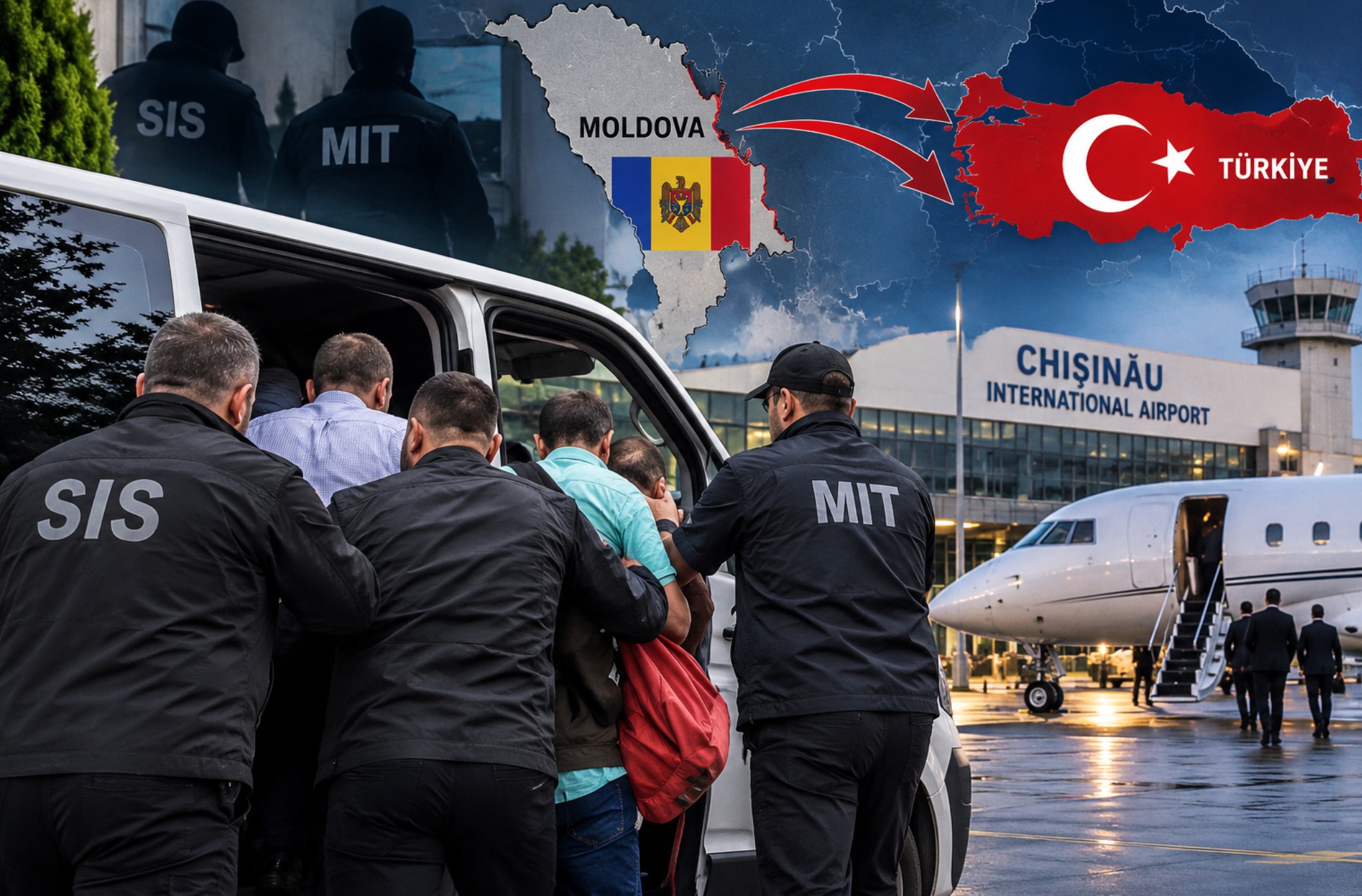
On January 14, 2026, Armenia transferred the two men through Turkey to Syrian authorities, officially so they could continue serving their Armenian life sentences in Syria. On the same day, Azerbaijan released four Armenian detainees to Armenia, fueling speculation that the two moves were connected.
Armenia’s Ministry of Justice announced that the two Syrian nationals had been handed to Syrian authorities “via the Republic of Turkey” under cooperation between the relevant authorities and existing legal mechanisms. Justice Minister Srbuhi Galyan later said the transfer was based on the principle of reciprocity and was intended in part to improve relations with Syria and help protect the interests of the Armenian community there.
She acknowledged that other routes had been considered before Armenia decided to move the prisoners through Turkey. Hetq, a Yerevan-based Armenian investigative news outlet, subsequently reported that the Armenian Justice Ministry did not confirm that it had obtained guarantees that the two men would actually remain incarcerated and continue serving their Armenian life sentences after their transfer to Syria.
Taken together, the Armenian judicial record, UN communications and subsequent US sanctions material add to a substantial body of evidence showing how Erdogan’s government turned armed Syrian factions into instruments of Turkish regional policy.