
Levent Kenez/Stockholm
Turkey’s latest military appointments show a command structure in transition. Although officers who began their careers long before President Recep Tayyip Erdogan came to power still occupy the top ranks, a younger generation is moving rapidly upward, advancing much faster than traditional military norms would dictate. The post-2016 coup purges and Erdogan’s restructuring of the armed forces have cleared the way for a new officer corps.
An analysis of the 206 generals and admirals included in the new assignments published in Turkey’s Official Gazette on August 15 shows the emerging shape of this transition. The group is heavily concentrated at the brigadier level, dominated by the Land Forces and centered in Ankara. Officers who graduated in the 1990s and early 2000s account for a large share of the appointments, putting them in the pipeline for the most senior commands as older officers leave the service.
The 206 figure refers only to the generals and admirals covered by the latest assignment list. The overall number of generals and admirals in the Turkish Armed Forces (TSK) is set to rise from 328 to 334 as of August 30, 2026, under this year’s Supreme Military Council (YAŞ) decisions. Twenty-five generals and admirals were promoted to the next rank, and 69 colonels were elevated to general or admiral ranks. The decisions also extended the service of 24 generals for one year and 530 colonels for two years. Two generals will retire because they reached the statutory age limit, while 61 generals and admirals will retire due to a lack of available positions.
An increasingly decisive factor shaping military appointments, retirements and promotions is the role of intelligence assessments. Promotions and assignments are subject to rigorous security evaluations, with reports from the National Intelligence Organization (MİT) playing a central role in vetting officers. In the post-2016 environment, officers viewed as politically unreliable or potentially opposed to Erdogan’s government have faced significant barriers to advancement. Conversely, those who remained in the system after the purges and were considered loyal have had greater opportunities to rise through the ranks.
The latest assignment list for generals and admirals published on August 15, 2026:
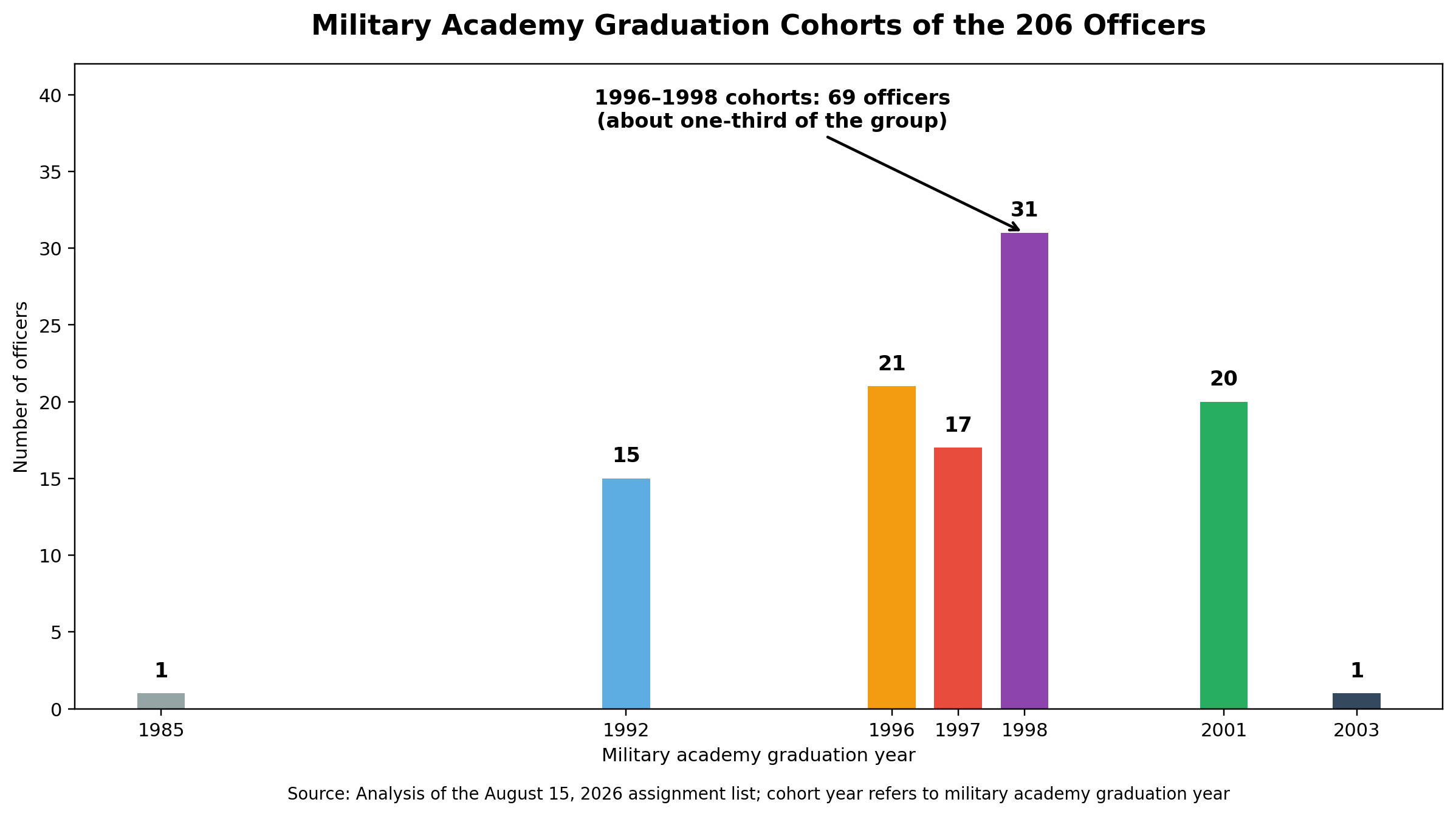
The 206-person assignment group provides a narrower but revealing picture of the personnel changes taking place within the upper ranks. The officers covered by the analysis come from cohorts stretching from 1985 to 2003 — an 18-year gap between the earliest and latest groups, which was significantly wider in previous eras. The oldest officer identified in the data is Lt. Gen. Zorlu Topaloğlu, a member of the 1985 group, while the other end of the distribution includes one officer from the 2003 cohort.
This distinction is important. Officers who entered the Turkish military during the 1990s or early 2000s cannot simply be described as an “Erdogan generation” from the start, as most had already entered military education or begun their careers before Erdogan came to power. What transformed their career environment was a coup attempt on July 15, 2016, and the sweeping institutional overhaul that followed.
Many critics and observers believe that the failed coup was a false flag organized by Turkish intelligence, following which Erdogan built an authoritarian regime and assumed complete control of the judiciary and armed forces through the purge of more than 150,000 civil servants and pro-NATO military officers.

The post-coup purge fundamentally altered the pool from which senior commanders could be selected. Erdogan stated in 2023 that 1,524 of the 1,886 staff officers serving in 2016 had been dismissed following the coup attempt. Of the 32,189 officers serving on July 15, 2016, a total of 10,468 were expelled. Updated Defense Ministry figures put the total number of military and civilian personnel in the military dismissed since the coup attempt at more than 26,000.
The impact was particularly pronounced at the top of the hierarchy. Only 42 of the 325 generals and admirals serving in 2016 retained their positions or were subsequently promoted in 2017. More than 150 generals were prosecuted and convicted. While the official account states that 8,651 military personnel including conscripts and military students participated in the coup attempt (equivalent to about 1.5 percent of the armed forces at the time), the subsequent purges went far beyond this group. The dismissals drastically reduced the pool of senior officers available to fill command positions, creating rapid advancement opportunities for those who remained and for younger cohorts moving through the ranks.
The largest group in the latest assignment data is 1998, with 31 officers, followed by 1996 with 21, and 2001 with 20. The 1997 cohort accounts for 17 officers, and the 1992 group for 15. The cohort year signifies the year of graduation from the military academy. The three consecutive cohorts of 1996, 1997 and 1998 account for 69 entries, roughly one-third of the 206-person assignment group. These officers are not products of Erdogan’s restructured military education system; rather, they represent a generation whose careers increasingly unfolded under Erdogan’s political dominance, particularly after 2016.
This distinction becomes even more significant when the appointments are viewed alongside the structural transformation of military education. More than three-quarters of Turkish military officers are now graduates of the National Defense University, which was established after the 2016 coup attempt to replace Turkey’s historic military academies.
Official figures show that 76 percent of Land Forces officers, 45 percent of Naval Forces officers and 31 percent of Air Force officers are graduates of this new university. Among noncommissioned officers, the corresponding figures are 59 percent, 32 percent and 24 percent, respectively. Erdogan has noted that these proportions will continue to rise as new classes enter the armed forces.
The emerging structure is therefore a mixture of generations. Officers who entered the military before Erdogan’s rise remain at the very top, having survived the post-coup purge and subsequently advanced under the government’s promotion system. Beneath them is a large cohort that entered the military in the 1990s and early 2000s, spending the decisive portion of their careers under Erdogan’s rule. Behind that group is the first generation trained entirely within the post-2016 military education system.
 The service distribution of the 206 officers is heavily weighted toward the Land Forces, which account for 124 officers (60.2 percent). The Air Force accounts for 44 officers (21.4 percent), while the Navy accounts for 38 (18.4 percent).
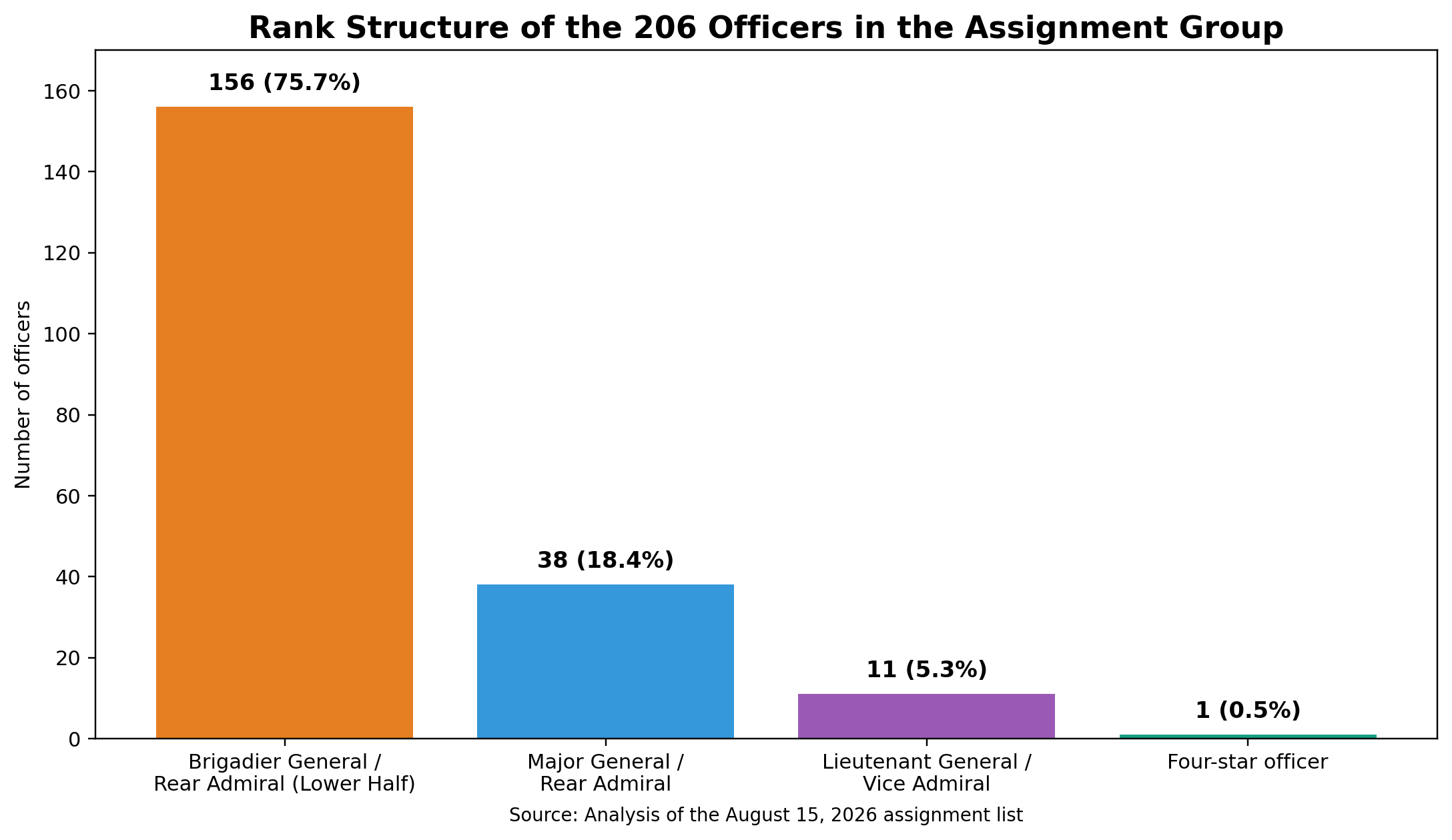
The rank structure is even more concentrated. Brigadier generals and rear admirals (lower half) account for 156 of the 206 officers, or 75.7 percent. Major generals and rear admirals account for 38 officers (18.4 percent). Eleven officers (5.3 percent) are lieutenant generals or vice admirals, while only one four-star officer is included in the assignment group.
Nearly three out of every four officers covered by the August 15 appointments are at the brigadier level. This makes the group critical for understanding the next stage of Turkey’s military leadership, as these are the ranks from which future major generals, lieutenant generals and four-star commanders will emerge.
The seniority figures reinforce this generational shift. The cohort year for the single four-star officer in the dataset is 1988. Lieutenant generals and vice admirals average 1988, major generals and rear admirals average 1992, and brigadier generals and rear admirals (lower half) average 1997. The gap between the average cohort of the four-star officer and that of the brigadier-level group is almost 10 years.