
Abdullah Bozkurt/Stockholm
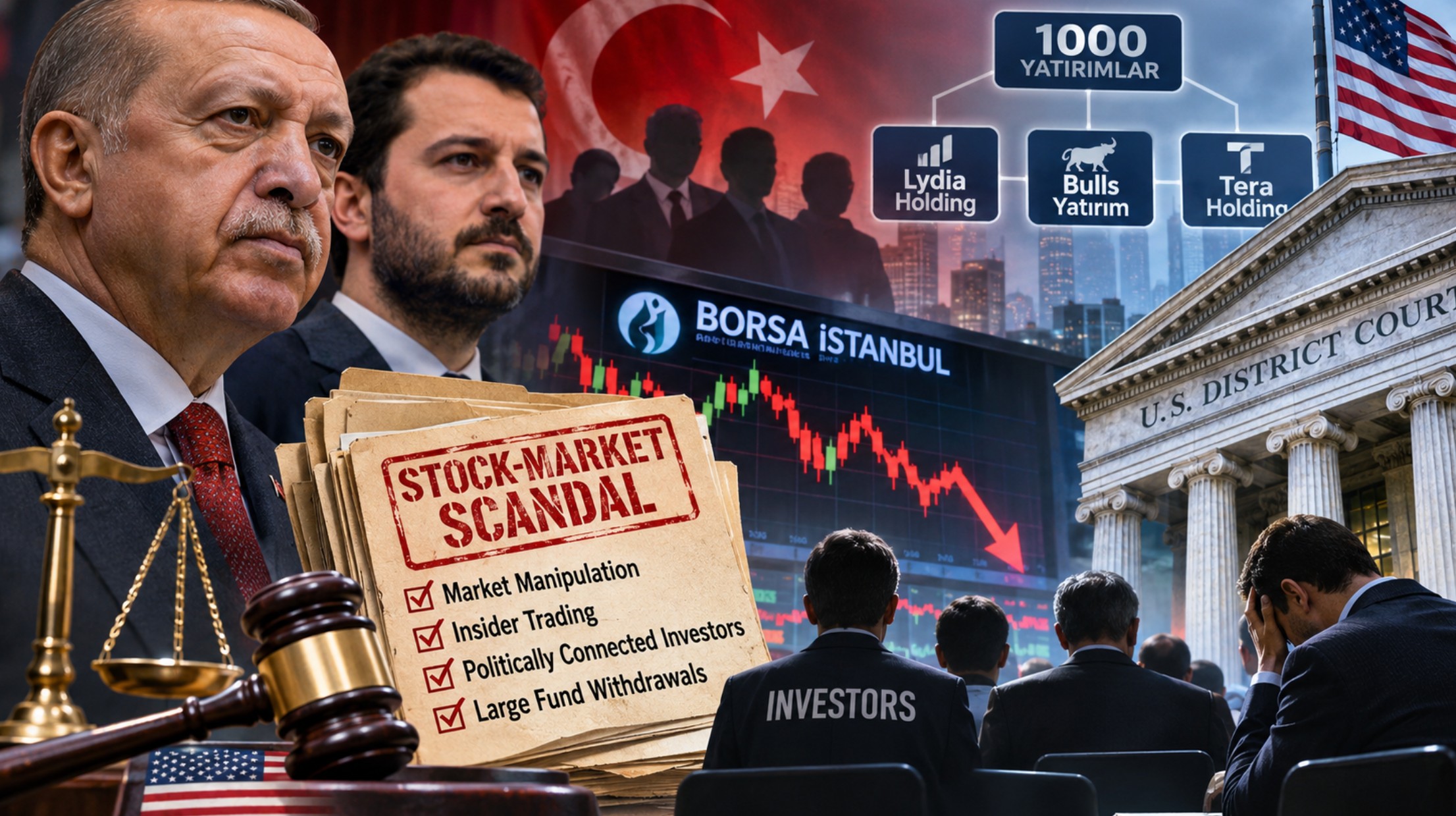
Turkey’s sprawling stock market scandal, which opposition politicians accuse President Recep Tayyip Erdogan’s government of trying to contain by shielding politically connected beneficiaries, could spill into American courts, where investors may explore legal action over suspected manipulation involving Turkish companies with financial links to the United States.
The investigation, which has continued amid mounting public outrage despite apparent efforts by the Erdogan government to push the scandal out of the national spotlight, has also brought renewed scrutiny to the business activities of President Erdogan’s nephew, Üsame Erdogan, whose corporate interests intersect with financial groups implicated in the controversy.
These connections raise questions about whether members of the president’s family, their business associates and executives linked to the troubled investment funds — potentially even Erdogan himself — could face civil lawsuits or criminal proceedings abroad if evidence emerges establishing their personal involvement in unlawful activities with sufficient ties to American financial markets to fall within the jurisdiction of US courts.
The potential international consequences are significant given the scope of the crisis, the participation of foreign investors in Turkish securities and earlier examples of Turkish corporate executives being sued in American courts.
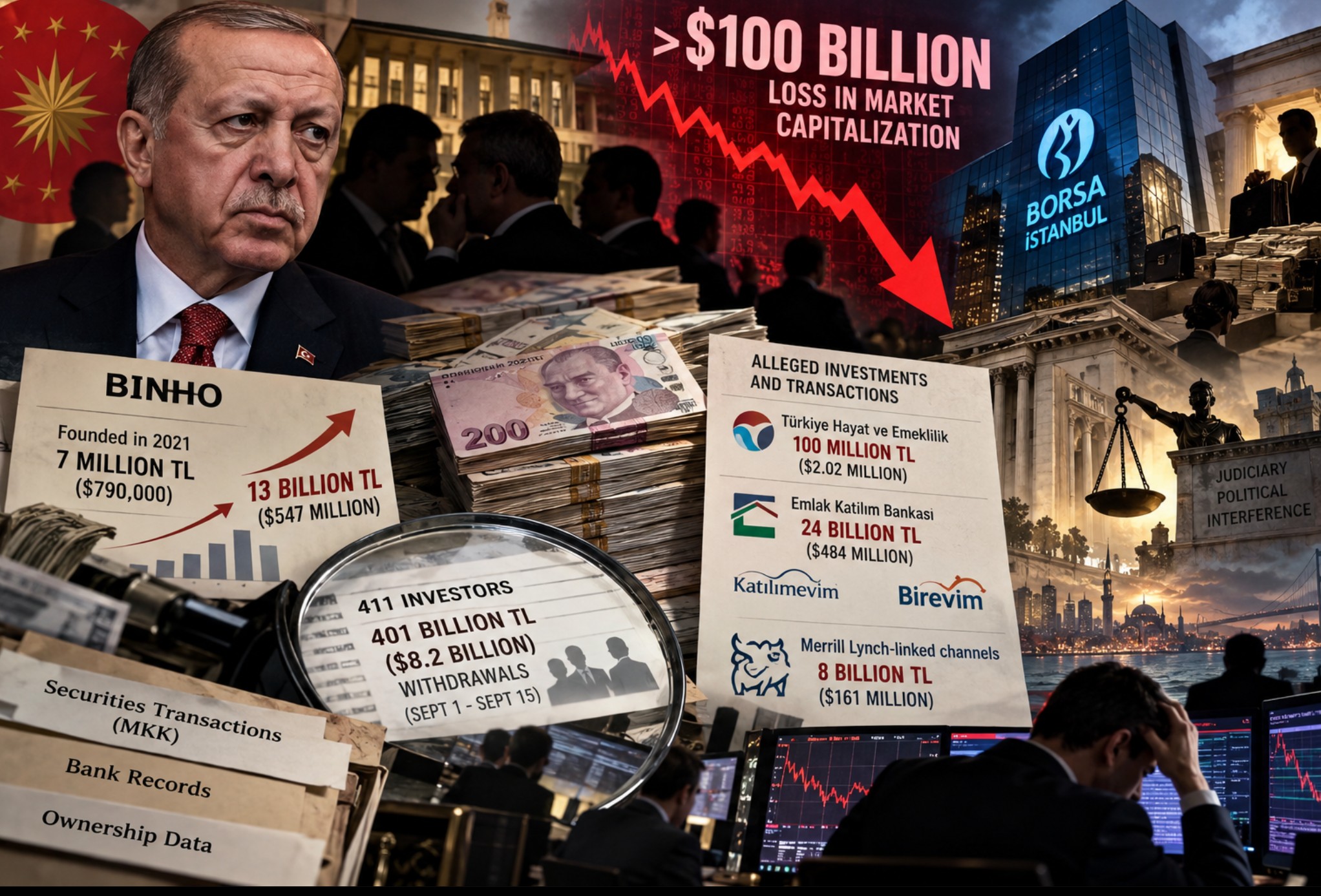
The scandal has affected nearly half a million investors and more than $20 billion in assets, prompting the liquidation of 131 investment funds managed by seven asset-management companies. Authorities are investigating allegations that managers and affiliated investors manipulated shares in thinly traded companies, inflated fund valuations and benefited from transactions that eventually left other investors facing substantial losses.
The investigation has expanded beyond the financial sector to politically connected business figures and officials associated with Erdogan’s ruling Justice and Development Party (AKP).
Although no verified US securities lawsuit arising specifically from the 2026 scandal has so far been identified, the documented American financial connections and precedents involving Turkish companies provide grounds for examining possible cross-border liability.
A copy of the securities class-action lawsuit filed against Turkish e-commerce giant Hepsiburada, its senior executives and board members and five international investment banks in the US District Court for the Southern District of New York on October 21, 2021, alleging that the company misled investors by concealing a slowdown in growth ahead of its Nasdaq IPO. The case was settled for $13.9 million in August 2023 without an admission or judicial finding of wrongdoing:
One of the most politically sensitive aspects of the scandal concerns Üsame Erdogan, the son of President Erdogan’s brother Mustafa Erdogan and a businessman whose investments have expanded across mobility services, financial technology, energy and other sectors.
Üsame Erdogan is chairman of 1000 Yatırımlar Holding, a publicly traded investment company established in 2022 and listed on Borsa Istanbul in November 2023. Corporate disclosures examined by Nordic Monitor show that he owned approximately 18.37 percent of the company’s shares and controlled 24.09 percent of its voting rights, making him its largest individual shareholder at the time of the reported disclosures.
The company operates through investments in electric scooters, payment services, software, renewable energy and technology businesses. Its subsidiaries and associated companies include Bin Ulaşım ve Akıllı Şehir Teknolojileri, commonly known as BinBin, an electric-scooter rental operator.
According to the corporate ownership records cited in the allegations, 1000 Yatırımlar has ownership links to Lydia Holding, an investment group with interests connected to Bulls Yatırım, a brokerage firm whose associated fund manager, Bulls Portföy, was among the companies affected by the liquidation orders. Bulls Yatırım also served as an intermediary in BinBin’s 2024 public offering.
The relationship is important because 15 funds managed by Bulls Portföy were among those ordered into liquidation following the September crisis. Political connections may have influenced how business figures associated with the network were treated during the investigation, especially after the release of Lydia chairman Enver Çevik and Bulls Yatırım chairman Kemal Akkaya after brief questioning.
For potential foreign litigation, such records could be significant if plaintiffs were able to establish that specific transactions involved actionable conduct within American jurisdiction.
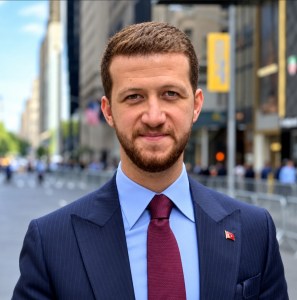
Another important financial link involves Tera Holding, whose investment and portfolio-management businesses became central to Turkey’s fund crisis. According to disclosures on Turkey’s Public Disclosure Platform (KAP) examined by Nordic Monitor, Tera subsidiary Veridion Teknoloji acquired all shares of 1000 Ödeme Hizmetleri ve Elektronik Para A.Ş., a payment and electronic-money company wholly owned by 1000 Yatırımlar Holding.
The transaction establishes a substantial commercial relationship between a company associated with the president’s nephew and a subsidiary of a financial group whose executives and investment funds subsequently attracted regulatory scrutiny.
The political fallout has extended beyond the president’s relatives. Fatma Betül Sayan Kaya, a former Turkish family minister and deputy chairwoman of the AKP, resigned from her party leadership position in September 2026 after allegations emerged concerning large share sales before the market collapse. Kaya sold shares worth approximately 1.3 billion Turkish lira, around $27.5 million, after purchasing them for approximately 63.4 million lira earlier in the year.
Much of the alleged trading involved shares in Özata Denizcilik, a shipbuilding company. It was alleged that she had received advance information about impending market developments. The controversy illustrates the importance of determining whether politically connected investors obtained material nonpublic information before other market participants.
If comparable conduct involved transactions subject to US securities law, an insider-trading or fraud investigation could become legally possible. The most concrete American connection to the scandal comes from investment disclosures showing that funds traded on US exchanges held shares in Turkish companies subsequently scrutinized by regulators.
Destek Finans Faktoring, one of the companies whose share trading came under investigation, appeared in the portfolio of BlackRock’s iShares MSCI Turkey ETF, which trades in the United States under the ticker TUR. The fund’s disclosures reported 307,325 Destek Finans Faktoring shares valued at approximately $10.5 million as of February 28, 2026.
A separate US-listed fund, the Renaissance International IPO ETF, reported holding 4,152 Destek shares valued at $175,832 as of March 31, 2026. These positions demonstrate that American investment products provided exposure to Turkish securities subsequently associated with the market-manipulation inquiry.

The exposure is significant because the affected Turkish companies were not isolated domestic businesses financed exclusively through local investors. Their shares were also held by internationally marketed investment vehicles subject to American disclosure requirements.
A US-listed exchange-traded fund (ETF) typically has shares in Turkish companies on behalf of its investors. Those investors own shares in the fund rather than directly owning the underlying Turkish securities. Consequently, investing in an ETF that holds Turkish stocks does not automatically give an individual investor the legal right to bring a direct securities fraud claim against the Turkish company that issued those stocks.
Any potential lawsuit would have to address questions of standing, applicable law, the location of relevant transactions, alleged misrepresentations and causation.
A separate corporate connection involves Tera Yatırım Teknoloji Holding, which disclosed an investment in Soter Technology Inc., a company incorporated in the United States. According to Tera’s financial statements, the investment was approved in April 2025 and involved $200,000 under a Simple Agreement for Future Equity, or SAFE. The financial statements also recorded payment of the investment amount.
The arrangement gave the Turkish investor a contractual route to potentially acquire equity in the American company under specified conditions. Although comparatively small, the investment establishes a direct corporate connection between a Turkish company associated with the wider Tera network and an American business.
Such investments could become relevant in potential asset-tracing proceedings or other litigation if an independent claim against the appropriate legal entity were established. The connection identifies a specific American corporate counterparty whose records could be examined through lawful proceedings where jurisdiction and evidentiary requirements were satisfied.
The business connections involving Üsame Erdogan, Lydia Holding, Bulls Yatırım and Tera raise a legal question that extends beyond the companies themselves: whether individuals associated with politically connected investment networks could be named personally in American litigation.
In principle, Turkish nationality, family relationships with government officials and ownership of companies registered outside the United States do not automatically protect private individuals from American civil jurisdiction. Directors, executives, traders and controlling shareholders can face personal liability under applicable US law when the required facts and legal elements are established.
In securities fraud litigation, such responsibility may arise from an individual’s own materially misleading statements, participation in a fraudulent scheme or legally recognized control over an entity responsible for a violation.

If fraudulent transfers involving US assets were established, separate civil recovery proceedings might be possible under applicable laws. Those proceedings would require their own factual and jurisdictional foundations.
The possibility of proceedings against President Erdogan personally involves a substantially different legal analysis. As Turkey’s sitting president, Erdogan benefits from the immunity traditionally recognized in the United States for foreign heads of state. The US State Department’s Foreign Affairs Manual states that sitting foreign heads of state and heads of government enjoy immunity from American civil and criminal jurisdiction during their terms in office. American courts generally give decisive weight to the US executive branch’s position on immunity for a sitting foreign leader.
The issue was prominently illustrated in proceedings involving Saudi Crown Prince Mohammed bin Salman, whose appointment as prime minister affected a US lawsuit against him. American courts addressed his immunity in light of his status as a sitting head of government. These principles mean that even if allegations emerged linking Erdogan personally to financial misconduct, a direct American civil lawsuit against him while he remains president would face formidable immunity barriers.
The position could change after he leaves office, although former officials may continue to invoke conduct-based immunity for certain official acts. Questions concerning private commercial activity would require a separate examination of the conduct and applicable immunity law.
The US Supreme Court’s 2010 ruling in Samantar v. Yousuf clarified that individual foreign officials do not automatically receive immunity under the Foreign Sovereign Immunities Act merely because of their official positions. Other forms of immunity, including common-law immunity, may still apply. These issues would be highly consequential if plaintiffs ever attempted to name Erdogan personally in proceedings related to the stock market scandal.
The allegations that President Erdogan’s government is attempting to contain the stock-market scandal and shield politically connected beneficiaries warrant a stronger examination of the president’s potential personal involvement. His chairmanship of Turkey’s sovereign wealth fund and his political authority over the government may be relevant to questions about governance and regulatory oversight.
Unlike the president, his private-business relatives would not automatically enjoy head-of-state immunity solely because of their family relationship.
The investment-fund crisis has also reached companies associated with the Turkish state. Türkiye Sigorta, the country’s largest insurance company, became part of the expanding investigation after senior executives were arrested. The company is majority-owned by the Turkey Wealth Fund, the sovereign investment vehicle chaired by President Erdogan.
Funds associated with Tera were among Türkiye Sigorta’s shareholders and had acquired at least some of their positions shortly before the scandal unfolded. The company’s share price had risen dramatically in previous years before declining sharply during the market turmoil.

The connection is politically significant because it places a state-controlled financial company within the broader web of investments being scrutinized.
An earlier American securities case offers an important point of comparison. In October 2021 investors filed a class-action lawsuit against Turkish e-commerce giant Hepsiburada, its executives and board members and five major international investment banks in the US District Court for the Southern District of New York.
The plaintiffs alleged that Hepsiburada’s July 2021 Nasdaq IPO prospectus contained materially misleading statements and failed to disclose a substantial slowdown in the company’s business before the offering. The company had sold approximately 62.25 million American depositary shares at $12 each. Following disappointing second-quarter results in August 2021, its share price plunged by approximately 25 percent in a single trading session. By October, the shares had traded as low as $5.30, nearly 56 percent below the offering price.
The lawsuit named prominent Turkish corporate figures, including Hanzade Doğan Boyner, Mehmet Murat Emirdağ and Halil Korhan Öz, together with other directors and underwriting institutions such as Morgan Stanley, JPMorgan Securities, Goldman Sachs, BofA Securities and UBS Securities.
The litigation eventually resulted in a $13.9 million settlement approved by US District Judge P. Kevin Castel on August 1, 2023. The agreement resolved the lawsuit without a trial or judicial determination that the defendants violated securities law. Nevertheless, it demonstrated that Turkish companies and their directors could become defendants in substantial American investor litigation when their securities offerings fell within US law.
The case also illustrated how institutional investors can organize collective legal proceedings against corporate defendants and pursue compensation through court-supervised settlements. The crucial distinction is that Hepsiburada’s claims arose from a US-registered public offering, while the transactions at the center of Turkey’s current scandal principally involved domestic securities and investment funds. That difference could prevent an otherwise similar claim from proceeding in an American court.
US government enforcement authorities may also possess jurisdictional powers different from those available to private investors, including under the conduct-and-effects provisions introduced by the Dodd-Frank Act. Whether such powers would apply to particular Turkish trading schemes would depend on the statutory elements and the evidence.
Separate federal laws addressing money laundering, wire fraud or other financial crimes could become relevant where prosecutors established qualifying conduct and jurisdictional connections.
The Halkbank case offers another example of international financial exposure. The criminal prosecution of Turkey’s state-owned Halkbank provides a separate illustration of how financial activity involving international transactions can lead to proceedings in the United States.
In October 2019 federal prosecutors in Manhattan charged Halkbank with fraud, sanctions-related offenses and money laundering in connection with an alleged scheme involving Iran. The case followed the conviction of former Halkbank deputy general manager Mehmet Hakan Atilla and proceedings involving Turkish-Iranian businessman Reza Zarrab.
Prosecutors alleged that financial transactions involving the American banking system formed part of the conduct underlying the charges. The case is legally distinct from securities manipulation. It nevertheless demonstrates that Turkish institutions and individuals can become involved in US proceedings when their conduct falls within American statutory jurisdiction.
One of the most significant unresolved questions surrounding Turkey’s stock market scandal concerns the identities of investors who profited from the extraordinary surge in share valuations before the crisis and whether those profits were obtained through lawful transactions. Despite repeated demands from opposition lawmakers, President Erdogan’s government has so far declined to publicly disclose the names of the major beneficiaries, fueling suspicions of a deliberate cover-up aimed at shielding individuals with close ties to Erdogan, his family and the ruling AKP.
The scandal’s international investment links create the possibility that disputes over financial losses, ownership and alleged wrongdoing could eventually extend beyond Turkey. If legally sufficient connections emerge, Turkish politicians, executives and politically connected business figures may find themselves defending allegations in foreign courts where political influence at home would not determine the outcome of the proceedings.