
Abdullah Bozkurt/Stockholm
An espionage prosecution targeting an alleged operative of Turkey’s spy agency collapsed after Switzerland’s Federal Criminal Court ruled that crucial evidence linking the suspect to clandestine surveillance of Kurdish dissidents was inadmissible, sparing Ankara a potentially embarrassing criminal conviction that could have exposed Turkish intelligence activities on Swiss territory and triggered diplomatic repercussions.
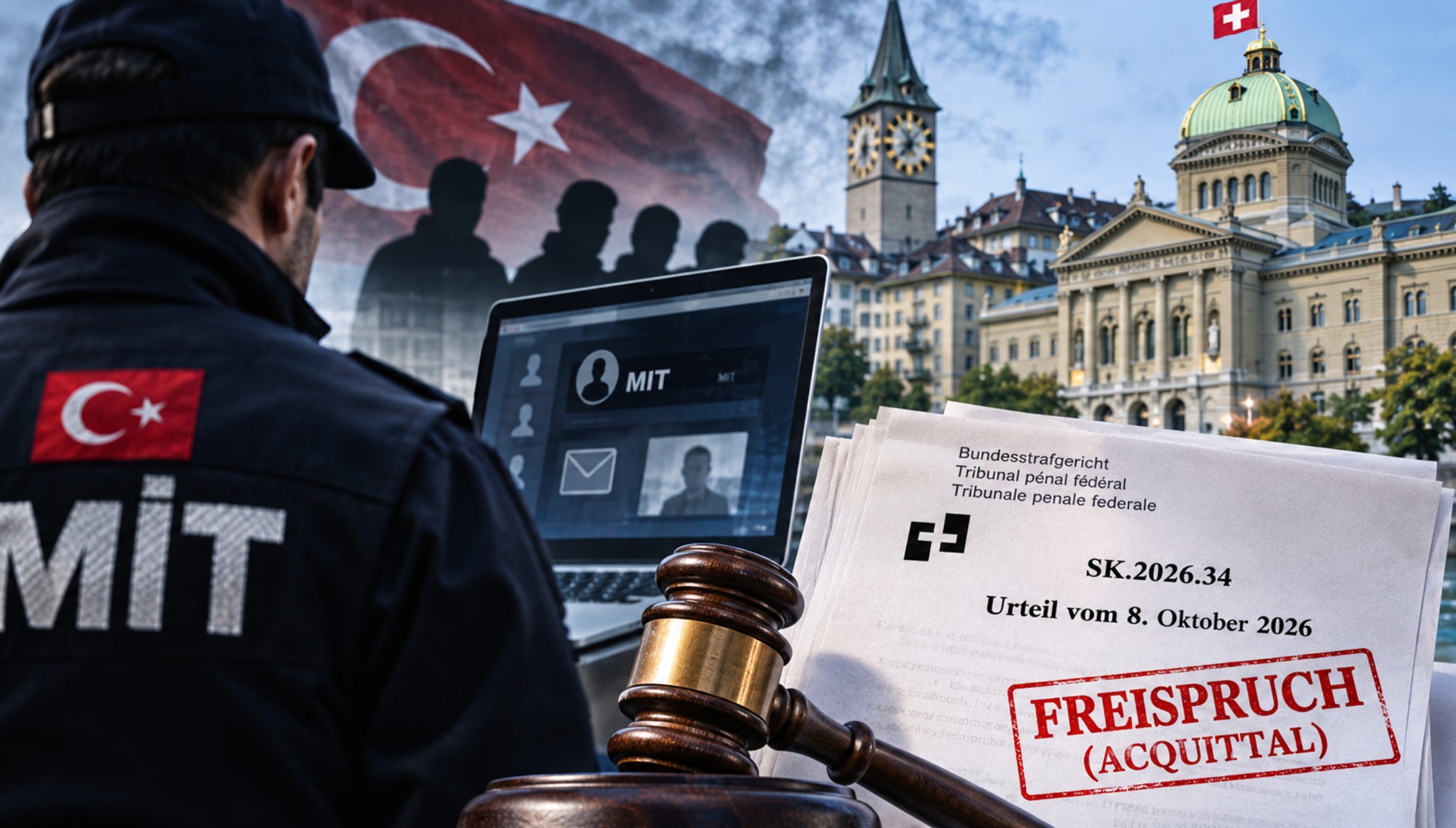
The ruling, delivered on October 8, 2026, and publicly announced on October 16, represents a significant setback for Swiss federal prosecutors, who accused a Turkish national of transmitting politically sensitive information about Kurdish residents in Switzerland to Turkish intelligence agency MIT and other Turkish security authorities. The defendant was acquitted of aggravated political espionage after judges excluded evidence recovered from a mobile telephone seized during his unlawful detention and violent interrogation by individuals who suspected him of informing for Turkish intelligence.
The acquittal deprived prosecutors of an opportunity to establish in a criminal judgment that an individual operating within Switzerland’s Kurdish community had supplied information to Turkish intelligence and security agencies.
Over the past decade numerous investigations, court proceedings and official reports have documented how the repressive government of Turkish President Recep Tayyip Erdogan has used informants and clandestine intelligence networks to monitor political opponents living in European countries, including dissidents who sought refuge abroad to escape persecution in Turkey.
The Swiss case adds another dimension to this pattern of transnational surveillance. A conviction could have further strengthened the growing body of judicial evidence implicating Turkish intelligence in operations conducted on foreign soil and potentially triggered diplomatic repercussions for Ankara.
Instead, the exclusion of crucial evidence on procedural grounds derailed the prosecution, sparing the Erdogan government a potentially damaging judicial finding and the international embarrassment that might have followed. The acquittal, however, did not establish that the alleged intelligence activities had never taken place.

The proceedings also revealed that information collected on Swiss soil had been used to facilitate the arrest and prosecution of a Kurdish resident who traveled to Turkey in 2019, highlighting the risks associated with the alleged transfer of intelligence about political dissidents to Turkish law enforcement agencies.
Although the Swiss ruling removes the immediate prospect of a criminal conviction based on the prosecution’s allegations, it does not establish that Turkish intelligence was uninvolved in gathering information about Kurdish political networks in Switzerland. Instead, the prosecution failed because the court determined that the central evidence had been obtained unlawfully and could not be admitted under Swiss criminal procedure.
The defendant, a 45-year-old Turkish national of Kurdish origin who had worked as a pizza maker in the Swiss city of Biel, denied the espionage charges. The judgment became subject to appeal after the court announced its decision.
The prosecution, registered under case number SK.2026.34 before the Federal Criminal Court in Bellinzona, centered on allegations that the defendant had secretly supplied Turkish intelligence and security officials with information about Kurdish residents, political activists and individuals allegedly associated with the Kurdistan Workers’ Party (PKK).
According to the prosecution, the alleged intelligence activity extended from July 2018 to May 2019, during which time the defendant transmitted several emails and 53 politically sensitive text messages to Turkish intelligence and other security institutions. He was also accused of making telephone calls to a Turkish police department between March and April 2019, providing information concerning Kurdish individuals and activities.
Swiss media identified the alleged recipients as MIT and Turkish police authorities in Diyarbakır, a predominantly Kurdish province in southeastern Turkey where intelligence and law enforcement agencies have long conducted operations against suspected PKK members and sympathizers.
The PKK has waged an armed insurgency against the Turkish state for decades and is designated as a terrorist organization by Turkey and its Western allies. Switzerland, however, does not maintain an equivalent blanket prohibition of the organization, although individual activities connected with violence or criminal offenses can be prosecuted under Swiss law.
The October 8, 2026, ruling by Switzerland’s Federal Criminal Court (case SK.2026.34), acquitting a Turkish national accused of aggravated political espionage for Turkish intelligence. The court also convicted the defendant of a separate immigration-related offense involving unauthorized employment. The five-page document contains the operative judgment, which was issued on October 14:
This distinction makes allegations of Turkish intelligence surveillance particularly sensitive because residents may engage in political activities that are lawful in Switzerland but could expose them to criminal investigation or prosecution if the information reaches Turkish authorities.
Federal prosecutors treated the alleged communications as political espionage carried out for a foreign state, an offense under Article 272 of the Swiss Criminal Code. The charge concerned not merely the defendant’s political sympathies or opinions but also his suspected participation in collecting and transmitting nonpublic information about identifiable individuals to Turkish government agencies.
Prosecutors argued that the information could have serious consequences for the individuals concerned, potentially exposing them to detention or prosecution if they traveled to Turkey. The prosecution sought a prison sentence of five years, two months, reflecting its assessment that the alleged conduct constituted a serious violation of Swiss sovereignty and security.
Had the judges accepted the prosecution’s evidence and returned a guilty verdict, the decision could have provided a judicial basis for allegations that Turkish intelligence maintained an informant inside a politically sensitive diaspora community in Switzerland.
It also could have intensified scrutiny of Ankara’s intelligence activities at a time when several European governments have investigated Turkish surveillance abroad of dissidents, journalists, Kurdish activists and members of the Gülen movement, a group opposed to President Erdogan’s government.
One of the most consequential aspects of the prosecution concerned the arrest of a Kurdish resident of Switzerland after he traveled to Turkey in March 2019. According to Swiss courtroom reporting, the individual had traveled to Turkey to attend a wedding when he was detained by Turkish security authorities over alleged connections to the PKK.
The arrested man was the brother of the owner of a pizzeria in Biel where the alleged informant worked. His detention prompted suspicions within the Kurdish community that someone with access to information about local residents had provided Turkish authorities with details concerning their political activities and personal connections.
Swiss reporting indicated that a telephone number associated with an informant appeared in records connected to the Turkish police investigation. When the pizzeria owner called the number, he reportedly discovered that it belonged to his employee, the man who would later face the Swiss espionage prosecution.

The discovery raised suspicions that the employee had been providing information to Turkish authorities and that such information may have contributed to the arrest. The alleged connection is significant because it suggests a possible intelligence pipeline in which information collected from political networks inside Switzerland could be transferred to Turkish police and intelligence services and subsequently used in criminal investigations against people who entered Turkey.
On May 7, 2019, the state-run Anadolu news agency reported that Turkish prosecutors had filed charges against an individual identified as Hamza Menge, allegedly associated with a Kurdish organization in Biel, following his detention in Diyarbakır. The report stated that the investigation relied in part on information provided by a person living in Switzerland and that the arrest operation had involved cooperation between MIT and the Turkish police’s counterterrorism department.
During the hearing in Turkey, the court noted that the Diyarbakır Chief Public Prosecutor’s Office had submitted as evidence a police report concerning a tip-off registered under reference number 2202901 and sent to the Provincial Police Department’s email address between court sessions. That tip was allegedly sent by a MIT informant in Switzerland, but Turkish authorities claimed they could not identify the source.
The prosecutor sought a prison sentence of up to 22-and-a-half years for alleged PKK membership and disseminating propaganda on behalf of the PKK, with the case assigned to the Diyarbakır 4th High Criminal Court. The Turkish account independently demonstrated that prosecutors were relying on information originating in Switzerland in at least one contemporaneous investigation involving MIT.
The events that ultimately destroyed the prosecution’s evidentiary foundation unfolded on May 7, 2019, when several Kurdish men confronted the defendant at the Biel pizzeria. They suspected him of supplying information to Turkish authorities and blamed him for the arrest of Menge, who had traveled to Turkey.
A September 4, 2026 ruling by Switzerland’s Federal Criminal Court (case SN.2026.4) restricting public access to sensitive intelligence-related evidence in the prosecution of a Turkish national accused of spying for Turkish intelligence. The court authorized the redaction of portions of the indictment containing alleged intelligence communications and the exclusion of the public from corresponding parts of the trial, citing the need to protect Switzerland’s national interests and individuals potentially affected by foreign espionage:
Rather than reporting their suspicions to Swiss authorities, the men subjected the employee to an unlawful detention and violent interrogation. According to judicial reporting, he was beaten, kicked, threatened and forced to surrender his personal belongings, including his mobile phone.
His assailants reportedly locked him inside the restaurant’s refrigerated storage room on two occasions and attempted to compel him to acknowledge that he had acted as an informant for Turkish intelligence. The confrontation lasted several hours and involved threats and coercion that Swiss authorities subsequently treated as serious criminal conduct.
Four of the individuals involved were eventually convicted in separate proceedings over the assault and unlawful detention.
The episode created an unusual legal situation in which the suspected informant was recognized as the victim of criminal violence while simultaneously coming under investigation for allegedly providing intelligence to a foreign government. More importantly, his telephone became a central part of the evidence used by federal prosecutors.
The device, obtained through the coercive actions of private individuals rather than a lawful police seizure, allegedly contained communications relevant to the suspected transfer of information to Turkish security authorities. The prosecution’s reliance on material obtained during the assault proved fatal to the case.
Under Swiss criminal procedure, evidence obtained unlawfully is subject to restrictions designed to prevent serious violations of fundamental rights from being used to secure criminal convictions. Although Swiss law permits exceptions in certain circumstances, including the prosecution of particularly serious crimes, the court determined that the conditions for admitting the disputed evidence had not been satisfied.
In its October 16 statement, the Federal Criminal Court explained that the available evidence was insufficient to justify treating the alleged activity as a sufficiently serious espionage offense to permit the use of the unlawfully obtained material. The judges consequently excluded the crucial telephone evidence.
Without the communications recovered from the device, prosecutors could not establish the defendant’s guilt through the remaining admissible material. The court therefore acquitted him of the political espionage charge, including its aggravated form.
The judgment did not determine that no information had ever been transmitted to Turkish authorities. Rather, it established that the prosecution had not proved the charged offense through evidence that the court was legally permitted to consider.
From the perspective of Ankara’s possible diplomatic exposure, the decision eliminated the immediate prospect of a Swiss criminal judgment formally establishing an operational connection between the defendant and Turkish intelligence. A potentially damaging trial for Turkey ended without an espionage conviction.
The potential repercussions were especially sensitive because Switzerland has previously investigated allegations involving Turkish intelligence officers and diplomatic personnel suspected of targeting government critics.
The Bellinzona proceedings were not the first time Swiss authorities had investigated suspected Turkish political espionage. In an earlier case Swiss federal prosecutors investigated two suspected Turkish intelligence operatives working under diplomatic cover who were accused of plotting to abduct a Swiss-Turkish businessman associated with the Gülen movement and secretly transfer him to Turkey, where authorities had launched a sweeping crackdown on suspected members of the movement.
The alleged operation, planned in the summer of 2016, involved two officials stationed at the Turkish Embassy in Bern: Hacı Mehmet Gani, who served as press attaché, and Hakan Kamil Yerge, the embassy’s second secretary. According to Swiss investigative reporting, the suspects planned to incapacitate the businessman with drugs before abducting him and transporting him to Turkey.
Swiss intelligence authorities uncovered the plot while it was still in the planning stages. The suspects held secret meetings in the Zurich region, including at a cemetery in the Zürcher Oberland, to discuss arrangements for the operation. The intended victim, a naturalized Swiss citizen and businessman living in the Zurich area, was reportedly put under police protection after authorities learned of the threat.
The Office of the Attorney General of Switzerland opened criminal proceedings in March 2017 on suspicion of political espionage and prohibited activities on behalf of a foreign state. The investigation subsequently expanded to examine the alleged kidnapping preparations involving Turkish spies.
In March 2018 the Swiss Federal Department of Foreign Affairs determined that the alleged activities did not fall within the legitimate functions of diplomatic personnel and that the suspects could not invoke diplomatic immunity in relation to the criminal proceedings.
The decision cleared a significant legal obstacle to the investigation and reflected the Swiss authorities’ position that diplomatic accreditation could not shield individuals from prosecution for suspected clandestine intelligence operations or an attempted abduction on Swiss territory.
On June 18, 2018, Swiss federal prosecutors issued national arrest warrants for Gani and Yerge, confirming that the two men would be arrested if they returned to Switzerland. Both had already left the country.
The case generated diplomatic tensions between Bern and Ankara. Switzerland formally protested the suspected espionage and kidnapping activities, making clear that intelligence operations targeting members of the Turkish diaspora were unacceptable.
Swiss State Secretary for Foreign Affairs Pascale Baeriswyl publicly emphasized the seriousness of the allegations while noting that Switzerland was pursuing the matter through criminal proceedings rather than by imposing diplomatic sanctions.

A separate investigation documented by the Stockholm Center for Freedom revealed that information concerning 96 Turkish and Swiss nationals, reportedly gathered through Turkish diplomatic channels in Switzerland, had been forwarded to prosecutors in Ankara. A Turkish judicial document dated December 14, 2018, identified an investigation registered under number 2018/27915 concerning individuals allegedly associated with the Gülen movement. The findings further raised concerns about how information collected abroad could be used in Turkish criminal investigations.
Against this background, the October 2026 collapse of the separate political-espionage prosecution in Bellinzona represents another chapter in Switzerland’s efforts to investigate suspected Turkish intelligence activities. Unlike the earlier kidnapping investigation, which resulted in arrest warrants for Turkish diplomatic personnel, the latest prosecution reached trial but ended in acquittal because crucial evidence was ruled inadmissible.
Although the defendant escaped conviction on espionage charges, he was found guilty of a separate offense involving unauthorized employment under Swiss immigration law. The decision on the espionage case became open to appeal after the Federal Criminal Court announced its judgment on October 16.
The two proceedings illustrate different obstacles confronting Swiss authorities in investigating Turkish intelligence operations: In the kidnapping case the departure of the suspects from Switzerland limited the authorities’ ability to bring them before a court. In the 2026 espionage case evidentiary restrictions prevented prosecutors from securing a conviction.
Taken together, however, the investigations demonstrate that concerns about Turkish intelligence activities in Switzerland have persisted for years and have involved surveillance, recruitment of local sources and possible attempts to remove political opponents from the country.
The broader European context is equally relevant. In Germany judicial records have described allegations of Turkish intelligence activity involving consular personnel, locally recruited sources and the transmission of sensitive information about government critics. German prosecutors have also pursued cases involving suspected MIT informants accused of collecting information on Kurdish and Gülen-linked networks.
In Austria courts have examined allegations that Turkish nationals supplied information about political opponents to MIT, while the Kosovo judiciary convicted a former intelligence chief over his role in facilitating the removal of Turkish nationals who were subsequently delivered to Turkish authorities.
These proceedings differ substantially in their facts, evidentiary records and outcomes, but collectively they illustrate Europe’s growing concern over Turkish intelligence operations extending beyond Turkey’s borders.