

Levent Kenez/Stockholm
The European Court of Human Rights (ECtHR) on August 25, 2026, ordered Turkey to release jailed philanthropist Osman Kavala and declared his conviction null and void, ruling that years of waiting for Turkey’s own Constitutional Court to act had become meaningless given how routinely Turkish authorities ignore that court’s own decisions.
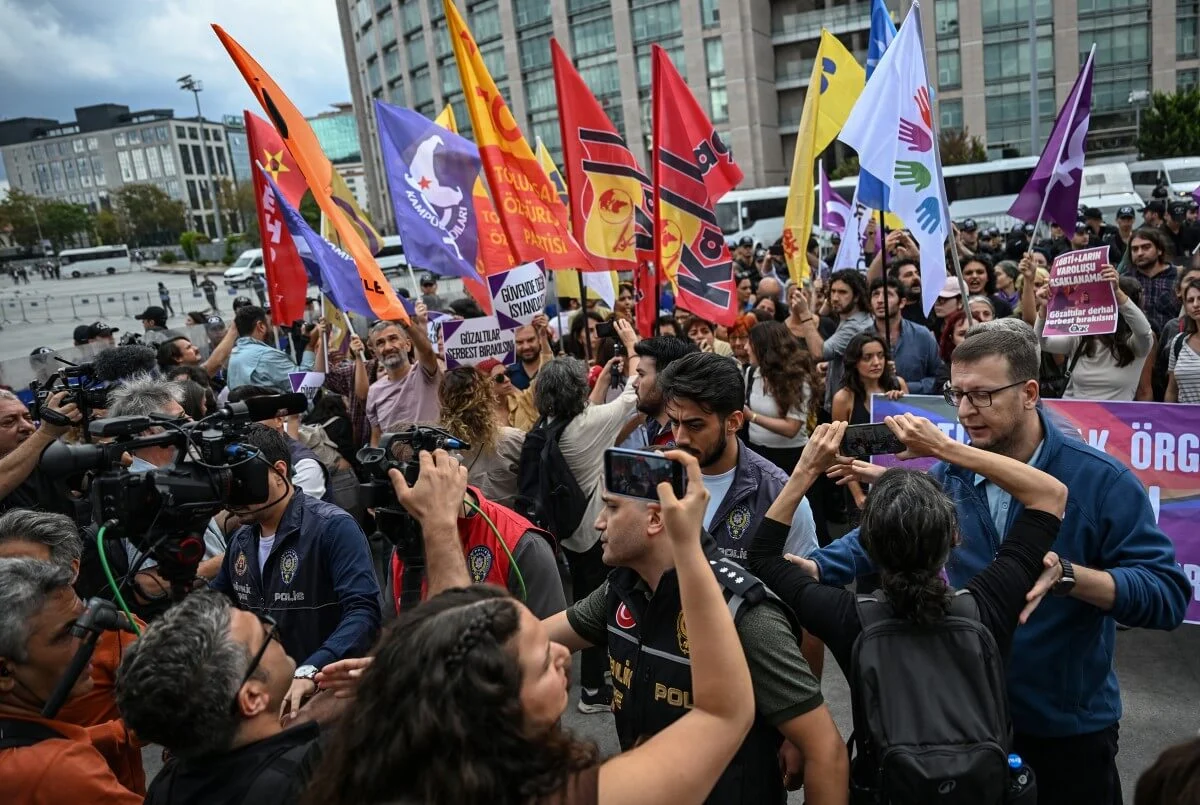
Kavala, a businessman and philanthropist who founded the Anadolu Kültür civil society organization, was first taken into custody on October 18, 2017, over his alleged role in the 2013 Gezi Park protests, a wave of demonstrations against government development plans that spread across Turkey. He was later also accused of involvement in a failed coup in July 2016, though prosecutors never presented direct evidence linking him to it. In February 2020 a Turkish court acquitted Kavala of the Gezi-related charges, and he was briefly released before being rearrested within hours on new accusations tied to the coup attempt. His cases were later merged, and in April 2022 an Istanbul court convicted him of attempting to overthrow the government and sentenced him to aggravated life imprisonment without the possibility of parole. He denied all charges throughout the proceedings and has been held in Silivri Prison near Istanbul since his original detention.
The Grand Chamber’s ruling, delivered this week in Strasbourg, marks the third time the European court has intervened in Kavala’s case since his arrest in 2017.

A central and unusual feature of the decision is the court’s refusal to require that Kavala continue to wait on two pending applications before Turkey’s Constitutional Court, filed in June 2022 and October 2023. Ankara had argued that the case in Strasbourg was premature because Turkey’s own top court had not yet ruled.
The judges rejected that argument. They noted that the first Constitutional Court application had sat unresolved for more than four years and the second for nearly three, and said the delay alone was excessive. More pointedly, the court cited Turkey’s own record of ignoring its Constitutional Court once it does rule. It pointed to the cases of jailed lawmaker Can Atalay and former Silivri prisoner Tayfun Kahraman, for whom Turkey’s Constitutional Court found rights violations but lower courts refused to order their release or retrial. That pattern, the Grand Chamber found, undermines the practical value of the domestic remedy Ankara insisted Kavala should still be pursuing.
The ruling also breaks new ground on what human rights lawyers call the “right to hope.” Judges found that an aggravated life sentence with no mechanism for future review or conditional release violates Article 3 of the European Convention on Human Rights, which bars inhuman and degrading treatment

Judges further found that the true aim behind Kavala’s prosecution, detention and conviction was to punish him for civil society and human rights work, silence him and send a warning to Turkish civil society more broadly, a misuse of power under Article 18 of the convention. They said his conviction rested on ordinary and peaceful activity, including film and documentary projects, exhibitions and civil society meetings, that had been recast as evidence of a crime carrying a life sentence.
The court also raised doubts about the independence of the Turkish judges who handled the case, citing repeated changes to the trial panel, the merging and splitting of cases, the presence on the bench of judge Murat Bircan, who according to earlier press reports had once applied to become a parliamentary candidate for the ruling party, and swift disciplinary action against judges who had earlier voted to acquit Kavala.

Beyond the roughly 113,000 euros in compensation awarded, the court said Kavala’s conviction should be treated as null and void under convention law and called on Turkey to fix a set of structural problems, including strengthening the independence of Turkey’s judicial appointments board and ensuring that lower courts actually comply with Constitutional Court rulings.
Turkish Judge Saadet Yüksel dissented, joined in part by Bosnian judge Faris Vehabović. In a joint opinion the two argued the case should not have been examined before Kavala’s pending Constitutional Court applications were resolved, saying the nearly three-year wait on the second application was not manifestly excessive and that the domestic remedy remained structurally effective. In a separate opinion Yüksel went further, arguing that Kavala’s complaint about his life sentence, which carries no possibility of parole or future review, had never been raised before Turkish courts, that part of his complaint over detention on espionage charges had been filed too late and that the majority was wrong to conclude Turkish authorities had acted with an ulterior political motive before the Constitutional Court had finished its own review.
Text of The European Court of Human Rights’ ruling on Kavala’s second application:
The dissent fits a pattern documented over several years by Nordic Monitor, which has tracked Yüksel’s voting record since her appointment to the Strasbourg court in 2019. In case after case involving Turkish government critics, Yüksel has been the lone dissenting voice or has broken from a near-unanimous majority to side with Ankara’s position.
In July 2025 she cast the only dissenting vote when the court ruled 6-1 that 239 people had been unlawfully convicted of terrorism based on alleged use of the ByLock encrypted messaging app, finding that Turkey had violated fair-trial guarantees and the principle that a person cannot be punished for conduct not clearly defined as criminal at the time.
In the landmark 2023 Grand Chamber case of schoolteacher Yüksel Yalçınkaya, whose ByLock-based terrorism conviction the court struck down by a vote of 16-1, Yüksel was the sole dissenter among 17 judges, arguing that his right to a fair trial had not actually been violated. During the hearing she had questioned Yalçınkaya’s lawyers using arguments that echoed the Turkish government’s position on the app, despite Turkey’s own Supreme Court of Appeals having ruled such records insufficient to prove ByLock use. A former vice president of the Ankara Bar Association’s human rights center said publicly she was embarrassed by the exchange, while a Turkish legal expert said Yüksel had acted more like a defense lawyer for the state than an impartial judge.
Nordic Monitor has documented similar dissents in the cases of journalist Nazlı Ilıcak, German-Turkish journalist Deniz Yücel, court reporter Ayşenur Parıldak and opposition leader Kemal Kılıçdaroğlu, along with earlier rulings involving jailed Kurdish politician Selahattin Demirtaş and Kavala himself. In several of those rulings Yüksel was the only judge, or one of a small minority, to find no violation by Turkey.
Yüksel’s brother, Cüneyt Yüksel, is a member of parliament from President Recep Tayyip Erdogan’s ruling Justice and Development Party (AKP) and chairs its legal affairs committee, a family tie that rights observers cited as a concern about her impartiality when she was appointed to the court in 2019.
There is no appeal against a Grand Chamber judgment. Enforcement now passes to the Council of Europe’s Committee of Ministers, which has already found Turkey in serious violation of its convention obligations for failing to comply with the two earlier Kavala rulings, in 2019 and 2022.