
Abdullah Bozkurt/Stockholm
President Recep Tayyip Erdogan’s deeply corrupt government has shown no public sign of opening a corresponding investigation into who inside Turkey may have facilitated, protected or benefited from the sprawling gambling operation now at the center of one of Britain’s largest corporate bribery cases, reinforcing a broader pattern of selective enforcement in which politically connected and pro-Erdogan individuals and business networks enjoy impunity.
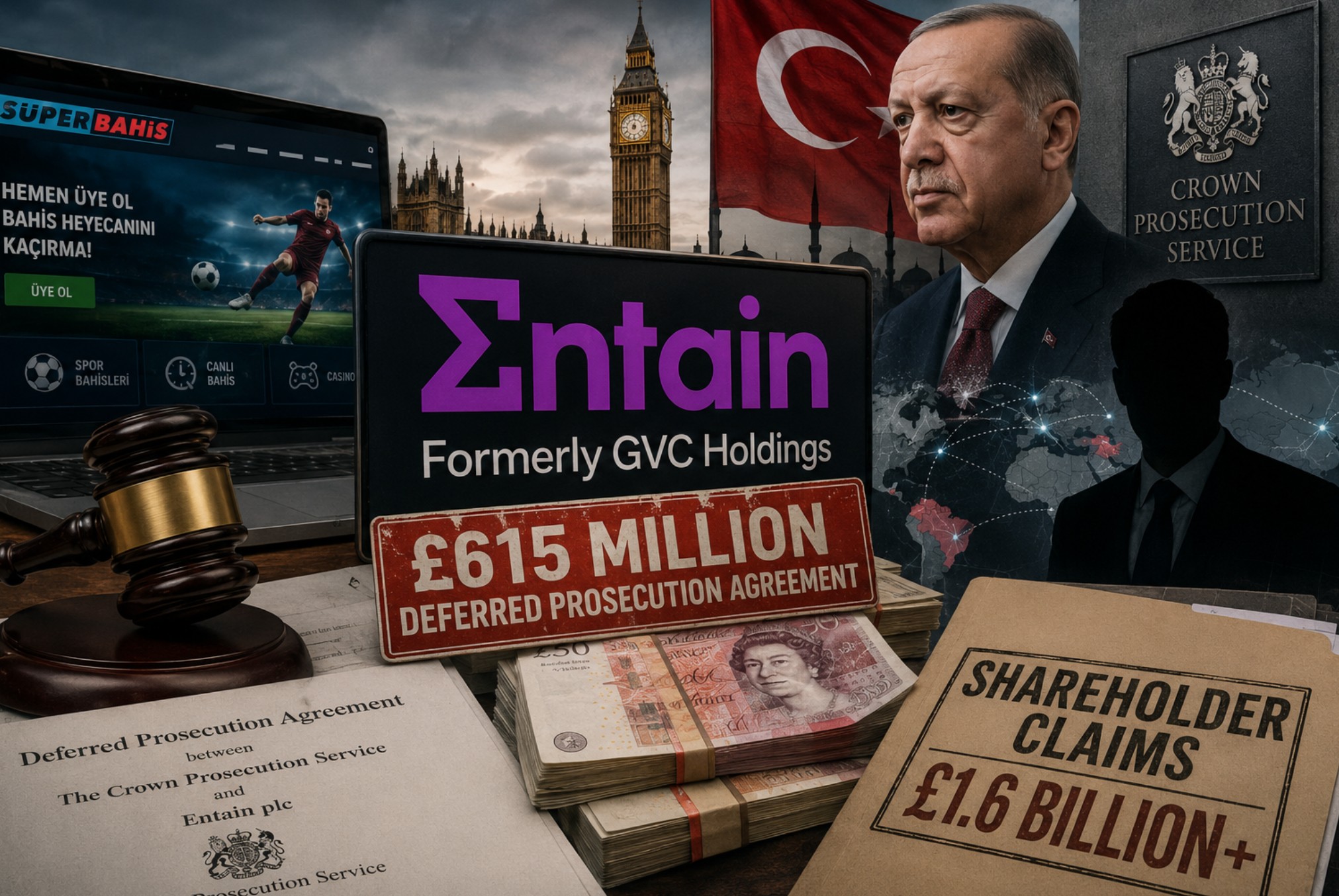
British authorities, by contrast, have pursued the affair for years, securing a £615 million ($830 million) deferred prosecution settlement from gambling giant Entain Plc over the activities of its former Turkey-linked business and bringing criminal charges against 11 former executives and associates.
The scandal has now expanded into shareholder litigation in London in which investors are seeking more than £1.6 billion in damages over allegations that the company failed to disclose the true extent of the risks surrounding its Turkish operations.
The disparity is especially striking because British courts have established that the alleged bribery occurred primarily in Turkey, where the gambling services at issue were illegal under domestic law, while politically connected individuals and business networks have long been accused of operating or facilitating illegal betting schemes with little apparent scrutiny from Turkish authorities.
Neither Turkish prosecutors nor financial-crimes investigators have publicly identified a domestic investigation into the people or entities in Turkey who allegedly received, facilitated or benefited from the payments at the heart of the British case.
That silence comes against the backdrop of longstanding international criticism of Turkey’s anti-corruption record. In July 2026 the OECD Working Group on Bribery took the exceptional step of issuing a due-diligence warning concerning Turkey, saying Ankara had made “no meaningful efforts” to investigate and prosecute actual foreign-bribery allegations.
The European Commission similarly reported in 2025 that Turkey had made no progress in fighting corruption, that the judiciary remained under executive control and that corruption investigations had been pursued selectively, particularly against opposition figures, while comparable cases involving ruling-party officials went untouched.
The UK Crown Prosecution Service announced on August 28, 2025, that it had authorized the prosecution of 11 individuals on bribery, fraud, tax and related charges stemming from the provision of gambling services in Turkey between 2011 and 2018:
The Entain case provides a striking new illustration of how a major corruption scandal centered on economic activity inside Turkey can generate years of investigative work, corporate penalties and criminal prosecutions abroad without producing a visible parallel process of accountability in Ankara.
The publicly available British court record does not yet identify the alleged recipients of the bribes. A detailed Statement of Facts agreed between Entain and the Crown Prosecution Service (CPS) remains sealed by court order to protect the fairness of pending criminal trials.
What is already public nevertheless paints an extraordinary picture of a lucrative offshore gambling operation targeting Turkish customers, a corporate structure spread across several jurisdictions, an eventual exit from Turkey under unusual financial arrangements and years of legal fallout that continue to expand.
Entain was known during the relevant period as GVC Holdings Plc. The company grew from a relatively small online gambling operator into one of the largest betting groups in the world, eventually acquiring Ladbrokes Coral in a transaction valued at roughly £4 billion.
Turkey played an important part in that growth. GVC’s own regulatory filings show that it launched its Betboo business in Turkey during the first half of 2011 and told investors that the initial results were “better than expected.” Its exposure to Turkey expanded considerably later that year through a complicated transaction involving Superbahis, a Turkish-language gambling website that had been operating since 1999.

In October 2011 Sportingbet agreed to sell the Turkish-language Superbahis business and associated offshore assets to East Pioneer Corporation B.V. (EPC). GVC simultaneously entered into agreements to provide the operation with back-office and customer-management services and guaranteed certain obligations undertaken by EPC.
GVC’s own documents described Superbahis as having become a well-recognized name in the Turkish-speaking gambling market, with particularly strong relationships with Turkish-speaking, high-net-worth customers.
EPC was described in GVC’s documentation as a newly incorporated Curaçao company owned by Sigma Corporate Management Inc., a Panama company controlled by the HBM Group, a corporate-services provider in Curaçao, a Caribbean island and constituent country within the Kingdom of the Netherlands. GVC said the entities were not related parties. GVC provided what it called a “full suite” of back-office services to the business.
The economics of the arrangement were also significant. Under the 2011 services agreement, GVC’s monthly fee was tied to the cash generated by EPC. GVC said its fee together with revenue from its own Turkish business was initially expected to represent 25 percent of combined net gaming revenue, increasing to 32.5 percent and ultimately to 100 percent after the final instalment of Sportingbet’s deferred consideration had been paid.
The arrangement demonstrates that Turkey was not a peripheral market. It was deliberately cultivated as an important source of online gambling revenue even though Turkish law tightly restricted private gambling.
When Dame Victoria Sharp, then president of the King’s Bench Division, approved Entain’s Deferred Prosecution Agreement in December 2023, she made the geographical focus explicit. The conduct involved GVC’s alleged failure to prevent bribery from July 2011 until December 2017, when the company disposed of its Turkey-linked business.
“The alleged bribery offences occurred primarily in Turkey,” the court said.
The judge further noted that during the relevant period Turkey was a jurisdiction where the gambling services concerned were considered illegal under Turkish law, although comparable gambling activity could lawfully be offered in England and Wales if properly licensed.
The British public record remains silent on exactly who had to be paid, influenced or otherwise induced in Turkey for the operation to function. That is largely because the most revealing document in the entire case has not been made public. As part of the DPA proceedings, prosecutors and Entain agreed on an extensive Statement of Facts describing the underlying conduct. But Dame Victoria ordered publication postponed because releasing it could prejudice criminal proceedings against individuals. The full judgment approving the DPA has similarly been withheld.
As a result, one of the most important questions for Turkey remains unanswered publicly: Who were the alleged bribes intended for? Were they paid to public officials, private intermediaries, payment processors or other persons capable of facilitating the illegal betting operation? Did politically connected figures play a role? Did Turkish law-enforcement or regulatory officials know of or assist the scheme?
The investigation that ultimately produced the bribery case initially appeared to focus heavily on third-party suppliers and payment processing. On November 28, 2019, HM Revenue & Customs obtained an order requiring a GVC subsidiary to produce information concerning the former Turkey-linked gambling business.
GVC told investors at the time that it understood HMRC’s investigation to be directed at several former third-party suppliers involved in processing payments for online gambling in Turkey.
That is a particularly important element of the case. Running a large-scale offshore gambling business aimed at customers in a jurisdiction where the activity was illegal required more than websites. Customers needed mechanisms to deposit money and withdraw winnings. A substantial operation would therefore require financial channels, payment processors, bank relationships, intermediaries or other infrastructure capable of moving large volumes of money in and out of the country.
By July 2020 HMRC had expanded the investigation to examine potential suspected criminal wrongdoing by GVC itself as a corporate entity and specifically referred to Section 7 of the UK Bribery Act 2010, which criminalizes a commercial organization’s failure to prevent bribery by associated persons.
The investigation became known as Operation Incendiary and ultimately developed into a complex international criminal inquiry lasting years.
The Turkey-linked business was highly profitable. GVC’s 2017 accounts show that the discontinued Turkish operations produced €100.3 million in revenue in 2016, with a contribution of €43.9 million and clean EBITDA (Earnings Before Interest, Taxes, Depreciation and Amortization) of approximately €35 million.
For the period through December 20, 2017 alone, the business generated another €82.4 million in revenue and €34.7 million in clean EBITDA.
The financial penalty imposed on Entain was not calculated around a token portion of the business. Entain later disclosed that the £465 million penalty component was calculated by reference to revenue from the whole of its Turkish operations during the relevant period.
GVC announced its withdrawal from Turkey on November 2, 2017. It agreed to sell Headlong Limited and associated businesses, which it described as comprising its Turkey-linked operations, to Ropso Malta Limited.
The buyer was not presented as an unrelated newcomer unfamiliar with the operation. GVC’s announcement specifically said Ropso was backed by investors who were already providing the primary IT services to the Turkish business.
The agreed purchase price was unusual. Instead of an upfront payment, GVC was supposed to receive a performance-related earn-out of as much as €150 million in cash, payable monthly over five years. The sale was formally completed on December 19, 2017. Just two days later, on December 21, GVC served what was called a Clean Break Notice, effectively abandoning its right to receive the earn-out. If the related Ladbrokes Coral acquisition proceeded, GVC would therefore receive none of the potential €150 million purchase price.
The waiver was connected to GVC’s much larger acquisition of Ladbrokes Coral. GVC later said walking away from the Turkish earn-out was specifically required for the Ladbrokes Coral board to recommend the acquisition. The company also said the sale had been conducted through an arm’s-length competitive process overseen by investment bank Houlihan Lokey.
GVC subsequently denied allegations that it maintained direct or indirect economic links to Turkey after the disposal. The transaction nevertheless remains notable in the chronology: A highly profitable operation, generating tens of millions of euros annually, was sold to a company backed by existing IT providers for up to €150 million, followed almost immediately by the seller relinquishing its entitlement to that consideration.
The public criminal record does not establish that the sale or waiver was itself corrupt, and it would be improper to characterize it as such without evidence. But the circumstances form an important part of the corporate history that preceded the HMRC investigation.
By 2023 British authorities had accumulated enough evidence to pursue corporate allegations against Entain. Instead of prosecuting the company to conviction, the CPS agreed to a four-year Deferred Prosecution Agreement, approved by Dame Victoria on December 5, 2023.
A December 2023 Southwark Crown Court judgment approving a deferred prosecution agreement between the UK Crown Prosecution Service and Entain Plc states that the alleged bribery occurred primarily in Turkey and requires the gambling company to pay £615 million in penalties, disgorgement, costs and a charitable contribution:
It was historically significant: the first DPA ever secured by the Crown Prosecution Service rather than the Serious Fraud Office. Under the agreement prosecutors lodged four counts alleging failure to prevent bribery under Section 7 of the Bribery Act, but the prosecution was immediately suspended.
Entain agreed to pay a total cash package of £615 million: £465 million as a financial penalty, £120 million in disgorgement of profits, £10 million toward HMRC and CPS costs and £20 million to charity.
The agreement does not constitute a criminal conviction. If Entain complies with all its terms for four years, prosecutors will discontinue the suspended case. If it violates the agreement, the prosecution can potentially be revived.
The court ultimately approved the DPA largely because Entain had undergone a sweeping change in management, corporate culture and compliance procedures and had cooperated extensively with investigators.
The DPA protected the company from immediate prosecution, but it did not protect individuals. On August 28, 2025 the CPS announced criminal charges against 11 people following the HMRC investigation. Ten defendants were charged over alleged conduct relating to gambling services in Turkey between 2011 and 2018; an eleventh was charged over alleged conduct relating to the later investigation.
Former GVC chief executive Kenneth Jack Alexander, former chairman Lee Michael Feldman, Richard Cooper, Robert Dowling, James Humberstone, Scott Masterton, Caroline Roe, Raymond Smart and Richard Raubitschek-Smith were charged with conspiracy offenses that include, depending on the individual, conspiracy to defraud and conspiracy to bribe. Alexander MacAngus was charged with conspiracy to defraud.

Masterton also faces allegations of fraudulent trading, cheating the public revenue and acting as a company director while an undischarged bankrupt. Roe faces additional allegations of fraudulent trading and fraudulent evasion of income tax. Former Entain governance executive Robert Grant Hoskin was separately charged with perverting the course of justice in connection with alleged conduct in February 2024.
The first trial, involving several defendants, is scheduled to begin on February 14, 2028, followed by separate trials involving other suspects in October 2028 and March 2029.
The consequences of the Turkish operation have also spread into the civil courts.More than 100 institutional and retail investors are pursuing Entain under Sections 90 and 90A of Britain’s Financial Services and Markets Act 2000, with aggregate claims exceeding £1.6 billion.
The investors allege that prospectuses, annual reports and other public statements over a lengthy period contained false or misleading information or omitted material information connected to the historic Turkey misconduct. They further allege that persons exercising managerial responsibility knew of relevant matters and that Entain improperly delayed the disclosure of information.
The claims are significant not merely because of their size but because they could eventually expose more of the internal corporate decision-making surrounding Turkey. The Turkish operation that GVC sold in 2017 may therefore still be generating litigation more than a decade later.
The Erdogan government occasionally launches investigations and prosecutions targeting illegal betting operations, but what remains conspicuously absent from the public record is any indication that Turkish authorities have sought to determine whether Turkish nationals, intermediaries, public officials or politically connected actors facilitated, protected or profited from the conduct that British authorities have spent years investigating.
For now the British proceedings leave a large hole exactly where the Turkish part of the story becomes most important. British authorities have publicly established that the alleged bribery occurred primarily in Turkey. A major company has agreed to pay £615 million to resolve its corporate exposure. Eleven individuals face criminal proceedings. Investors are claiming more than £1.6 billion. The company’s historic payment processors and third-party suppliers have been scrutinized. A profitable Turkey-linked business and its Malta-based successor structure have been examined for years.
But the names and roles of the alleged recipients of the bribes remain hidden. That may change dramatically once the criminal proceedings conclude. The sealed Statement of Facts is expected eventually to become public unless the court orders otherwise. Because Entain agreed that the document was true and accurate to the best of its knowledge and belief, its eventual release could provide the clearest official account yet of how the Turkey-linked operation functioned, what payments were made, who authorized or facilitated them and who benefited.
Until then, Britain is preparing three criminal trials extending into 2029 and handling billion-pound investor litigation over conduct centered on Turkey, while Ankara’s side of one of the most consequential international betting and bribery scandals connected to the country remains largely unexplored in its own courts.