
Abdullah Bozkurt/Stockholm
In a sophisticated and far-reaching profiling campaign that bears historical similarities in its use of family-based political suspicion to practices seen in Nazi Germany, communist Albania and Stalin’s Soviet Union, the Turkish government has secretly flagged university students on the basis of punitive measures previously imposed on their relatives, effectively turning family ties into indicators of suspected political disloyalty and dissent, according to confidential government records obtained by Nordic Monitor.
The records show that authorities scrutinized 207 students, frequently citing politically motivated investigations, prosecutions, unlawful dismissals and other measures taken against their parents, siblings, uncles and aunts over alleged links to the Gülen movement, a group that has been opposing President Recep Tayyip Erdogan’s repressive rule for over a decade.
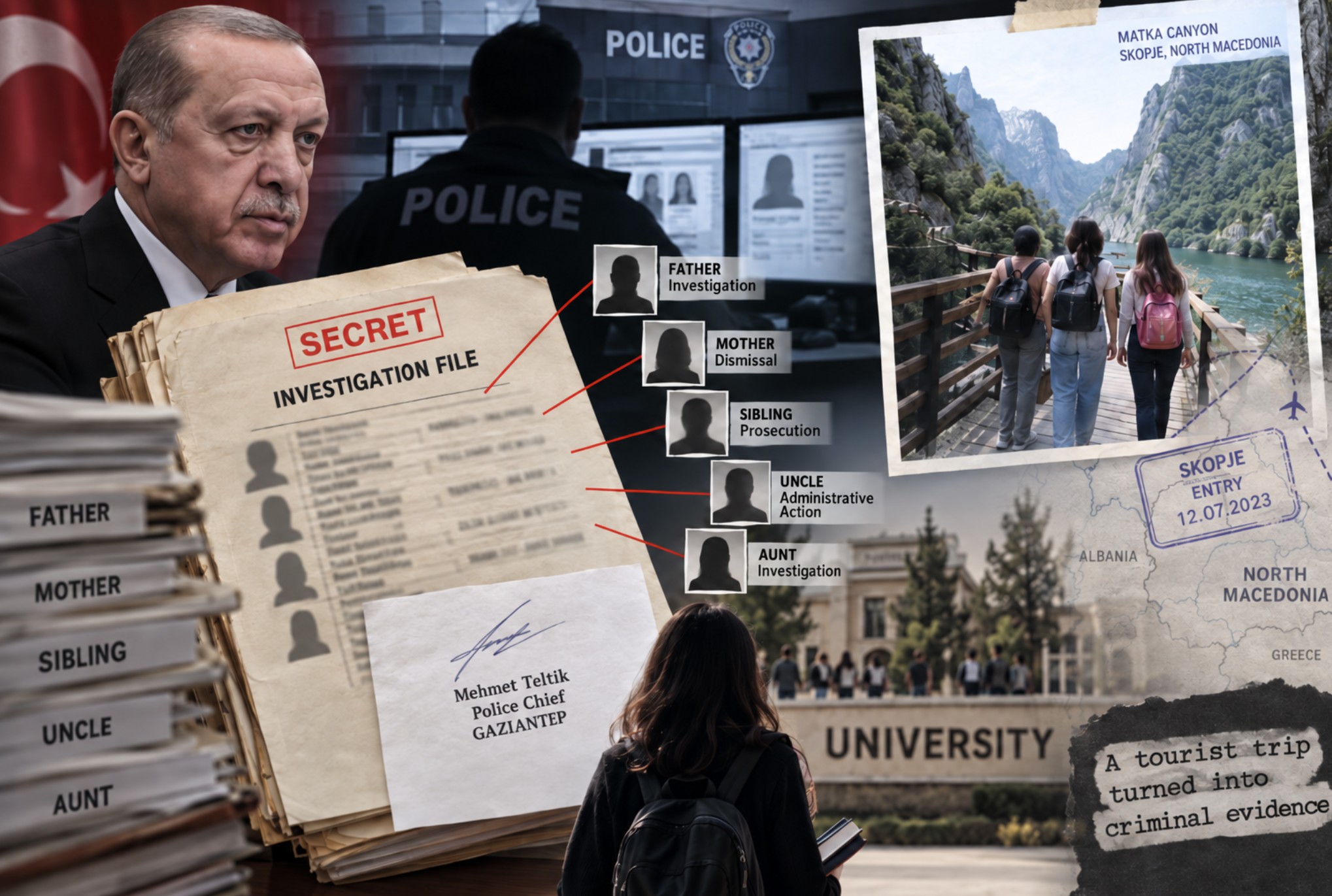
The document, sent with a cover letter to a prosecutor’s office in Turkey’s southeastern province of Gaziantep by Police Chief Mehmet Teltik on May 23, 2025, reveals a systematic effort to map their families and record whether parents, siblings, uncles, aunts and other relatives had previously been investigated, prosecuted, dismissed from public employment or subjected to administrative measures over alleged connections to the Gülen movement.
In most of the cases, the adverse information concerns one or both parents. In others the authorities reach farther into the family tree, identifying brothers, sisters, uncles, aunts and other relatives whose previous encounters with Turkey’s police, prosecutors or administrative machinery are recorded alongside information about the student.
The significance of the document lies not merely in the government’s possession of information about relatives. The family histories are included as adverse intelligence for assessing the students themselves, indicating that measures imposed on one person can be carried forward and attached to another individual solely through kinship.
The document, part of a 262-page police investigation file compiled by the provincial police in Gaziantep, suggests that similar mapping and profiling may also be taking place in other provinces across Turkey. Since police units nationwide have access to the same internal databases and records, the Gaziantep file raises the possibility that comparable profiling has been conducted on a nationwide scale.
Secret police profiling list of university students that cites the records of their relatives — including parents, siblings, uncles and aunts — as grounds for flagging them for scrutiny. Identifying information has been redacted by Nordic Monitor due to privacy and security concerns:
According to the latest figures released by the Justice Ministry, Turkish authorities have initiated legal proceedings against 720,338 people over alleged links to the Gülen movement in the last decade alone. If relatives of those individuals are being systematically entered into secret profiling databases on the basis of family ties alone, the number of people affected could very well run into the millions.
The records provide a rare documentary window into what amounts to an intergenerational system of guilt by association, in which the security history of a family becomes part of the government’s assessment of young adults who were not themselves necessarily accused of the conduct attributed to their relatives.
The method raises fundamental questions about individual criminal responsibility: whether a young person can legitimately be regarded as suspicious because a parent was fired, prosecuted or investigated, or because an uncle or aunt was previously accused of association with a political or religious movement disfavored by the government.
The Gülen movement, inspired by Turkish Muslim cleric Fethullah Gülen, who passed away two year ago in the United States, emerged as one of Erdogan’s principal adversaries. Signs of a widening rift became public in 2010, when Gülen, in an interview with The Wall Street Journal, criticized the government of President Recep Tayyip Erdogan for allowing the jihadist-linked Turkish charity IHH — the Foundation for Human Rights and Freedoms and Humanitarian Relief (İnsan Hak ve Hürriyetleri ve İnsani Yardım Vakfı) — to lead the deadly Gaza flotilla.
The cover letter attached to the police investigation file bears the signature of Gaziantep Police Chief Mehmet Teltik:
The rupture became much deeper following major corruption investigations launched in December 2013 that implicated senior government officials, their family members and politically connected businessmen. The investigations centered in part on Iranian-Turkish businessman Reza Zarrab and an alleged scheme to move Iranian funds through Turkey in circumvention of international sanctions.
Another figure who surfaced in the investigations was Saudi businessman Yasin al-Qadi, who had previously been put on the UN Security Council’s Al-Qaeda sanctions list and designated by the US Treasury. Gülen publicly criticized the Erdogan government for the corruption scandal. Shaken by the scandal, President Erdogan, then prime minister, branded the Gülen movement as a terrorist organization overnight, despite its decades-long public profile as a faith-inspired civic network focused largely on education, interfaith dialogue, community outreach and social initiatives.
The crackdown on the Gülen movement initially faced significant legal challenges and public criticism, putting the Erdogan government on the defensive. Following a false flag coup attempt on July 15, 2016, that was organized by Turkish intelligence agency MIT, the crackdown intensified dramatically. Erdogan declared a state of emergency days later, allowing his government to rule extensively by decree and carry out sweeping dismissals, arrests and institutional restructuring.

The judiciary was among the institutions hit hardest. Within a day of the coup attempt, 2,735 judges and prosecutors were suspended, while two Constitutional Court judges and members of the judicial council were arrested. Thousands more members of the judiciary were subsequently removed or subjected to criminal proceedings. The Venice Commission warned that the mass dismissals lacked individualized evidence and procedural safeguards and created a strong appearance of arbitrariness. The purge significantly altered the composition of the judiciary as Erdogan simultaneously pushed through a constitutional transformation that replaced Turkey’s parliamentary system of governance with an executive imperial-style presidency, concentrating substantially greater authority in the presidency.
The purge was extraordinary in scale and extended across virtually every sector of the state. Large numbers of staff officers in the armed forces were dismissed, along with roughly two-thirds of Turkey’s generals and admirals. About one-third of the diplomatic corps was also purged, with many officials — including serving ambassadors posted abroad — abruptly branded as terrorists.
Veteran police chiefs with years of experience in organized crime, counterterrorism and other sensitive fields were likewise removed. Many were dismissed through emergency decrees or administrative measures without ordinary disciplinary proceedings and without being given a meaningful opportunity to challenge the allegations against them or present a defense.
Yet the confidential list of 207 students points to a different and more enduring dimension of the post-coup campaign: the inheritance of suspicion by family members who belong to another generation. Parents become evidence against their children. The pattern repeated throughout the document is striking.
A parent who was previously prosecuted over alleged Gülen links becomes part of the student’s profile. So does a father or mother removed from public service. A sibling subjected to a criminal investigation is recorded. In other cases the net extends beyond the immediate household to uncles and aunts.
The records show how broadly the profiling extended beyond the individuals directly targeted by the authorities. A 21-year-old computer engineering student was flagged solely because his brother had been subjected to police or judicial action. A 20-year-old law student was marked because his father, a police officer, had been purged by the Erdogan government. A 22-year-old gastronomy student was flagged because his father had faced action by the authorities, while a 24-year-old industrial design engineering student was marked because his late father had been among those purged. A 25-year-old construction engineering student was similarly flagged because her aunt had been subjected to an official measure. The examples continue throughout the file, revealing a system in which young people were entered into police profiling records not because of any alleged wrongdoing of their own, but because relatives had previously come under government scrutiny.
Three female students are seen sightseeing at Matka Canyon in North Macedonia in a photo Turkish police included in a criminal investigation file as purported evidence against them:
The students were also scrutinized over short summer trips to Balkan countries such as North Macedonia, Bosnia and Herzegovina and Albania, destinations that Turkish citizens can visit without obtaining a visa in advance. Such countries are popular among Turkish travelers not only because of their visa-free entry but also because they offer relatively affordable vacation options.
Turkish prosecutors, however, portrayed some of these trips as evidence that the students were traveling as part of an organized Gülen movement activity. The investigation file reviewed by Nordic Monitor contains no apparent evidence showing that the trips were arranged by the movement, involved organizational meetings or served any clandestine purpose.
The police investigation file also contains photographs of the students sightseeing at Matka Canyon, a popular tourist destination just outside Skopje in North Macedonia. In one image three female students are seen walking along the Matka Canyon Viewpoint Walkway. Turkish police nevertheless inserted the photograph into the criminal investigation file as purported evidence against them, effectively recasting an ordinary tourist visit as something suspicious. Nothing visible in the image itself indicates clandestine activity, an organizational meeting or any other criminal conduct.
The records further show that some students who had no adverse information attached to their own profiles or to members of their families were nevertheless swept into the investigation because they had traveled to the same or similar destinations at roughly the same time as students who had already been flagged and put under surveillance.
The pattern points to a guilt-by-association methodology in which an otherwise routine trip could become grounds for suspicion simply because another traveler had previously attracted the attention of the authorities. In this way the profiling system appears to have expanded outward from already targeted individuals, drawing additional students into police scrutiny without evidence of wrongdoing on their part.
What emerges from the secret records is a system that amounts to a form of political genealogy. Each government action against one member of a family becomes a data point that can later be attached to another: a father investigated, a mother dismissed, a brother prosecuted or an uncle targeted in an administrative proceeding.
Under ordinary principles of criminal law, a student bears no legal responsibility for actions attributed to relatives. Yet the files show that Turkish authorities nevertheless considered such family connections relevant enough to record and use when flagging individuals for further scrutiny. The result is a profiling system in which suspicion can effectively travel through family ties, extending the consequences of a government action against one person to relatives who themselves are not accused of any wrongdoing.
Governments routinely examine relatives when investigators have evidence that family members are participating in the same criminal conspiracy. What distinguishes guilt by association is the use of the relationship itself — rather than proof of the individual’s own criminal behavior — as adverse evidence.
The 207-person list indicates that Turkish authorities have institutionalized precisely that type of family mapping in their handling of university students.
For students whose parents were swept up in the post-2016 purge, the implications can continue for years. A government action taken against a parent when the student was a child can reappear later in the student’s own security profile.
The mechanism therefore allows the consequences of the government’s crackdown to survive beyond the original suspect and beyond the original criminal or administrative proceeding.
The practice documented in the student files fits a pattern that United Nations human rights monitors began warning about years ago. In a major March 2018 report on Turkey, the Office of the UN High Commissioner for Human Rights said it had observed punitive measures affecting not only primary suspects but also people associated with them, “particularly their family members,” including children, siblings, parents and other relatives.
The UN office said the pattern raised concern that Turkey might be applying an unlawful standard of “guilt by association or collective guilt,” contrary to the principle of individual legal responsibility.
That warning is especially relevant to the 207 students because the new records illustrate how family association can be transformed from background information into an enduring security marker.
In an October 8, 2025, communication to the Turkish government, UN special rapporteurs and other mandate holders raised concerns over counterterrorism operations carried out on May 7, 2024, and May 6, 2025, that resulted in the arrest of 55 and 208 people, respectively, many of them students, women and young people.
The experts said the operations appeared to form part of a broader pattern of criminalizing otherwise lawful conduct by children, students and people with alleged familial or social links to the Gülen movement.
The new 207-person document, however, offers a particularly revealing view of how familial association operates inside the security bureaucracy: Relatives and measures taken against them are systematically catalogued in the profiles of university students.
The idea that political suspicion can attach itself to a family and be transmitted from one generation to another has a long history. The closest historical parallel may be found in communist Albania, where the concept of a person’s biografi, or political “biography,” became an important instrument of state control under Enver Hoxha.
The term did not simply refer to what an individual had personally done. In practice, biografi was often synonymous with family or lineage. The political record of parents and ancestors could therefore influence how authorities treated their descendants. The consequences were concrete. A politically undesirable family background could restrict educational and professional opportunities even when the younger family member had committed no offense.
The Turkish files demonstrate a comparable mechanism when an investigation against a student’s father or the dismissal of the student’s mother is preserved as adverse information in the child’s later security profile.
Family political reliability also influenced educational opportunities in communist East Germany. The German Federal Agency for Civic Education (Bundeszentrale für politische Bildung) notes that political conformity by both students and their parents became a criterion for educational advancement in the German Democratic Republic. The 207 Turkish student profiles demonstrate that family political history can similarly remain institutionally relevant long after a government action against the original relative.
The most extreme historical manifestations of kin-based political liability went considerably beyond profiling. During Stalin’s Great Terror, the Soviet security apparatus formally codified punishment of relatives. NKVD Operational Order No. 00486, issued on August 15, 1937, ordered repression of the wives of people classified as “traitors to the Motherland” and established procedures concerning their children.
The order required the authorities to prepare detailed family records identifying the convicted head of household, members of the family and information about individual relatives. It separately instructed officials to prepare assessments of children over the age of 15 whom the state considered “socially dangerous.” Women could be imprisoned in labor camps, while children were separated from their parents and put in orphanages or other state institutions.
Another historically notorious expression of family liability was the Nazi concept of Sippenhaft, generally translated as kin or family liability. After the failed July 20, 1944, attempt to assassinate Adolf Hitler, the Nazi government retaliated not only against participants in the conspiracy but also against some of their relatives.
Sippenhaft became one of the clearest historical expressions of a principle fundamentally at odds with modern individual responsibility: that the consequences of alleged political disloyalty may extend beyond the person accused and attach to his or her family. The Turkish system revealed by the 207 profiles represents a modern variation of the same underlying problem.
The government’s databases preserve the parent’s history. An old prosecution, investigation, dismissal or administrative measure remains available years later. Through databases and intelligence files, it can be connected to children, siblings, nieces, nephews or other relatives. That makes family-based political classification potentially more durable than an individual criminal proceeding.
A case can end. A sentence can be completed. An investigation can be closed. But a family relationship does not expire. Once kinship itself becomes a security indicator, a government can continue generating new subjects of suspicion indefinitely as children reach adulthood, enroll at universities, apply for government jobs or enter other areas of public life.
The 207 students therefore represent something larger than the individuals named in a single secret document. They illustrate how Turkey’s post-2016 regime can reproduce suspicion across generations.
It also explains why the student list is important beyond Turkey’s long-running dispute with the Gülen movement. The document shows what happens when an expansive repressive system stops treating the individual as the sole object of suspicion and begins preserving the family as a permanent security category.
Nearly a decade after the failed coup, many of the young people now entering Turkish universities belong to a generation that was still in school — and in some cases was considerably younger — when the government launched its mass crackdown in 2016. Yet the secret records indicate that the political consequences of that period have followed them into adulthood.
The students’ profiles carry the institutional memory of what happened to their families. A prosecution against a father, a dismissal imposed on a mother, an investigation involving a sibling or a proceeding against an uncle or aunt can surface years later in a file bearing the student’s own name. In that respect, the 207-person list points to an evolution in Turkey’s post-coup campaign.