
Abdullah Bozkurt/Stockholm
President Recep Tayyip Erdogan’s pro-Hamas government has provided shelter, residency and in some cases Turkish citizenship to figures linked by Abu Dhabi to a Muslim Brotherhood network that Emirati authorities accuse of seeking to oust the country’s rulers from power, including individuals who have been convicted or remain subject to outstanding arrest warrants, despite the rapprochement between Turkey and the United Arab Emirates in recent years.
A recently disclosed United Nations communication shows that Turkey became a principal refuge for members and associates of the network after a sweeping UAE crackdown that began in 2012, allowing several to establish themselves on Turkish soil despite terrorism designations and criminal proceedings in Abu Dhabi.
The Turkish connection emerges from an April 28, 2026, communication sent to the UAE government by four UN special rapporteurs who examined the Emirati Cabinet’s decision to put 11 people and eight entities on the country’s terrorism list over alleged links to the Muslim Brotherhood.
The UN document identifies multiple people on the UAE list as having taken refuge in Turkey, among them figures directly connected to the politically sensitive legal case known as UAE94 as well as Emiratis who fled the country amid the 2012 crackdown.
The case provides another illustration of Turkey’s emergence under Erdogan as a hub for Brotherhood-affiliated or Brotherhood-sympathetic movements driven out of Arab countries, particularly after the upheavals of the Arab Spring. Some who had initially settled in Western countries also appear to have later moved to Turkey, where they were able to continue their activities with fewer or no restrictions.
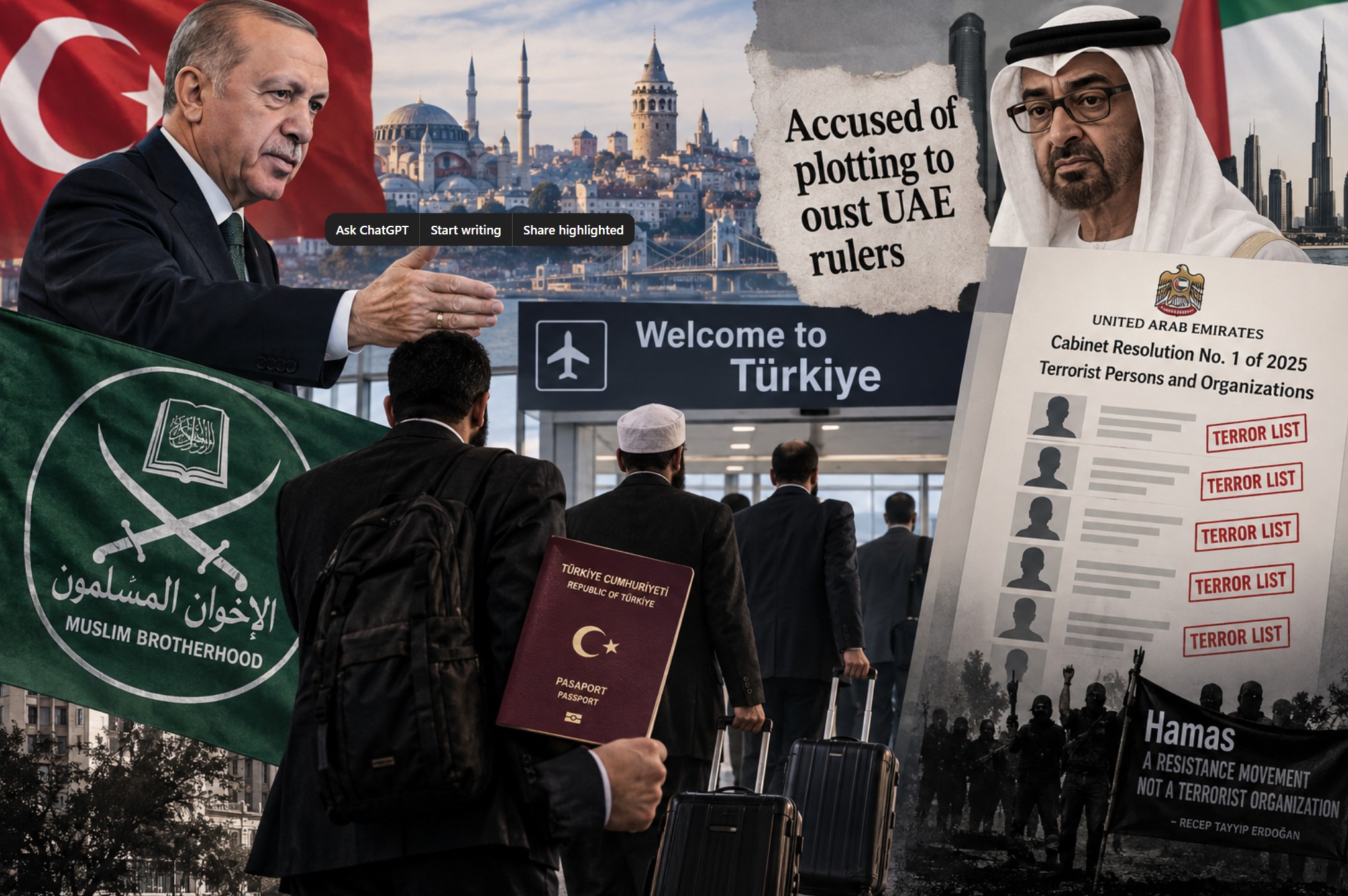
Erdogan’s ideological affinity with Hamas, itself founded as the Palestinian branch of the Muslim Brotherhood, has been equally explicit. In September 2025 Erdogan said publicly that he did not regard Hamas as a terrorist organization but rather as a “resistance group.” His government has repeatedly referred to Hamas in official statements as the “Palestinian Resistance Movement” and has maintained direct contacts with its leadership.
The United Arab Emirates’ Cabinet Resolution No. 1 of 2025, issued on January 8, 2025, formally approved a new terrorism list naming 11 individuals and eight organizations, including several Emirati dissidents living abroad and at least one dual Turkish-UAE national:
Likewise, the Muslim Brotherhood network found a receptive environment under the Erdogan government, with many of its operatives settling in Turkey and gaining access to the country’s financial, banking and corporate sectors to raise, move and conceal funds. The network also benefited from political protection extended by Erdogan’s government, while numerous operatives acquired Turkish citizenship, with some adopting Turkish names that made their backgrounds and previous identities more difficult to trace.
The Emirati investigation at the center of the dispute dates to March 2012, when security authorities began arresting dozens of members of Al-Islah, the Reform and Social Guidance Association, which Abu Dhabi considers the UAE branch of the Muslim Brotherhood.
Emirati prosecutors accused the defendants of creating a secret organizational structure aimed initially at turning public opinion against the government and the leadership of the state. The prosecution further alleged that the group had communicated with people, international organizations and foreign institutions outside the UAE to damage the country’s image and had established contacts with the international Muslim Brotherhood and comparable organizations abroad.
Most significantly, prosecutors alleged that the defendants sought “help, expertise and financial support” from those organizations to advance what the UAE described as the group’s undeclared objective of seizing power.
Authorities also alleged that money raised through membership contributions, alms and zakat (the obligatory charitable giving required of Muslims) had been channeled into companies, real estate, agricultural land and shares registered in members’ names in an effort to conceal assets from the government.
The defendants disputed the charges, maintaining that their activities amounted to calls for political reform and greater public participation rather than a conspiracy to overthrow the monarchy.
The UAE, however, has maintained that the network represented a national security threat. The country formally designated the Muslim Brotherhood as a terrorist organization in 2014 and has continued pursuing individuals and organizations it regards as part of the movement’s international financial and political infrastructure.
That confrontation resurfaced on January 8, 2025, when the UAE Cabinet adopted Resolution No. 1 of 2025, adding 11 individuals and eight organizations to its Local Terrorist List.
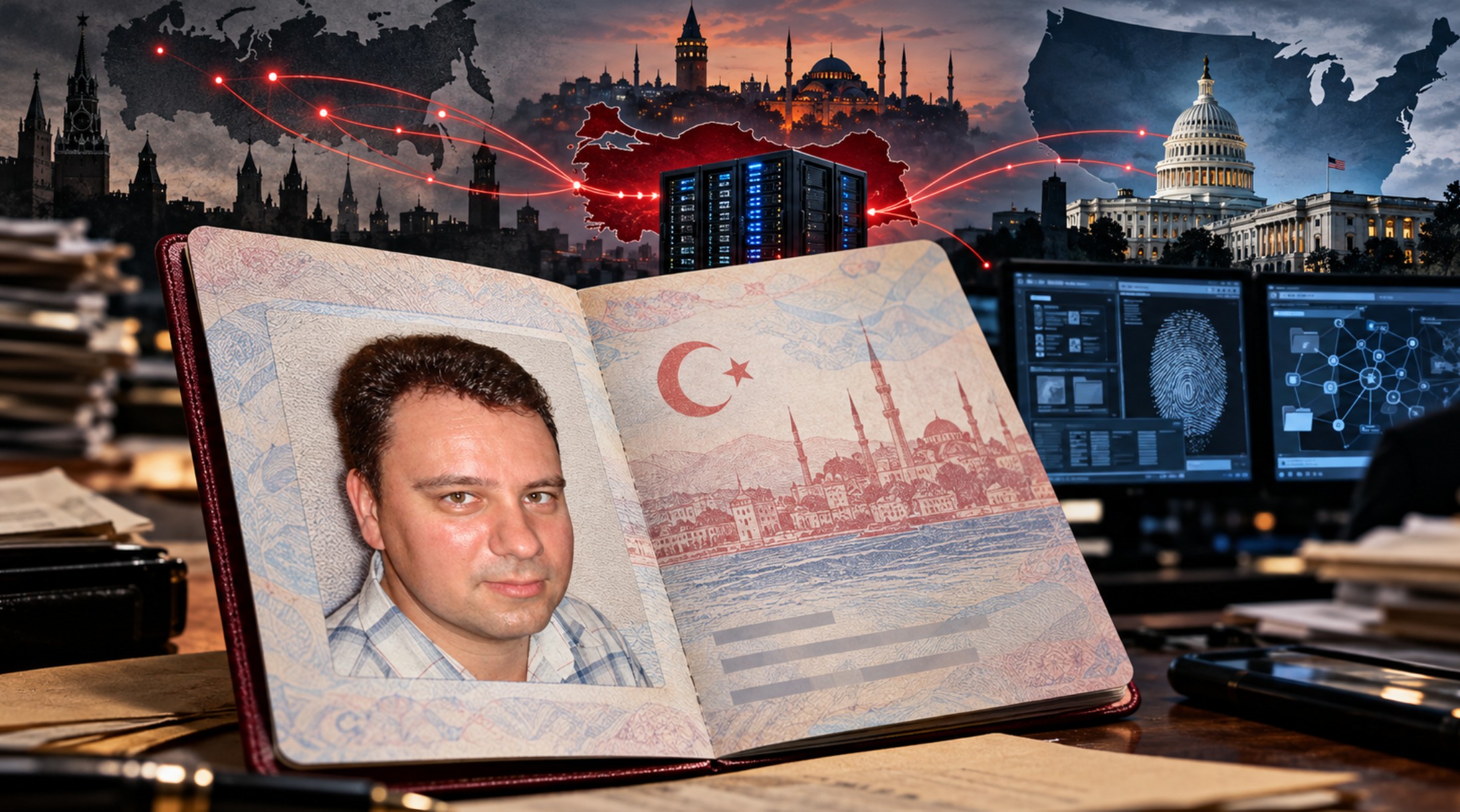
The official resolution identifies, among others, Saeed Khadem Ahmed Bintouq al-Marri as a citizen of both Turkey and the UAE. The UAE government’s published annex even records a Turkish passport for him.
Al-Marri’s case illustrates the depth of the Turkish connection. He left the UAE in 2012 after authorities imposed restrictions on him, including suspension of his pension, and subsequently settled in Turkey. By the time Abu Dhabi put him on its terrorism list, however, al-Marri had acquired Turkish citizenship as well as retaining Emirati nationality.

Ibrahim Ahmed Ibrahim Ali al-Hammadi, a dual Swedish-Emirati citizen, is another exile residing in Turkey according to UN records after leaving the Emirates in 2012. Elham Abdulla Ahmad al-Hashemi, another Emirati on the 2025 terrorist list, was also reported by the UN as living in Turkey after deciding not to return to the UAE following a trip to Britain for medical treatment in 2012.
More directly tied to the criminal proceedings was Abderrahman Omar Salim Bajubair al-Hadhrami. He was living in Turkey and had been accused in 2013 of assisting suspects in the UAE94 case by creating and operating the social media account “uaemot.” The account has 12,000 followers, remains accessible online and contains extensive material on the UAE.
Another particularly significant figure is Jasem Rashed Khalfan Rashed al-Shamsi, an Emirati suspect who was also reported in UN documents to have been residing in Turkey. In March 2024 Turkish authorities detained him and members of his family at Dalaman Airport, reportedly because his name appeared in an INTERPOL system. Yet he was not transferred to the UAE. He remained outside Emirati custody and eventually moved with his family from Turkey to Syria in December 2024.
Khalaf Abdul Rahman Humaid al-Romaithi, another figure sought by the UAE, also lived in Turkey and acquired Turkish nationality after leaving the Emirates. A UAE court had sentenced him in absentia to 15 years in prison. Al-Romaithi remained in Turkey until May 2023, when he traveled to Jordan. Jordanian authorities arrested him and subsequently handed him over to the UAE pursuant to the Emirati request.
Taken together, the cases show how Turkey supplied an important geographic and political sanctuary for Emirati Islamists at a time when Abu Dhabi was attempting to dismantle what it regarded as a transnational Brotherhood infrastructure.
Abu Dhabi said the country’s terrorism designations were intended to disrupt networks connected to the financing of the Muslim Brotherhood and terrorism. Financial institutions were ordered to take measures against listed individuals and entities.
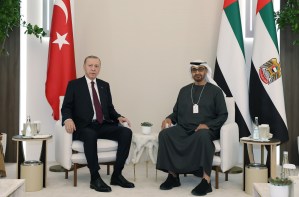
The dispute reflects a broader regional fault line that has persisted despite the diplomatic rapprochement between Ankara and Abu Dhabi: The UAE views the Muslim Brotherhood and affiliated organizations as an existential threat to monarchical rule, while Erdogan’s government has for years cultivated political Islamists to project power beyond Turkish borders while using a similar ideology to shore up support in Turkey with the core Islamist base.
The coverage of Turkey’s state-run Anadolu news agency over the years has closely reflected the ideological outlook of the Erdogan government toward the Muslim Brotherhood, while often depicting Emirati President Mohammed bin Zayed as the architect of a broader campaign to eradicate political Islam. Although that tone softened after Erdogan began reconciling with Abu Dhabi in 2021, largely in pursuit of Emirati investment and trade, Ankara’s underlying approach to the Brotherhood appears to have remained largely unchanged, with the dispute instead pushed into the background.
Turkey also took no visible action after the UAE in January 2025 designated 11 individuals and eight entities as being linked to terrorism, even though several of the listed Emiratis were reported to have lived in Turkey and at least one had acquired Turkish citizenship.
As a result, the Erdogan government has continued to make Turkish territory available as a safe haven for members and associates of a network that Abu Dhabi accuses of seeking to seize power. Emirati individuals and entities targeted by Abu Dhabi have repeatedly resurfaced on Turkish soil, some having Turkish passports, even as the UAE has continued to pursue what it describes as a transnational Muslim Brotherhood network posing a threat to the country’s political order.