

Abdullah Bozkurt/Stockholm
An Egyptian court case in which eight Turkish nationals including a current diplomat were sentenced to life in prison on sprawling espionage and terrorism charges exposed how Turkish intelligence operatives has been working with the Muslim Brotherhood to penetrate Egypt’s sensitive telecommunications infrastructure, collect information on Egyptian society and finance a coordinated influence campaign intended to undermine the country’s national security.
The April 7, 2026, judgment represents Egypt’s most consequential legal action to date against what its security services have portrayed as a yearslong Turkish operation directed at weakening Egyptian state institutions and eventually restoring the Muslim Brotherhood to power.
The case, officially registered as No. 955/2017 by the Supreme State Security Prosecution, was widely known in Egypt as the “espionage with Turkey” case. It was subsequently entered as Case No. 12430/2021 before the Fifth Settlement Criminal Court and No. 1206/2021 before the New Cairo Plenary Court.
The First Terrorism Circuit of the Cairo Criminal Court, sitting at the Badr court complex and headed by Judge Mohamed al-Saeed al-Sherbiny, imposed life sentences on 37 defendants, including all eight Turkish nationals, according to the published operative part of the ruling.
The Turkish defendants were identified in Arabic court and case-monitoring records as Nihat Akman, Fehmi Bülent Yıldırım, Alptekin Cihangir İşbilir, Arif Özkan, Mustafa Muhammed Gül, Esim Ünal, Mustafa Demirci and Mert Ararat. All eight have been prosecuted and convicted in absentia.
Yıldırım has long been running a Turkish entity known as the Foundation for Human Rights and Freedoms and Humanitarian Relief (İnsan Hak ve Hürriyetleri İnsani Yardım Vakfı, IHH), an Istanbul-based charity closely aligned with the government of President Recep Tayyip Erdogan and linked to Turkey’s National Intelligence Organization (MİT).
Although the organization publicly operates as a humanitarian relief group in Turkey and abroad, Turkish court files, police investigations, intelligence records and witness testimony have all confirmed that IHH personnel provided financial, logistical and material assistance to jihadist networks, including al-Qaeda- and ISIS-linked groups, particularly during the Syrian conflict. IHH has also been involved in clandestine arms shipments to jihadist groups in Libya.
The Egyptian indictment reportedly referred to the IHH as one of the organizations through which Brotherhood figures coordinated activities in Turkey.
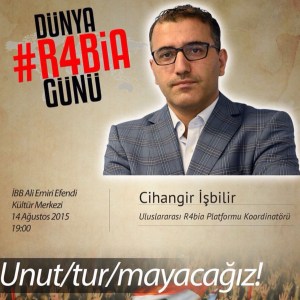
The second significant figure is Alptekin Cihangir İşbilir, founder and former general coordinator of the Istanbul-based International Rabia Platform, which was established with support from the Erdogan government in August 2013. İşbilir initially handled the platform’s secretariat and coordination work and later publicly served as its general coordinator and president.
His own official biography, obtained by Nordic Monitor, shows that Ibrahim Kalin, the head of Turkey’s spy agency MIT, vouched for him as a reference. It confirms what Egyptian authorities alleged in a court case, i.e., how the Brotherhood is in bed with Turkish intelligence. İşbilir served as general coordinator of the International Rabia Platform from 2014 to 2020. Under his leadership, the platform organized demonstrations, campaigns and public events directed not only at the Egyptian government but also at Russia, often working alongside Turkish Islamist organizations.
The Rabia Platform also took part in joint campaigns and coalitions with the IHH, putting İşbilir within a broader network of organizations connected through personnel, campaigns and shared political causes. The platform organized anti-Egyptian government rallies in Turkey and abroad, conducted multilingual public relations campaigns and cooperated with the IHH on various initiatives.
The last page of Alptekin Cihangir İşbilir’s official CV lists İbrahim Kalın, the head of Turkey’s National Intelligence Organization (MİT), as a professional reference who could vouch for his credentials:
He also worked closely with Ahmet Yusuf, who has been described as the Muslim Brotherhood’s representative in Turkey. The two appeared together at rallies across Turkey and delivered speeches in support of the Brotherhood and against the Egyptian government. İşbilir told Turkey’s state-run Anadolu news agency in 2014 that the platform represented some 500 organizations and media outlets and had more than 10,000 unofficial members.
İşbilir’s activities concerning Egypt were frequently featured by Anadolu. That is not surprising given the fact that around the same time he had been running Anadolu’s News Academy, a position that gave him an influential role in the training of aspiring journalists joining the government-run news service and in shaping the academy’s editorial and ideological outlook.Between 2015 and 2019, he served as deputy director of News Academy and later as a director until 2024.
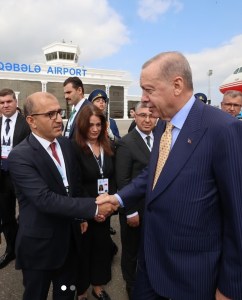
He subsequently moved into the Turkish presidency’s communications apparatus, joining the presidency’s Directorate of Communications (Cumhurbaşkanlığı İletişim Başkanlığı), a large government institution responsible for coordinating domestic and international influence operations on behalf of the Erdogan administration. The directorate has also worked closely with MİT on strategic communications and influence-related activities. Since 2024, İşbilir has served as communications and press counselor under diplomatic cover at the Turkish Embassy in Baku under the Directorate of Communications.
Neither the Turkish government nor the individuals concerned appear to have publicly addressed the April 2026 ruling. The absence of a detailed Turkish response is especially notable because the verdict was issued only two months after President Erdogan visited Cairo and signed an extensive cooperation declaration with Egyptian President Abdel Fattah El-Sisi.
The Egyptian case began with a General Intelligence Service investigation in 2017. Egypt’s Office of the Public Prosecutor announced on November 22 of that year that 29 people had been detained on suspicion of espionage for Turkey, membership in a terrorist organization, illegally routing international telephone calls, laundering criminal proceeds and conducting unauthorized foreign-currency transactions.
The two-page statement by Egypt’s public prosecutor describes the opening phase of a major national-security investigation into an alleged Turkish intelligence operation conducted in cooperation with members of the Muslim Brotherhood:
Egyptian investigators alleged that members of the Turkish security and intelligence services had reached an agreement with elements of the Muslim Brotherhood’s international organization to carry out a plan aimed at destabilizing Egyptian state institutions. The alleged purpose, according to the investigation, was to create sufficient political, economic and administrative disorder to bring down the existing government and enable the Brotherhood to regain power.
The prosecution divided the purported operation into two mutually supporting components. The first was a communications and intelligence-gathering operation. Investigators alleged that the defendants illegally routed international telephone calls over the internet through servers located in Turkey. The infrastructure allegedly enabled members of the network to monitor and record telephone traffic, collect information about conditions inside Egypt and assess how different sections of the population viewed political, economic and social developments.
The system was not described merely as an effort to avoid telecommunications fees. Prosecutors claimed it had been turned into an intelligence-collection mechanism. Information taken from the intercepted or routed calls was allegedly transferred to Turkish intelligence bodies. According to the prosecution’s account, the material could then be used to identify and recruit people inside Egypt for hostile activities.
The second component was an information and media operation. Egyptian authorities alleged that the conspirators established media entities and broadcasting platforms outside the country. These outlets supposedly used the information gathered through the communications network to prepare false or misleading reports, spread rumors and conduct coordinated campaigns against Egypt’s institutions.
The objective, as described by prosecutors, was to inflame public opinion, magnify economic and political grievances and damage Egypt’s international standing. The prosecution further claimed that proceeds generated by the illegal routing of international calls were used to finance the media platforms and provide money to the Brotherhood.
Thus, in the Egyptian government’s narrative, the alleged Turkish operation formed a closed financial and intelligence cycle: illegal call routing generated money and information; the information was transferred to Turkish-linked handlers and media outlets; the revenue financed Brotherhood activities; and the media operation exploited the collected material to intensify domestic opposition to the Egyptian state.
Egyptian prosecutors said they obtained judicial authorization to monitor telephone conversations, meetings and correspondence for several months. The recorded material allegedly revealed the participants, the companies used to move money and the relationship between the telecommunications operation and the Brotherhood’s political and media structures.
During raids on homes and business premises, investigators reported seizing equipment used to route international calls, electromagnetic transmitters and receivers, high-speed “nano stations,” computers containing remote-control software and miniature cameras and recording devices.

The 2021 referral order expanded the case. The prosecution joined the original case with Supreme State Security Case No. 310/2021, adding senior Brotherhood leaders, members of its international organization and the eight Turkish nationals. The combined indictment contained 81 defendants.
The alleged activity covered an exceptionally long period, from July 1992 through December 2020, although the Turkish intelligence and telecommunications investigation itself originated in 2017. According to the referral order, leading Brotherhood figures reached understandings with Turkish-based individuals and organizations concerning the creation of media entities that would serve as fronts for communication between Brotherhood members inside and outside Egypt. The organizations and institutions mentioned in published accounts of the indictment included the Egyptian Solidarity Association, also referred to as the Egyptian Rabia Solidarity Association, the IHH, the International Rabia Platform and Turkey’s state-run Anadolu news agency.
The indictment alleged that these structures provided cover for communications between Brotherhood members and foreign elements hostile to Egypt. The resulting media entities were used to conduct organized campaigns, disseminate false information and encourage opposition to the Egyptian authorities.
Following the removal of Mohamed Morsi, Turkey became the principal foreign base for Egyptian Brotherhood members and other opponents of the El-Sisi government. Egyptian opposition television channels including Mekameleen, Al-Sharq, Watan and Al-Thawra established or expanded their operations in Istanbul. Their programs regularly attacked El-Sisi, the Egyptian military and Egyptian security services.
The Erdogan government publicly rejected the legitimacy of the new Egyptian leadership. Erdogan repeatedly displayed the four-finger Rabia salute, adopted from the Rabaa protests, and described Morsi as Egypt’s legitimate president.

Turkey also provided residence to Brotherhood members and political activists who had fled Egypt. Some reportedly obtained Turkish citizenship, while organizations sympathetic to the Brotherhood were permitted to organize conferences, fundraising campaigns, demonstrations and media operations.
The April 2026 court ruling reportedly ordered the closure of Brotherhood-affiliated channels including Mekameleen, Al-Sharq, Watan and Al-Thawra, along with associated organizations and offices inside and outside Egypt. Egyptian courts do not have the practical authority to close a media company operating in Turkey without cooperation from Ankara. The ruling nevertheless provides a domestic legal basis for blocking the channels, confiscating any assets under Egyptian jurisdiction and prosecuting people who finance, facilitate or distribute their programming in Egypt.
The court also reportedly put the Muslim Brotherhood and several associated entities on Egypt’s terrorism list, including the Egyptian Parallel Parliament, the Egyptian Revolutionary Council, the Egyptian Rabia Solidarity Association and the IHH.
In addition to the prison sentences, the court ordered 29 defendants to pay EGP 7,054,734,000 to Egypt’s National Telecommunications Regulatory Authority. At the exchange rate cited in Egyptian reporting at the time, the amount was approximately $132 million.
The extraordinary financial award reinforces the importance of the alleged telecommunications operation to the prosecution’s case. The network was accused not only of diverting revenue from licensed Egyptian operators but also of using the illegal infrastructure to finance Brotherhood activities and collect politically valuable information.
The sentences included life imprisonment for 37 defendants, 15-year terms for 26, 10-year terms for five, a three-year term followed by supervision for one defendant, one-year sentences for two and an acquittal for one. All eight Turkish nationals were included in the group sentenced to life, according to the published judgment list.

Because their convictions were entered in absentia, they may be entitled to a new trial under Egyptian criminal procedure if they appear before the court or are arrested before the sentence expires. The life sentences therefore carry immediate legal and diplomatic consequences but may not represent the final adjudication of their cases.
The 2026 decision is not the first Egyptian judgment to portray Turkey as a base for Brotherhood coordination. In the separate retrial known as the “espionage with Hamas” case, a Cairo court’s 2019 judgment described a series of Brotherhood meetings and contacts in Turkey extending back years before Morsi became president.
The judgment said Brotherhood figures Mohamed Saad al-Katatni and Saad al-Husseini traveled to Istanbul between June 30 and July 2, 2007, for a meeting of the movement’s international Guidance Bureau. It also referred to a November 2007 meeting in Turkey of the Brotherhood’s international Shura Council, where participants allegedly discussed establishing a satellite television channel.
Other findings concerned meetings in Istanbul in 2009 involving Brotherhood figures, student organizations, a Palestine-support committee and purported Hamas representatives. The court also said Ahmed Abdel Ati, who later became a senior official in Morsi’s presidential office, was in Turkey in January 2011 and had been instructed to meet with international Brotherhood elements shortly before Egypt’s January 25 uprising.
These judicial cases show that Egyptian security bodies view Turkey as a longstanding operational center for transnational Brotherhood organization, fundraising, communications and media activity despite political rapprochement in recent years.
Turkey’s policy toward Egypt changed dramatically after the 2011 fall of Hosni Mubarak and the election of Morsi. Erdogan’s Justice and Development Party (AKP) developed close political and ideological relations with Morsi’s Freedom and Justice Party and treated the Brotherhood’s electoral rise as an opportunity to expand Turkish influence across the Arab world.
Relations collapsed after the Egyptian military removed Morsi on July 3, 2013. Turkey condemned the intervention as a coup, while Egypt accused Ankara of interfering in its internal affairs and providing institutional protection to a movement Cairo had declared a terrorist organization. The two governments expelled each other’s ambassadors later in 2013.
During the ensuing rupture, Turkey offered the Brotherhood something it could not obtain in most other regional states: a permissive political environment, access to broadcasting infrastructure, opportunities to establish associations and companies and proximity to Turkish government institutions.
That environment allowed Istanbul to become a central gathering point for Egyptian opposition activists. Cairo repeatedly claimed that the distinction between political refuge and state-supported hostile activity had effectively disappeared.
The 2017 espionage investigation was the most direct manifestation of that suspicion. Rather than merely accusing Turkey of hosting opposition figures, Egyptian intelligence alleged that Turkish security personnel were actively exploiting Brotherhood-linked communications and media networks to collect information, recruit operatives and destabilize Egypt.
The timing of the final judgment is striking because Egypt and Turkey have formally ended their diplomatic confrontation. Beginning in 2021, the Erdogan government quietly restricted Egyptian opposition media operating in Istanbul. Turkish officials asked the management of several stations to moderate their criticism of El-Sisi’s government, according to station owners and staff. Reuters reported the intervention in March 2021.
Ankara and Cairo restored full ambassadorial relations in July 2023. Erdogan visited Cairo in February 2024, his first visit to Egypt in more than a decade. El-Sisi made a reciprocal visit to Ankara in September 2024.
At their first High-Level Strategic Cooperation Council meeting, the two governments agreed to expand military, security and consular contacts and strengthen cooperation against terrorism, transnational organized crime, migrant smuggling and human trafficking. They also agreed to cooperate in media, communications and combating disinformation.
The relationship advanced further on February 4, 2026, when Erdogan again visited Cairo for the second meeting of the council. The two presidents welcomed growing bilateral trade, which had approached $9 billion, signed agreements including in defense and set a target of $15 billion in trade by 2028.
Only two months later, an Egyptian court imposed life sentences on eight Turks in a case premised on allegations that Turkish intelligence and Turkish-based organizations had sought to damage Egypt’s political and economic interests.
The verdict therefore suggests that rapprochement has not erased Cairo’s institutional record of Turkish interference. Egypt may be prepared to cooperate with Erdogan for economic, regional and security reasons while continuing to formalize legal findings concerning Ankara’s activities during the years of confrontation.
It remains unclear whether Egypt has asked Turkey to arrest or extradite any of the eight men, whether international notices have been requested or whether their convictions have been raised through diplomatic or intelligence channels.
What is clear is that Cairo has converted its longstanding accusations into a major criminal judgment. In the Egyptian court’s account, Turkey was not simply a safe haven where political exiles criticized El-Sisi. It was the center of an integrated operation in which intelligence collection, telecommunications fraud, media influence, Brotherhood financing and political destabilization reinforced one another.
The case represents Egypt’s clearest legal declaration yet that it considers the Turkish-backed infrastructure built after Morsi’s removal not merely opposition activity, but a foreign-directed national-security operation aimed at the Egyptian state.