
Abdullah Bozkurt / Stockholm
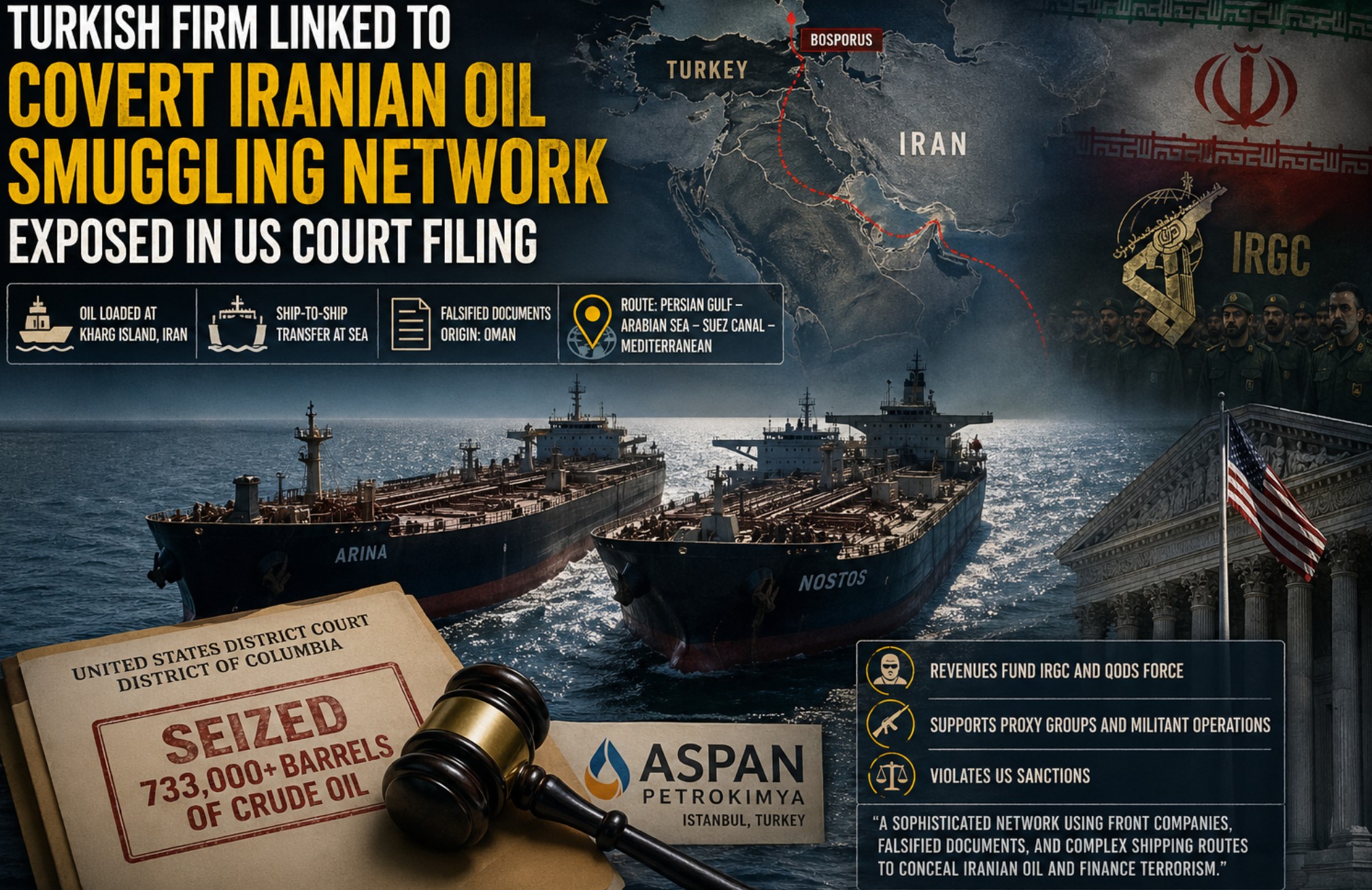
A detailed US federal court case that culminated in an appellate ruling this month has exposed a sophisticated sanctions-busting oil network tied to Iran’s revolutionary guard corps, revealing how a Turkish company run by Iranian nationals became entangled in a covert operation designed to disguise the origin of Iranian oil and channel proceeds to entities accused of financing terrorism.
The case, filed in the US District Court for the District of Columbia, centers on the seizure and forfeiture of petroleum cargo transported aboard two tankers — the M/T Arina and the M/T Nostos — as part of a broader investigation into Iran’s illicit oil trade.
At the heart of the case is Aspan Petrokimya Co., a Turkish company controlled by an Iranian national that filed a legal claim over the seized cargo. US prosecutors argue that Aspan’s purported purchase was not a legitimate commercial transaction but rather part of a wider scheme enabling Iranian state actors including the Islamic Revolutionary Guard Corps (IRGC) to monetize oil shipments in violation of US sanctions.
The case once again confirms a long-observed pattern in Turkey under the Islamist government of President Recep Tayyip Erdogan, in which Iranian networks are able to exploit Turkish corporate, industrial and financial sectors to circumvent international sanctions regimes with relative ease.
According to the complaint, companies willing to purchase such cargo play a critical role in sustaining these networks, effectively allowing Iran to convert concealed oil shipments into revenue streams that would otherwise be blocked under sanctions enforcement mechanisms.
The filing describes a carefully orchestrated process designed to conceal the Iranian origin of the oil at every stage. The crude was initially loaded at Kharg Island, Iran’s primary oil export terminal, before being transferred at sea through ship-to-ship operations, a method frequently used to obscure the true source of cargo. During these transfers, vessels deliberately disabled their Automatic Identification System (AIS) transponders, effectively going dark to evade maritime tracking systems.
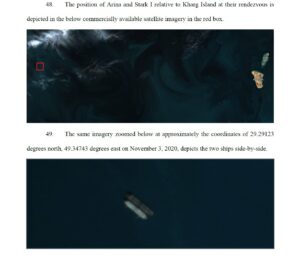
To reinforce the deception, falsified shipping documents were generated, falsely identifying the cargo as originating from Oman rather than Iran. Satellite imagery cited in the filing shows vessels positioned side by side in the Persian Gulf, visually confirming at least one such covert transfer operation.
The cargo, amounting to more than 733,000 barrels of crude oil, remained onboard for months and traversed multiple strategic waterways, including the Persian Gulf, the Arabian Sea, the Suez Canal and the Mediterranean. The route reflects a deliberate effort to integrate the shipment into global trade flows while masking its origin.
A particularly notable aspect of the case is that the oil cargo transited the Bosporus Strait, one of the world’s most critical maritime chokepoints under Turkish jurisdiction. This passage underscores Turkey’s geographic exposure to sanctions evasion schemes, where vessels carrying potentially illicit cargo can pass through its waters as part of broader international shipping routes with limited scrutiny.
US authorities frame the case as part of a larger effort to disrupt financial networks that support militant activities. According to the filing, revenues generated from Iranian oil sales constitute a key funding source for the IRGC and its Quds Force, both designated as terrorist organizations by the United States. These funds are believed to support proxy groups, regional militant operations and more extensive intelligence activities targeting US and allied interests.
Prosecutors portray the IRGC as a dominant economic force within Iran, deeply embedded in sectors such as energy, shipping and finance. Through a complex web of front companies and intermediaries, the organization is able to obscure its role in oil transactions while continuing to generate substantial revenue.
The involvement of a Turkish company adds to growing concern among Western officials that Turkey has become increasingly exposed to sanctions evasion networks. In recent years, multiple investigations have pointed to the use of Turkish companies as intermediaries in restricted trade, often operating in regulatory environments lacking robust oversight and enforcement.
This pattern is not new. The Halkbank case, which first surfaced during 2013 corruption probes in Turkey and later evolved into a major US federal prosecution in 2016, demonstrated how Turkish state-owned Halkbank facilitated the laundering of billions of dollars on behalf of Iran in violation of US sanctions. Evidence presented in US courts indicated that these schemes were approved at the highest levels of the Turkish government, with senior officials receiving illicit kickbacks tied to transactions orchestrated by Iranian state actors.
Since then, dozens of Turkish companies have faced criminal scrutiny in the United States, while the US Department of the Treasury and the US Department of State have designated numerous Turkey-based companies, entities and individuals under sanctions for facilitating illicit trade.
Against this backdrop, Aspan appears to fit a well-established pattern. Trade registry data reviewed by Nordic Monitor suggests the company was structured in a manner consistent with a shell entity designed to facilitate sanctions evasion.
Aspan Petrokimya Ticaret Anonim Şirketi was formally registered in Istanbul on February 20, 2020, with headquarters in the Şişli district. Official records show that the company was granted an unusually broad commercial mandate, covering petrochemical trading, oil and fuel-related activities, logistics, storage, distribution and international trade across multiple sectors.
The registry filing outlines an expansive scope of permitted activities extending beyond petrochemicals to include industrial goods, machinery, financial transactions such as lending and borrowing, and the establishment of partnerships and joint ventures, a structure often associated with entities designed to obscure financial flows.
The same filing identifies Zumrad Urazajiyeva, a Kazakhstan-linked individual, as a founding figure with significant control over the company’s operations.
Subsequent filings indicate notable changes in ownership. In May 2023 the company was transferred to Mahdieh Sancoulli, an Iranian national who declared residence in the United Arab Emirates. In a February 2025 filing, Sancoulli requested amendments to his identity records, listing himself as a UAE national rather than Iranian, a move that suggests an attempt to obscure his background while continuing to operate within a sanctions-sensitive network using a Turkish corporate vehicle.
US prosecutors, however, argue that the evidence leaves little doubt about Aspan’s role. Rather than Iranian or UAE-based entities linked to the IRGC challenging the seizure, it was Aspan — the Turkish-registered company that filed a claim in US courts seeking to reverse the forfeiture decision.
Aspan contested the seizure on three main grounds: ownership of the cargo, the alleged impact on foreign commerce and the intent requirement related to influencing government conduct.
US authorities countered that the oil belonged to the National Iranian Oil Company (NIOC), which is closely tied to the IRGC. According to prosecutors, the crude was loaded in Iran, transferred between vessels at sea and ultimately seized in the Mediterranean as part of a sanctions enforcement operation.
The United States Court of Appeals for the District of Columbia Circuit upheld the government’s position, affirming the seizure and forfeiture of more than 700,000 barrels of crude oil.
In its April ruling the court held that ownership must be assessed at the time of the underlying illegal conduct and found that available evidence plausibly demonstrated NIOC’s control over the oil. The court also noted that large-scale Iranian oil transactions have a direct impact on global markets, thereby affecting US commerce. Furthermore, NIOC’s close coordination with the IRGC supported the inference that the transactions were intended, at least in part, to support activities targeting governments, including the United States.
The ruling ultimately affirmed the lower court’s decision, allowing the forfeiture process to proceed.
For Turkey, the implications extend far beyond a single case. The findings highlight structural vulnerabilities that expose Turkish companies to secondary US sanctions, undermine confidence in the country’s regulatory and financial oversight mechanisms and reinforce the perception that Turkey increasingly serves as a conduit for illicit trade and sanctions evasion networks.