
Abdullah Bozkurt/Stockholm
A secret Turkish government document obtained by Nordic Monitor reveals that Turkish intelligence and counterterrorism authorities conducted an intelligence-gathering operation targeting members of the Gülen movement in Norway, Finland and Denmark, identifying individuals who participated in peaceful demonstrations against the repressive government of President Recep Tayyip Erdogan and forwarding their personal information for use in criminal proceedings in Turkey.
The classified document, dated August 19, 2026, shows that Turkish authorities systematically examined photographs and social media posts from demonstrations held simultaneously in the three Nordic countries on June 24, 2026, compiling lists of participants suspected of having links to the Gülen movement, a faith-based civic group that has become one of the principal targets of Erdogan’s sweeping crackdown on political opponents.
The intelligence collected on the demonstrators was transmitted to the counterterrorism department of the Turkish National Police, which subsequently instructed provincial police departments to identify individuals and report their findings to the relevant courts and prosecutors.
The operation reveals how the Erdogan government has extended its domestic surveillance and intelligence apparatus beyond Turkey’s borders, treating peaceful political expression in European democracies as grounds for intelligence collection and potential criminal prosecution.
Marked “GİZLİ” (SECRET), the document was issued by the Antalya Provincial Police Department in response to an August 11, 2026, directive from the Counterterrorism Department (Terörle Mücadele Daire Başkanlığı) of the Security Directorate General (Emniyet).
Signed by Yasin Neciboğlu, a deputy provincial police chief acting on behalf of the Antalya police chief, the letter was addressed to the Antalya 2nd High Criminal Court, with a copy forwarded to the national Counterterrorism Department.
The document specifically identified demonstrations held in Denmark, Finland and Norway in solidarity with a protest organized by the Peaceful Actions Platform outside the Council of Europe headquarters in Strasbourg, France.
The document does not disclose the original source of the intelligence, an omission consistent with a practice in Turkish security correspondence of concealing the involvement of intelligence operatives and protecting the government from potential exposure should classified documents become public.
Although the letter refers to the examination of photographs and social media posts, this explanation may obscure the actual methods used to identify and track participants in the Nordic countries. Intelligence potentially obtained through clandestine surveillance and spying operations could have been repackaged as information gathered from publicly available social media sources, allowing Turkish authorities to conceal the involvement of covert operatives while presenting the resulting intelligence as routine counterterrorism research.
A classified Turkish police document dated August 19, 2026, reveals intelligence gathering on Gülen movement supporters in Norway, Finland and Denmark. Redactions were made by Nordic Monitor:
According to the police correspondence, the demonstrations were held on the same day, June 24, 2026, by individuals whom Turkish authorities described as affiliated with the Gülen movement. Turkish officials examined images posted on social media about the events, identified participants and compiled lists of their names along with screenshots documenting their involvement.
The document states that these materials were subsequently distributed to provincial counterterrorism units with instructions to examine the individuals already subject to judicial proceedings in Turkey, conduct further investigations and submit relevant findings to judicial authorities.
The letter explicitly confirms that Turkish police in Antalya prepared an additional investigative report on one individual named in the intelligence material and forwarded the report to the Antalya 2nd High Criminal Court.
The individual’s name and Turkish national identification number have been redacted by Nordic Monitor for the security and safety of that individual, who is actually a British national.
A separate classified investigative report obtained by Nordic Monitor provides further details about how Turkish counterterrorism authorities identified and profiled individuals who participated in the demonstrations in European countries.
The report, titled Araştırma Tutanağı (Investigation Report), was prepared on August 19, 2026, by two officers from the counterterrorism branch of the Antalya Provincial Police Department. It was completed at 4:20 p.m. and signed by both officers, whose identification numbers appear at the bottom of the document.
Marked “GİZLİ” (SECRET), the report cites the August 11 directive issued by the national Counterterrorism Department and refers to intelligence concerning demonstrations organized by the Peaceful Actions Platform in Strasbourg, France, and solidarity events in Denmark, Finland and Norway on June 24, 2026.
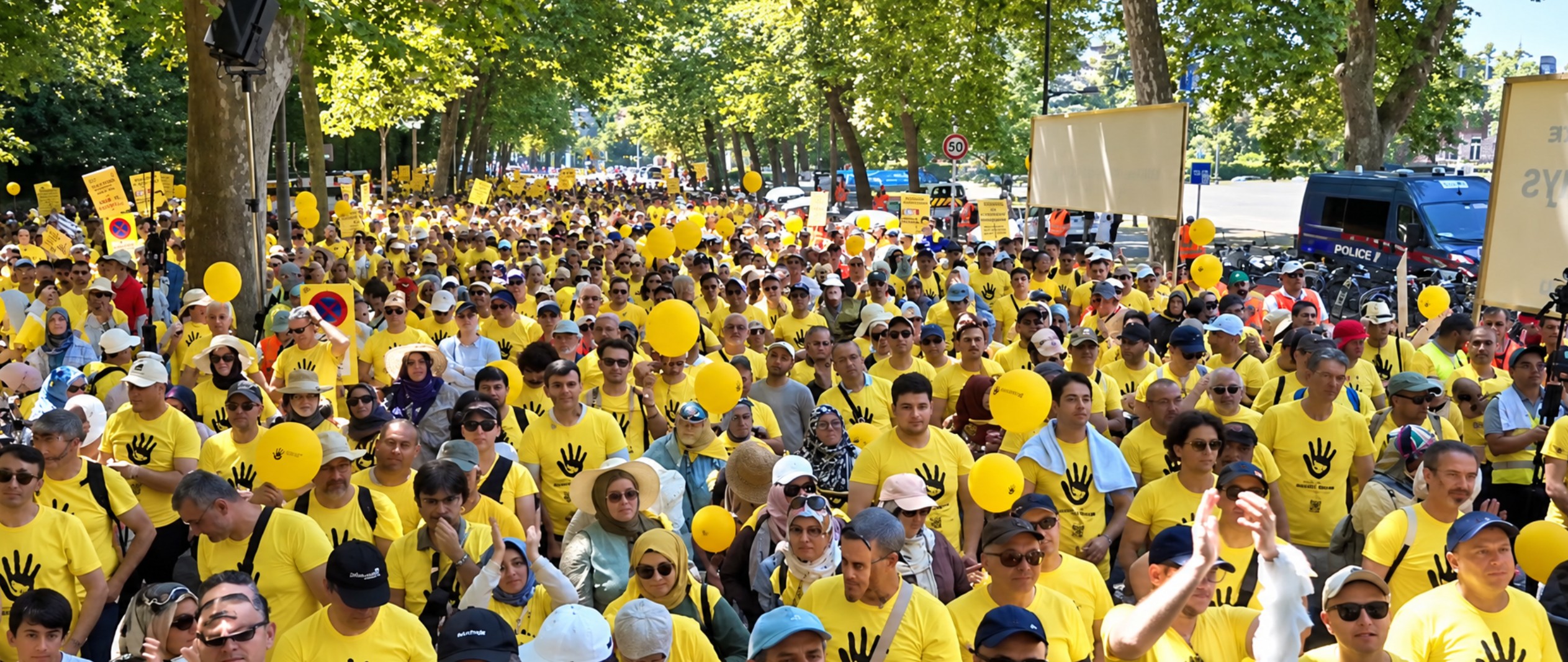
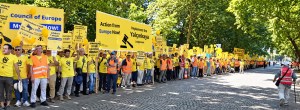
The document contains a photograph showing individuals wearing yellow vests bearing the emblem of a handprint, seated outdoors. Turkish police incorporated the image into their investigative report and identified at least one person in connection with the demonstrations. The image was accompanied by a social media reference and information about the individual’s identity, establishing how photographic material from a peaceful civic activity was incorporated into an official counterterrorism dossier.
The police report described the individual as having connections to the Gülen movement, without presenting evidence that the person had engaged in violence or committed any criminal offense during the demonstrations.
The investigators did not explain how the individual had been identified in the first place, who initially supplied the intelligence or whether any covert surveillance had been conducted in the Nordic countries.
Although the report explicitly characterizes the investigation as open-source intelligence work, citing images circulated on social media, the origin of the underlying information remains undisclosed. The wording of the open source appears to have been deliberately inserted into the document to mask the origin of secret intelligence work.
A classified Turkish police investigative report dated August 19, 2026, documents the identification and profiling of a Gülen movement supporter who participated in a peaceful demonstration in Europe. Redactions were made by Nordic Monitor:
The investigative report demonstrates that Turkish authorities subjected individuals associated with peaceful demonstrations abroad to detailed background checks, combining photographs, social media material and government-held personal records to build intelligence files for use in domestic judicial proceedings.
Nordic Monitor has withheld the individual’s name, identification number, other identifying details and portions of the photograph to protect the person from possible reprisal by Turkish authorities.
The evidence establishes that Turkish authorities were not merely observing political developments in Nordic countries but were turning information about participation in peaceful demonstrations into material for domestic criminal investigations and court proceedings.
The Erdogan government has a long track record of criminalizing peaceful dissent and using the judiciary as a political instrument to silence critics and opponents. Through politically motivated investigations, fabricated evidence and terrorism-related or other criminal charges, Turkish authorities have pursued individuals for exercising their fundamental rights to freedom of expression, association and peaceful assembly.
The government’s use of counterterrorism laws against political opponents has also raised serious concerns about judicial independence, due process and the systematic erosion of the rule of law in Turkey.
The disclosures raise concerns about the Erdogan government’s use of state security institutions to track political dissidents living abroad, particularly members of the Turkish diaspora who sought refuge in European countries after facing persecution in Turkey.
The latest revelations follow an earlier Nordic Monitor investigation published on June 11, 2026, which exposed a Turkish intelligence operation targeting participants in a demonstration held outside the Council of Europe headquarters in Strasbourg on June 25, 2025.
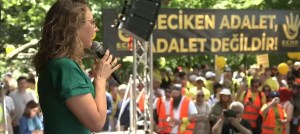
That investigation, based on leaked Turkish government correspondence, revealed that intelligence collected on Turkish dissidents in France had been transmitted to police authorities in Ankara and subsequently incorporated into criminal proceedings against an individual who had been granted political asylum in Germany.
The earlier document described how intelligence concerning the Strasbourg protest reached Turkish police through what officials called an affiliated institution, a designation frequently used in Turkish bureaucratic correspondence to avoid identifying the precise source of sensitive information.
The intelligence reportedly included details about individuals attending the protest, which had drawn thousands of participants from across Europe to demand that Turkey comply with binding judgments of the European Court of Human Rights (ECtHR).
The newly obtained August 2026 correspondence points to a continuation and geographical expansion of the same pattern, with Turkish authorities now documenting the activities of demonstrators in three Nordic countries and integrating the information into their counterterrorism investigations.
The directive’s transmission through the national police counterterrorism hierarchy, the identification of individual participants and the subsequent submission of investigative findings to a Turkish criminal court demonstrate the official use of information gathered about political activities abroad.
The August 19 letter also provides insight into the coordination among Turkey’s central security apparatus, provincial police departments and the judiciary.
The initial correspondence was issued by the Counterterrorism Department on August 11, less than two months after the demonstrations. Provincial authorities were instructed to cross-reference the participant lists against existing judicial records and undertake further investigative work on individuals already facing proceedings.

In Antalya the instructions resulted in the preparation of an investigative report concerning at least one individual. The report was submitted directly to the 2nd High Criminal Court, indicating that information about a person’s participation in political activities outside Turkey had become part of a judicial process.
The operation also highlights the increasingly transnational nature of Ankara’s campaign against the Gülen movement. The movement, inspired by the late Turkish Muslim cleric Fethullah Gülen, established an extensive network of schools, charities, educational institutions and civil society organizations in Turkey and abroad before a falling out with Erdogan’s government.
The conflict intensified after corruption investigations in December 2013 implicated senior government officials and members of Erdogan’s inner circle. Erdogan accused the movement of orchestrating the investigations, an allegation its members denied, and subsequently launched a sweeping crackdown on individuals and institutions associated with it.
The crackdown escalated dramatically following a coup attempt on July 15, 2016, which was in fact a false flag operation orchestrated by Turkish intelligence to provide a pretext for an unprecedented purge of government institutions, the consolidation of power under Erdogan’s increasingly centralized presidential system and the expansion of Turkish military operations beyond the country’s borders.
The Gülen movement, which emerged in Turkey in the 1960s under the leadership of Muslim cleric Fethullah Gülen, has historically advocated education, interfaith dialogue, civic engagement and nonviolence. The movement has consistently rejected the use of violence to achieve political or religious objectives, a position that has also made it a target of hostility from radical jihadist organizations, including al-Qaeda and the Islamic State (ISIS). The Erdogan government’s designation of the movement as a terrorist organization has no bearing on facts. Norway, Finland and Denmark have not adopted Turkey’s terrorist designation, nor has the European Union, the United States and the rest of the world.

Many members and perceived supporters of the movement subsequently relocated to European countries, including the Nordic states, where some obtained asylum or other forms of legal protection. Despite their residence abroad, the newly disclosed correspondence indicates that Turkish authorities continue to regard their participation in public demonstrations as activities warranting counterterrorism scrutiny.
The events referenced in the August document were organized in connection with the Peaceful Actions Platform, a coalition of civil society groups that has mobilized demonstrations in Strasbourg to protest human rights violations in Turkey and demand compliance with ECtHR judgments.
Among the principal grievances raised by the coalition is Ankara’s continued reliance on broadly formulated terrorism allegations against people accused of association with the Gülen movement.
The ECtHR’s landmark judgment in Yüksel Yalçınkaya v. Türkiye in September 2023 found violations of fundamental rights in a terrorism conviction involving alleged Gülen movement membership. The ruling raised greater concerns about the Turkish judiciary’s approach to evidence, individual criminal responsibility and the principle that there can be no punishment without law.
For people who fled Turkey following the crackdown by the Erdogan governemnt, the ability to participate in peaceful protests in their countries of residence is an important element of freedom of expression and assembly.
The Turkish government’s decision to identify participants in such gatherings and circulate their names to law enforcement and judicial authorities raises questions about the potential consequences for the individuals concerned, including exposure to further investigation or prosecution in Turkey.
The disclosure is particularly significant because Norway, Finland and Denmark are established European democracies with legal protections for political expression and peaceful assembly. The activities described in the Turkish correspondence were demonstrations carried out in support of a protest outside a major European human rights institution.
The August correspondence provides another illustration of how Turkey’s domestic security priorities extend into the lives of people residing outside its jurisdiction. Information about lawful demonstrations abroad can be collected, evaluated and used by Turkish authorities in proceedings against individuals regarded as political opponents.
The findings also raise the question of whether the security authorities in Norway, Finland and Denmark were aware of the Turkish government’s monitoring of the demonstrations or the subsequent use of information about participants in Turkish judicial proceedings.
Taken together with the earlier Strasbourg disclosures, the classified correspondence suggests an established mechanism through which Turkish security agencies monitor political activities across Europe, identify participants, match their identities with Turkish population records and transmit the resulting information to courts and prosecutors.
The cases illustrate how a campaign of repression that originated inside Turkey can continue to affect critics of the Erdogan government after they have relocated to countries where their political activities are legally and constitutionally protected.