
Abdullah Bozkurt/Stockholm
The government of Turkish President Recep Tayyip Erdogan has effectively paved the way for the resurgence of a radical Kurdish Islamist network that seeks to establish a sharia-based independent Kurdish state spanning territories in Turkey, Syria, Iraq and Iran, after Turkish courts quietly dismantled key terrorism convictions of members of the group and reframed years of organized militant activity as ordinary criminal conduct.
The group, known as the Kürdistan İslami Devrim Hareketi (Kurdistan Islamic Revolution Movement in English, Tevgera Şoreja İslamiya Kürdistan in Kurdish, KİDH), first emerged publicly in the 1990s as a clandestine Islamist Kurdish organization advocating an armed campaign to create an Islamic Kurdish state across what it described as the divided Kurdish lands of the Middle East.
Turkish judicial documents, police investigations and court rulings reviewed by Nordic Monitor describe the organization as combining Kurdish nationalism with radical Islamist ideology, aiming to replace the constitutional order with a religious regime based on Islamic law.
Although the group was largely dismantled through police operations and prosecutions in the 2000s and early 2010s, the Erdogan government’s behind-the-scenes interventions over the past decade, culminating in a recent retrial in the predominantly Kurdish city of Diyarbakır, dramatically reversed the legal characterization of the organization and overturned some of the most serious terrorism-related convictions linked to the movement.
In a decision issued on May 13, 2026, a Turkish court acquitted seven defendants of attempting to overthrow the constitutional order, despite earlier rulings that had sentenced them to aggravated life for carrying out an armed bank robbery on behalf of the KİDH. The retrial came after the Supreme Court of Appeals, dominated by Islamist judges appointed by the Erdogan government, surprisingly overturned previous convictions.
The ruling marked a striking reversal from earlier judicial findings that had portrayed the organization as a structured militant network pursuing separatist Islamist objectives through armed conflict, robberies, extortion and underground organizing.
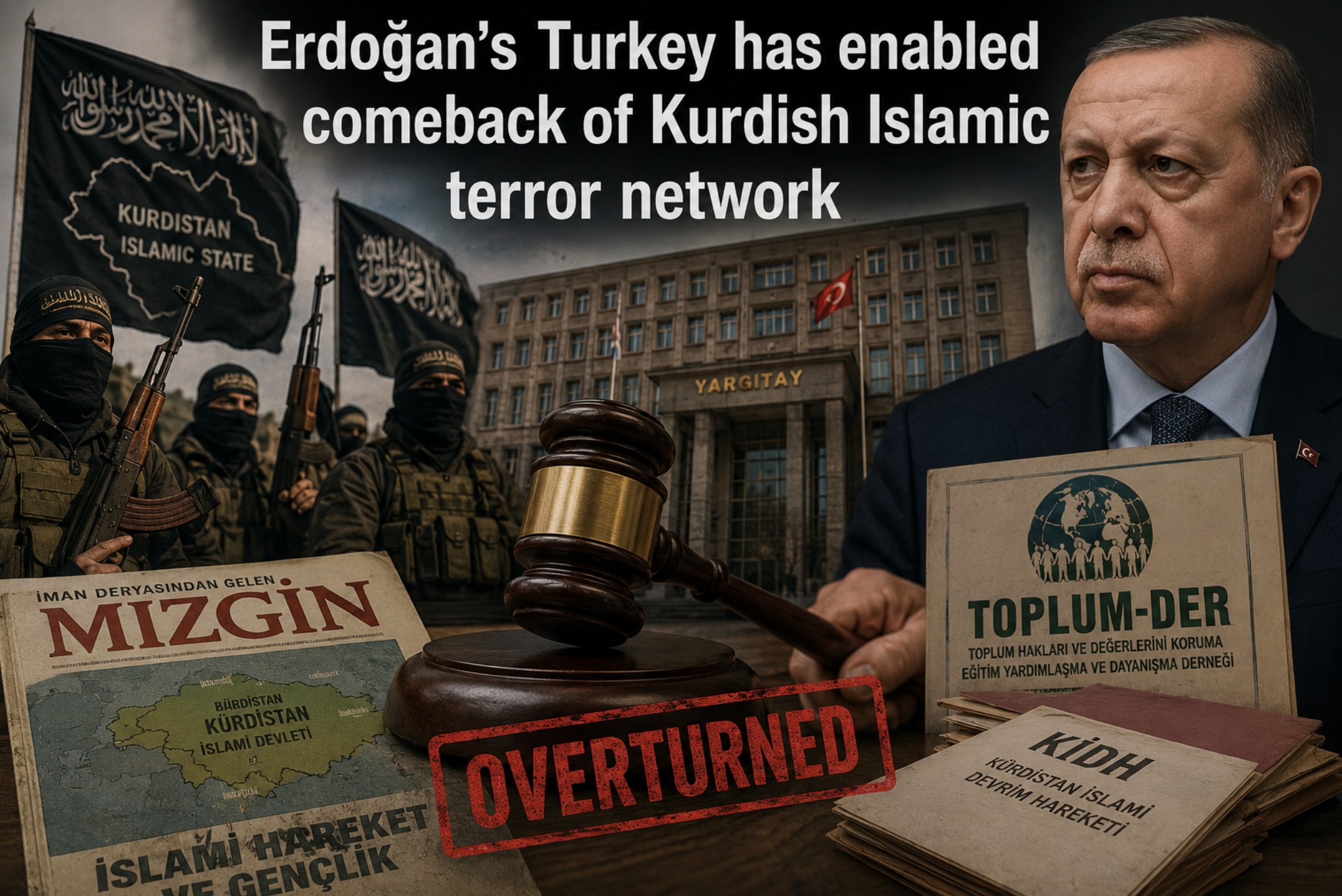
A ruling by the Supreme Court of Appeals overturned its earlier decision which had ruled that the Kürdistan İslami Devrim Hareketi was a terrorist organization aimed at overthrowing Turkey’s constitutional order and acquitted all convicted members of the KİDH:
The original case stemmed from the October 13, 2009, armed robbery of a branch of state-lender Ziraat Bank in Diyarbakır’s Bağlar district. According to court records, masked gunmen stormed the bank shouting, “This is a robbery, everybody get on the floor,” before seizing cash in Turkish lira, US dollars and euros at gunpoint.
The first trial concluded that the robbery had been conducted in the name of the KİDH to finance the organization’s activities and propaganda operations. Seven defendants — Bayram Bulduk, Bayram Güney, Mustafa Hocaoğlu, İrfan Yıldız, Mehmet Şirin, Muhammet Aslan and Bayram Kılıç — were sentenced to aggravated life for attempting to overturn the constitutional order through armed action, in addition to lengthy prison terms for armed robbery.
Court rulings at the time stated that the organization considered robbery, extortion and similar criminal acts religiously permissible to fund the movement. Judges determined that the suspects had planned the bank robbery after concluding that “the only way to escape poverty was robbing a bank,” especially as the organization struggled financially and could no longer sustain publication of its propaganda magazine, Mizgin.
However, during the retrial concluded this month, defendants recast the robbery as an ordinary criminal act motivated by personal financial hardship rather than ideological militancy. One defendant claimed he carried out the robbery because his father was addicted to alcohol, drugs and gambling and that creditors constantly harassed the family over debts. Others similarly denied acting on behalf of the KİDH and insisted they merely needed money.
The court accepted those arguments and acquitted all seven defendants of constitutional crimes, reducing their punishment to sentences for ordinary aggravated robbery. Two defendants previously convicted of assisting the organization were fully acquitted.
The decision effectively stripped the case of its terrorism dimension despite extensive earlier findings and years of investigations and monitoring that documented the KİDH’s ideological structure, publications, organizational hierarchy and militant activities.
Turkish security and judicial records dating back years described the KİDH as a radical organization established in 1993 with the objective of creating a religious Kurdish state encompassing parts of Turkey, Syria, Iraq and Iran. The founders included Turkish nationals Mehmet Pektaş (the leader of the group also known by his code name Yusuf Muhammet Hoca), Ömer Aybar, Adem Sağun and Atilla Kiliç.

The organization adopted a four-stage strategy aimed at ultimately establishing an Islamic state through armed uprising. The stages included ideological outreach and indoctrination (“tebliğ”), recruitment into small organizational cells (“kadro”), mass mobilization around a shared ideology (“kitleselleşme”) and eventually armed rebellion against state authority (“devletleşme”). Investigators said members sought to recruit supporters by first targeting friends and acquaintances in schools and neighborhoods and expand to other areas later.
According to court findings, the organization operated in Diyarbakır, Batman, Van, Elazığ, Gaziantep and Malatya and established armed cells known as “Silahlı Savunma Birlikleri” (Armed Defense Units, SSB) in Turkey’s Diyarbakır and Elazığ provinces.
SSB members were tasked with carrying out operations approved by the group’s leadership council, referred to as the “Karma Şura” (KAŞ). Investigators said SSB members received training in intelligence gathering, surveillance, weapons handling, bomb-making, interrogation techniques, first aid, recruitment, reconnaissance, map and sketch preparation and armed robbery.
The units were organized into small operational cells and conducted field exercises to prepare for future attacks. Court documents further stated that the group rented a safe house under the codename “Internet,” where members held training sessions on first aid, reconnaissance, surveillance, intelligence collection, interrogation methods and shooting drills, including exercises with air rifles near a riverbank.

Investigators said these armed units financed the organization through robberies, extortion, theft and kidnappings for ransom. Court documents also stated that the KİDH used legal-looking civil structures and media outlets as fronts for recruitment and ideological indoctrination.
The organization embraced the view that any method necessary to achieve its objectives including theft, robbery and armed attacks was acceptable and that all are religiously permissible. The group believed that arming itself and carrying out armed actions were essential to creating psychological pressure on the local population and that its first operation should be a sensational attack capable of attracting widespread attention.
The organization also viewed Turkey as a “Dar al-Harb” (land of unbelief), rejected participation in elections and opposed obedience to state authorities and public officials. Investigators recovered operational sketches and intelligence reports detailing potential attacks targeting the governor’s office, senior government officials, police stations and public institutions, leading authorities to conclude that planned operations had been uncovered before they could be carried out.
One of the most important instruments linked to the organization was the Islamist Kurdish magazine Mizgin (Iman Deryasından Gelen Mizgin in Turkish), published in Kurdish and Turkish beginning in 2004. Turkish prosecutors and courts repeatedly identified the publication as the movement’s propaganda organ. Some of the names appearing in the publication as advocates of the group included Deniz Tursun, Gülcan Bahtiyar, Ömer Aybar, Mehmet Pektaş, Seid Dilgeş, Metin Denizhan, İdris Ertaş, Siyabend Azad, Cemal A. Bıçak, Merve Esmer, Bawer Erişen and Hamza Aksakal.
The magazine openly promoted visions of an independent Kurdish Islamic state. In its 55th issue Mizgin published a map labeled “Independent Kurdistan State,” while the following issue carried a map titled “Independent Kurdistan Islamic State.” Both issues were later banned by court order.

Articles published in the magazine repeatedly advocated either an independent Kurdish state, a Kurdish federation or an Islamic Kurdish state uniting Kurds from Turkey, Syria, Iraq and Iran under an Islamic political structure.
Turkish prosecutors launched multiple criminal investigations into the magazine’s editors and contributors. In 2006 Diyarbakır prosecutors charged Mizgin’s editor-in-chief and several writers with “inciting hatred and hostility.”
Court records later detailed how the KİDH reorganized itself under ostensibly legal structures after earlier security crackdowns. Members created a charity and education association named “Toplum Hakları ve Değerlerini Koruma Eğitim Yardımlaşma ve Dayanışma Derneği,” commonly known as Toplum-Der, in 2003 as a cover structure for continued organizing. It was led by a man named Abdulbaki Yetik, who had faced multiple criminal investigations by public prosecutors.
The group used associations, meetings, publications and religious events to recruit Kurdish youth and spread Islamist Kurdish ideology while avoiding security scrutiny. It organized meetings emphasizing that Kurdish suffering could only end through the establishment of an independent Kurdistan compatible with Islamic principles.
Investigators recovered documents, CDs, DVDs, maps and publications from homes and offices linked to the organization, including materials advocating a Kurdish Islamic political entity and discussing regions such as “Red Kurdistan,” which includes territories from Azerbaijan’s Karabakh and Nakhchivan.
Witness testimony cited in court decisions claimed that members avoided using the KİDH name openly and instead operated through the association structure while maintaining the same ideological objectives.
The witness also alleged that members were taught that Turkey represented “unbelief” while the movement represented “faith” and that the organization ultimately sought to unite Muslims under an Islamic political system while also bringing together divided Kurdish populations.
Turkish authorities launched major operations against the network in May 2010 and May 2014. In coordinated raids across multiple provinces police detained dozens of suspects including alleged leaders, public employees and activists connected to Toplum-Der and the Mizgin magazine.
Authorities said they recovered firearms, organizational documents, digital materials and ideological publications during the raids. Officials also linked suspects to the 2009 bank robbery and other criminal activities including thefts from businesses and religious sites.

Despite those earlier operations and convictions, the group effectively received a reprieve from the crackdown after the Erdogan government launched a massive purge of Turkey’s judiciary and police between 2014 and 2017, arbitrarily dismissing nearly 5,000 judges and prosecutors and over 20,000 police chiefs over alleged links to the Gülen movement, a faith-based group critical of the government on issues including pervasive corruption and Turkey’s aiding and abetting of radical Islamist groups.
In June 2014 the Supreme Court of Appeals overturned convictions of KİDH members in a case involving constitutional violations and other crimes, claiming that prosecutors had failed to sufficiently prove organizational links between the Mizgin magazine, the Toplum-Der association and an armed terrorist organization.
In a separate case multiple defendants were convicted for conducting illegal activities on behalf of the KİDH terrorist organization under the umbrella of Toplum-Der. Although the convictions were upheld on appeal, in a surprise move the Chief Public Prosecutor’s Office at the Supreme Court of Appeals challenged the ruling in 2017, arguing that the defendants should have been acquitted due to insufficient evidence. In December 2022 the Supreme Court of Appeals, which initially upheld the convictions, overturned them all.
On November 2022 the Turkish Constitutional Court, stacked with Erdogan loyalists after the purge, ruled for rights violations in the case of convicted KİDH member Cihat Aydoğmus, who had run the Malatya branch of the group’s Toplum-Der, recruited new members and carried out propaganda activities on behalf of the terrorist organization. The case was returned to the first degree court for a new trial, which resulted in acquittal.
The latest court decisions signal a broader political and judicial shift in Turkey in which radical Islamist groups once categorized as serious national security threats increasingly receive more lenient treatment under Erdogan’s government, especially when they are viewed as useful counterweights against broader opposition forces.
The retrial outcome this month also reflects the increasingly politicized nature of Turkey’s judiciary under Erdogan’s political Islamist government, where terrorism designations and prosecutions have become inconsistent and often dependent on shifting political priorities rather than established legal standards.
Critics argue that by downgrading the activities of KİDH members from terrorism and constitutional subversion to ordinary criminal offenses, Turkish courts have effectively normalized a violent extremist movement that openly advocated for dismantling Turkey’s constitutional order and replacing it with a transnational Islamist Kurdish entity governed by sharia law.