

Abdullah Bozkurt/Stockholm
A Turkish national has been charged with knowingly transporting counterfeit Mexican passports from Cancun, providing a fresh glimpse into an international document-fraud infrastructure operating alongside migrant-smuggling routes used by Turkish nationals and other foreign travelers.
The allegations, filed in a North Carolina federal court, describe a seemingly compartmentalized operation involving a Turkish client, an intermediary traveling legally between the United States and Mexico, an unidentified document supplier in Cancun, encrypted communications and the physical concealment of forged passports.
The case bears operational similarities to other networks documented in US court proceedings, including Turkish-run migrant pipelines spanning Mexico, Canada and the United States and, in a separate terrorism context, an Islamic State in Iraq and Syria (ISIS) logistical network that used Istanbul safehouses, encrypted messaging and counterfeit Turkish identity cards to move foreign fighters.
There is no allegation in the new criminal complaint that the defendant, Kaan Elmas, has any connection to ISIS or that he transported migrants. Nor have prosecutors linked him to previously identified smuggling organizations. The relevance of the earlier cases lies in the methods they expose: the procurement of false identity documents, the use of couriers and intermediaries, coordination through secure applications and the exploitation of legitimate international travel to support unlawful movement.
According to a criminal complaint filed on July 10 in the US District Court for the Western District of North Carolina, Elmas arrived at Charlotte-Douglas International Airport on July 9 aboard Flight 2248 from Cancun, Mexico.
Elmas, a US green card holder born in Turkey in 1992, presented himself for primary inspection and was referred to a secondary examination by Customs and Border Protection officers.
During a search of his luggage, officers discovered two Mexican passports concealed inside a clothing pocket in a pair of shorts. Elmas had neither declared the passports nor voluntarily presented them to inspectors, the complaint states.
The first passport was issued in the name of Cihan Omur Demiral, with a date of birth in April 1983. It purported to identify him as a Mexican passport holder born in Boston and included a Mexican CURP personal identification number.
The second passport carried the name Aslan Abubakarov, also born in April 1983, and likewise listed Boston as his place of birth. It contained a separate Mexican passport number and CURP identifier.
Computer checks and document examination established that both passports were counterfeit, investigators said.
Biometric analysis through US Customs and Border Protection (CBP) databases further showed that Demiral was in fact a Turkish citizen born in Pendik, Istanbul, rather than a Mexican citizen born in the United States. US records showed that Demiral possessed a Turkish passport and had obtained a B1/B2 visitor visa under his Turkish identity. He had previously traveled lawfully to the United States, most recently entering on March 30, 2025 and departing from Miami for Istanbul on April 5, 2025.
The complaint does not explain why Demiral allegedly sought a false Mexican passport despite already possessing a US visitor visa. The document might have been intended for future travel, identity substitution, immigration fraud, access to benefits or movement under an assumed identity, but prosecutors have not yet publicly established its intended use.
The affidavit also provides no verified information about Abubakarov. It’s unclear whether that is the identity of an actual person, an assumed name or a fabricated identity created for use with the counterfeit passport. The name suggests he may be Chechen and a Russian national.
The physical discovery of the passports was reinforced by evidence found on Elmas’s mobile phone. During the border inspection, officers searched an iPhone in his possession and recovered communications concerning the promised identity documents, payments and arrangements for collecting them.
Investigators said the messages showed that Elmas was not an unwitting traveler carrying an unknown package. Instead, he allegedly knew in advance that he was collecting identity documents and acted as an intermediary for a person identified as “Omur,” apparently Cihan Omur Demiral.
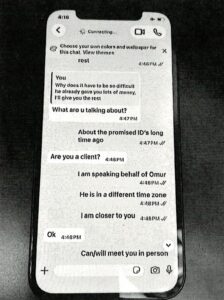
In one exchange Elmas complained about delays in producing the documents and referred to money already paid to the supplier. He indicated that the remaining balance would be delivered and told the other party that he was speaking on Omur’s behalf.
Elmas explained that Omur was in another time zone and that he was physically closer to the document provider, according to screenshots reproduced in the affidavit.
The messages then turned to an in-person meeting and referred to appointments involving both Omur and another individual described as “the Russian.” The parties subsequently agreed to continue their conversation through Signal.
The reference to “the Russian” may correspond to the second counterfeit passport issued in the name Aslan Abubakarov. However, the complaint does not expressly identify Abubakarov as the person mentioned in the communications or establish his actual nationality.

Investigators also recovered Signal communications with a user identified as “Afonso SVPPB.” Those messages discussed the process of purchasing and obtaining fraudulent documents and, according to the affidavit, demonstrated Elmas’s prior knowledge and active role in arranging their acquisition and transport.
The filing does not identify the person behind the “Afonso SVPPB” account or disclose whether US or Mexican authorities have located the suspected document broker.
Elmas admitted during the inspection that he had brought the documents from Cancun for a friend, the affidavit states. He told officers that he collected the passports from an unknown man outside a 7-Eleven convenience store in Cancun. Elmas described the person only as a man wearing a white T-shirt.
The documents were then concealed in the pocket of the shorts and placed inside his luggage for the return journey to Charlotte. The alleged handover indicates a compartmentalized delivery method in which the courier did not necessarily meet the document producer or know the identity of the broader network. A supplier or low-level delivery operative could conduct a brief exchange in a public place, leaving the traveler responsible for transporting the documents across an international border.

A LinkedIn profile bearing Elmas’s name portrays him as a Greater Boston-based businessman active in logistics, catering delivery and restaurant distribution. The profile identifies him as the owner of Elmas Enterprise. It lists Turkish and English at native or bilingual proficiency and Russian at limited working proficiency. His Facebook page shows him in Times Square, New York City, holding the flag of Abkhazia, a Russian-occupied breakaway territory that is internationally recognized by most countries as part of Georgia. It suggests he has some sort of connection to Abkhazia or people originating from there.
The Cancun passport case emerges months after another US prosecution exposed a Turkish-run migrant-smuggling operation along the Canadian border. In that case Turkish national Serkan Gökce pleaded guilty to alien smuggling after he was caught near Mooers Forks, New York, while allegedly attempting to collect three Turkish migrants who had crossed illegally from Quebec.
US Border Patrol sensors detected several people walking through woodland shortly before 3 a.m. on April 18, 2025. Agents detained three Turkish nationals who admitted entered the country without legal documents.
Gökce was stopped nearby in a Honda Civic after his vehicle approached the designated pickup area, slowed and then drove away. One of the migrants allowed agents to inspect his phone, revealing WhatsApp messages in which he had shared live GPS coordinates with Gökce throughout the crossing.
The migrant identified a Canada-based Turkish facilitator by the initials T.Y., who had arranged the crossing and told the group to look for a Honda Civic on the US side. The migrant said he had paid $1,500 to the organizer in Canada, with another $1,500 to be paid to Gökce after the successful pickup.
The three migrants had previously been apprehended entering the United States illegally. Two had crossed from Mexico near Tecate, California, in 2023, while another had been apprehended near El Paso, Texas, before later moving to Canada and attempting to re-enter through the northern route.
The Gökce case demonstrated how Turkish facilitators can move migrants between multiple countries rather than relying on a single border. The structure included a coordinator in Canada, migrants guided through remote terrain, a driver positioned inside the United States and real-time location sharing over WhatsApp.

The Elmas case points to a potentially complementary service: counterfeit documents obtained in Mexico and delivered by a lawful US resident. Although the two cases are not linked, both involve Turkish intermediaries, international travel, digital coordination and logistical roles divided among multiple participants.
CBP data show that nationwide encounters involving Turkish nationals rose to 18,986 in fiscal year 2023, before declining to 13,311 in FY2024 and 5,192 in FY2025. During the first nine months of FY2026, from October 2025 through June 2026, CBP recorded 1,546 encounters involving Turkish nationals.
The decline from the 2023 peak coincided with a much broader reduction in encounters across US borders as enforcement policies and migration routes changed. Yet despite the drop, CBP data indicate that the flow has continued, averaging approximately 172 encounters per month during the first nine months of fiscal year 2026.
The persistence of this migration pipeline has been attributed to a combination of Turkey’s prolonged economic crisis, political repression and the emergence of professional facilitators capable of organizing long-distance routes. Many migrants travel legally from Turkey to countries in Latin America before continuing through Mexico toward the US border. Others who previously entered the United States through Mexico have moved to Canada and later attempted to re-enter through less heavily fortified sections of the Quebec-New York frontier.

The new passport prosecution suggests that the ecosystem surrounding these movements extends beyond guides and drivers. It may also include document brokers, identity suppliers, payment intermediaries and couriers capable of transporting forged passports on commercial flights.
The use of forged identity documents and compartmentalized travel logistics is not limited to economic migration or conventional organized crime.
Separate US terrorism proceedings involving Mirsad Kandic, a convicted ISIS operative, revealed that Istanbul had earlier served as a base for a sophisticated foreign-fighter network that used safehouses, encrypted communications, false Turkish identity documents and facilitators to move recruits into Syria.
Kandic, a Kosovar national who had lived in the United States since 2003, was convicted in federal court in Brooklyn of providing material support to ISIS and received two life sentences. The US Court of Appeals for the Second Circuit upheld his conviction in 2025.
After being put on a US no-fly list, Kandic traveled overland to Mexico and then took flights through Panama and Brazil before reaching Turkey. He later crossed into Syria and joined Jaysh al-Muhajireen wal-Ansar, a foreign-fighter brigade that was subsequently absorbed into ISIS.
By 2014 Kandic had returned to Istanbul and become part of the organization’s international recruitment and logistical infrastructure. US court records described him as operating one or more safehouses used to receive foreign recruits arriving in Turkey.
The Kandic history provides important context on how counterfeit documents can be integrated into a larger clandestine travel system, but it does not establish any connection between Elmas and terrorism.

The Elmas complaint charges only passport and document fraud. It contains no allegation that the passports were intended for militants, that Elmas knew anyone affiliated with an extremist group or that the two intended recipients planned to enter the United States illegally.
What the three cases collectively demonstrate is the durability and adaptability of transnational facilitation methods connected to Turkey.
The Kandic network used Istanbul safehouses, false Turkish identity cards and encrypted communications to move ISIS recruits toward Syria. The Gökce organization used Canada-based coordinators, WhatsApp and GPS locations to move Turkish migrants across the northern US border. The Elmas complaint describes counterfeit Mexican passports ordered for Turkish-linked clients, collected in Cancun and concealed in the luggage of a lawful US resident.
The objectives and participants differ sharply, but the underlying operational tools — false identities, trusted couriers, legal international travel, digital coordination and compartmentalized handovers — remain strikingly similar.
The continuing challenge for investigators will be determining whether the counterfeit passports found in Charlotte were produced as part of an isolated transaction or by an established document network serving multiple clients.
Payment records, the “Afonso SVPPB” Signal account, communications with Omur and the identity of the man who conducted the Cancun handover could provide investigators with leads extending well beyond the prosecution of a single courier.
As the case moves forward in US federal court, additional evidence may emerge, shedding further light on the document-trafficking networks and migration routes extending to Turkey.