
Abdullah Bozkurt/Stockholm
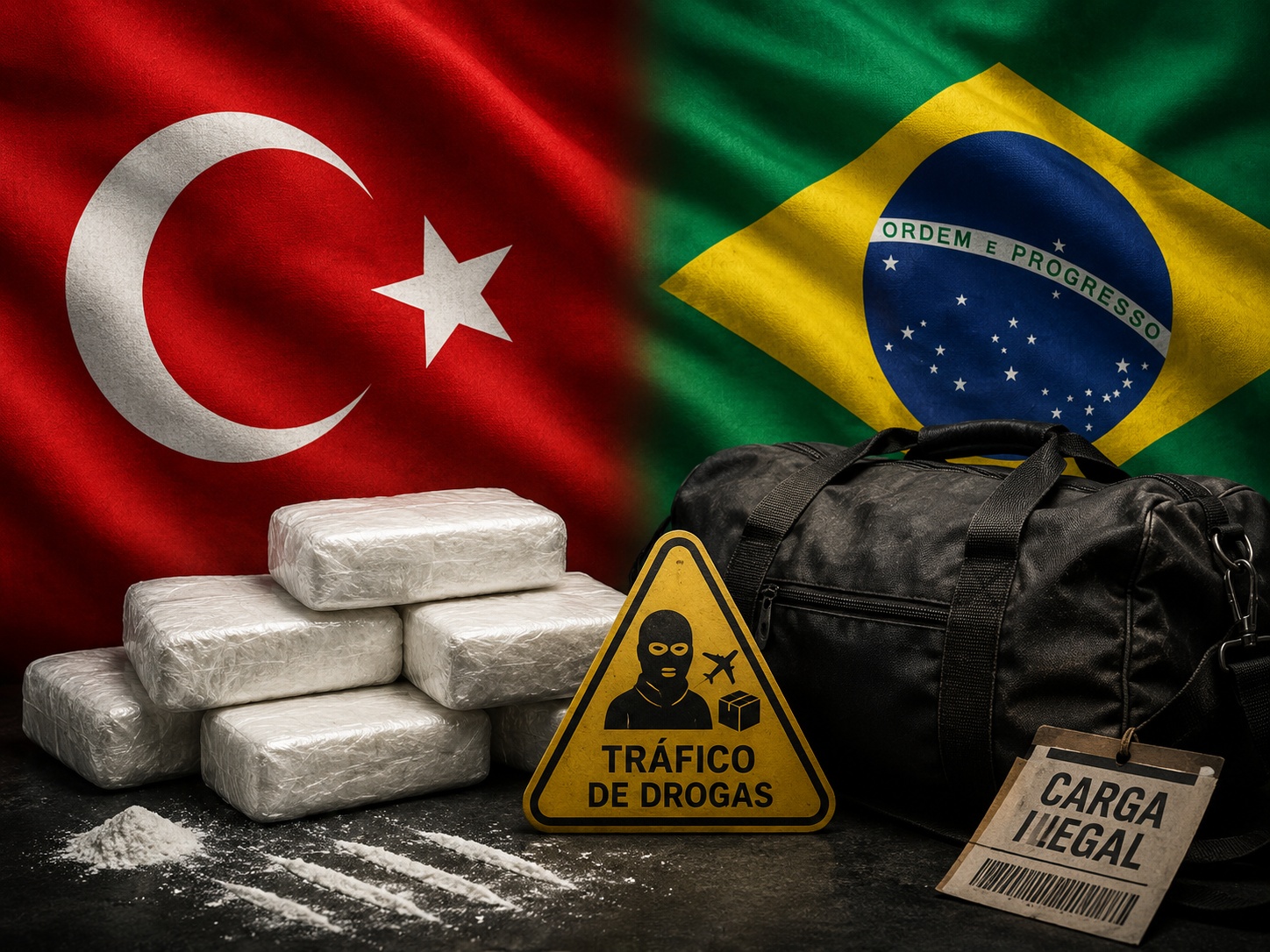
A Jordanian drug trafficker with a criminal record stretching back three decades was able to settle in Turkey under a false identity, obtain a residence permit, establish a company in Istanbul and even secure legal protection when faced with an arrest warrant from Brazil.
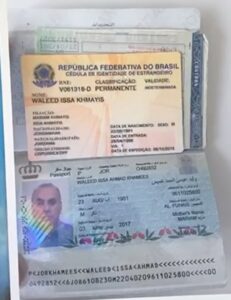
Waleed Issa Ahmad Khamees (65), whose surname appears in Brazilian judicial records under several variants including Khmayis, Khamayis and Khamays, quietly settled in Turkey apparently with help from local conspirators and managed to avoid being red flagged despite his long criminal record from Europe to Brazil.
His case is certainly not an isolated one. Over the past decade, scores of internationally wanted fugitives and criminals have chosen Turkey as a base of operations, securing residency and even citizenship, adopting Turkish names and gaining access to the country’s financial, banking and corporate sectors. This has occurred under the enabling government of President Recep Tayyip Erdogan, which has turned a blind eye to organized criminal activity as long as illicit funds continue to prop up the country’s troubled economy.
Khamees’s journey to Turkey unfolded within this ecosystem of criminality, deliberately fostered by the Erdogan government. His troubles emerged only after pressure and exposure from Brazil. His legal cases also show that Khamees was able to secure favorable outcomes even from Turkey’s highest court, an institution dominated by Islamist and nationalist figures loyal to the government.
Turkey was forced to take an action only after Brazilian INTERPOL officers informed their Turkish counterparts of the precise location where he was believed to be staying with his girlfriend, facts that Turkish police and intelligence already knew but had turned a blind eye to until then.
Text of the Turkish Supreme Court of Appeals ruling that in March 2021 overturned the lower court’s decision allowing Waleed Issa Ahmad Khamees’s extradition:
What followed was an extradition process that exposed striking weaknesses in Turkey’s handling of internationally wanted criminals. Khamees initially avoided detention for extradition, repeatedly challenged his identity and presented contradictory accounts of his nationality and political background. His case was twice sent back by the Supreme Court of Appeals (Yargitay), Turkey’s highest appeals court, substantially delaying his transfer to Brazil.
Khamees’s powerful local partners scrambled to secure his release, calling in favors from judges and prosecutors and seeking to delay his extradition proceedings. His ultimate fate remains unclear. Although a local media report claimed that he was handed over to Brazilian officers at Istanbul Airport on October 31, 2023, Turkey’s Constitutional Court, where Khamees had filed a complaint alleging violations of his fundamental rights, stated on January 24, 2024, that government records contained no information showing that he had either been extradited or released from pretrial detention.
The ultimate outcome notwithstanding, his case demonstrated how easily a convicted international drug trafficker could establish a legitimate-looking commercial and residential presence in Turkey, and how Turkish authorities allowed him to operate despite being aware of his documented criminal history and troubled past.
Khamees was already well known to Brazilian authorities long before he appeared in Turkey as purported Serbian citizen Robert Sekeres. Brazilian federal court records show that he was sentenced to nine years in prison by a federal court in Fortaleza for international drug trafficking. The conviction arose from an attempt in July 1992 to send approximately 600 kilograms of cocaine from Brazil to Europe.
Brazilian investigative material connected that shipment to a network involving Italian ’Ndrangheta figures, including Rocco Morabito and Francesco Sculli. A later Brazilian court decision said Morabito had been received at São Paulo’s Guarulhos Airport by Khamees in April 1992 and taken to a residence associated with him. Investigators described Khamees as part of the infrastructure used to transport South American cocaine to Italy.
In June 2004 Brazilian Federal Police arrested Khamees at Salgado Filho Airport in Porto Alegre as he prepared to board a flight to São Paulo. He was carrying false documents in the name of Rogério Cury Mattar.
Khamees was then being investigated with other Jordanian nationals for allegedly laundering proceeds from international narcotics trafficking. Searches of an apartment in Porto Alegre and two rural properties in Eldorado do Sul produced jewelry and large amounts of Brazilian reais, US dollars and euros. Bank accounts were frozen, while other men detained during the operation were accused of illegal firearms possession.
At the time of his arrest Khamees was also described as a fugitive from the nine-year drug-trafficking sentence imposed in Fortaleza. Brazilian proceedings concerning the investigation referred to seized vehicles, foreign currency and real estate as well as suspected money laundering, use of false documents, illegal weapons possession and participation in a criminal organization.
The later Brazilian investigation portrayed him as far more than a marginal participant. Court records described Khamees, also known as “Velho” or “Rogério,” as the leader of a trafficking nucleus that coordinated several operatives. Brazilian police considered him a veteran international trafficker with links to figures involved in drug routes through Brazil’s southern and southeastern regions.
Brazilian and European investigators also identified him as an intermediary between South American cocaine suppliers, the Brazilian criminal organization Primeiro Comando da Capital, better known as the PCC, and Italian and Balkan organized crime groups.
An international investigation published by Brazil news company Universo Online (UOL), Investigative Reporting Project Italy (IRPI) and the Organized Crime and Corruption Reporting Project described Khamees as a longstanding associate of ’Ndrangheta trafficker Rocco Morabito. According to the investigation, their relationship extended back to the late 1980s and early 1990s, when they allegedly helped organize cocaine shipments from Brazil to Italy and laundered proceeds through European financial channels.
Brazil’s official TRF3 Federal Justice Gazette records show that Waleed Issa Khmayis was indicted on October 25, 2017, under Brazil’s organized-crime statute in connection with the Operação Brabo investigation. The court later issued a public notice after authorities were unable to locate him at the addresses listed in the case:
A new Brazilian investigation resulted in a preventive arrest order for Khamees in 2017. Brazilian court records said investigators had detected his contacts with Miroslav Jevtic, who allegedly used false identities, and with Italian trafficker Vincenzo Macrì.
Macrì, an alleged senior ’Ndrangheta figure, was arrested at Guarulhos Airport in June 2017 while traveling under a false identity. Brazilian investigators alleged that intercepted conversations and photographs showed Khamees trying to arrange legal assistance and resolve Macrì’s situation following his arrest.
According to the extradition material later examined in Turkey, Brazilian prosecutors filed a criminal complaint against Khamees on October 25, 2017, with a preventive detention order following on November 22. INTERPOL subsequently issued Red Notice A-29/1-2018, which described him as connected to criminal groups in Italy and involved in an organization engaged in international drug trafficking.
A second notice, A-4824/5-2020, stated that Khamees had been convicted on August 23, 2019, of drug trafficking and criminal-organization offenses and sentenced to 19 years, six days in prison. The notice said the case involved the possession or supply of 545 kilograms of cocaine for trafficking.
Brazilian judicial material portrayed him as one of the country’s important cocaine suppliers. Brazilian courts rejected attempts to lift his detention order, emphasizing that he had been a fugitive since 2017 and had demonstrated an ability to evade law enforcement through false identities and international connections.
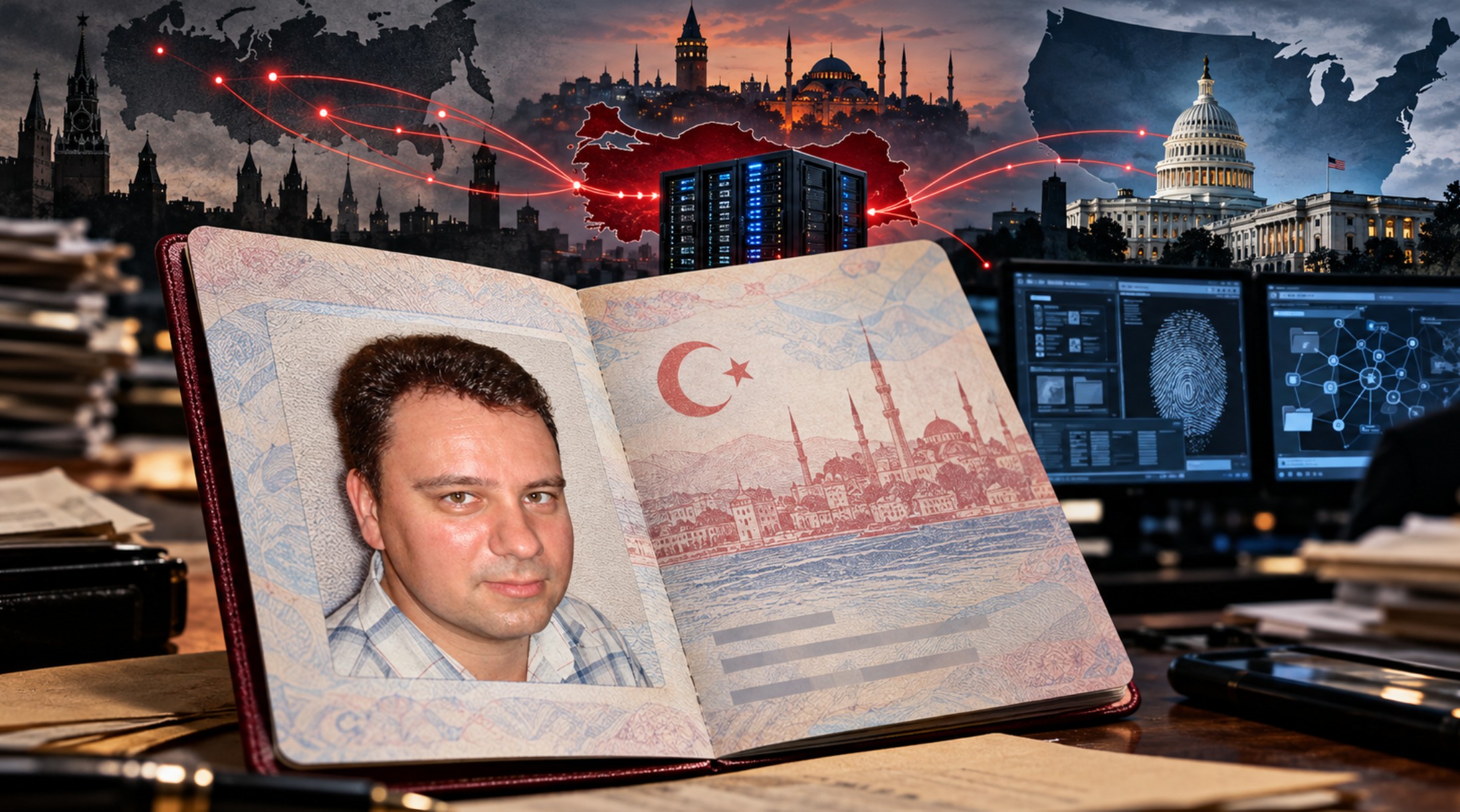
While Brazilian authorities were looking for him, Khamees relocated to Turkey using documents issued in the name of Robert Sekeres. The passport presented him as a Serbian citizen. Under that identity he obtained a short-term Turkish residence permit, secured an address and became the manager and owner of a Turkish company.
Corporate records reviewed by Nordic Monitor show that Khamees, using the false identity Robert Sekeres, established a company under the name of Jakarta Export Tekstil Gayrimenkul Danışmanlığı Limited Şirketi in December 2019, registering it at a commercial unit in Istanbul’s upscale Maslak business district at Nazmi Akbacı Ticaret Merkezi, No. 5/59.
The company, capitalized at TL 20,000, was granted tax id number 4830954643 and was formally authorized to engage in a wide range of real estate, property management, construction and commercial activities — sectors broad enough to provide its owner with an apparently legitimate commercial profile. There was no record of any activity in the trade registry after this initial notice of establishment.
Documents later submitted by Khamees’s defense included his Turkish residence information, short-term residence permit, corporate records showing that he managed the company and rental contracts signed both personally and on behalf of the firm.
The fact that Khamees was able to obtain Turkish residency and incorporate a company under a false identity raises serious questions about how he managed to navigate the country’s immigration and corporate-registration systems. Turkish residency and citizenship procedures normally involve background checks by law enforcement and intelligence agencies that should, in principle, have raised red flags. His apparent ability to get through those safeguards suggests either serious institutional failures or assistance from well-connected individuals capable of helping him overcome such obstacles.
It is also noteworthy that Khamees was already the subject of an INTERPOL Red Notice when the company was established, yet his identity and fingerprints were apparently not matched against the international alert system. That failure certainly raises further questions about whether he circumvented the system through corruption, official protection or other forms of high-level assistance inside Turkey.
In extradition procedures, there is no indication that Turkish authorities independently identified him or took an interest in monitoring his activities. Instead, on July 17, 2020, INTERPOL’s Brazilian National Central Bureau informed Turkey that Khamees, using his Serbian passport under the name of Sekeres, was probably spending the weekend with his foreign girlfriend in Marmaris, a popular resort location in the southwestern part of Turkey. Brazil asked Turkey to arrest him or at least confirm his presence so extradition procedures could begin.

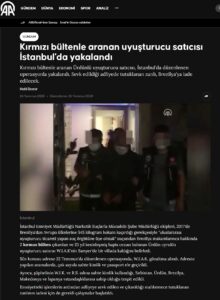
Although Turkish authorities had taken no meaningful action against Khamees until Brazilian intelligence pinpointed his location and formally requested his temporary detention pending extradition, Turkey’s state-run Anadolu news agency presented a different narrative. In a report published four days after the Istanbul raid, Anadolu claimed that Turkish narcotics police had identified Khamees’s whereabouts themselves, omitting any reference to the intelligence supplied by Brazil. The discrepancy suggests an effort by Turkish authorities to portray the arrest as the result of their own investigative work while obscuring the decisive role played by Brazilian authorities in locating the fugitive.
Turkish police searched his home and vehicle on July 22, 2020. Khamees presented the Serbian passport and the Turkish residence document issued under the false identity. Officers also recovered additional documents in the same name. Police found identity documents linked to Brazil, Jordan, Palestine and Serbia in his possession. The records reinforced the conclusion that Khamees had extensive experience constructing alternative identities and moving between jurisdictions.
Khamees continued to insist that he was Robert Sekeres, a Serbian national. He claimed he had visited Brazil only once, eight years earlier, had stayed for approximately 10 days and knew nothing about the Red Notices. His fingerprints, however, matched those attached to the INTERPOL notices.
The Istanbul Chief Public Prosecutor’s Office sought Khamees’s detention both for document forgery and for the Brazilian extradition request. But strangely, the Istanbul 7th Criminal Court of Peace ordered his arrest on the forgery accusation but rejected temporary detention for extradition. The judge found that the Brazilian material had not yet presented concrete evidence establishing strong suspicion of drug trafficking. He was instead put under judicial supervision and prohibited from leaving Turkey.
The Istanbul 10th High Criminal Court initially continued that approach, rejecting a further request to detain him over the extradition case. An objection submitted by prosecutors was rejected by the Istanbul 11th High Criminal Court. It is worth noting that numerous judges and prosecutors serving in Istanbul courthouses have, over the years, been implicated in allegations of corruption, bribery and abuse of authority involving organized crime figures.
Only on September 4, 2020, did the 10th High Criminal Court rule that Brazil’s request was admissible and ordered Khamees’s detention pending extradition. The court found that his fingerprints corresponded to the internationally wanted Jordanian and concluded that his insistence on being another person was intended to obstruct his return to Brazil.
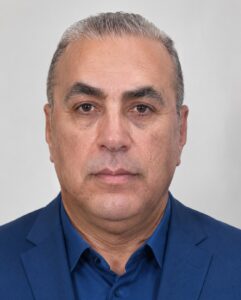
During the hearing Khamees reportedly told the court that he wanted to remain in Turkey, had come to work and was a Muslim. He was transferred to Maltepe No. 3 L-Type Prison.
Khamees and his lawyers adopted several mutually inconsistent defenses during the proceedings. The lawyer initially maintained that his client was Robert Sekeres, a Muslim from Kosovo who had lived in Turkey for years, created employment and maintained a permanent address.
In another section of the same defense, however, he described Khamees as a Palestinian Muslim who had participated in the Palestinian struggle for independence as a member of the Palestine Liberation Army.
Khamees himself later abandoned his claim that he had spent only 10 days in Brazil. During a hearing held on July 13, 2021, he told the Turkish court that he was of Palestinian origin, had moved to Jordan after his father’s death, later went to Italy and was deported from there in 1987. He then admitted moving to Brazil, marrying there and having three children.
He claimed Brazil intended to transfer him to Israel because of his Palestinian background and political activities. His lawyer similarly alleged that he had previously been imprisoned in Jordan because of actions directed against Israel.
The Istanbul court rejected those arguments, emphasizing that Khamees had offered changing and contradictory accounts and that no strong evidence suggested he would be persecuted or mistreated in Brazil because of his ethnicity, religion, nationality or political views.
As Khamees’s case proceeded, intense negotiations were allegedly taking place in judicial circles. On March 8, 2021, the 10th Criminal Chamber of Turkey’s Supreme Court of Appeals overturned the Istanbul court’s decision. The speed with which the high court handled the case is particularly noteworthy. Appeals before the court often take considerable time because of its enormous backlog, which has accumulated over the years. Yet Khamees’s case was reviewed and decided in roughly five months — an unusually swift turnaround for Turkey’s highest appeals court and one that raises further questions about whether his case received preferential treatment.
The chamber focused on a technicality and ruled that the file did not contain a certified Turkish translation of the Brazilian conviction or sufficiently detailed evidence explaining Khamees’s connection to the offenses. It also asked whether the 19-year sentence had been imposed in his absence and whether Brazil would guarantee a new trial if he had been convicted without presenting a defense.
The ruling forced the extradition process back to the lower court and required additional correspondence with Brazilian authorities while further delaying extradition. After Brazil supplied more information, the Istanbul court again approved extradition for both drug trafficking and participation in a criminal organization on September 21, 2021.
The high court intervened for a second time on December 27, 2021. It concluded that the Brazilian material showed the 19-year sentence had been imposed in Khamees’s absence and that Brazil had not clearly guaranteed a retrial with full defense rights. The chamber therefore overturned the extradition approval again while once more refusing to release him.
This is highly unusual and raises questions about the extent to which Khamees’s local Turkish contacts were able to wield influence within Turkey’s highest appellate courts, where the judiciary has long faced allegations of political interference, favoritism and corruption.
On October 20, 2022, the Istanbul 10th High Criminal Court ruled that Khamees could be extradited for the criminal-organization charge but not for drug trafficking because Brazil had not provided the guarantee demanded concerning the trial conducted in his absence. The Supreme Court of Appeals upheld that decision on April 11, 2023.
The most troubling part of the Khamees case is not that Turkish courts examined whether Brazil had respected his defense rights. Such a review is required in any lawful extradition system. The deeper scandal lies in everything that happened before his arrest.
A man with an extensive Brazilian criminal history, prior false-document cases and active international alerts was able to enter Turkey, obtain legal residency and register a company under an assumed identity. No Turkish institution flagged him during immigration processing, the issuing of his residence permit or the incorporation of his business.
Even after his arrest, the initial extradition-detention request was rejected despite the false passport and fingerprint match. His changing accounts — Serbian, Kosovar, Jordanian and Palestinian — did not prevent a complex defense campaign that repeatedly delayed his transfer.
Khamees’s case does establish that the Erdoğan government allowed him to build a life in Turkey and that the judicial process gave him years of procedural shelter after Brazil exposed his presence.
Had Brazilian INTERPOL not informed Turkey exactly where to find him in July 2020, Khamees might have continued operating his Istanbul company and living under a new identity since the Turkish government was not interested in coming after him.
The case, therefore, offers another example of Turkey’s emergence as an attractive environment for internationally wanted organized-crime figures: a country where false foreign documents could be converted into residence rights, commercial standing and a path toward a more permanent legal identity before foreign authorities intervened.