

Abdullah Bozkurt/Stockholm
In yet another striking example of how extensively Turkey’s judiciary has been weaponized by the authoritarian government of President Recep Tayyip Erdogan, a court operating under the control of the ruling Islamist administration has gone completely off the rails by renewing an arrest warrant for Turkish cleric and government critic Fethullah Gülen, who died in the United States two years ago.
The decision, issued by a panel of judges in Ankara on May 14, demonstrated that not even death is enough to end the malicious and politically motivated persecution directed at the 84-year-old cleric, who passed away in a US hospital on October 20, 2024, after suffering multiple health complications.
Although Gülen’s death was publicly announced by members of the movement he inspired within hours, followed by a widely attended funeral ceremony in New Jersey, and despite the fact that his death certificate was formally transmitted to Turkish authorities through the US State Department, the Erdogan government has continued prosecuting and trying Gülen in literally hundreds of bogus criminal cases launched against him over the past decade.
The latest example emerged during a hearing before the Ankara 4th High Criminal Court, where a three-judge panel composed of Necati Görgülü, Ebru Kotan Acar and Dilara Zorluer ruled that the arrest warrant for Gülen and dozens of co-defendants named in the case file would remain actively enforceable.
According to the summary minutes from the hearing, a copy of which was obtained by Nordic Monitor, the judges noted in their ruling that previous arrest warrants issued for Gülen had been returned unexecuted and stated that the outstanding warrants would remain in force pending their eventual execution.
In a stunning display of deliberate malicious intent, the two-page court record made no mention whatsoever of Gülen’s death, even though Turkish authorities had officially entered the verification of his passing into government records after receiving notification from the United States through diplomatic channels.
Gülen was not the only deceased defendant whose arrest warrant was renewed under the court ruling. Two additional co-defendants — Ali Bayram, an educator who died in Egypt on June 2, 2020, after suffering a brain hemorrhage; and Mehmet Erdoğan Tüzün, the former general manager of the now-defunct Cihan News Agency who passed away in Albania on November 22, 2021 — were also the subjects of renewed arrest warrants despite official population registry records confirming their deaths. The court also noted that the arrest warrant for another defendent, Mehmet Ali Şengül, a longtime close associate of Gülen who died in Germany on July 11, 2021, remained unexecuted.
According to the case file, the deaths of all three men had already been formally recorded in Turkey’s civil registry system following notifications and filings submitted by surviving relatives. Nevertheless, the court chose to keep the warrants active, further underscoring what critics describe as the complete collapse of legal rationality and basic judicial scrutiny in politically charged prosecutions pursued under President Erdogan’s government.
The extraordinary decision has sparked renewed criticism of the Turkish judiciary, which has already come under fire for acting as a political tool of Erdogan’s government rather than an independent institution bound by legal norms and factual scrutiny.
The move also highlights the profound institutional decay within Turkey’s judicial system, where courts routinely approve politically motivated indictments, detention orders and arrest warrants with little or no regard for evidence, procedural safeguards or even basic factual verification.
Gülen, an influential Muslim cleric who had lived in self-imposed exile in the United States since 1999, became a primary target of President Erdogan after he publicly criticized the government and called for accountability in the wake of corruption investigations in 2013. The probes implicated Erdogan, members of his family and a circle of political and business associates in a multibillion-dollar corruption scandal involving allegations that the government had secretly facilitated sanctions-evasion schemes run by Iranian-Turkish gold trader Reza Zarrab and maintained ties with Saudi businessman Yasin al-Qadi, who had previously been designated by the United States and the United Nations for financing al-Qaeda.
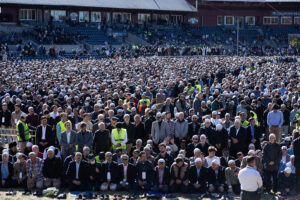
Erdogan blamed the corruption probes on the movement inspired by Gülen and subsequently launched an unprecedented crackdown on its followers, initiating sweeping purges and filing hundreds of criminal cases based on dubious terrorism accusations, despite the fact that the movement had never been associated with violence throughout its six-decade presence in Turkish society.
Prosecutors seeking to criminalize Gülen even cited his interfaith dialogue and outreach initiatives as purported evidence of terrorism in an indictment filed in 2015. Among the activities listed as incriminating evidence were Gülen’s meetings with prominent religious leaders, including the late Pope John Paul II during the 1990s, which had at the time been widely praised as efforts to promote inter-religious understanding and tolerance.
The Erdogan government used a coup attempt in July 2016, a false flag operation orchestrated by the intelligence agency MIT, as a sweeping pretext to further criminalize the movement, eliminate dissent and suppress opposition. More than 130,000 public servants — including senior judges, prosecutors, diplomats,, academics and police chiefs — as well as more than 24,000 members of the armed forces were summarily and arbitrarily dismissed through government decrees issued without any judicial, legislative or administrative oversight.
Tens of thousands of people were detained or imprisoned as Erdogan escalated the crackdown on alleged followers of the Gülen movement and other critics of the government. Hundreds of private institutions, media outlets, schools, universities, foundations, charities and businesses linked to the movement were confiscated or forcibly shut down under Erdogan’s decrees.
The sweeping asset seizures allowed the government to take control of companies and properties worth tens of billions of US dollars. The confiscated wealth was systematically redistributed to business groups and loyalists aligned with Erdogan’s political network, transforming the purge into not only a political crackdown but also one of the largest state-engineered wealth transfers in modern Turkish history.

The purge also fundamentally transformed the judiciary itself. Thousands of judges and prosecutors were summarily removed and replaced with loyalists selected largely on the basis of political allegiance to Erdogan’s government, effectively destroying judicial independence in Turkey.
International organizations including the European Court of Human Rights, the Council of Europe and the United Nations have repeatedly criticized Turkey for widespread due process violations, politically motivated prosecutions and the abuse of counterterrorism legislation to silence dissent.
The decision to renew Gülen’s arrest warrant after his death illustrates how Turkish courts continue to mechanically process politically sensitive cases regardless of legal merit or factual reality.
Under Turkish criminal law, proceedings are terminated upon the death of a defendant. Jurists note that maintaining an active arrest warrant for a deceased person has no legitimate legal function and serves purely symbolic and political purposes. Erdogan’s government deliberately keeps such cases alive to reinforce official propaganda narratives and sustain pressure on perceived opponents, even years after their deaths.
The bizarre court decision has become the latest symbol of the severe erosion of the rule of law in Turkey, where judicial institutions once expected to uphold legality are now widely viewed as instruments of political intimidation and repression.
For many observers the continued legal pursuit of Gülen even after his death underscores the extent to which Turkey’s judiciary has abandoned basic legal rationality under Erdogan’s increasingly authoritarian rule.