
Levent Kenez/Stockholm
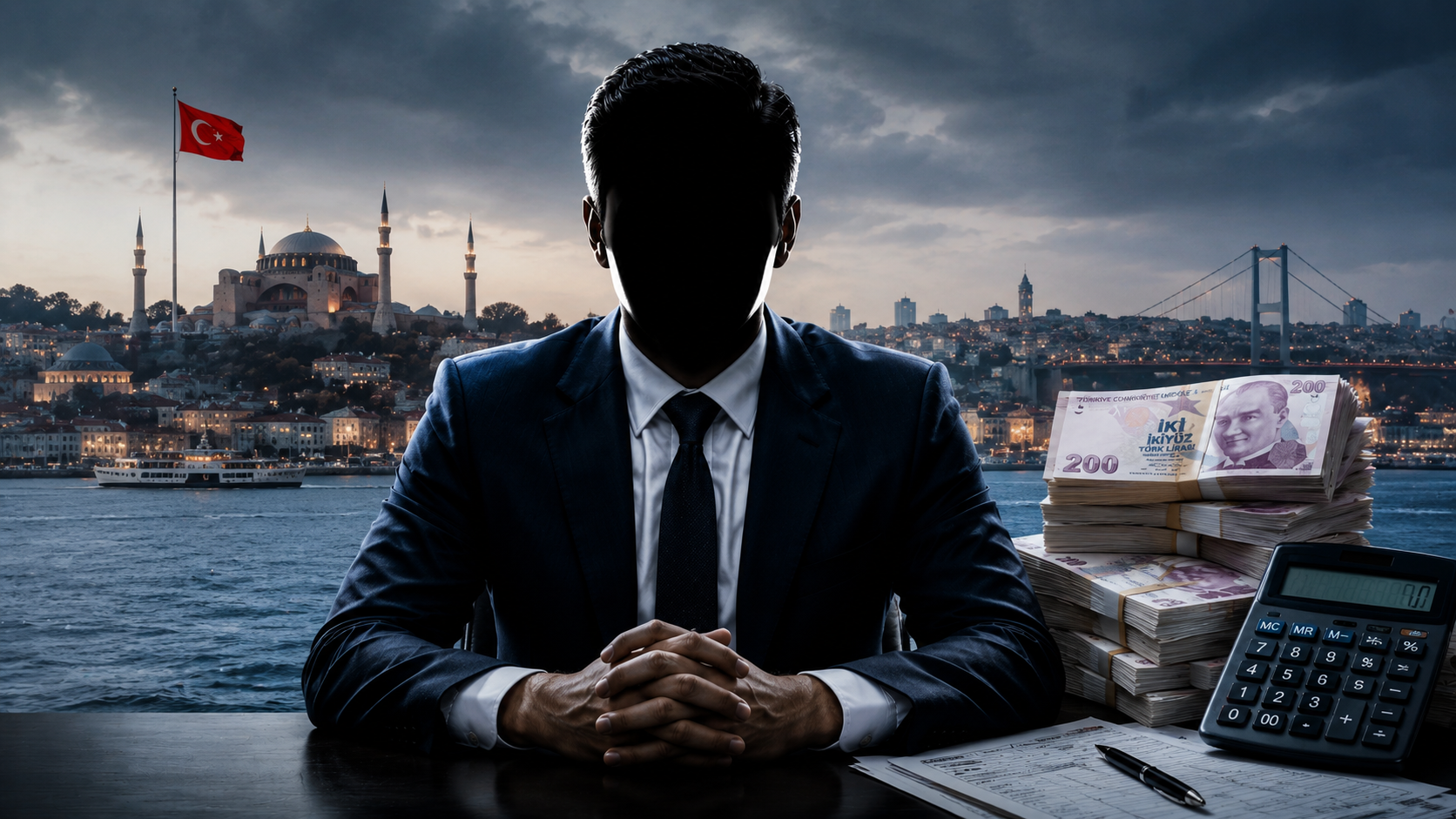
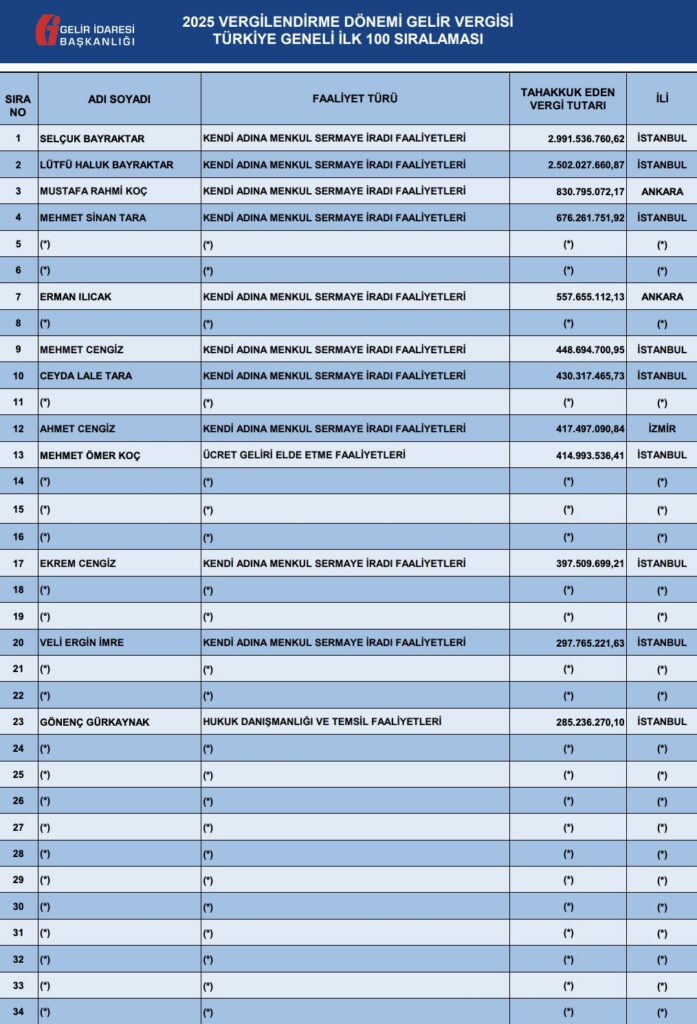
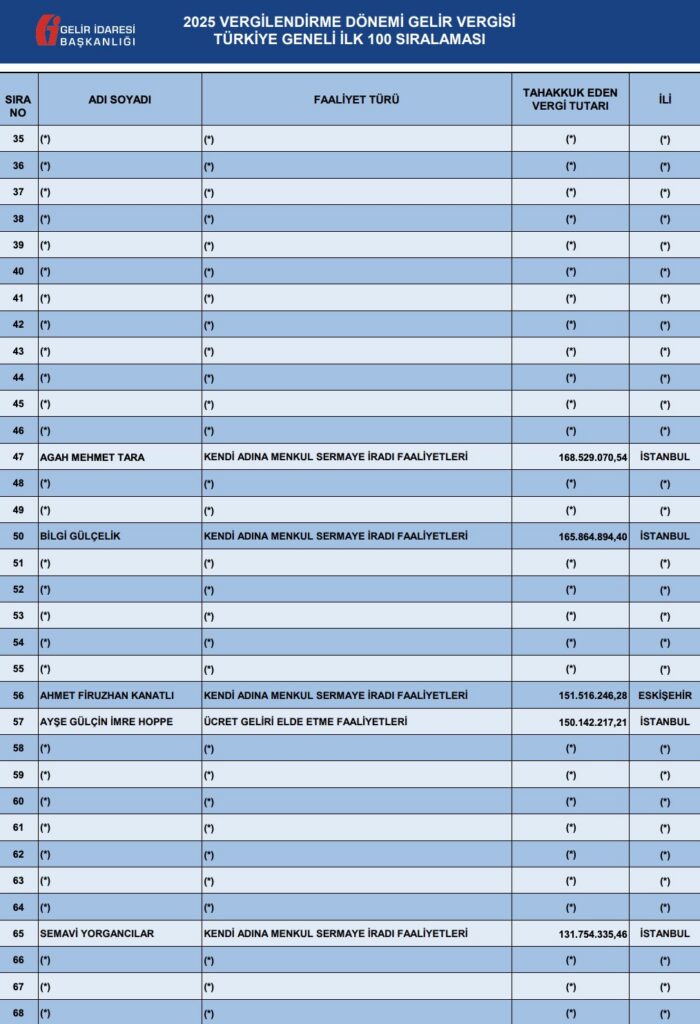
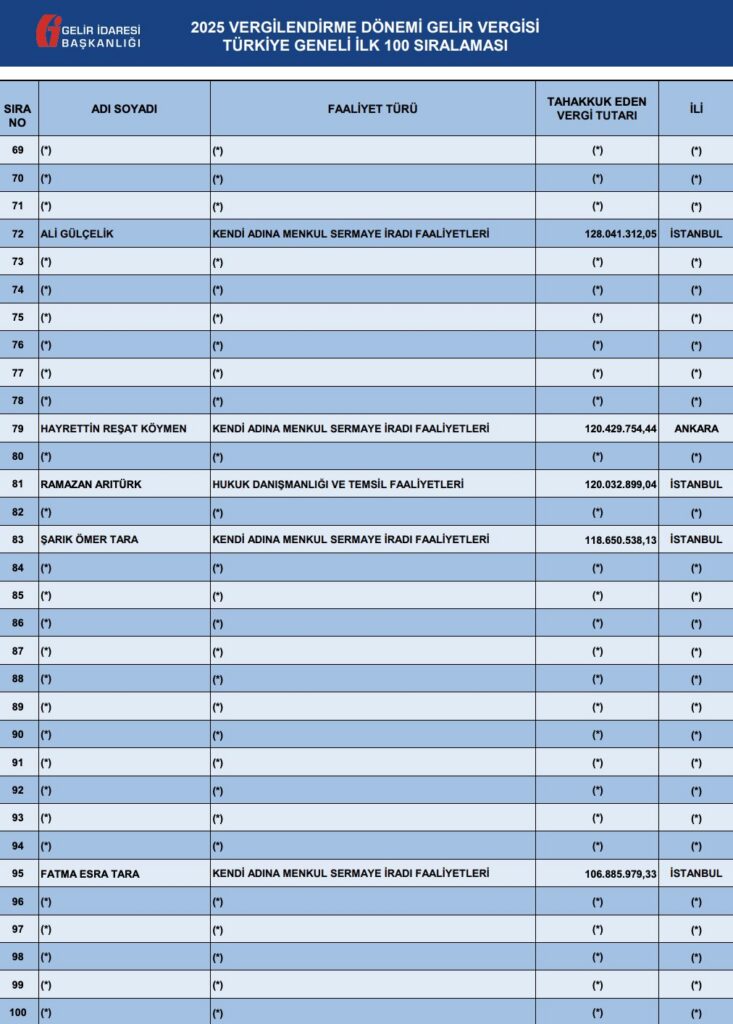
Turkey’s Revenue Administration (GİB) released its annual list of top income taxpayers this week, with the most striking detail not the people who topped it but rather those who refused to be named at all. Of the 100 individuals who paid the highest income tax in the country for the 2025 filing year, 78 asked the government to withhold their identities from the public record.
The Turkish tax code permits filers to opt out of having their names released along with the annual rankings, an option that has been used by a large share of top earners for years.
In the 2023 filing year, 73 of the 100 highest-paying individuals declined disclosure; in 2024, that figure rose to 79; this year it settled at 78. The consistency of the pattern means that, in each of the past three years, roughly three-quarters of the country’s most heavily taxed citizens have chosen to keep their names out of the public list GİB itself compiles and releases.
GİB’s announcement did not explain why individual filers request anonymity, and the agency does not publish reasons along with its data. What the numbers show is only that the option exists, that it is used on a large scale and that the scale has held steady for three consecutive years even as the total tax revenue reported by the top 100 filers surged.
GİB reported that the combined tax base declared nationwide for 2025 rose 70.1 percent over the prior year, with total income tax revenue up 69.8 percent to 710.57 billion lira ($14.88 billion) from 2.39 trillion lira ($50.04 billion) in declared taxable income.
In 2025, 78 of the 100 people who paid the most income tax in Turkey chose to keep their names confidential:
The anonymity option applies broadly, not only to individuals. On the separate list of top corporate taxpayers, the entity that finished second behind Ziraat Bank, the state lender that paid 70.39 billion lira ($1.47 billion) in corporate tax, also asked that its name be withheld.
The disclosure pattern comes as Turkey’s organized-crime record has attracted renewed scrutiny from foreign researchers and Turkey’s own Interior Ministry. Beyond basic corporate privacy, the pervasive secrecy stems directly from systemic fears regarding physical security and targeted criminal extortion.
Turkey maintains a highly documented history of pervasive organized crime networks, mafia factions and illicit syndicates that view visible wealth as a primary target for financial predation.
The Global Organized Crime Index, compiled by the Geneva-based Global Initiative Against Transnational Organized Crime, gave Turkey a criminality score of 7.20 out of 10 in its 2025 edition, ranking the country 10th worldwide, while assigning it a resilience score of just 3.96, a measure the index uses to gauge institutional capacity to counter organized crime. The index describes Turkey as a transit corridor for cocaine moving from Latin America toward European, Russian and Caucasian markets, along with its longstanding role as a route for Afghan heroin.
Turkey’s Interior Ministry has supplied figures pointing to the scale of the problem it is confronting. According to documents presented to parliament in November 2025, authorities dismantled 552 organized crime groups and arrested 6,788 people in the first 10 months of 2025 alone, seizing assets worth roughly 76 billion lira ($1.59 billion), or about $1.8 billion (as originally reported at the time).
A year earlier, then-interior minister Ali Yerlikaya told parliament that more than 660 such groups had been broken up over a 12-month period and that 552 fugitives sought under INTERPOLRed Notices had been arrested in Turkey, a figure that itself raised questions about how many wanted individuals had been operating inside the country’s borders undetected.

Political calculations represent another critical factor driving this historic wave of tax list secrecy. A substantial portion of the nation’s affluent elite chooses anonymity to avoid public accusations of accumulating vast wealth through direct political favoritism and state-directed resource distribution. Under the current executive administration, major infrastructure projects, state enterprise privatizations and lucrative public tenders are routinely awarded to a highly concentrated circle of corporate entities aligned with President Recep Tayyip Erdogan. By deliberately withholding their names from the top 100 roster, these individuals insulate themselves from public backlash, media investigations and political opposition campaigns that criticize the creation of a state-backed capitalist class.
At the top of the list, by contrast, are two names GİB did disclose. Selçuk Bayraktar, chairman of the board of Baykar, Turkey’s largest drone manufacturer and the son-in-law of President Erdogan through his marriage to his daughter Sümeyye, was named the country’s top income taxpayer for the fifth consecutive year.
GİB recorded his 2025 income tax bill at 2.99 billion lira ($62.6 million). Right behind him was his older brother, Haluk Bayraktar, Baykar’s general manager, who paid 2.50 billion lira ($52.35 million). Combined, the brothers’ tax bills reached roughly 5.49 billion lira ($115 million), more than six times the amount paid by the third-place filer.
That third name was Rahmi Koç, honorary chairman of Koç Holding, one of Turkey’s largest industrial conglomerates, who paid 830.8 million lira ($17.4 million), a figure GİB listed as essentially unchanged in ranking from the year before, even as the gap between his tax bill and the Bayraktar brothers’ widened.
Baykar’s rise has tracked closely with the export success of its armed drones, led by the Bayraktar TB2, which has been sold to dozens of countries and used in conflicts from Ukraine to Libya. Baykar also benefited from extensive use of state infrastructure and testing facilities developed by the Turkish Armed Forces over decades of publicly funded drone research programs.
Further down the disclosed portion of the ranking, businessman Mehmet Sinan Tara placed fourth with 676.3 million lira ($14.16 million), and construction executive Erman Ilıcak placed seventh with 557.7 million lira ($11.68 million). The fifth, sixth and eighth positions were among those left blank at the filers’ request.