

Levent Kenez/Stockholm
Turkey’s SAHA 2026 defense exhibition turned into a political and ideological showcase last week as President Recep Tayyip Erdogan used the event to promote the country’s expanding defense industry ahead of a possible new election cycle, while pro-government Islamist figures framed missile programs and air defense systems in explicitly religious terms.
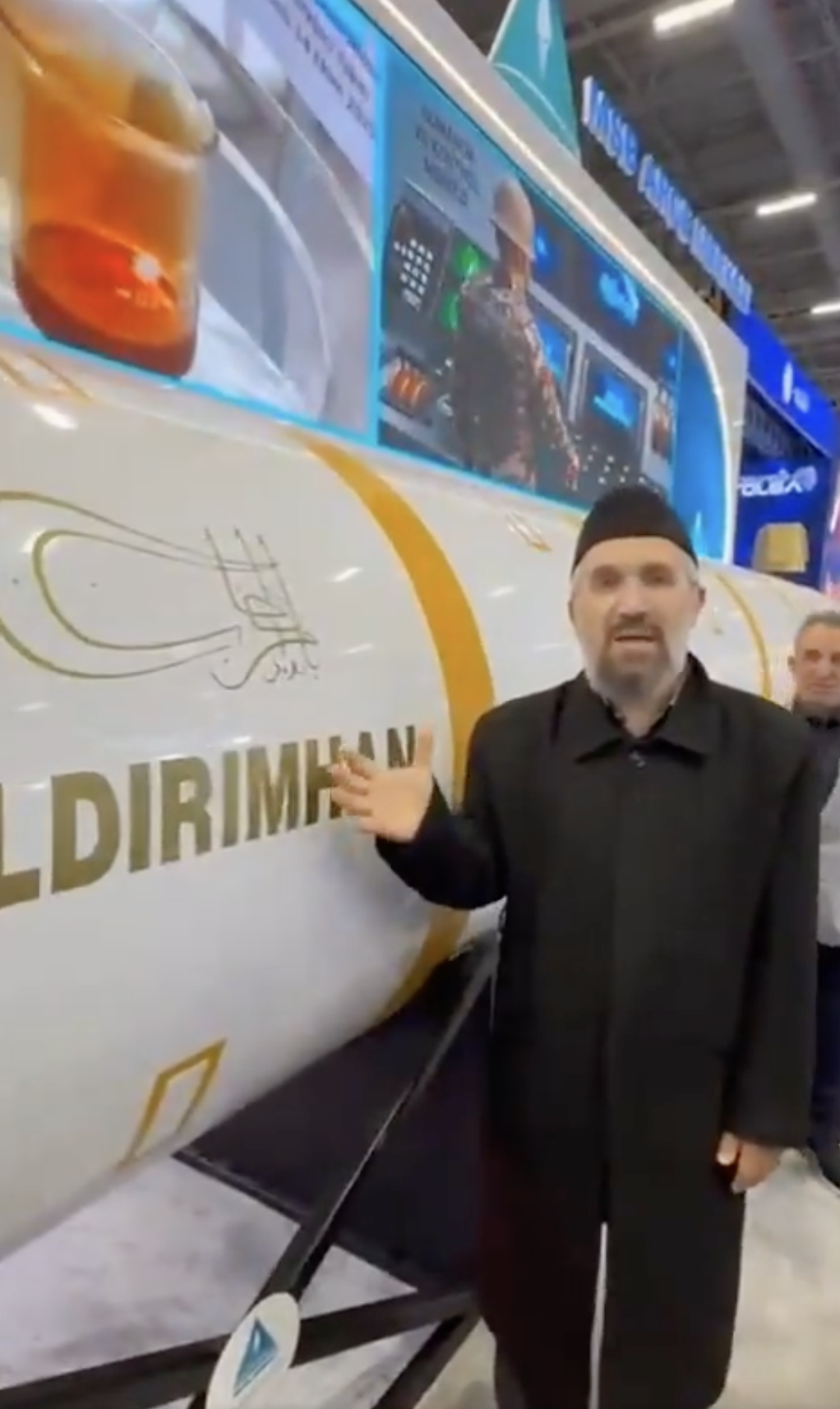
Among the most visible visitors at the Istanbul Expo Center was İhsan Şenocak, a hardline jihadist preacher and founder of the Center for Scientific and Intellectual Research (İFAM). Şenocak toured defense stands while recording videos that blended religious references, Ottoman imagery and military rhetoric with support for Turkey’s growing missile and drone programs.
Standing in front of the newly unveiled Yıldırımhan ballistic missile display, Şenocak described the project as a weapon that would “frighten the enemies of Allah” and said Muslims were religiously obligated to produce advanced weapons in every era. Referring to the missile’s reported 6,000-kilometer range, Şenocak linked the system to Ottoman Sultan Bayezid I, known as Yıldırım Bayezid, and described the missile as a message to “oppressed Muslims from Gaza to East Turkestan.”
In another video recorded at the exhibition, Şenocak praised Turkey’s air defense systems through religious references, saying military technology was part of a divine mission to defend Jerusalem, Kashmir and other Muslim regions.
The videos circulated widely on pro-government social media accounts during the exhibition and reflected the increasingly religious and militarized language used by Islamist figures aligned with Erdogan’s political bloc.
Şenocak has long supported Erdogan’s foreign policy and security agenda. In previous speeches and social media posts, he called for military action against Israel, praised armed jihadist language and supported harsh crackdowns after a 2016 coup attempt. Nordic Monitor previously documented Şenocak’s calls for “beheading traitors” and his close ties with Islamist organizations linked to pro-government networks in Turkey.
SAHA 2026 itself became one of the largest defense exhibitions organized during Erdogan’s presidency. Turkish officials said more than 1,700 companies from 120 countries participated in the fair between May 5 and May 9 at the Istanbul Expo Center. Erdogan attended the closing ceremony on May 8 and used the event to present Turkey’s defense industry as proof of national independence and technological advancement.
In his speech Erdogan praised domestic weapons production, criticized past opponents of defense spending and said Turkey would continue expanding its military-industrial sector despite international pressure and embargoes. He also referred to opposition politicians who had previously criticized missile testing and defense expenditures.
Defense production has become one of Erdogan’s central political themes during election periods over the past decade. Military drones, naval programs, missile systems and fighter jet projects have repeatedly appeared in campaign speeches, state television broadcasts and rallies organized by the ruling Justice and Development Party (AKP).
This year’s exhibition focused heavily on the Yıldırımhan ballistic missile, introduced as Turkey’s first intercontinental ballistic missile project. Turkish media outlets and state-linked broadcasters described the missile as capable of traveling 6,000 kilometers at speeds reaching Mach 25. The missile was displayed with Ottoman symbols on one side and the signature of Turkey’s secular founder, Mustafa Kemal Atatürk, on the other, reflecting an attempt to combine nationalist and conservative imagery in the same political narrative.
The project immediately became one of the most discussed elements of the exhibition, partly because no publicly known flight test or operational deployment has been announced. Defense publications covering the exhibition reported that Turkish authorities presented a full-scale model and technical claims but provided no public testing schedule, deployment timeline or operational details.

The Turkish Defense Ministry’s research center described Yıldırımhan as a liquid-fueled missile powered by four rocket engines and capable of carrying a payload of up to three tons. Yet official presentations stopped short of confirming whether the missile exists beyond a concept or prototype stage.
The gap between state-backed publicity and the absence of confirmed operational milestones became more visible during Erdogan’s own visit to the exhibition on May 8. Although Turkish state media and pro-government accounts devoted extensive coverage to Yıldırımhan throughout the week, Erdogan did not publicly mention the missile during his lengthy closing speech and did not visit the missile stand during the protocol tour of the exhibition halls.
The contrast drew attention because pro-government broadcasters had spent days presenting the missile as a historic strategic breakthrough, while officials avoided publicly discussing testing status or deployment plans.
Özgür Özel, the leader of Turkey’s main opposition party, the secular Republican People’s Party (CHP), also visited SAHA 2026 and posed for photographs near displays carrying Atatürk’s signature, including the Yıldırımhan stand. Özel later praised Turkey’s domestic defense industry and said investments in military technology represented a national achievement rather than a partisan issue. Erdogan later mocked Özel’s earlier criticism of defense spending during his own speech at the exhibition.

Online debate surrounding the missile quickly moved beyond military capability into political symbolism. Social media discussions focused on the use of both Ottoman emblems and Atatürk’s signature on the missile body, a combination interpreted by many users as an effort to appeal simultaneously to Islamist conservatives and secular nationalists.
That dual messaging appeared throughout the event in the exhibition halls. Islamist preachers quoted Quranic verses in front of missile systems, while government officials described defense exports as evidence of technological sovereignty. Giant screens played promotional videos of hypersonic missiles and drones as visitors lined up for photographs beside fighter jet prototypes and ballistic missile mockups.
The exhibition also exposed contradictions within the Islamist rhetoric surrounding the fair. While pro-government preachers repeatedly described Israel as a long-term enemy and called for Turkey to prepare militarily for a future confrontation, they made no public reference to the participation of defense contractors linked to Israeli military supply chains.

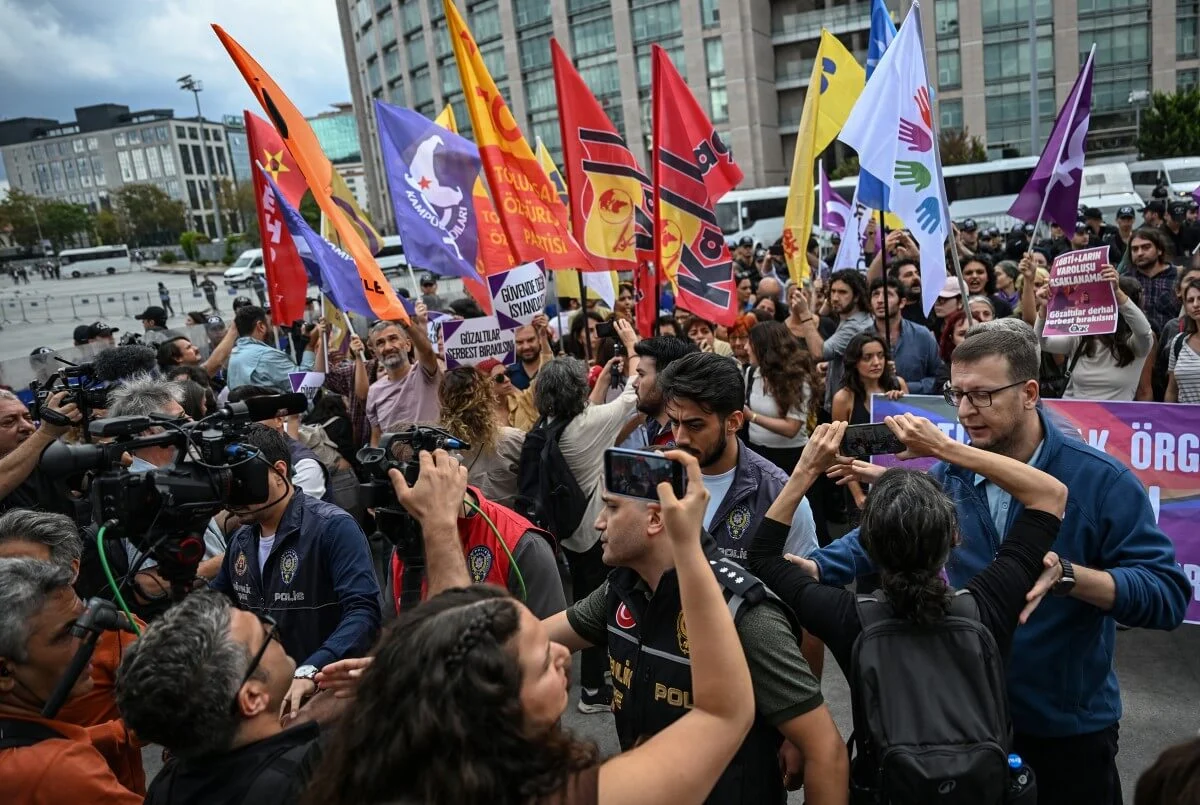
Several exhibitors at SAHA 2026, including REPKON, BAE Systems, Leonardo and LBA Systems, faced protests from anti-Israel demonstrators during the exhibition because of their defense ties and military exports connected to Israel. Protesters briefly disrupted access to parts of the exhibition hall, leading organizers to temporarily suspend visitor entry before security restored access.
The fair itself was organized by SAHA Istanbul, a platform established by Turkish defense contractors and run by Haluk Bayraktar, the brother of drone manufacturer Selçuk Bayraktar, President Erdogan’s son-in-law. Baykar, Turkey’s leading drone producer, controlled by the Bayraktar family, recently entered a partnership agreement with Italian defense contractor Leonardo, which has supplied military equipment and technology used by Israel.
Despite the protests and the participation of companies accused by demonstrators of contributing to Israel’s military capabilities, Islamist speakers visiting the fair avoided direct criticism of the exhibitors while continuing to frame Turkey’s defense industry through religious and anti-Israel narratives.