
Abdullah Bozkurt/Stockholm
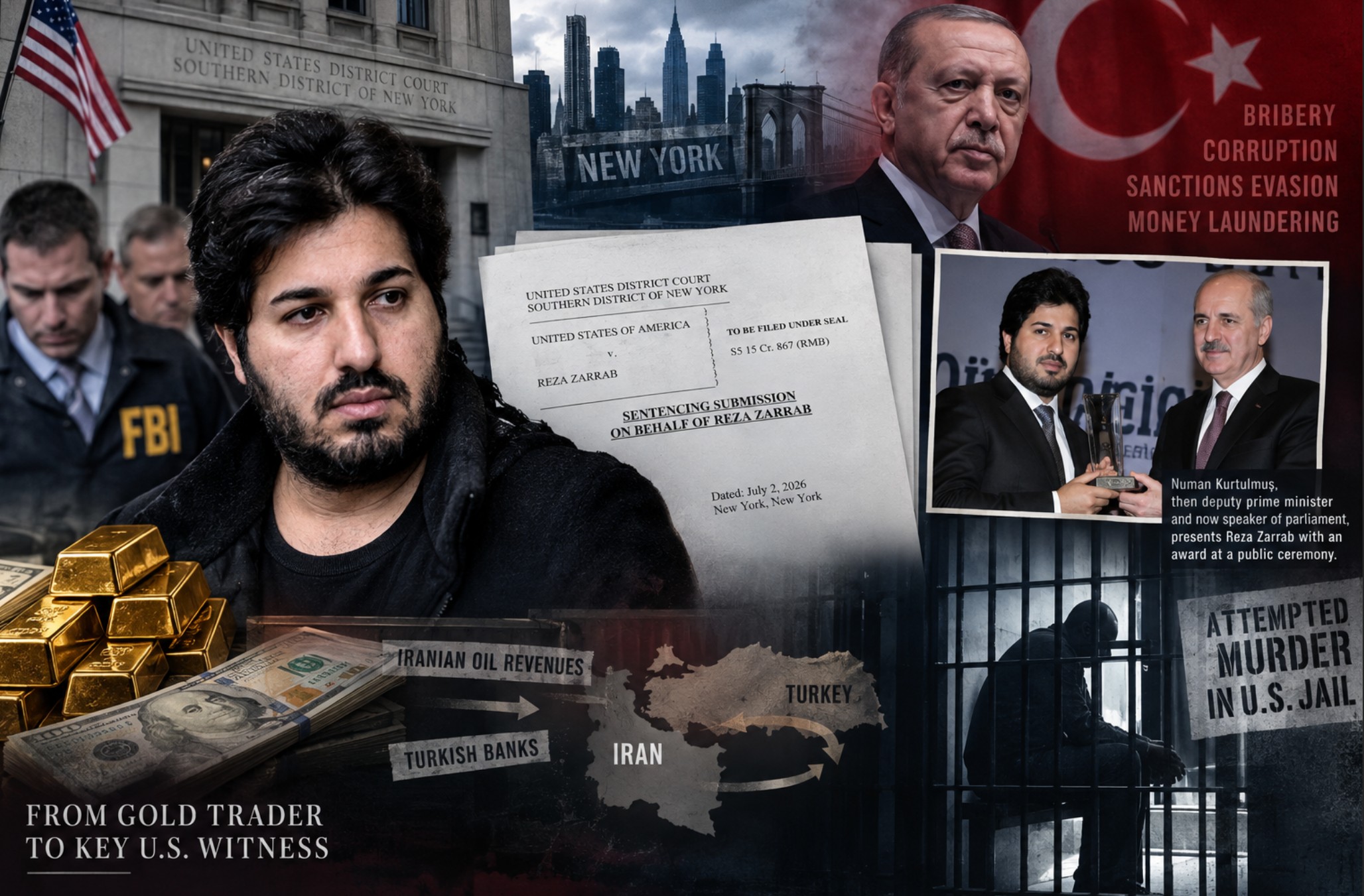
The Turkish government tried to have Iranian-Turkish gold trader Reza Zarrab killed inside a US federal detention facility after learning that he was cooperating with prosecutors in a sweeping Iran sanctions-evasion investigation implicating senior Turkish officials including President Recep Tayyip Erdogan, according to a sentencing memorandum filed in federal court in New York.
The extraordinary allegation is contained in a 57-page submission filed on behalf of Zarrab in the US District Court for the Southern District of New York. Dated July 2, 2026, and filed July 8, the memorandum was prepared ahead of Zarrab’s sentencing and asks the court to impose a sentence of time served, citing his extensive cooperation with US authorities and what his lawyers describe as years of retaliation by the Turkish government.
In perhaps the most striking disclosure, Zarrab’s lawyers devote an entire section of the filing to what they titled “Simultaneous Retaliation and Attempted Murder by Turkey.”
According to the filing, Zarrab was being held at the Metropolitan Detention Center (MDC) while secretly meeting with prosecutors to prepare for the trial of Mehmet Hakan Atilla, then a deputy general manager of Turkey’s state-owned lender Halkbank. US authorities were taking extensive measures to conceal his cooperation, but rumors began circulating among inmates that Zarrab had switched sides and was helping the government.
In early November 2017 the threats escalated dramatically. A fellow inmate armed with a knife cornered Zarrab and told him that he had been paid to kill him and would do so if Zarrab was cooperating with US authorities, the memorandum says. The identity of the person or entity that allegedly paid the inmate is blacked out in the publicly available version of the filing, although Zarrab’s lawyers characterize the episode in the section heading as an attempted murder by Turkey.
Zarrab escaped only after his cellmate came looking for him and, together with other prisoners, forcibly rescued him, according to his attorneys.
The incident was considered so serious that Zarrab was immediately transferred to FBI custody. Two FBI agents guarded him at all times because, the filing says, authorities concluded that the reach of those seeking to harm him was so extensive that “no jail would be sufficiently safe.”
The alleged attempt on his life came amid a broader campaign that Zarrab’s lawyers say was designed to stop him from testifying about a massive sanctions-busting network in which Halkbank, under directives from Turkey’s leadership, helped Iran gain access to billions of dollars in oil revenue despite US restrictions.
A July 2, 2026, sentencing submission filed by attorneys for Iranian-Turkish gold trader Reza Zarrab in federal court in New York details his cooperation with US prosecutors and alleges that the Turkish government retaliated against him and attempted to have him killed after he agreed to expose a multibillion-dollar Iran sanctions-evasion scheme involving senior Turkish officials and state-owned Halkbank:
About a week before Atilla’s trial, Turkish authorities arrested three Zarrab employees, according to the filing. His lawyers describe the arrests as a last-ditch effort to pressure him not to testify. The employees were released the day before Zarrab was due to take the witness stand, which the memorandum characterizes as a gesture intended to influence him. Turkish authorities also raided the home of another Zarrab employee in the middle of the night, the filing says.
From November 29 to December 7, 2017, he testified for seven days at Atilla’s trial, providing prosecutors with detailed accounts of the mechanisms used to move Iranian oil and gas proceeds, the officials and businesses involved and the payments and bribes that sustained the network. The court later described Zarrab as one of the government’s most important witnesses and characterized his testimony as credible and largely unrefuted, according to the memorandum.
His testimony triggered another wave of retaliation from Ankara, his lawyers say.
On the first day of his testimony the three employees previously detained in Turkey were arrested again. The following day Turkish prosecutors opened what the defense describes as a “sham” criminal espionage investigation into Zarrab, exposing him to life imprisonment. At roughly the same time Turkish authorities seized more than $172 million in assets belonging to Zarrab and his family, including real estate, an aircraft, boats, vehicles and an art collection. The authorities also moved to demolish his home on the Bosporus, according to the filing.
The filing portrays the measures not as ordinary law enforcement but as punishment for Zarrab’s cooperation with Washington.
Then-prime minister Binali Yıldırım publicly expressed hope that the asset seizures would make Zarrab “turn back from his mistake,” according to a statement cited by the defense. Zarrab continued testifying despite the pressure.
His lawyers calculate that Turkish seizures, deterioration of properties, lost rental revenue and related expenses ultimately cost Zarrab and his family at least $150.7 million. That figure does not include various vehicles, artwork and other property, they say.
Zarrab was a key suspect arrested in Turkey’s sweeping corruption investigation, which became public in December 2013 and implicated senior Turkish officials, with allegations reaching Erdogan himself. Investigators alleged that Zarrab had put several senior government figures on his bribery payroll, including economy minister Zafer Çağlayan, interior minister Muammer Güler and European Union minister Egemen Bağış, funneling millions of dollars to them while laundering billions in Iranian funds. Investigators also alleged that a large share of the money was destined for Erdogan, who was purportedly referred to as “big brother” in documents seized during the investigation.
Erdogan, then prime minister, intervened as his government moved to derail the investigation. Police chiefs, prosecutors and judges involved in the corruption probe were removed or reassigned, and Zarrab was ultimately released from pretrial detention. The Erdogan government portrayed Zarrab as a legitimate businessman who had contributed to the Turkish economy and dismissed the bribery allegations despite evidence gathered by investigators, including bank records, wiretaps and surveillance footage. Zarrab was even given a prime-time interview on A Haber, a pro-government television network whose ownership has been linked to Erdogan’s family.
After his release, Zarrab resumed the sanctions-evasion operation that had put him at the center of the corruption investigation, continuing to move Iranian funds through Turkey with the assistance of Turkish officials, according to evidence that later emerged in US proceedings.
The situation changed dramatically in March 2016, when Zarrab was arrested by US authorities in Miami. He initially denied the charges, while the Erdogan government mounted an intensive effort to secure his release and return to Turkey, including diplomatic representations to the US government.
Zarrab pleaded guilty in a sealed proceeding on October 26, 2017, to charges that included conspiracy to violate US sanctions, bank fraud, money laundering and bribing a jail guard. His underlying sanctions case centered on a scheme to move Iranian oil proceeds through Turkey using gold transactions and fictitious food trades.
According to his sentencing submission, Halkbank had accounts containing Iranian oil and gas revenue that could not be freely transferred under US sanctions. Zarrab testified that then-economy minister Çağlayan helped arrange his access to Halkbank in return for 50 percent of Zarrab’s profits, while then-Halkbank chief executive Süleyman Aslan also demanded a share.
The operation initially relied on converting Iranian funds held at Halkbank into gold, shipping the gold to Dubai and turning it into cash. After sanctions rules changed, the network moved to a fictitious food-trade mechanism using fabricated invoices, customs declarations and shipping records to disguise transfers of Iranian money, according to the memorandum.
Zarrab’s lawyers say Ankara regarded his decision to reveal the operation as an act of treason because his testimony exposed corruption at the highest levels of the Turkish government and detailed how Iran had been able to circumvent US sanctions through Turkey.
Atilla was convicted on January 3, 2018, and subsequently sentenced to 32 months in prison. He was allowed to return Turkey after serving his sentence.
Yet the much larger Halkbank prosecution dragged on for years. According to the filing, the bank mounted repeated legal challenges in the Second Circuit Court of Appeals and the US Supreme Court, contributing to a nearly nine-year gap between Zarrab’s guilty plea and his sentencing.
In March 2026 US prosecutors reached a deferred prosecution agreement with Halkbank under which the criminal case against the bank would ultimately be dropped in exchange for what the prosecutors said was the Turkish government’s assistance to US foreign policy and national security interests, including efforts to secure the release of hostages held by Hamas.
After his January 2018 release, Zarrab was required to employ round-the-clock private security and was initially put in home confinement with electronic and GPS monitoring. His Turkish identification documents had been cancelled, the filing says, and he was unable to safely use his real name, forcing him to rent an apartment under an assumed identity.
Even after the court relaxed his restrictions, the threat did not disappear. His attorneys say Turkish figures continued tracking and photographing him in New York, prompting Zarrab, with the consent of US authorities, to seek a safer location elsewhere. He continued to travel with a driver and bodyguard and struggled to obtain identification, banking services and employment.
The defense argues that the attempted killing in detention, the arrest of people around him, espionage proceedings, confiscation of his fortune and continued security threats collectively constitute punishment far exceeding what other participants in the sanctions scheme have faced.
Zarrab’s lawyers consequently asked Judge Richard M. Berman to sentence him to time served. The filing says Zarrab had already spent 22 months behind bars, another five months in strict home confinement and 95 months under restrictive bail conditions.
The assassination allegation stands out because it adds a previously obscured dimension to Ankara’s response to Zarrab’s defection: His attorneys are not merely accusing the Turkish government of financial and judicial retaliation but of trying to silence a critical witness while he was in the custody of the United States.
It also shows how far President Erdogan is allegedly willing to go to silence a key figure who initially worked with his government in laundering Iranian state funds in violation of multiple Turkish and US laws but later turned against Erdogan after striking a plea deal with US prosecutors and agreeing to cooperate with them.