

Levent Kenez/Stockholm
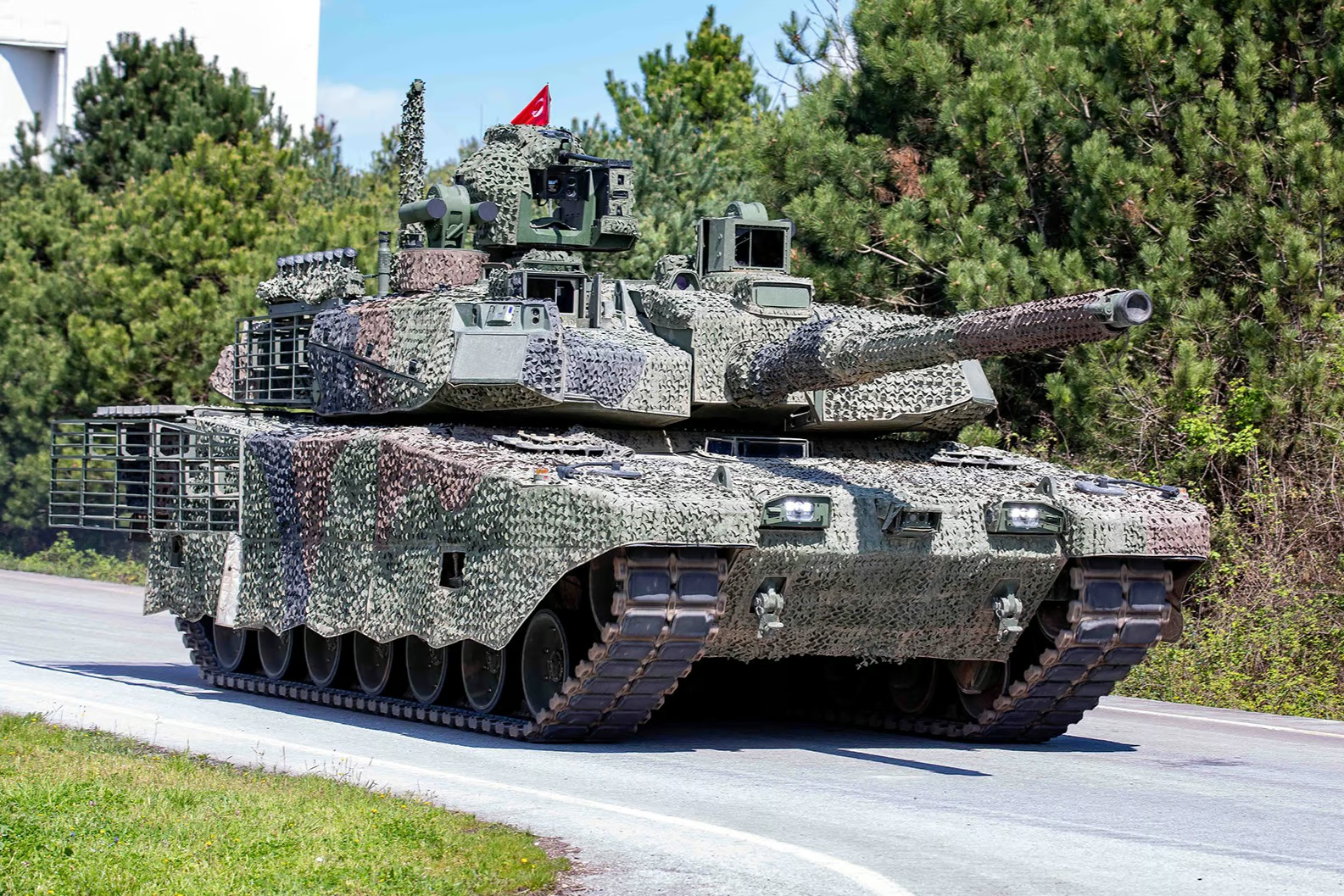
Turkey’s Altay main battle tank, a project first launched nearly two decades ago, spent most of that time stalled by contractor changes tied to businessmen close to the government, an uncompleted factory, a foreign arms embargo and years without a working engine supplier. Only in the past year has serial production begun reaching the army in small numbers, and even now output remains far below what was originally promised.
Turkey’s state-owned Machinery and Chemical Industry Corporation (MKE) confirmed on September 10, 2026, that it has delivered a new batch of main weapons systems and coaxial guns for the Altay, along with a mid-range missile fuel rod, as production continues to ramp up. The delivery is the latest step in a rollout that only began reaching Turkish army units at scale after years of setbacks.
Presidency of the Defense Industry chairman Haluk Görgün previously said the government aims to deliver at least 10 Altay tanks to the Land Forces Command by the end of 2026, up from three delivered in 2025. The tank officially entered service with the Turkish army on October 28, 2025, at a ceremony in Kahramankazan near Ankara, where President Recep Tayyip Erdogan called it Turkey’s first new tank added to the force since 1940. Under the current schedule 85 tanks in the T1 configuration are due to reach the army between 2026 and 2028, 11 this year, 41 in 2027 and 30 in 2028, before a more advanced T2 version, expected to carry a fully domestic engine, begins arriving from 2028 with 165 units planned.
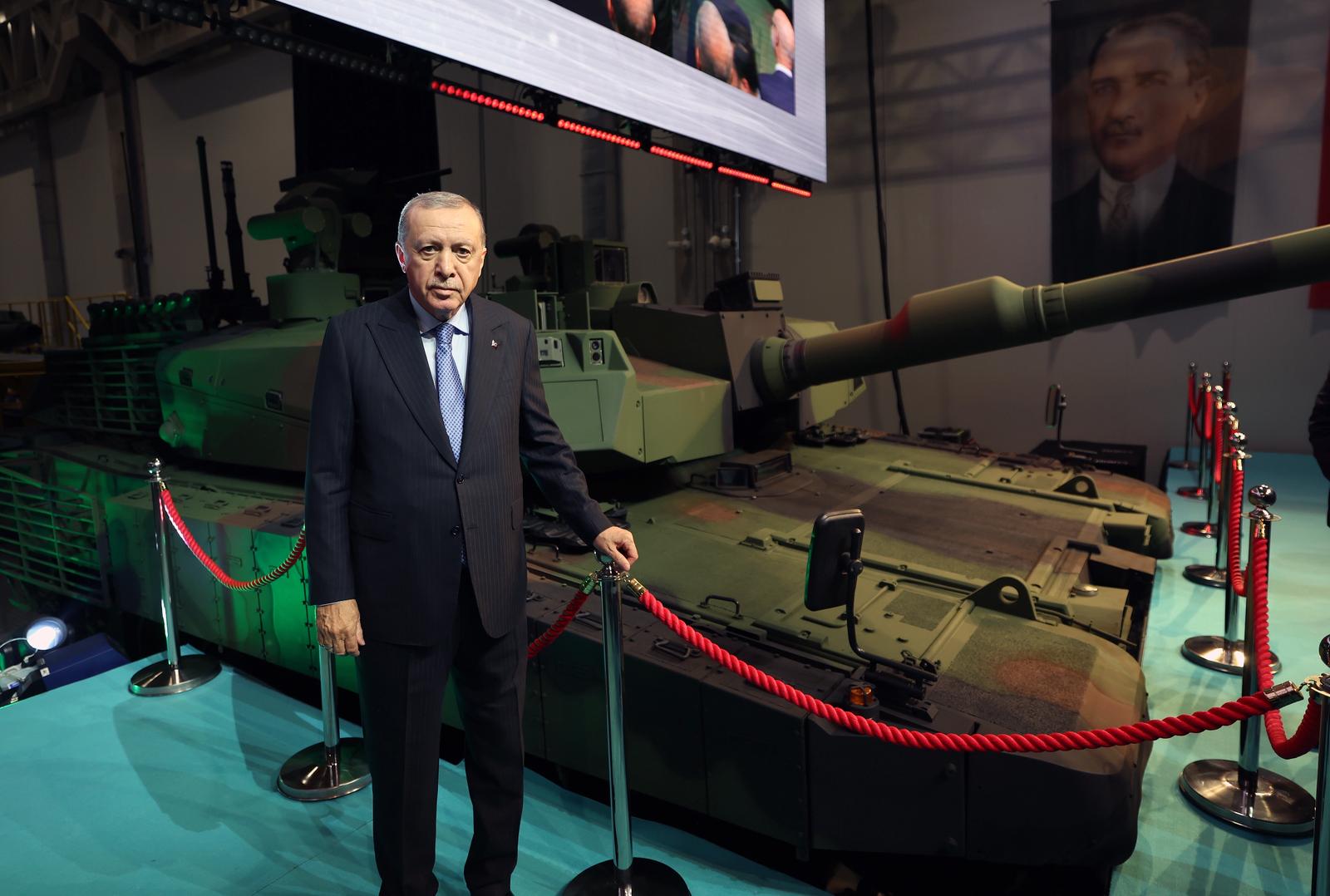
Despite the announced 2026 target, little public information is available on the progress of this year’s batch or how many of the planned tanks have been completed or delivered. The absence of production figures makes it difficult to assess whether production and deliveries are keeping pace with the announced schedule at the new Kahramankazan facility.
That output arrives roughly 18 years after the formal development contract was signed, and only after a procurement history that opposition politicians and industry insiders say was shaped as much by political access as by engineering.
The latest phase of the program began in June 2021, when Ethem Sancak and his partner Talip Öztürk sold their controlling stake in BMC, the company having the serial production contract, to Tosyalı Holding, led by Fuat Tosyalı, a board member of Turkey’s sovereign wealth fund and a businessman close to the government. Tosyalı canceled a partially built factory in Karasu on Turkey’s northwestern coast, saying the location made it difficult to attract skilled workers. Other observers have suggested rising land values there made the site more attractive to sell than to build on. Production was shifted to a new facility in Kahramankazan designed to build up to eight tanks a month.
Before that, in April 2018, the serial production contract had been awarded to BMC while it was still controlled by Sancak, a senior figure in the ruling Justice and Development Party’s (AKP) decision-making body at the time and an outspoken Erdogan supporter. Qatar’s armed forces acquired a 49 percent stake in the company around the same time, though management remained with Sancak and Öztürk.
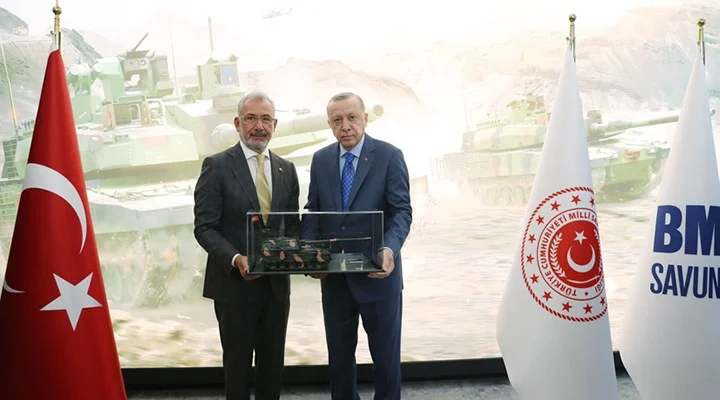
In January 2019 the government leased the Arifiye tank track factory, long operated by the military, to BMC for 25 years without a competitive tender, a decision that drew accusations of favoritism. BMC had no prior experience building tanks, and industry sources estimate that the time needed to build engineering capacity from scratch rather than absorb expertise already developed by the project’s original contractor delayed the program by roughly two years.
That original contractor was Otokar, a subsidiary of Koç Holding, Turkey’s largest industrial conglomerate, which built and tested Altay prototypes between 2007 and 2017 and submitted a final bid for mass production. The government rejected that bid on cost and terms and reopened the tender, a decision insiders link to a broader shift of strategic defense contracts to businesses seen as closer to Erdogan. Investigative journalist Cevheri Güven separately alleged that Tosyalı served as one of Erdogan’s informal financial proxies and that his position on the wealth fund’s board, which oversees Turkish Airlines and major state banks, created a conflict of interest given his companies’ reliance on financing from those same institutions. BMC and Tosyalı Holding have publicly attributed the delays to technical and site selection factors rather than political interference.
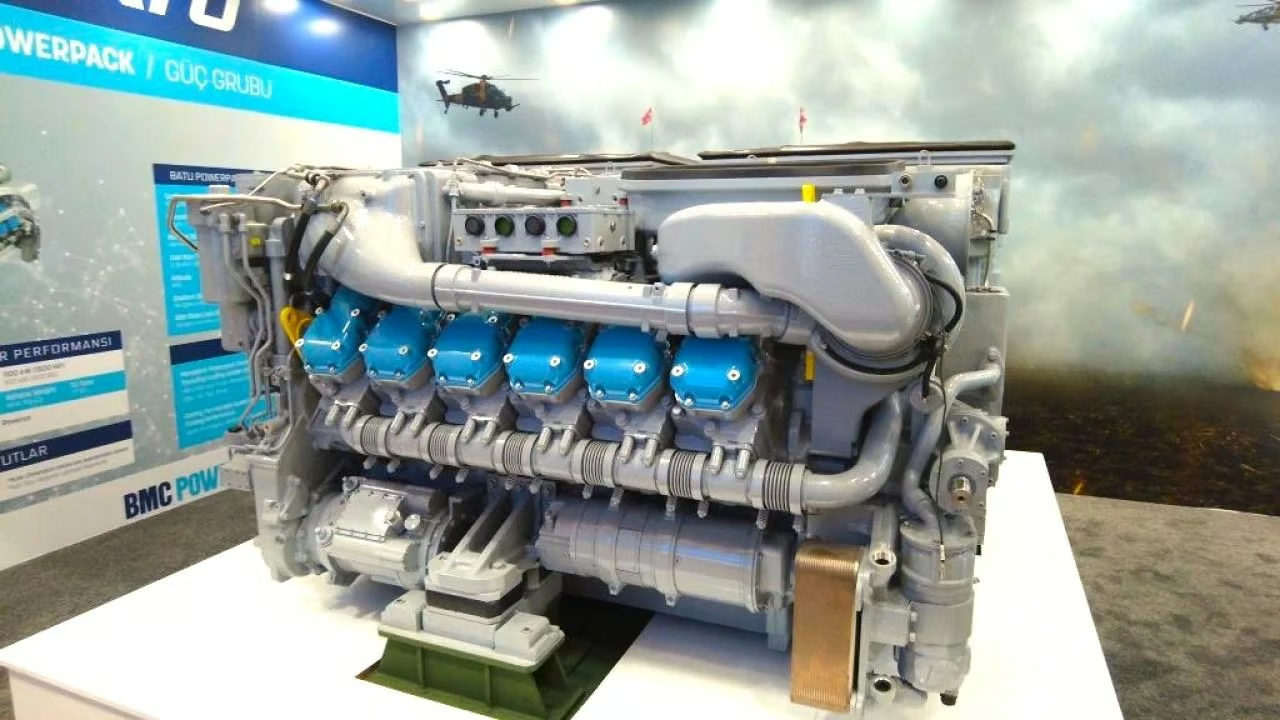
Compounding the change in ownership was an undeclared German arms embargo, triggered by Turkey’s past military operations in Syria that cut off supplies of the MTU engines and Renk transmissions that the Altay had been designed around, the same components used in Turkey’s Leopard 2A4 fleet. With no backup supply chain in place, the program went roughly five years without a working engine source before Turkey turned to South Korea’s Doosan and S&T Dynamics, which agreed in 2023 to supply the power packs now used in the first production tanks. A fully domestic replacement, the BMC Power-built Batu engine, has yet to complete the 10,000 hour endurance testing required before it can be deployed at scale.
Behind the scenes, questions have emerged over who will control BMC going forward. Journalist Güntay Şimşek claims that OYAK, the military pension fund with major holdings in automotive, metallurgy, heavy industry and finance, could take a stronger position within BMC, though no official confirmation of such a change has been given. The speculation has coincided with separate reports that OYAK Energy Companies chairman Uğur Doğan has held talks with Saudi Arabia’s Aramco, discussions that observers say point to a broader alignment of energy, logistics, financing and defense interests rather than a routine fuel distribution deal. Since the first deliveries began, public updates on the program’s pace have been limited, with the most notable development being a book by former BMC chief executive Murat Yalçıntaş chronicling the tank’s development, even as analysts note a gap between the officially announced delivery calendar and the program’s actual production tempo.
Production is ultimately expected to reach more than 90 Altay tanks a year once production, subsystem integration and the supply chain are fully stabilized. At that level the program would also provide sustained production for companies including Aselsan, Roketsan, MKE and BMC Power. But the long-term viability of the program still depends heavily on BMC Power’s domestically developed Batu engine, which is intended to replace the imported power pack used in the first production tanks and give Turkey a fully domestic powertrain for the Altay.
The project’s roots go back further still, to 1996, when initial planning for a Turkish-designed tank first began, and to 2008, when the formal development contract was signed.
Even as deliveries pick up, the Altay remains a small fraction of Turkey’s overall armored force. The Turkish army fields between 2,200 and 2,400 main battle tanks in total. That fleet includes roughly 330 to 340 German-made Leopard 2A4s undergoing armor and electronics upgrades; 165 to 170 M60T “Fırat” tanks fitted with Turkish-made active protection systems; 600 to 650 M60A3 tanks receiving partial modernization; some 350 Leopard 1 variants, many refitted with Turkish fire control systems and used mainly in secondary roles; and roughly 750 M48A5T2 tanks dating to a 1980s upgrade. Most of the M48s are now assigned to border posts and fixed defensive positions. Ankara has said it intends to gradually retire the M48 fleet and older M60 variants as Altay production scales up, and some surplus M48 and M60 tanks have already been shipped abroad, including a delivery to Somalia’s armed forces earlier this year.