
Abdullah Bozkurt/Stockholm
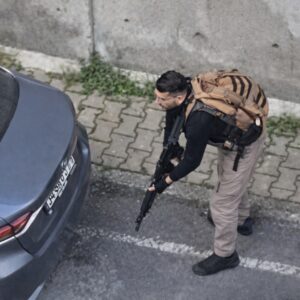
The latest terrorist attack on the Israeli consulate in Istanbul, attributed to the Islamic State in Iraq and Syria (ISIS), adds to mounting evidence that Hizb ut-Tahrir, a radical network advocating the establishment of a global Islamic caliphate, functions as a conveyor belt for militancy, systematically radicalizing and mobilizing individuals willing to take up arms in support of jihadist ideology.
Two of the three attackers who attempted to storm the building housing the Israeli consulate on April 7 were found to have close ties to Hizb ut-Tahrir, an outlawed organization that has nonetheless been able to operate freely in Turkey under the Islamist government of President Recep Tayyip Erdogan.
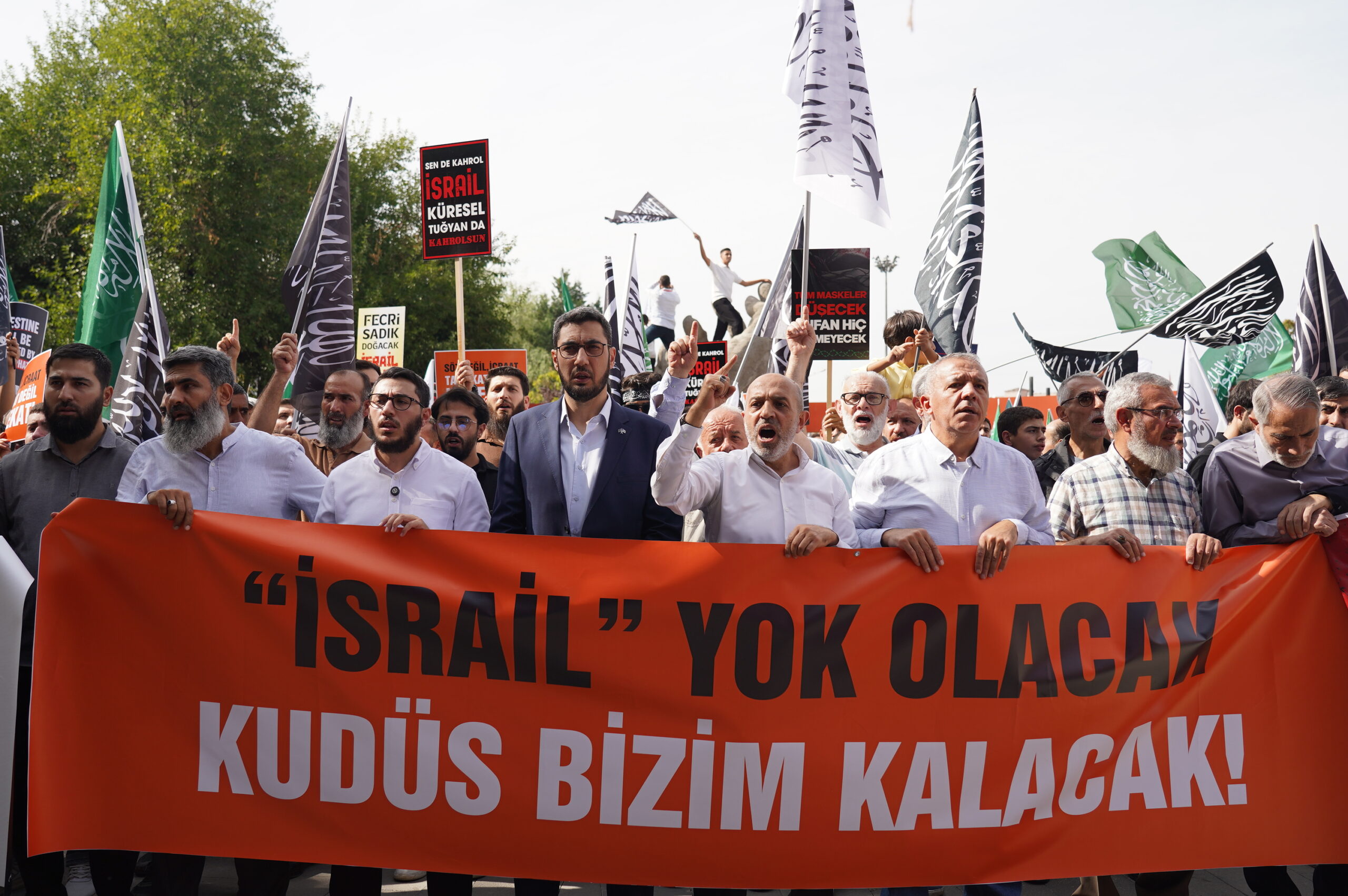
Hizb ut-Tahrir has openly called for the destruction of Israel, demanded the deployment of the Turkish military to Gaza, endorsed Hamas attacks and organized mass anti-Israel rallies across multiple Turkish provinces. Its rhetoric and mobilization efforts have increasingly mirrored narratives long promoted by jihadist groups.
Background investigations into Onur Çelik, a 25-year-old assailant involved in the consulate attack, revealed that he had been a regular attendee for the past two years at a Hizb ut-Tahrir venue in Gebze, a major industrial hub where the group has established operational cells under the umbrella of its propaganda platform, Köklü Değişim Dergisi (Radical Change Magazine).
Çelik actively participated in anti-Israel protests organized by Hizb ut-Tahrir, including demonstrations staged directly in front of the same consulate he later attempted to attack.

In his statement to the police following the attack, Çelik said he met fellow attacker Ahmet İmrak, who was wounded and captured after a shootout with police outside the consulate, at a Hizb ut-Tahrir office in Gebze. İmrak’s brother Murat was also part of the same network. Çelik further stated that through İmrak he was introduced to Yunus Emre Sarban, the third attacker and a known ISIS militant who was killed during the assault.
Sarban had previously been detained and indicted on charges of ISIS membership. Although his assets were frozen, Turkish authorities later released him, lifted the asset freeze and ultimately secured his acquittal of terrorism charges, a pattern critics say reflects systemic leniency toward jihadist actors by Turkish authorities.
This marks the second time Hizb ut-Tahrir has been publicly linked to an ISIS-related terrorist plot in Turkey. Abdulkadir Ercan, a 45-year-old Turkish national who established an ISIS cell in Ankara, was initially radicalized by Hizb ut-Tahrir in 2007. He later joined al-Qaeda in 2010 before aligning with ISIS in Syria in 2013.
Despite being under extensive surveillance, Turkish authorities were aware that Ercan had set up an ISIS network in Sincan, on the outskirts of Ankara, where he recruited militants including members of his own family. Although he faced multiple criminal investigations ranging from drug trafficking to membership in al-Qaeda and was the subject of numerous court proceedings, he was able to travel freely between Turkey and Syria.
Ercan was the target of 12 criminal investigations conducted by prosecutors in Ankara and Kilis and has been involved in 13 separate criminal cases since 2006. Nevertheless, authorities failed to intervene effectively as he radicalized at least 20 relatives and facilitated their travel to Syria to join ISIS. Five of his family members were later killed while fighting for jihadist groups.
His elder brother, Alattin Ercan, who opposed these recruitment efforts, appeared before the Turkish Parliament in April 2015, criticizing authorities for their inaction. He explicitly accused Hizb ut-Tahrir of playing a key role in his brother’s radicalization.
Both the Ercan and Çelik cases reveal striking similarities. Beyond their shared ideological grounding in Hizb ut-Tahrir, both individuals had criminal backgrounds involving drug-related offenses and other illegal activities. Their exposure to the group’s ideology appears to have provided a unifying framework that channeled their trajectories toward violent extremism, reinforcing a sense of purpose and facilitating their transition into ISIS networks.
Hizb ut-Tahrir’s operations in Turkey are led by Mahmut Kar, a hardline figure who has publicly campaigned for the deployment of Turkish troops to “wipe Israel off the map.” He has also advocated sending volunteer fighters if the government fails to act and has called on authorities to facilitate such a mobilization. Under his leadership the group has organized rallies outside the Israeli and US diplomatic missions in Istanbul and Ankara.
The organization has openly endorsed Hamas’s attacks, referring to its militants as “mujahideen” and urging Turkey to support Hamas’s armed wing, the Izz ad-Din al-Qassam Brigades. In public demonstrations, Hizb ut-Tahrir frequently labels Western countries as “infidels,” echoing rhetoric commonly used by ISIS and similar jihadist groups.
Ideologically, the group blames the Republic of Turkey for abolishing the Ottoman caliphate in 1924, framing this event as the root cause of contemporary crises in the Muslim world, including the Palestinian issue. It has sought to exploit the ongoing Israel-Hamas conflict to advance its longstanding goal of re-establishing a caliphate.
Despite being formally banned and designated as a terrorist organization, Hizb ut-Tahrir has experienced a notable resurgence during Erdogan’s rule. This revival has been facilitated in part by the group’s ideological alignment with the ruling Justice and Development Party (AKP), which has Islamist roots. As a result the group has been able to organize large-scale public events in major cities, openly promoting its agenda.
Hizb ut-Tahrir operates through a registered media and publishing company, Köklü Değişim Medya Basın Yayın Organizasyon Ticaret Limited Şirketi, established on December 1, 2016, in Ankara. Trade registry records show that Mahmut Kar is the founder and sole authorized representative of the company.
The company’s charter allows for a wide range of domestic and international activities. Although its founding capital was listed as 20,000 Turkish lira (approximately $5,714 at the time), this appears largely symbolic given the scale of its operations. The company has since expanded with branches in Istanbul and other provinces, publishing books and magazines while actively using social media and video platforms to disseminate its ideology.
Hizb ut-Tahrir has maintained a presence in Turkey since the late 1960s. Over the decades, successive governments have periodically prosecuted its members through various legal and security measures aimed at preventing the group from evolving into a major national security threat.
The Turkish Supreme Court of Appeals’ 9th Criminal Chamber designated Hizb ut-Tahrir as a terrorist organization on September 26, 2004, under Article 314 of the Turkish Penal Code, which addresses armed terrorist groups. This designation was reaffirmed in a subsequent ruling on November 29, 2007, and upheld again on October 4, 2017.
However, in a controversial decision on July 19, 2018, Turkey’s Constitutional Court ruled that Hizb ut-Tahrir could not be classified as a terrorist organization. Critics argue that the court exceeded its jurisdiction by effectively overturning established criminal jurisprudence, creating a legal contradiction that has benefited members of the group.
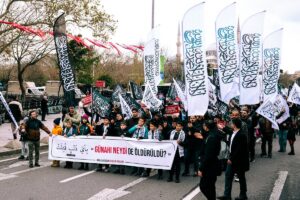
As a result of these conflicting rulings, many Hizb ut-Tahrir members have been acquitted, while some lower courts continue to treat the organization as a terrorist entity based on earlier appellate decisions. This legal ambiguity has significantly weakened enforcement efforts.
Globally, Hizb ut-Tahrir designated Turkey as one of its provinces in 1997 and established a clandestine organizational structure ranging from local grassroots cells to a centralized leadership body overseen by a provincial authority. The group operates hierarchically, holding regular internal meetings and reporting activities to its leadership council, while also receiving foreign funding.
In June 2011 Turkish prosecutors ordered coordinated police raids against Hizb ut-Tahrir cells in five cities, resulting in the detention of 17 people. Investigators found that the group was regularly funded by Imameddin A.A. Barakat, a Jordanian citizen of Palestinian origin. Financial records showed that a courier, Mazin Harbawi, entered Turkey every two months carrying cash — estimated at around $40,000 per visit — which he delivered to a senior operative responsible for the group’s Istanbul activities.
A report issued by Turkey’s Directorate General of Security on February 24, 2017, described Hizb ut-Tahrir as operating under a secret leadership committee composed of three to 10 members, reporting to a higher presidential council within the organization.
Although the group has not been directly linked to a successful large-scale violent attack since a crackdown in 1967, a 2009 police operation uncovered weapons including a long-barreled rifle, two handguns, five rifles and six blank-firing pistols. Authorities at the time said the group was planning a major attack in Istanbul to coincide with the anniversary of the abolition of the caliphate.
The Ottoman Caliphate was abolished by Mustafa Kemal Atatürk on March 3, 1924, following the establishment of the secular Turkish Republic. Investigators concluded that Hizb ut-Tahrir could resort to violence when conditions become favorable.
Wiretap evidence from 2008 further revealed internal discussions among members about engaging in jihad and traveling to Palestine. The investigation also uncovered links between some Hizb ut-Tahrir members and ultranationalist factions (Ulusalcilar) in Turkey’s military and intelligence apparatus, suggesting overlapping interests in destabilizing the country to advance ideological objectives.