
Levent Kenez/Stockholm
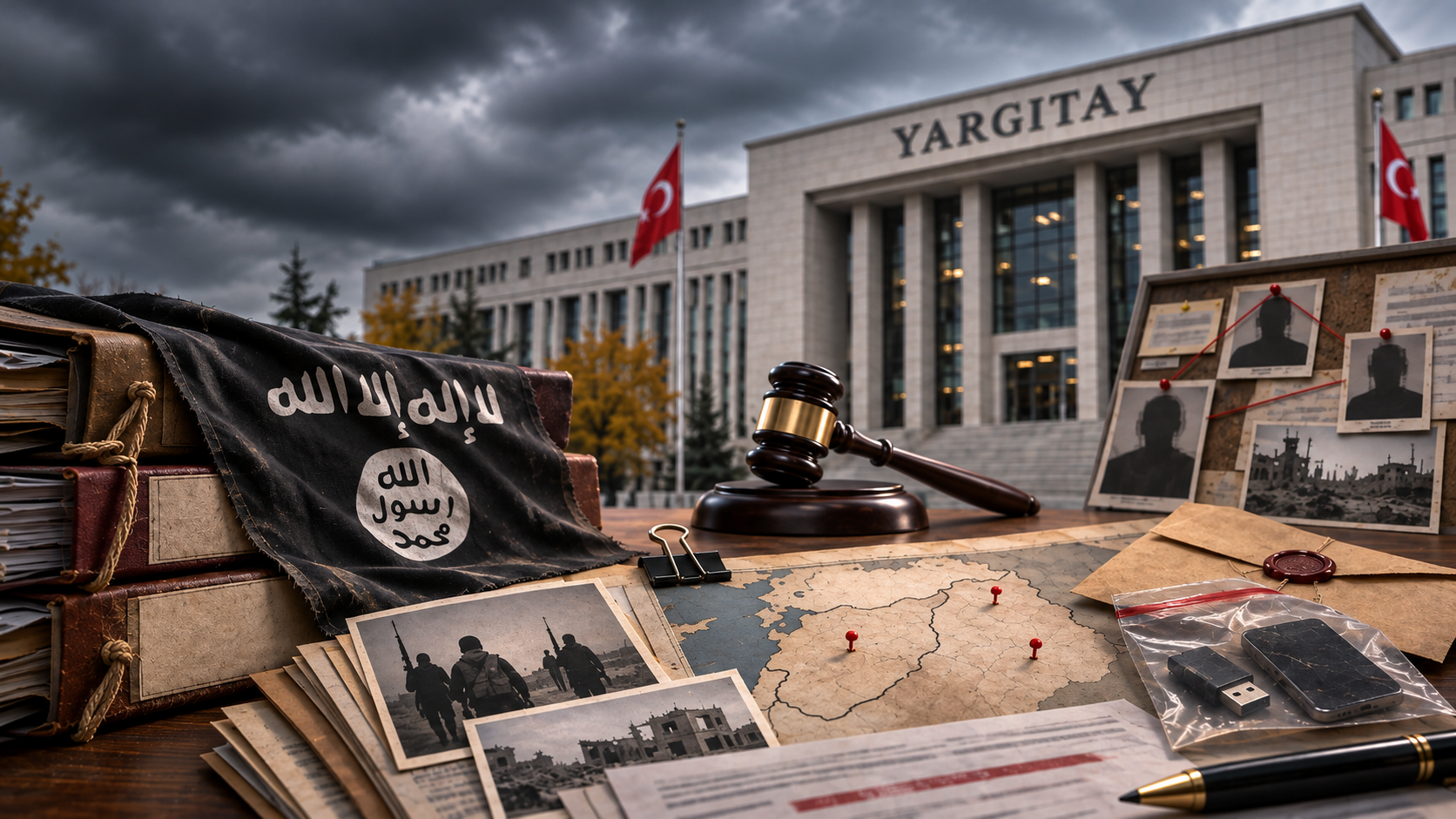
Turkey’s highest appeals court has overturned a conviction for membership in the Islamic State in Iraq and Syria (ISIS), finding that crucial inquiries into the defendant’s activities were not completed and that evidence was not properly addressed in court. The omissions also left unanswered whether witnesses or related case files might contain information about his suspected contacts.
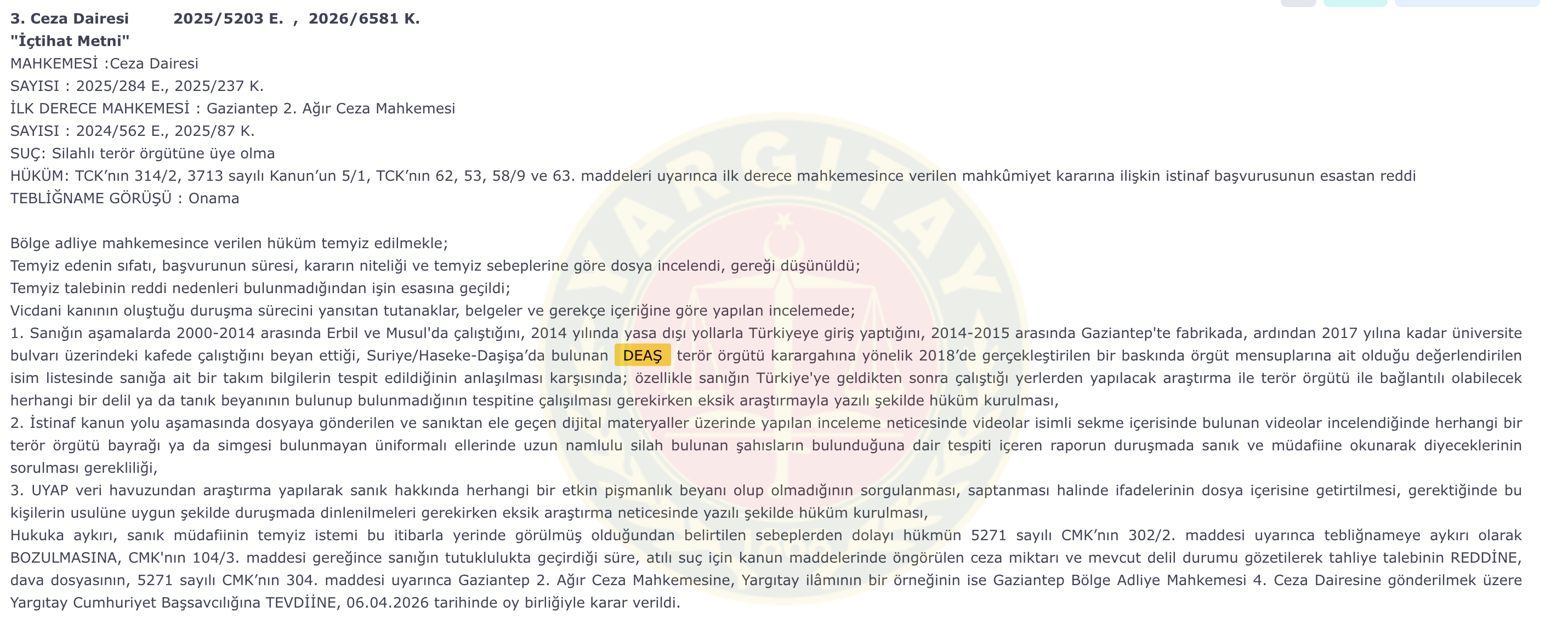
On April 6, 2026, the Third Criminal Chamber of Turkey’s Supreme Court of Appeals (Yargıtay) identified failures involving workplace inquiries, a digital evidence report and a search for testimony in other cases. It sent the proceedings back to a criminal court in Gaziantep in southeastern Turkey but rejected the defendant’s request for release. The ruling does not identify him by name.
The Gaziantep 2nd High Criminal Court had convicted the defendant of membership in an armed terrorist organization. The 4th Criminal Chamber of the Gaziantep Regional Court of Appeals rejected his appeal on the merits. The Supreme Court of Appeals unanimously overturned the conviction despite a recommendation to uphold it from the Office of the Chief Public Prosecutor at the Supreme Court of Appeals.
At the center of the case was a list recovered during a 2018 raid on what the Turkish judgment describes as an ISIS headquarters in Dashisha, in Syria’s Hasakah province. The list was believed to identify organization members and included information attributed to the defendant, according to the ruling.
The defendant told investigators and the courts that he had worked in Erbil and Mosul, Iraq, from 2000 to 2014 before entering Turkey illegally in 2014. He said he worked at a factory in Gaziantep until 2015 and then at a cafe DELETED until 2017. The appeals judges found that inquiries at those workplaces should have been made to determine whether witnesses or evidence could shed light on any terrorist organization links.
Records and witnesses at those workplaces could test his account and clarify his contacts. The judges did not say such inquiries would reveal other ISIS members, and the judgment makes no finding that coworkers were involved. Their criticism was that the checks had not been completed before the conviction was upheld.
The second problem involved videos on digital material seized from the accused. A report submitted to the case file during the regional appeal described uniformed men carrying long guns with no terrorist flags or symbols visible. The high appeals court said the report should be read to the defendant and his lawyer at a hearing, with both given an opportunity to comment. It did not identify the armed men as ISIS operatives.
The third deficiency concerned Turkey’s National Judiciary Informatics System (UYAP), a database used by the judiciary. The judges directed the lower court to determine whether people in other proceedings had made statements about this defendant under Turkish law’s effective repentance provisions. If such accounts existed, the statements should be obtained and the people concerned heard in court when necessary. The ruling does not say any such testimony exists.
Effective repentance provisions can allow defendants in terrorism cases to receive legal benefits when they provide information under the applicable conditions. Such statements can be relevant to a suspect’s contacts or activities. Here, the missing search meant the court had not established whether relevant testimony from other cases was available. Whether it would support the prosecution, assist the defense or identify other leads is unknown.
The ruling identifies shortcomings in the evidence gathering and judicial review of this particular case. It does not establish deliberate misconduct by prosecutors or judges, nor does it demonstrate that additional ISIS suspects went undetected. A greater failure to identify members of an ISIS network has not been established.

Earlier Nordic Monitor reporting documented investigative shortcomings in separate ISIS-related proceedings in Gaziantep, including failures to fully examine financial records. In April 2021 Nordic Monitor reported on a case involving allegations that Yazidi women and children had been trafficked through an unregistered currency exchange business. Six defendants were acquitted in January 2016 by the Gaziantep Second High Criminal Court, the same court handling the case returned by the Supreme Court in April 2026.
In the earlier case investigators had not traced the senders and recipients of substantial transfers between Turkey and Syria or fully pursued a lead pointing to another currency exchange operation in Istanbul. Arabic language transaction receipts had not been translated before the court reached its verdict, a concern also raised by the Gaziantep Bar Association at the time. The defendants denied the accusations, and their acquittals cannot be treated as proof that the alleged trafficking occurred.
In a January 2022 report Nordic Monitor examined an earlier Supreme Court of Appeals ruling involving an ISIS suspect sought by Spain. The court overturned his conviction in October 2021 because necessary documentation from Spanish authorities had not been obtained. It instructed Turkish officials to seek the information through established international judicial cooperation procedures.
A February 2023 report by the International Crisis Group on foreign nationals linked to ISIS in Turkey described difficulties in collecting evidence, shortages of qualified interpreters and uneven judicial expertise. The organization also noted improvements in authorities’ handling of digital evidence and said Turkey had strengthened its security response. It observed that intelligence obtained in Syria could support prosecutions but required corroborating evidence in court. Refugees and migrants who could provide witness testimony were another potential source of information for Turkish investigators.
The April 2026 ruling returned the case to the Gaziantep Second High Criminal Court for further proceedings. The Supreme Court of Appeals rejected the defendant’s request for release, citing the time he had spent in detention, the potential penalty and the evidence in the case. The lower court must address the identified deficiencies before issuing a new judgment. Whether the additional inquiries will produce further evidence against the defendant or reveal other investigative leads remains to be seen.