
Levent Kenez/Stockholm
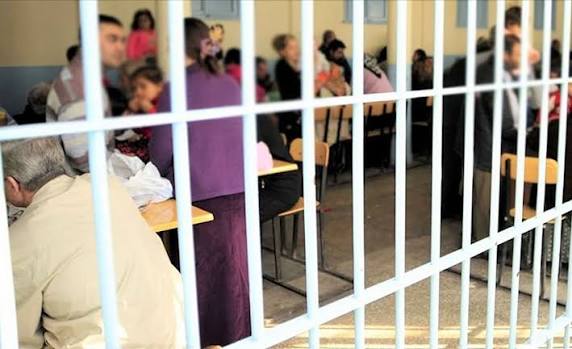
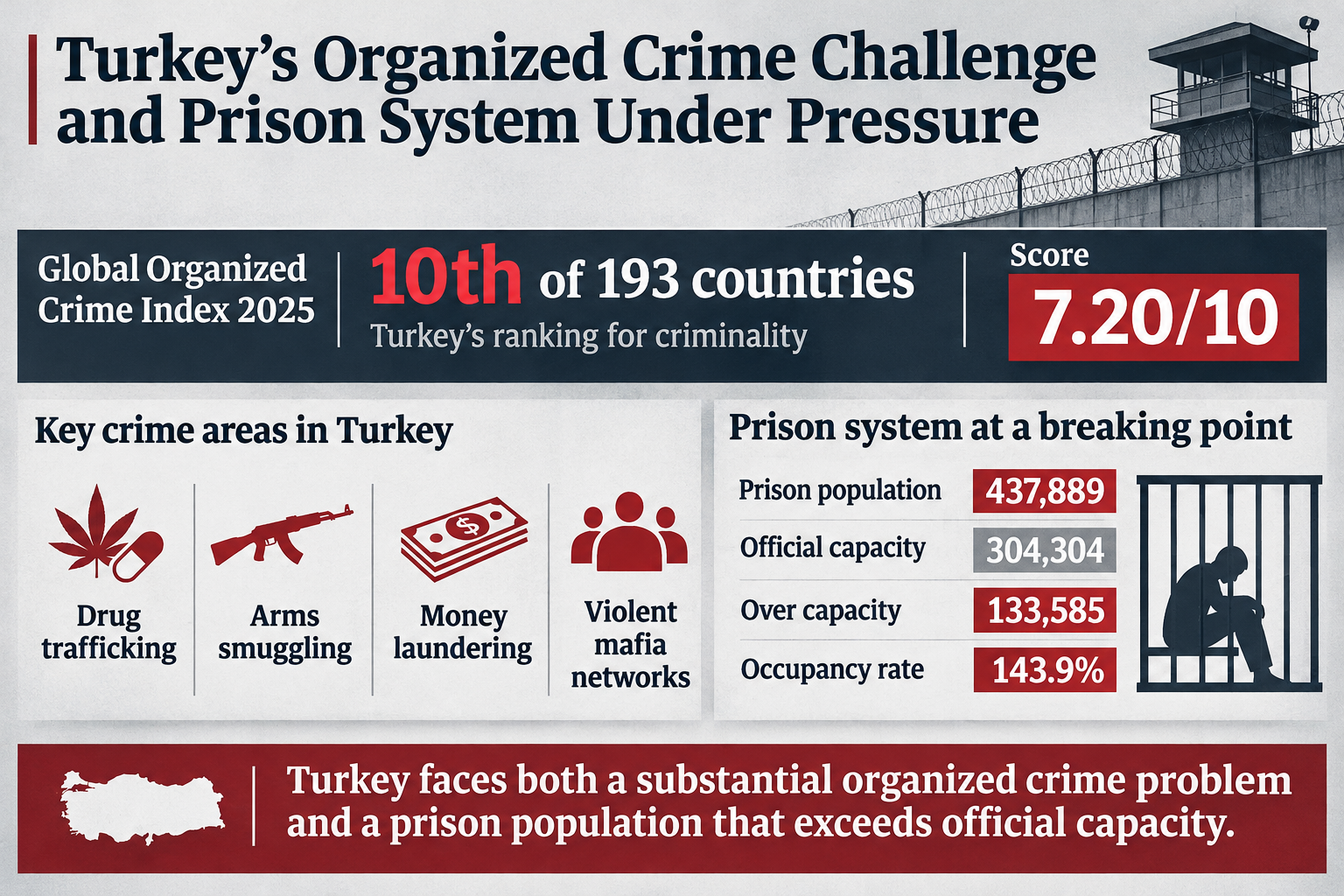
Turkey’s prison population has climbed to a record 437,889, exceeding the country’s official capacity by more than 133,000 inmates, according to Justice Ministry figures presented to parliament on November 9. The figures expose a deepening overcrowding crisis in a country already holding more prisoners per capita than any member of the Council of Europe.
The statistics, discussed during parliamentary hearings on the Justice Ministry’s 2027 budget, show that Turkey’s 402 prisons were designed to accommodate 304,304 people. Their occupancy rate reached nearly 144 percent on November 2, meaning approximately 144 inmates were being held for every 100 available places.
The prison population increased by 3,552 in just over a month, rising from 434,337 on October 1. Of those incarcerated in November, 365,758 were convicted prisoners and 72,131 were in pretrial detention, according to figures from the Directorate General of Prisons and Detention Houses.
Turkey’s prison population has expanded dramatically under the government of President Recep Tayyip Erdogan, reflecting both rising criminal caseloads and the extensive use of imprisonment in politically sensitive prosecutions. The country had approximately 59,500 prisoners in 2002, when Erdogan’s Justice and Development Party (AKP) came to power, compared with nearly 438,000 today, a more than sevenfold increase.
The scale of imprisonment places Turkey far outside European Union norms. Eurostat reported that the EU’s 27 member states held 508,746 prisoners in 2024, equivalent to 113 inmates per 100,000 residents. Turkey’s imprisonment rate had already reached 458 per 100,000 in January 2025, according to the Council of Europe, and rose to approximately 504 by October 2026, according to the World Prison Brief.
Even Hungary, which recorded the EU’s highest imprisonment rate in 2024, held 193 prisoners per 100,000 residents. Finland had 57, while Germany and Denmark each recorded approximately 70. The figures come from different reporting periods but demonstrate the substantial gap between Turkey and EU prison systems.
The Council of Europe’s annual penal statistics, published in May 2026, identified Turkey as having the highest imprisonment rate among the countries surveyed. Its prison population rate increased by 29 percent between January 2024 and January 2025, the largest increase recorded among the participating prison systems.
Overcrowding is not unique to Turkey. Eurostat found that 14 EU countries reported overcrowded prison cells in 2024, with Cyprus recording an occupancy rate of 227.6 percent, followed by Slovenia at 134.2 percent and France at 129.3 percent. Turkey’s latest nationwide occupancy rate of nearly 144 percent exceeds the figures reported for France and Slovenia, although the comparisons cover different years.
The consequences are documented in reports by Turkey’s Human Rights and Equality Institution (TİHEK), cited during the parliamentary hearings. At the Tarsus Women’s Closed Prison in Mersin province, inspectors found 705 prisoners in a facility with an expanded capacity of 460, with some women sleeping on floor mattresses and sharing clothing lockers.
One lawmaker described personally witnessing a 75-year-old prisoner sleeping on a mattress laid out in a kitchen at Istanbul’s Paşakapısı Prison. Republican People’s Party (CHP) lawmaker Tahsin Ocaklı also cited complaints that cell blocks intended for 26 to 28 people were accommodating between 65 and 70 inmates.
Children represent another concern. Official figures presented during the hearings showed that 5,121 minors ages 12 to 17 were incarcerated as of November 2, including 3,809 in pretrial detention. The figures cover juvenile detention facilities and other correctional institutions where minors may be held in separate sections, but do not provide a breakdown by facility type. That means approximately 74 percent of imprisoned minors had not received final convictions.
A lawmaker also cited a TİHEK report documenting 1,805 disciplinary penalties imposed at a juvenile detention facility in Hatay over the course of one year, including 566 penalties involving confinement alone in a room as punishment for up to five days. The lawmaker questioned the use of such punishments and alleged that the facility lacked a psychologist and sufficient social workers.
Turkey’s imprisonment figures also reflect its extensive use of counterterrorism legislation. According to an analysis of the Council of Europe’s 2023 penal statistics published by Nordic Monitor, Turkish prisons held 30,555 of the 32,006 prisoners reported as convicted of terrorism-related offenses across the surveyed European prison systems, approximately 95 percent of the total.
The comparison, based on the 2023 reporting period, does not establish the current number of terrorism prisoners. It nevertheless illustrates the unusually large share of such convictions recorded in Turkey, where human rights organizations have repeatedly criticized the breadth of terrorism charges brought against journalists, Kurdish politicians, activists and alleged members of the faith-based Gülen movement.
Following a failed coup in July 2016, Turkish authorities launched sweeping investigations targeting alleged members of the Gülen movement. Tens of thousands of people were prosecuted under terrorism laws, while opposition politicians and journalists have faced separate criminal proceedings that rights organizations have criticized as politically motivated. The European Court of Human Rights (ECtHR) has repeatedly found violations of fundamental rights in cases involving alleged movement members, including unlawful detention and convictions based on insufficient evidence. The European Union has also repeatedly criticized Turkey’s broad interpretation of counterterrorism legislation, warning that such laws have been used to target government critics.
Among the country’s prominent detainees are opposition figures whose cases have prompted rulings by the ECtHR. During the budget hearings, lawmakers questioned the government over its failure to implement judgments involving former Kurdish political leader Selahattin Demirtaş and philanthropist Osman Kavala, along with disputes over Constitutional Court rulings.
Turkey’s growing prison population cannot, however, be attributed solely to political prosecutions. Official criminal justice statistics also document substantial caseloads involving property offenses, violence and drug-related crimes, while government operations against organized crime networks have produced thousands of detentions and arrests.
Justice Ministry statistics previously examined by Nordic Monitor recorded 4.74 million investigation files involving property offenses in 2023, covering nearly 5.9 million suspects. Investigations involving bodily harm exceeded 1.38 million files, while theft-related investigations accounted for approximately 2.79 million files.
Those figures represent criminal investigations rather than confirmed crimes or convictions, and they cannot establish how much of the prison population increase resulted from rising criminal activity. Sentencing practices, the use of pretrial detention, prosecution policies and rules governing early release also affect the number of people behind bars.
The Erdogan government has repeatedly introduced measures allowing large numbers of prisoners to leave custody early, including arrangements adopted during the coronavirus pandemic. Nearly 357,000 inmates had benefited from various release arrangements since 2020, yet Turkey’s prison population continued to grow, reaching 437,889 in November 2026.
Justice Minister Akın Gürlek defended the government’s prison modernization record during the November 9 hearings, saying 410 facilities with inadequate physical conditions had been closed since 2002 and 314 new institutions constructed. Opposition lawmakers countered that additional prison construction had failed to prevent worsening overcrowding and demanded improvements in healthcare, hygiene and rehabilitation.
The parliamentary debate also addressed allegations that prison administrative boards had delayed the release of inmates who were otherwise approaching eligibility for freedom. One lawmaker claimed that 342 prisoners had been denied release through such decisions in 2025 and demanded updated figures for 2026.

Lawmakers raised concerns about seriously ill prisoners, delayed hospital transfers and deaths in custody. They also questioned the government’s allocation of resources to rehabilitation programs, pointing to a planned reduction in vocational course targets for people under probation supervision.
Opposition proposals to increase funding for prison conditions, healthcare and child protection were rejected during the committee proceedings. The Justice Ministry’s 2027 budget was subsequently approved, leaving the government facing a prison population that continues to grow despite years of construction and repeated prisoner release measures.
Beyond the government’s crackdown on political opponents, Turkey’s prison overcrowding crisis has unfolded alongside the expansion of organized crime, drug trafficking and a new generation of violent mafia networks. The 2025 Global Organized Crime Index ranked Turkey 10th among 193 countries for criminality, with a score of 7.20 out of 10, identifying drug trafficking, arms smuggling, money laundering and powerful criminal networks as major concerns. Turkey has become an important transit route for heroin and cocaine, while younger criminal gangs have been linked to extortion, contract killings and armed attacks. The growing reach of Turkish criminal networks has also attracted attention abroad, with German authorities documenting their activities. Despite repeated police operations and the construction of hundreds of new prisons, Turkey continues to face both a substantial organized crime problem and a prison population that far exceeds its official capacity.