
Levent Kenez/Stockholm
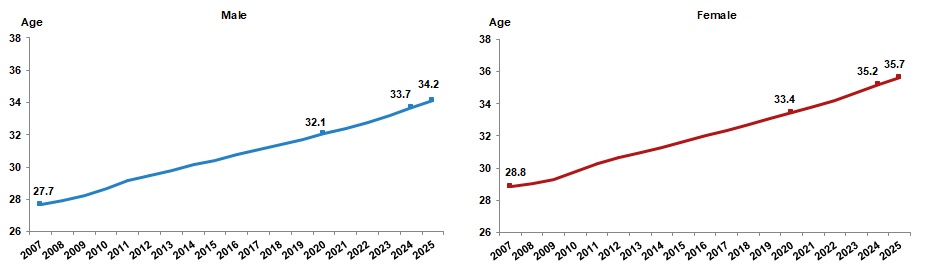
Turkey’s population is getting older at a pace that is beginning to reshape the country’s economic and social outlook, with the median age rising to 34.9 in 2025 from 34.4 a year earlier and from roughly 28 years in 2007.
The new figures published last week by the Turkish Statistical Institute (TUİK or TurkStat), show that the change is being driven primarily by a sustained decline in fertility, combined with falling mortality. The number of children is shrinking while the share of older people is increasing, gradually changing the balance between those who work and those who depend on public services and social benefits.
Turkey’s population still grew in 2025, reaching 86.1 million, but the annual population growth rate was only 5 per thousand. The country’s total fertility rate fell to 1.48 children per woman in 2024, well below the replacement level of about 2.1. TUİK says fertility has fallen sharply since 2014 after remaining around replacement level for much of the previous decade.
The demographic change is particularly striking because Turkey remains considerably younger than the European Union. The median age in the EU was 44.9 in 2025, compared with 34.9 in Turkey. People aged 65 and over accounted for 22 percent of the EU population, twice Turkey’s 11.1 percent. But Turkey is moving in the same direction and is doing so quickly.
Median age by sex, 2007-2025
In 2007 children aged 0 to 14 accounted for 26.4 percent of Turkey’s population. By 2025 their share had fallen to 20.4 percent. Over the same period, the share of people aged 65 and over increased from 7.1 percent to 11.1 percent.
The working-age population, defined as people aged 15 to 64, still represented 68.5 percent of the population in 2025, up from 66.5 percent in 2007. But that increase is largely a consequence of the shrinking share of children moving into the working-age group. It does not mean that Turkey has escaped the effects of aging.
The elderly dependency ratio, which measures the number of people aged 65 and over for every 100 people of working age, rose from 15.5 in 2024 to 16.2 in 2025. TUİK projects that it could reach 19.5 in 2030, 26.5 in 2040 and 45.5 in 2060 if current demographic trends continue.
Turkey is also highly uneven demographically, with older populations concentrated in the north and younger populations in the south and southeast. Sinop on the Black Sea coast in northern Turkey had the highest median age in 2025 at 44, followed by the northern provinces of Giresun at 43.5 and Kastamonu at 43.3. In contrast, Şanlıurfa in southeastern Turkey had the lowest median age at 21.8, followed by neighboring Şırnak at 23.3 and Siirt at 25. The divide shows how demographic ageing is already far more advanced in some northern parts of the country than in the younger south and southeast.
Population and annual population growth rate, 2007-2025
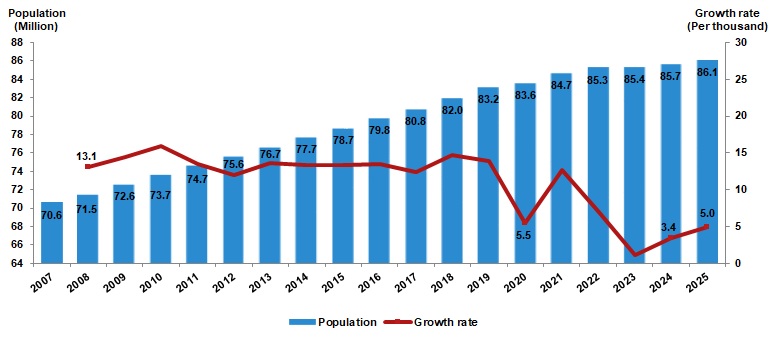
TUİK defines the demographic window of opportunity as the period when the dependent population remains relatively small compared with the working-age population. Its projections say the window is expected to close in the first half of 2030 because the share of people aged 65 and over is projected to exceed 15 percent.
That is the basis for the 2030 reference. It is not an independent estimate that Turkey will suddenly become an old country in 2030. Rather, it is the date TUİK’s population projections identify for the end of a period in which the country has a relatively favorable ratio of working-age people to dependents.
The same projections put the median age at 37.1 in 2030, 41.4 in 2040 and 48 in 2060. That creates a narrowing period in which Turkey can convert its relatively large working-age population into higher productivity, employment and economic growth before aging places greater pressure on public finances.
Population pyramid, 2007, 2025
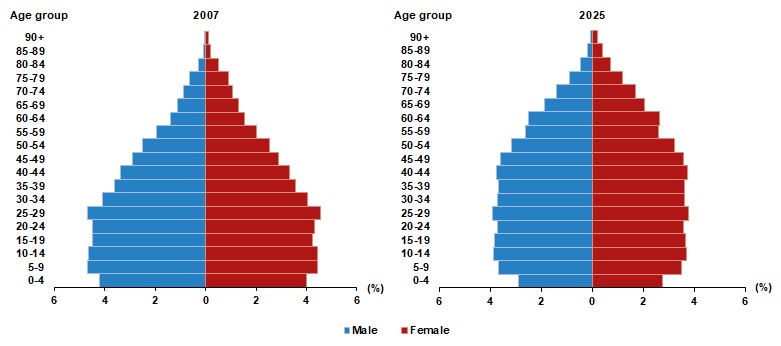
The Social Security Institution (SGK) will face a gradually more difficult demographic environment as the number of retirees grows relative to the number of people paying contributions. The demographic balance behind the system will become less favorable. Governments could face greater pressure to increase revenue, contain pension costs, encourage longer working lives or raise employment among groups with lower participation rates.
Health care will face a similar shift. An older population generally requires more treatment for chronic diseases and greater demand for long-term and elderly care. As the share of older people rises, spending priorities are likely to move gradually from services associated with a young population toward chronic disease management, rehabilitation and long-term care.
The EU is already further along this path. With 22 percent of its population aged 65 or older in 2025, European countries are dealing with a much larger elderly population than Turkey currently has.
Age dependency ratios, 2021-2025

Demographic aging also has implications for Turkey’s compulsory military service system. A smaller generation of young men means a smaller pool from which conscripts can be drawn. That does not necessarily mean a smaller military. It can increase the importance of professional personnel, technology and unmanned systems as the number of young people available for compulsory service declines.
Education faces an almost opposite problem. For decades Turkey responded to a growing young population largely by building more schools, universities and other facilities, rather than focusing on the quality of education. Falling birth rates will gradually reduce the number of children entering schools and the number of young people reaching university age.
That could mean pressure to consolidate schools in areas with falling populations, adjust teacher requirements and reconsider university capacity. The issue will be less about accommodating ever-larger groups of students and more about adapting institutions to smaller ones.
TUİK’s main projection puts the population at 93.8 million in 2050 before it begins to decline, eventually falling below 77 million by 2100 if current demographic trends continue. The immediate problem is therefore not population decline itself but the combination of slower growth and rapid aging.
Economic conditions are an important part of the fertility story. The United Nations Population Fund says economic uncertainty, housing costs, the rising cost of raising and educating children and the difficulty of combining work and family life are among the factors causing many people in Turkey to delay parenthood or have fewer children than they would otherwise want.
The OECD has similarly pointed to limited access to affordable childcare and the low level of public spending on early childhood education and care as barriers affecting families and women’s participation in the labor market.
Fewer children mean fewer future workers. Fewer workers mean greater pressure on pension and health systems. At the same time a smaller workforce can make economic growth increasingly dependent on productivity gains rather than an expanding labor supply.
Turkey still has a demographic advantage compared with most European Union countries. Its median age is about 10 years below the EU average and its elderly population is half the EU share. But the gap is narrowing in structural terms as fertility remains well below replacement level. The OECD says Turkey’s demographic dividend is set to decline and points to higher female labor-force participation, better skills and stronger productivity as important elements for sustaining growth.
For Turkey, the demographic challenge is therefore not simply that people are living longer. It is that the generations replacing today’s workers are becoming smaller.