
Abdullah Bozkurt/Stockholm
Turkish President Recep Tayyip Erdogan’s increasingly frequent verbal slips, apparent moments of confusion, memory lapses, angry outbursts and visible signs of fatigue have renewed questions about the 72-year-old leader’s health and whether age-related decline compounded by a longstanding neurological condition may be affecting his performance in office.
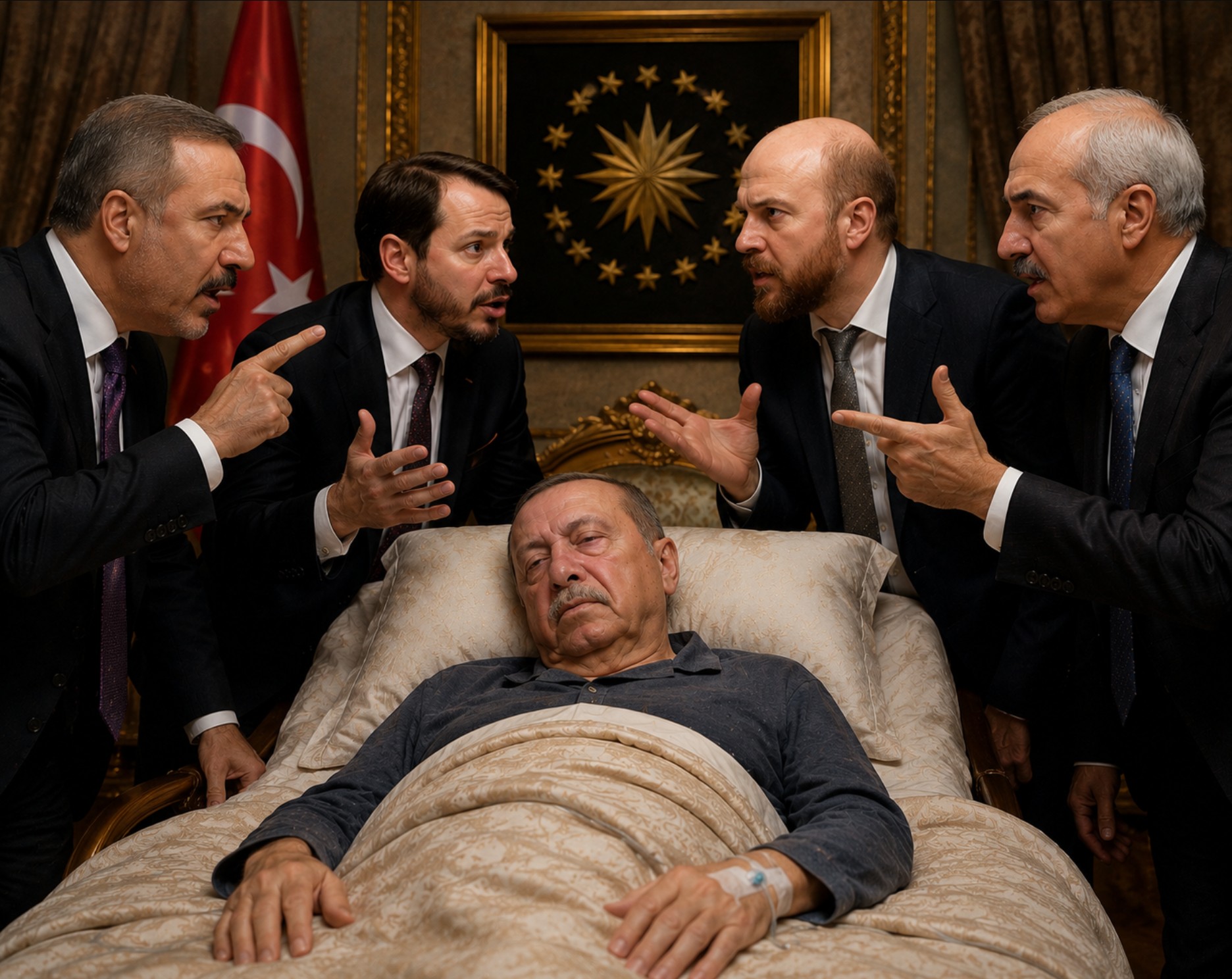
Concerns over his deteriorating condition have also intensified jockeying among competing power centers within the ruling establishment, including members of his own family, over who might eventually succeed Turkey’s longest-serving leader in the event that health problems force him from the political stage.
The issue is particularly significant in Turkey, where immense powers have been concentrated in the presidency since a constitutional referendum in 2018 transformed the country into an executive presidential system. Erdogan personally oversees virtually all major decisions involving domestic politics, the judiciary, intelligence and security services, public finances, military operations and foreign policy, leaving little room for institutional checks or delegation of authority.
Confidential information obtained by Nordic Monitor indicates that Erdogan is spending less time focused on day-to-day governance, increasingly relying on a tight circle of presidential advisors who control access to him, including for members of his ruling Justice and Development Party (AKP). A feud within Erdogan’s family, whose members have intimate knowledge of his declining health, has reportedly deepened in recent years, with rival factions seeking support from the AKP, the military, intelligence services and other power centers in the state bureaucracy.
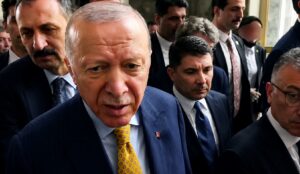
Questions about Erdogan’s health have circulated for years. A previous Nordic Monitor investigation revealed that the Turkish president underwent surgery for colorectal cancer in 2011 and suffers from epilepsy, a condition that former associates said required close monitoring by a small circle of trusted aides. The Turkish government has repeatedly denied reports suggesting that Erdogan suffers from serious health problems and has often reacted aggressively to speculation about his medical condition.
In recent years, however, incidents involving the president have become more difficult to dismiss as isolated episodes. Erdogan has at times appeared physically exhausted during public appearances, dozing off during joint press events, struggled to maintain focus while speaking, lost his train of thought, mixed up names and dates and occasionally displayed sudden bursts of anger directed at political opponents, journalists and foreign governments.
Medical experts note that epilepsy is not simply a disorder characterized by seizures. In some patients, particularly those who have lived with the condition for many years as in the case of Erdogan, epilepsy may also be associated with cognitive difficulties that can become more pronounced with advancing age.
Studies have shown that patients with longstanding epilepsy may experience problems with short-term memory, attention span, information-processing speed and word retrieval. Some complain of forgetfulness, difficulty concentrating, losing their train of thought during conversations and struggling to recall names, places or recent events.
President Recep Tayyip Erdogan appears not to recognize his longtime chief bodyguard, Muhsin Köse, refusing a glass of water offered by him during a campaign stop in Hatay on May 21, 2023. The president drank only after his son Bilal Erdoğan stepped in and personally handed him the glass:
Although the severity of these symptoms varies considerably from person to person, older patients who have had epilepsy for decades may be more susceptible to cognitive impairment.
That seems to be what is happening with Erdogan.
Experts Nordic Monitor talked to also point out that anti-epileptic medications Erdogan has been using can sometimes contribute to drowsiness, fatigue, slowed thinking, speech difficulties and memory problems, particularly when taken over extended periods or in combination with other drugs as in the case of Erdogan.
Recurrent seizures, sleep deprivation, stress and aging may further aggravate these symptoms.
Without access to Erdogan’s medical records, details of his treatment or independent evaluations by physicians, it is impossible to determine whether any observed behavioral changes are linked to epilepsy, medication side effects, the natural aging process or other medical conditions. Erdogan’s office has kept mum on his medical check-up results, instead organizing carefully choreographed events in his palace, showing him shooting basketball or playing football with no press invited to cover.
Nevertheless, the recurrence of episodes involving speech lapses, apparent confusion and visible discomfort has prompted renewed scrutiny of the president’s fitness for office.
Publicly available footage from recent years has also raised questions about Erdogan’s mobility. In numerous videos, the president appears to walk more slowly than those accompanying him, particularly during arrivals and departures of visiting dignitaries or while greeting officials during overseas trips. He has occasionally been seen placing a hand on a bodyguard or aide while climbing or descending stairs, seemingly seeking additional support.
Observers have also noted that Erdogan often wears orthopedic-looking footwear or balance shoes that appear designed to provide greater stability. While these images have fueled speculation about possible balance or gait issues, the underlying cause remains unknown to the public. They could very well stem from a variety of factors, including aging, medication side effects, neurological conditions or other health problems.
President Recep Tayyip Erdogan is seen leaning on the shoulder of a bodyguard while his wife, Emine Erdoğan, holds his arm as he carefully walks down steps from a podium following a speech in 2021, fueling speculation about possible balance or mobility issues:
Neurologists note that while epilepsy does not ordinarily cause persistent gait impairment, some patients — particularly older individuals with longstanding epilepsy — may experience balance problems, unsteady walking or coordination difficulties as a result of recurrent seizures, medication side effects or age-related neurological changes.
Some notable incidents involving Erdogan’s health have unfolded in full view of television cameras. During an election campaign stop in Hatay on May 21, 2023, Erdogan declined a glass of water offered by his longtime chief bodyguard, Muhsin Köse, who has accompanied him at virtually every public event since 2012 and is regarded as one of his most trusted aides. He appeared to have not recognized Köse. Only after his younger son, Necmettin Bilal Erdogan, intervened and handed him the same glass of water himself did the president take a drink.
In a subsequent interview with Qatar-based Atheer TV in 2023, Bilal Erdogan sought to explain the incident as a matter of security protocol. The explanation raised eyebrows because Köse has headed Erdogan’s protective detail for more than a decade and is among the few people granted constant physical proximity to the president. Bilal also disclosed that family members expected him to remain by his father’s side throughout the election campaign, saying, “It was necessary for me to be with our president during that election. Our family also had such an expectation.” His remarks appeared to indicate that Erdogan’s relatives maintain a close watch over his health, particularly during strenuous campaign periods when the risk of fatigue or medical complications increases.
Erdogan relies heavily on teleprompters during public speeches, typically reading from transparent screens positioned on both sides of the podium. While the use of teleprompters is common among political leaders, Erdogan has on several occasions appeared uncomfortable when technical glitches interrupted the flow of prepared remarks. During such episodes he has sometimes paused for extended periods, lost his place in the speech, misspoken or delivered remarks that critics said lacked coherence. Similar incidents, captured live on television, have fueled speculation that the president has become increasingly dependent on scripted appearances and carefully managed public engagements.
Even during supposedly unscripted television interviews, measures appear to have been taken to minimize the risk of mistakes. In one televised appearance in August 2021, a camera briefly switched to a wider angle, inadvertently revealing a large teleprompter screen positioned behind the journalists and outside the main camera frame. The screen appeared to display text corresponding to Erdogan’s responses, fueling criticism that the interview had been carefully choreographed, with questions agreed upon in advance and answers prepared beforehand. The incident reinforced perceptions that the president’s media appearances are tightly managed to avoid gaffes, lapses in concentration or other unscripted moments that could trigger renewed speculation about his health.
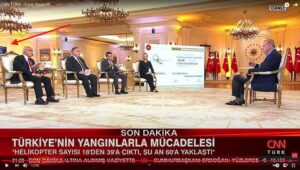
Erdogan has at times appeared to have difficulty following questions even during carefully managed television appearances. In a live TRT interview ahead of the 2019 Istanbul mayoral election rerun, he twice misunderstood questions posed by the presenter, forcing the host and other participants to clarify what had actually been asked.
Similar scenes have continued in recent years. In April 2026 Erdogan appeared not to understand a journalist’s question about arrests linked to the widely publicized disappearance and suspected murder of a young woman named Gülistan Doku. His party comrade Abdullah Güler, standing nearby, stepped in to explain the issue in the president’s ear and suggested an answer, after which Erdogan merely indicated that whatever he said on the matter would be his comment as well.
Erdogan’s public appearances have also been marked by occasional verbal slips. Following a cabinet meeting in 2020, he mistakenly declared, “Our people’s lives are not more precious than anything else,” while speaking about an earthquake in İzmir, conveying the opposite of what he intended to say.
Erdogan’s deteriorating health, closely observed by family members, longtime associates and senior party figures, has already fueled growing debate in Ankara over who might eventually succeed Turkey’s longest-serving leader. Rival factions within the ruling establishment, including the AKP, the cabinet and Erdogan’s own family, have reportedly been positioning themselves for a post-Erdogan era amid concerns that health complications could abruptly end his political career.
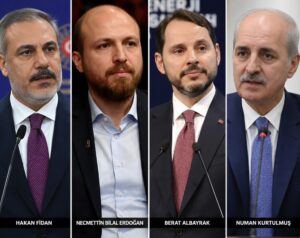
The most visible rivalry appears to involve Erdogan’s younger son, Necmettin Bilal Erdogan, widely believed to be the president’s preferred successor, and his son-in-law, former finance minister Berat Albayrak, who retains considerable influence within the party apparatus and state bureaucracy.
Another son-in-law, Selçuk Bayraktar, the chairman of Turkey’s leading drone manufacturer and a prominent figure in the defense industry, was at one point seen by some observers as a potential contender but is now believed to have aligned himself more closely with Bilal Erdogan.
Within the cabinet, former intelligence chief and current foreign minister Hakan Fidan is widely believed in Ankara political circles to harbor presidential ambitions and has quietly been positioning himself as a potential successor. He relies on a network of businessmen, media personalities and underworld figures cultivated during his long tenure at the intelligence agency to bolster his public profile, generate funding and support political outreach efforts.
Meanwhile, Parliament Speaker Numan Kurtulmuş, a veteran Islamist politician once touted as a possible heir apparent to Erdogan, has increasingly emphasized his readiness to serve if called upon and is said to be conducting his own behind-the-scenes campaign to rally support within the ruling establishment.
The secrecy surrounding Erdogan’s health stands in contrast to practices in many democratic countries, where leaders routinely disclose medical evaluations to reassure the public about their ability to carry out the demanding responsibilities of office. In Turkey, however, discussions about the president’s health remain highly sensitive, and authorities have investigated or prosecuted individuals accused of spreading rumors regarding Erdogan’s condition when they wrote or commented about it.
As Erdogan enters his third decade as Turkey’s dominant political figure, the growing number of public incidents has made it increasingly difficult for his aides and government officials to dismiss concerns about his health. Whether these episodes reflect a neurological disorder, the side effects of medication, age-related decline or a combination of factors remains unknown. Yet the secrecy surrounding the president’s medical condition has only fueled speculation about the fitness of a man who wields more power than any Turkish leader in modern history, perhaps with the exception of the founder of the republic, Mustafa Kemal Atatürk.