
Abdullah Bozkurt/Stockholm
The Turkish government’s aggressive use of imprisonment against critics, dissidents and political opponents has continued to drive the country’s prison population to unprecedented levels, transforming Turkey into Europe’s largest jailer despite repeated amnesty-style releases of hundreds of thousands of non-political inmates.
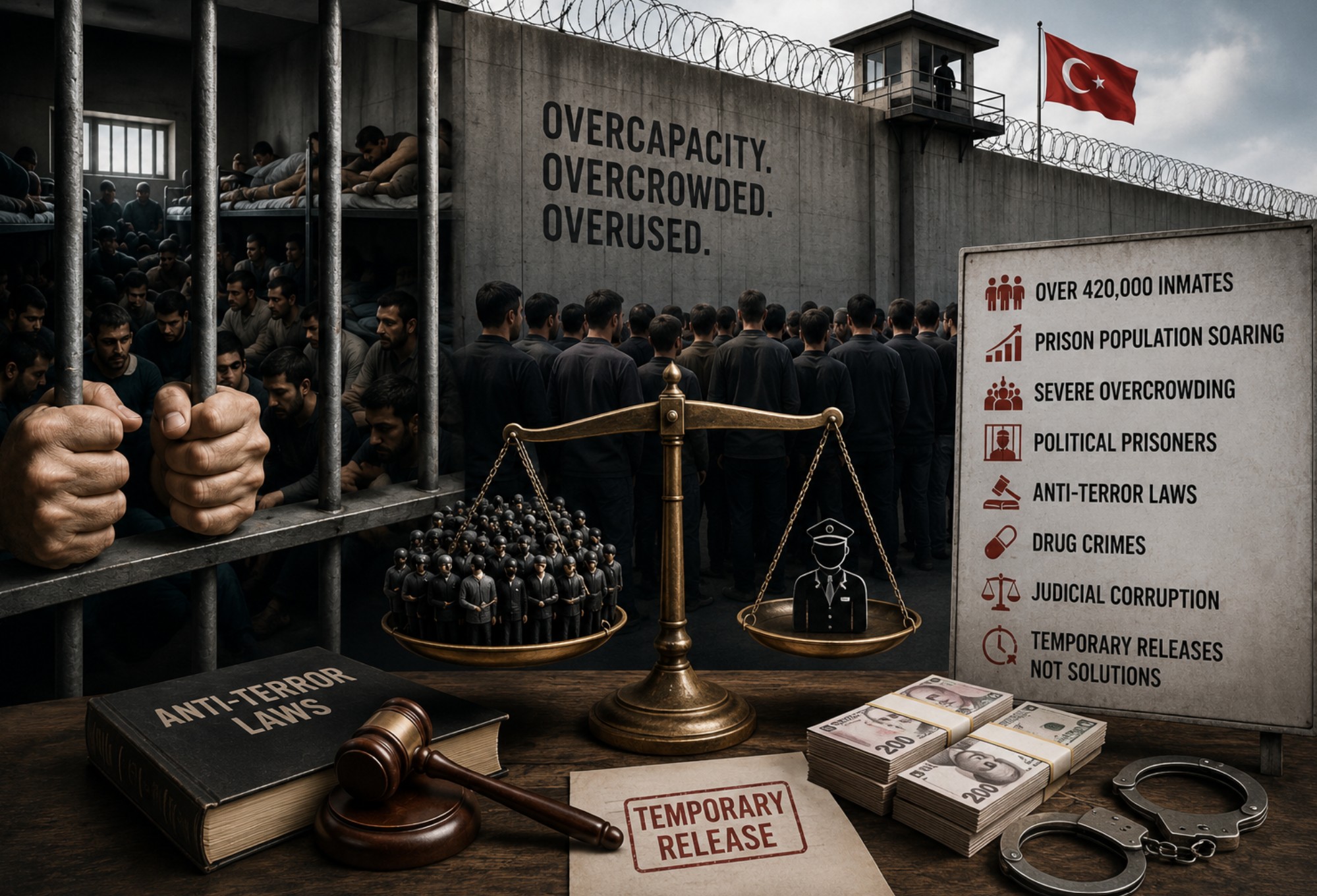
According to the latest official figures released by the Justice Ministry, Turkey’s prison population had exceeded 420,000 inmates as of May 2026, far surpassing the system’s official capacity and placing the country at the top of Europe in incarceration rates.
Turkey’s prison system is currently holding 420,798 inmates in 402 prisons designed to accommodate only 304,390 people. Of the total prison population, 357,283 are convicted prisoners while 63,515 are pretrial detainees awaiting trial or final sentencing.
The figures reveal not only a severe overcrowding crisis but also the increasingly punitive character of Turkey’s justice system under President Recep Tayyip Erdogan.
Among those imprisoned are 4,680 youngsters between the ages of 12 and 18, including 526 girls, who were jailed in juvenile detention facilities. In addition, 891 children between the ages of zero and six are currently living behind bars with their incarcerated mothers, many of whom were imprisoned on politically motivated charges for failing to align themselves with the Erdogan government’s political Islamist agenda.
The scale of Turkey’s prison crisis was also highlighted in the Council of Europe’s latest SPACE I 2025 penal statistics report prepared by criminologists Marcelo Aebi and Edoardo Cocco, which placed Turkey in the “very high” category for prison population rates, overcrowding and inmate-to-staff ratios.

The report concluded that Turkey’s penal system increasingly resembles authoritarian and post-Soviet incarceration models rather than the lower-incarceration systems now favored across much of Western and Northern Europe.
The increase in inmate numbers has been staggering when viewed historically. In 1999 Turkey’s prison population stood at around 70,000, while the country’s population was approximately 65 million. Today Turkey’s population is roughly 85 million, yet the number of prisoners has increased nearly sixfold.
According to the Council of Europe report, the European median prison population rate stood at 110.1 inmates per 100,000 inhabitants in 2025. Turkey’s incarceration rate was significantly higher, putting it among Europe’s most prison-heavy systems.
This has happened despite repeated prisoner-release measures introduced by the Erdogan government, with prisons continuing to fill rapidly. Since 2020 Turkey has released nearly 357,000 inmates through various amnesty arrangements, including COVID-era releases. Yet the prison population quickly rebounded. Without those mass releases, Turkey’s already severe overcrowding crisis would have been even worse.
According to the Council of Europe’s latest SPACE I 2025 penal statistics report, Turkey ranks among Europe’s worst-performing countries in key prison indicators, including incarceration rates, overcrowding and inmate-to-staff ratios:
Several factors lie behind this massive overcrowding crisis. Chief among them are the mass incarceration policies pursued under President Erdogan, whose government continues to rely heavily on prolonged pretrial detention, sweeping prosecutions and false convictions under broadly defined counterterrorism laws.
The problem intensified dramatically following a coup attempt in July 2016, widely described by critics as a false-flag operation by Turkish intelligence agency MIT, after which Erdogan launched sweeping purges and politically motivated prosecutions targeting dissidents, journalists, academics, judges, military officers and civil servants.
Human rights organizations and legal experts have long argued that Turkey’s exploding prison population reflects not merely rising crime but also the systematic weaponization of the criminal justice system under Erdogan’s increasingly authoritarian rule.
A second major factor is the collapse of state institutions following the mass purges and the deepening corruption within the judiciary and law enforcement agencies. Political loyalists who often lacked merit, experience or professional qualifications replaced thousands of judges, prosecutors and police officials, severely weakening the rule of law and crippling the independence of criminal justice institutions.
Turkey has increasingly drifted toward becoming a narco-state where organized crime networks and major drug traffickers operate with political protection and relative impunity. Nearly one-third of the prison population is incarcerated on drug-related charges, many of them low-level street dealers or users, while major narcotics kingpins and organized crime bosses continue operating under the protection of corrupt officials and politically connected figures.

At the same time, ordinary crime statistics have also surged sharply.
In 2023 alone investigations involving property crimes reached 4.74 million files involving nearly 5.9 million suspects. Investigations into crimes involving bodily harm exceeded 1.38 million files with more than 2 million suspects, while theft-related investigations alone totaled 2.79 million files involving more than 3.15 million suspects.
Crimes against life also increased significantly. Investigations into intentional killing, negligent homicide and incitement to suicide rose from 77,416 files in 2022 to 96,505 files in 2023. The number of suspects climbed from 124,025 to 140,084.
Rather than addressing the root causes of overcrowding through credible judicial, institutional and social reforms, the Erdogan government has repeatedly resorted to early-release mechanisms to temporarily ease pressure on prisons.
The latest such measure, adopted in December 2025, paved the way for the release of up to 100,000 inmates, including convicted prisoners, pretrial detainees and repeat offenders.
Authorities have also increasingly relied on transferring inmates between prisons to create space in larger facilities, but the strategy has merely shifted overcrowding to smaller regional prisons that are themselves struggling with severe capacity shortages.

Meanwhile the construction of new prisons continues at full speed.
According to Turkey’s Presidential Investment Program, two new prisons planned for the Alaplı district of Zonguldak and the Boyabat district of Sinop will cost nearly 1.9 billion Turkish lira. In addition, the government plans to spend 7.7 billion lira in 2026 to complete 11 prisons currently under construction.
Turkey’s largest prison complex, Silivri Prison near Istanbul, notorious for housing political prisoners, journalists and dissidents, holds nearly 22,000 inmates, effectively functioning as a medium-sized city.
The Sincan prison complex near Ankara, another facility heavily used for political detentions, is also operating at full capacity with approximately 10,000 inmates.
The Council of Europe report further highlighted that Turkey records one of Europe’s highest prison admission and release rates, reflecting the enormous turnover, instability and dysfunction within the penal system.
The Erdogan government now faces a growing dilemma: continue building prisons indefinitely or move toward broader amnesty legislation to manage the exploding inmate population. Discussions are already circulating in Ankara about the possibility of a more comprehensive future amnesty.
Yet the Erdogan government’s heavy reliance on intimidation, fear and politically motivated prosecutions to maintain its increasingly authoritarian rule means that the prison system remains one of its primary tools for suppressing opposition and silencing dissent.
As long as imprisonment continues to serve as a central instrument of political control, and law enforcement efforts against organized crime remain focused primarily on low-level offenders rather than major criminal networks, Turkey’s chronic prison overcrowding crisis is likely to persist despite repeated amnesty laws, temporary release programs and the construction of new mega-prisons across the country.