


Levent Kenez/Stockholm
The European Court of Human Rights (ECtHR) has finalized a new judgment against Turkey after rejecting the government’s request to refer the case of Abo v. Turkey to its Grand Chamber, raising concerns that Ankara continues to resist compliance with binding rulings from Europe’s top human rights court.
The court’s Grand Chamber on March 23, 2026, declined Turkey’s appeal, making final a November 13, 2025, judgment that found violations of the right to a fair trial under Article 6 of the European Convention on Human Rights. The ruling centered on how Turkish courts handled a request to reopen criminal proceedings following an earlier violation judgment in the same case.
In its decision the Strasbourg-based court concluded that domestic courts in Turkey dismissed the applicant’s request for a retrial using what it described as automatic and insufficient reasoning, failing to properly assess the legal consequences of an earlier rights violation. The court held that such an approach undermined the applicant’s right to a fair hearing.
The case concerns Davut Abo, who had previously secured a ruling from the ECtHR in 2013 finding that he was denied access to a lawyer while in police custody. Despite that earlier finding, Turkish courts refused to reopen his case, arguing that the procedural violation did not affect the outcome of his conviction and was not about the merits of the case.
The European court rejected that reasoning. It said that serious procedural flaws such as reliance on statements obtained without legal counsel cannot be dismissed as irrelevant to the outcome of a case. It found that Turkish courts failed to conduct a meaningful review and instead relied on formulaic justifications to deny a retrial.
The ruling also addressed delays in the reconsideration process. The court found that proceedings related to the reopen the case lasted more than 11 months, violating the requirement for a trial within a reasonable period of time. It ordered Turkey to pay compensation and stated that a new trial conducted in line with fair trial standards would be the most appropriate remedy.
Text of the European Court of Human Rights judgment delivered on March 23, 2026:
The judgment goes beyond the individual case and points to structural issues in how Turkish courts respond to rulings from Strasbourg. The ECtHR explicitly criticized Turkey’s Constitutional Court for failing to correct shortcomings in lower court decisions. It found that the high court did not provide effective oversight and instead dismissed the applicant’s complaints without adequately addressing the substance of the violations.
The court noted that the Constitutional Court relied on the argument that it should not act as a “fourth instance,” meaning it should not function as an additional level of appeal that re-examines the facts and evidence, avoiding a deeper review of the lower courts’ reasoning. According to the ECtHR, this approach contributed to a pattern in which domestic courts resist implementing binding human rights judgments.
Legal scholar Ufuk Yeşil wrote on X that the ruling is significant because it clarifies how retrial requests following European court judgments should be handled. He noted that the Grand Chamber’s rejection of Turkey’s appeal made the violation ruling final and pointed to the binding nature of the decision.
Yeşil said the court clearly found that rejecting requests for retrial with formulaic reasoning violates the right to a fair trial, especially in cases involving serious procedural flaws such as statements taken without the presence of a lawyer. He added that the court also treated the retrial phase as part of the determination of a criminal charge, meaning it must comply fully with fair trial guarantees. According to Yeşil the ruling also criticized the Turkish Constitutional Court for remaining passive in the face of unlawful resistance by lower courts, allowing a culture of judicial non-compliance to develop. He said the ECtHR accused the high court of weakening fair trial protections by failing to exercise proper oversight.
The Abo ruling adds to a growing body of judgments in which the European court has found that Turkey does not fully implement its decisions. While the convention system requires member states to comply with final judgments, enforcement depends on domestic authorities taking corrective action.
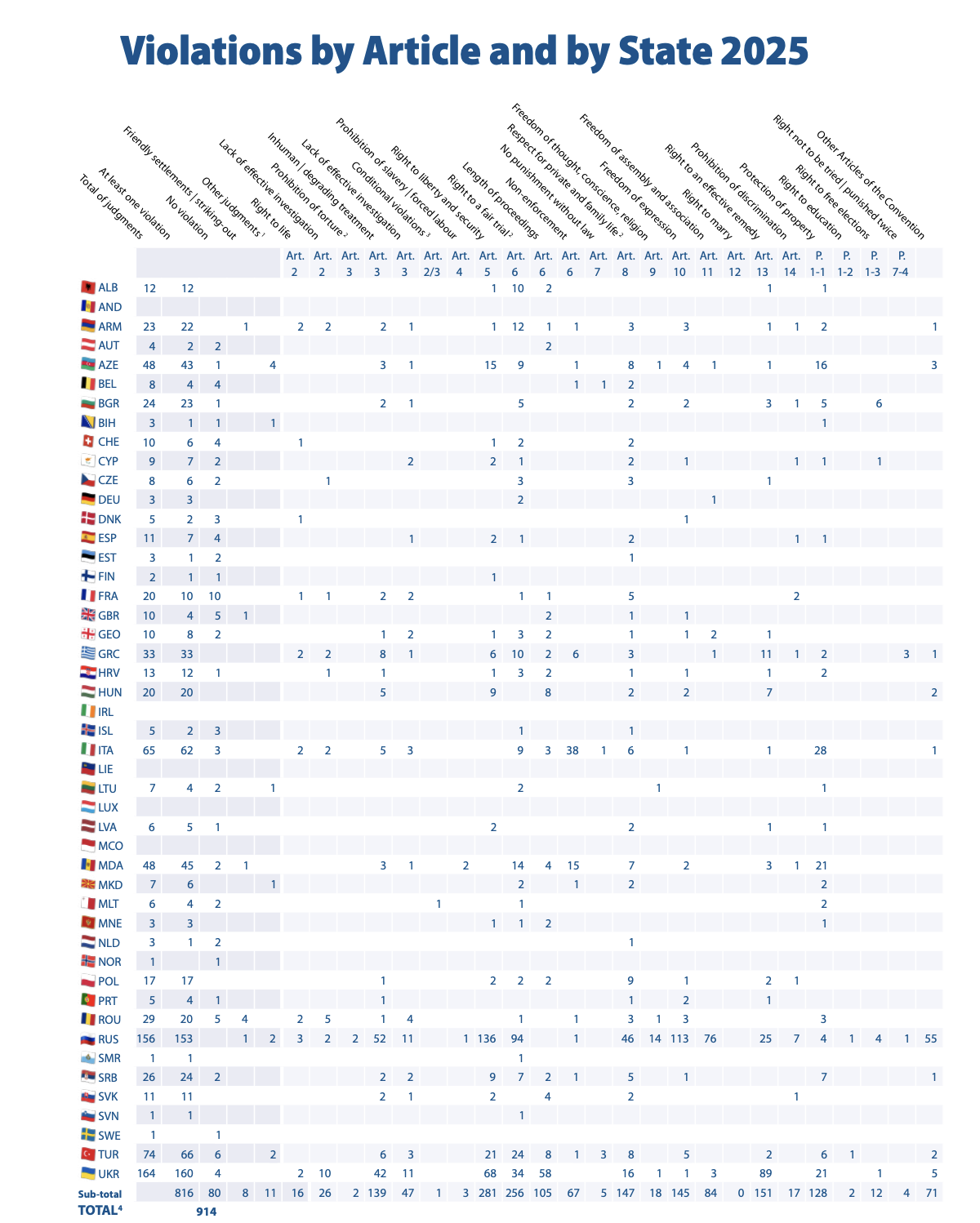
Recent data show that Turkey remains the country with the highest number of applications before the ECtHR among the 46 member states of the Council of Europe. According to the court’s 2025 Annual Report, 6,743 new applications were filed against Turkey during the year, and 18,464 cases were pending as of December 31, accounting for more than a third of the court’s total caseload.
The report also indicated that the court delivered 74 judgments concerning Turkey in 2025, finding at least one violation in 66 of them. The most frequent violations involved the right to a fair trial and the right to liberty and security.
A significant portion of these cases stems from measures taken after a coup attempt on July 15, 2016, including arrests, detentions and dismissals from public service. The court noted that many applications raise similar legal issues and are therefore examined in groups, meaning the number of affected individuals is substantially higher than the number of judgments.
Among the most serious findings are violations of Article 7 of the convention, which prohibits punishment without law. In 2025 three of the five Article 7 violations identified across all member states involved Turkey. The court found that domestic courts applied criminal law in ways that were not foreseeable, undermining the principle of legality.
The concentration of such violations in Turkish cases was described in the court’s report as indicative of systemic problems. Article 7 is considered absolute under the convention, meaning it allows no exceptions even in times of emergency.
Despite repeated findings, the volume of applications from Turkey remains high. The court reported approximately 650 new cases in the first weeks of 2026 alone, suggesting that the flow of complaints is continuing.
The Abo judgment adds to concerns that Turkey’s judiciary has not aligned its practices with European human rights standards. By finalizing the ruling, the European court has once again signaled that domestic courts must provide substantive and reasoned decisions when addressing rights violations.
The decision also points to a broader issue. While the ECtHR continues to issue detailed rulings, their impact depends on whether national authorities take them seriously. In the case of Turkey the pattern identified by the court suggests that compliance remains inconsistent, raising ongoing questions about the effectiveness of the convention system in ensuring accountability.