
Abdullah Bozkurt/Stockholm
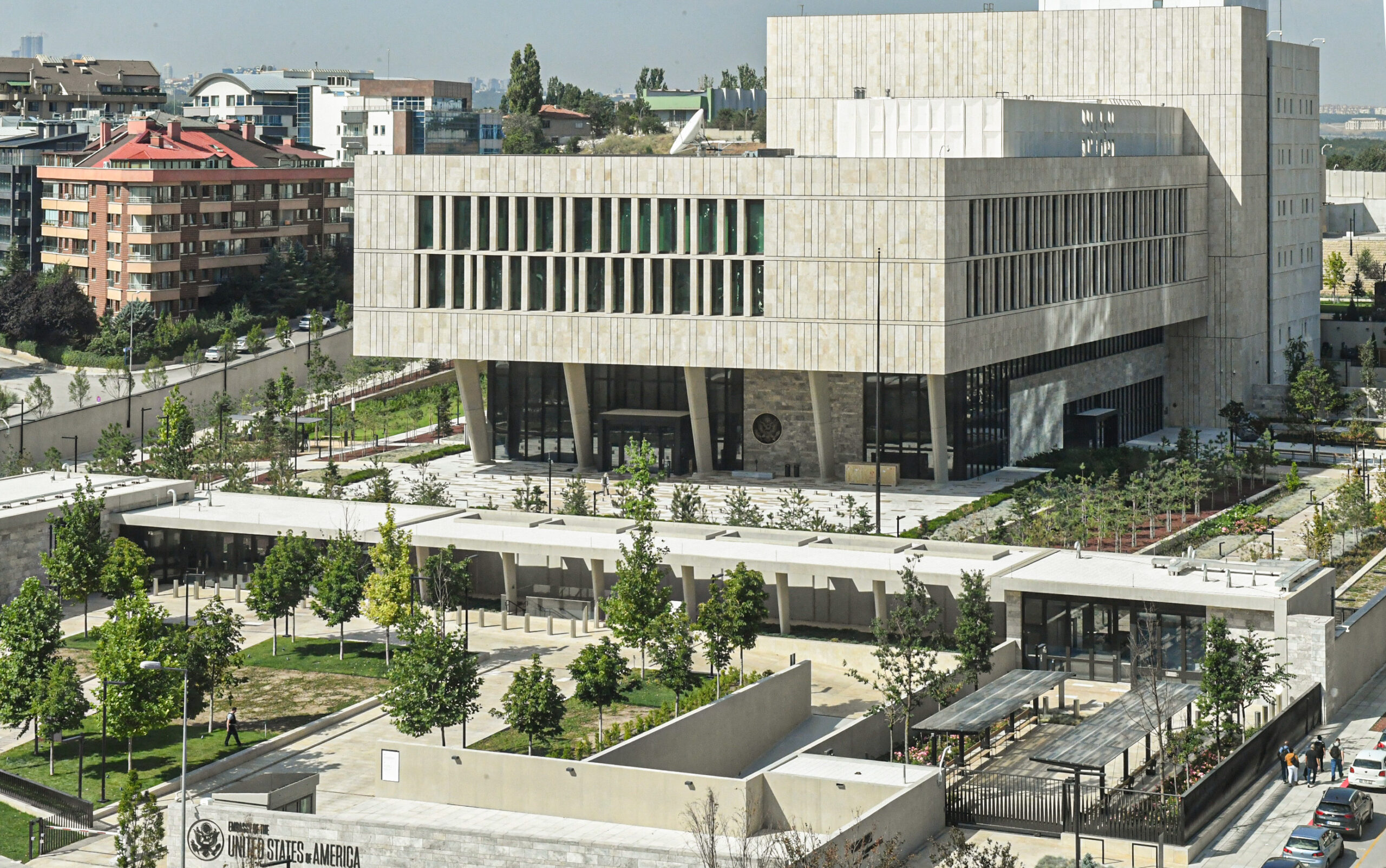
The sprawling new US Embassy compound in Ankara, operational since 2022, faces renewed legal uncertainty after Turkey’s Supreme Court of Appeals annulled a lower court ruling that had dismissed a lawsuit challenging the land sale behind the project.
The decision by Turkey’s high court, dominated by far-right nationalists and Islamists, reopens a politically sensitive case at the intersection of diplomacy, property law and the legacy of modern Turkey’s founder, Mustafa Kemal Atatürk.
The dispute centers on a 36,999-square-meter plot in Çukurambar, where the embassy compound is now located. The plaintiffs argued that the land had once been part of the Atatürk Orman Çiftliği (Atatürk Forest Farm, AOÇ), a large agricultural and recreational area in Ankara that was founded personally by Mustafa Kemal Atatürk, the founder of the Turkish Republic, in 1925, The AOÇ was later donated to the Turkish state in 1937 through Atatürk’s will, which specified that the estate should be used for public benefit, education and agriculture.
They claimed that instead of being returned to the AOÇ administration when Gazi University no longer needed it, the land was transferred to Turkey’s Housing Development Administration (TOKİ), which then sold it to the United States in 2014. According to the plaintiffs, this amounted to a violation of Atatürk’s will and of the public interest.
TOKİ rejected this argument, maintaining that the parcel in question was not part of AOÇ land but a standard registered plot in Çukurambar. It stressed that the sale followed established legal procedures, including approval by the Prime Ministry under a 2012 directive at the time, and coordination with the Ministry of Foreign Affairs.
The ruling of the Supreme Court of Appeals has put the status of the new US Embassy compound in legal limbo:
The agency also noted that international law allows such transfers, citing the 1961 Vienna Convention on Diplomatic Relations, which provides for host states to facilitate diplomatic premises for foreign governments. The sale was formalized through a protocol signed in July 2013 between TOKİ, the Turkish Foreign Ministry and US representatives, with transfer of the deed completed in April 2014.
The Ankara 9th Civil Court of First Instance dismissed the lawsuit, reasoning that the United States, as the other party to the disputed contract, was not formally included in the case and that a court could not annul a contract without the participation of all parties. The Ankara Regional Court of Appeals (4th Civil Chamber) upheld this decision in 2021, finding no procedural or legal fault.
But in its May 26, 2025 ruling, the 3rd Civil Chamber of the Supreme Court of Appeals found that the appellate court had failed to provide a sufficiently reasoned judgment. Citing Article 141 of the Turkish Constitution and Article 359 of the Code of Civil Procedure, the high court stressed that judicial decisions must clearly explain the factual findings and legal grounds on which they rest.
It emphasized that the reasoning of a court is not a formality but a constitutional requirement that ensures transparency, prevents arbitrariness and allows meaningful appellate review.
The chamber referred to earlier jurisprudence, including a precedent which held that a court’s reasoning must demonstrate how evidence and legal principles were weighed. It noted that in this case, the appellate court had failed to explain why it rejected the plaintiffs’ arguments, including claims that the AOÇ boundaries were ignored and that an earlier order to obtain maps and documents showing those boundaries was abandoned without justification. Without proper reasoning, the high court ruled, neither the parties nor the Supreme Court of Appeals itself could assess the lawfulness of the judgment.

On those grounds, the high court annulled the appellate ruling and returned the file to the Ankara Regional Court of Appeals for reconsideration.
It did not yet address the plaintiffs’ substantive claims regarding Atatürk’s will, AOÇ boundaries or the legality of the sale, holding that such matters could only be reviewed after the appeals court issued a properly reasoned decision.
Meanwhile, the US Embassy complex has already been completed on the contested land. The nine-acre compound, designed by Ennead Architects and Turkish partner Emre Arolat and built by B.L. Harbert International between 2017 and 2022, includes an eight-story chancery building, underground visitor garage and landscaped courtyards.
The decision could have far-reaching repercussions for Turkey and may raise issues at the bilateral level between Ankara and Washington. Given that the Turkish judiciary is entirely dominated by the government of President Recep Tayyip Erdoğan and that the rule of law has been effectively suspended, with the government weaponizing the justice system, the high court’s ruling may have been driven more by political considerations than by substantive procedural arguments.
The court also extended the legal process by refraining from examining the case on its merits, leaving the door open for further scrutiny of substantive issues even after the lower court’s detailed, reasoned judgment addressed the stated procedural flaws, which would follow the supreme court’s ruling.
As a result the ruling ensures that the debate is far from over, leaving the legal status of the embassy land and, by extension, the symbolic foundation of one of America’s largest diplomatic outposts in a state of limbo. This grants diplomatic and political leverage to President Erdogan, who could potentially use the legal case as a bargaining tool with the US administration.