
Abdullah Bozkurt/Stockholm
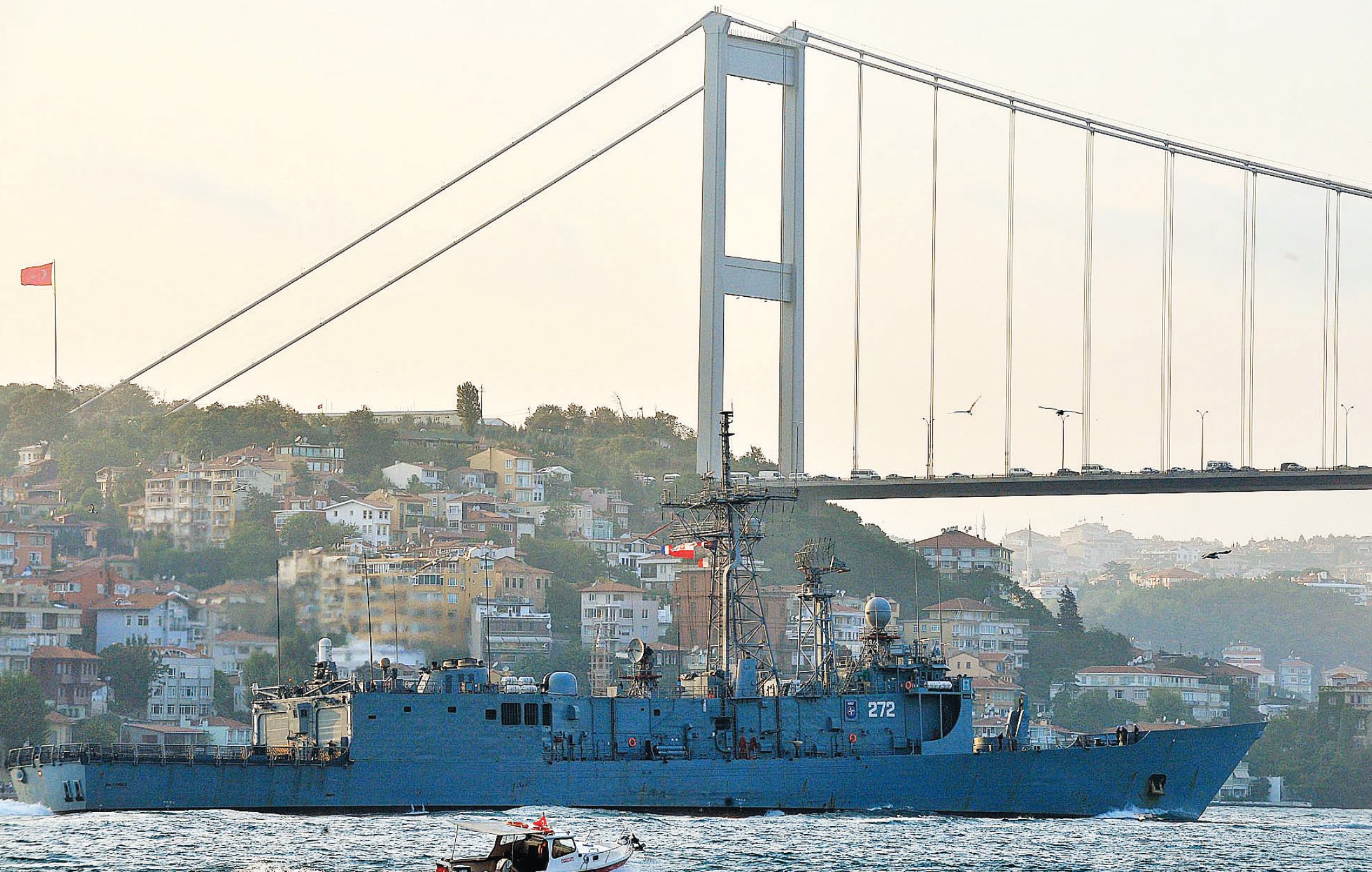
A secret draft directive for the Turkish navy concerning warships passing through the strategic Bosporus and Dardanelles straits in peacetime in violation of the 1936 Montreux Convention does not allow the Turkish military to strike, sink or harass vessels.
According to the draft “Joint Air and Missile Defense Directive of the Turkish Armed Forces” (Türk Silahli Kuvvetleri Müşterek Hava ve Füze Savunma Yönergesi), which updated the rules of engagement in 2016, the Turkish navy was authorized to monitor warships passing through Turkish straits and prevent violation of the Montreux articles, deny ships in violation from entering the straits in the first place and escort them out if they had managed to enter them.
The 246-page comprehensive directive, a copy of which was obtained by Nordic Monitor, lays out in detail the rules and regulations for the use of missiles and air defense elements in the Turkish armed forces in order to protect Turkish interests. It also covers the rules of engagement for violators of the Montreux Convention in the straits and Turkish territorial waters. The update was ordered by Hulusi Akar, the then-chief of general staff and currently defense minister and was set to replace previously issued directives.
“Foreign warships that are found to be in violation of the rules of the Montreux Convention are blocked before entering the strait. After entering the strait, these vessels are accompanied or closely monitored during their passage when a situation is found to be contrary to the rules of the Montreux Convention,” the directive states.
The directive does not authorize commanders on the ground or admirals at sea to take any direct action against foreign warships that violate Montreux. It instructs them to report the violation to their superiors, request for an order for a course of action if necessary and execute the order given by officer higher up in the chain of command.
The cover and parts of the draft directive concerning the rules of engagement in the Turkish straits with respect to the Montreux Convention:
The rules of engagement on the sea explicitly state in section 7 that “the rules of maritime engagement in the form of deterrent and coercive measures such as boat/ship sinking, firing, harassment and similar engagements that can create political impact and/or consequences are put into effect with the permission of the Chief of the General Staff in accordance with the authority given by the Prime Minister.”
In other words, only Turkish President Recep Tayyip Erdoğan — who abolished the prime ministerial position in 2017 when Turkey switched to presidential system of governance from parliamentary democracy – can order the firing, sinking or harassment of foreign warships in the Turkish straits.
The rules of engagement are said to be valid during peacetime or in a crisis and do not apply when Turkey is at war. They cover situations when Turkish navy ships, troops, maritime patrol planes and helicopters come in contact with foreign warships and commercial vessels.
It is not clear what happened to the draft on directives, but it was most likely approved in its final form with not much substantial change. The directive reflects Turkey’s long-standing position to avoid any conflict over the Montreux Convention and to keep peace in the Black Sea. Ankara has since the beginning of the 2000s opposed US pressure to allow a new and permanent NATO force in the Black Sea, fearing that it would violate the convention and complicate relations with Russia.
Turkey’s balancing act between the US, its long-time NATO ally, and Russia, its neighbor and trading partner, has become more complicated in recent years, especially with a massive purge of the Turkish military in the aftermath of a false flag coup bid in July 2016. The Erdoğan government even dismissed and/or jailed many of those who worked on the draft directive on the naval rules of engagement.
Similar changes in the rules of engagement with respect to Syria led to the shooting down of a Russian Sukhoi Su-24M on November 24, 2015 by a Turkish F-16 fighter jet near the border with Syria, close to where Turkey’s Hatay and Syria’s Latakia provinces meet in mountainous terrain. Nordic Monitor previously published documents showing that President Erdoğan instructed the Turkish Air Force to shoot down a military aircraft and that the order was executed by Akar, who personally congratulated the pilot who took the shot.
The downing of the Russian jet caused a diplomatic row between the two countries, with Russian President Vladimir Putin calling it “a stab in the back,” until Moscow and Ankara agreed to restore relations in June 2016. Although Erdoğan and other Turkish leaders had initially defied Russian threats and vowed to act again in line with the rules of engagement if another violation were to take place in the air, they later toned down the rhetoric.
The Montreux Convention has been a subject of debate in Turkey recently amid mounting tension between Kyiv and Moscow over the lingering conflict in Ukraine’s eastern Donbass region. The debate was triggered by a remark of Parliament Speaker Mustafa Şentop, who said Turkey can withdraw from the Montreux Convention just as it pulled out from the Istanbul Convention, a European treaty aimed at preventing and combating violence against women, with an executive decision issued by President Erdoğan.
The remark prompted neo-nationalist retired admirals to make a public declaration warning the government to keep its commitment to the Montreux Convention. President Erdoğan, who described the declaration as a prelude to a coup, nevertheless made it clear that Turkey is committed to the convention.
“The Montreux Convention was an important gain for Turkey for its time. We are continuing our commitment to the Montreux Convention, at least until there is a favorable replacement. If they want to declare an opinion in the discussion regarding the Montreux Convention, the way to do it is not to make such a statement, but instead to have academic study that will contribute to the literature on the convention,” Erdoğan said.
“We don’t have any intention and are not working to leave the Montreux Convention as of now. But if in the future there are other options, then we would be ready to re-evaluate the terms of the Montreux Convention in the international realm,” he added.
On April 9, 2021 Russian President Putin told Erdoğan on the phone that it was important to observe the current requirements of the Montreux Convention in the Turkish straits. Putin’s phone call came a day before Ukrainian President Volodymyr Zelenskiy’s visit to Istanbul to hold an intergovernmental conference, the Turkey-Ukraine High-Level Strategic Cooperation Council. In a joint press release, both presidents expressed their desire to keep peace in the Black Sea.
Russia, which has deployed more troops near border with Ukraine, is also concerned about the US and NATO military presence in the Black Sea. The US has already notified Turkey that it would send two warships to the Black Sea in line with the Montreux Convention.
Notification about Greek naval vessel in line with the Montreux Convention:
The Montreux Convention was signed on July 20, 1936 by Turkey, Great Britain, France, the USSR (Russia), Bulgaria, Greece, Germany, Yugoslavia and Japan (with reservations). During peacetime, light surface vessels (defined as warships displacing more than 100 tons but not above 10,000 tons) of all powers may transit the straits after giving prior notice to Turkey as required by the convention. Turkey may waive the notification requirement if the warships are transiting for the purpose of providing humanitarian assistance.
The convention applies specific individual and aggregate tonnage and numbers limits. These limitations effectively preclude the transit of capital ships and submarines of non-Black Sea powers through the straits, unless exempted under Article 17. Article 17 of the convention permits a naval force of any tonnage or composition to pay a courtesy visit of limited duration to a port in the straits at the invitation of the Turkish government. In such instances, the tonnage and numbers limitations of the convention do not apply. Warships of non-Black Sea powers may not remain in the Black Sea for longer than 21 days.
Despite being the subject of much discussion since it entered into force, the Montreux Convention has survived major crises, including World War II, the collapse of the Soviet Union, the Warsaw Pact and Russian conflicts with Ukraine and Georgia.
The implementation of the agreement is the responsibility of the Turkish Ministry of Foreign Affairs. Standard operating procedure foresees that notification of warships intending to transit the Turkish straits be made initially with the Turkish Foreign Ministry, which in turn passes the request to the General Staff and that the request be assessed by the Navy Command, which shares the notification with the relevant branches within the Joint Address Indicator Group code named MAGG-7063, military units that have a mandate to monitor passing warships.
A copy of the notification is also sent to the Signal Intelligence Directorate (MIT Sinyal İstihbaratı Başkanlığı, SINISTHBSK) in Ankara, which is run by the National Intelligence Organization (MIT).
Notification about Russian naval vessel in line with the Montreux Convention:
One such declaration obtained by Nordic Monitor showed a General Staff communique on July 19, 2016 reporting that the Greek government had notified Turkey about the expected passage of the Greek navy support ship HS Prometheus A374 in line with the Montreux Convention. The Greek notification was shared with naval branches as well as MIT.
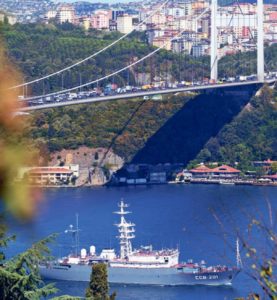
In an intelligence report filed by the Coast Guard Command’s Marmara and Straits Regional Command Communication Center (Sahil Güvenlik Komutanlığı Marmara ve Boğazlar Bölge Komutanlığı Muhabere Merkezi, SAGUVMAR), a Russian Navy MB-31 tug boat transited the Bosporus on July 14, 2016. The boat was escorted by the coast guard and photographed. The report noted that the Russian ship was put on an alert status identified as SABKOR (protection against sabotage).
The rule of engagement do not apply in wartime situations. If Turkey is a belligerent, it may act as it wants to and is allowed to close the straits to all foreign war vessels (Convention Article 20). This right is granted to Turkey if it believes it faces an imminent threat of war. However, it must forward a prior notification to the UN secretary-general on the matter (Article 21).