
Abdullah Bozkurt
Furious at The Economist’s coverage of Turkey’s handling of anti-government protests in 2013 and other issues, Turkish President Recep Tayyip Erdoğan personally ordered the government’s investment promotion agency to stop placing advertisements in the British magazine, secret wiretap recordings have revealed.
The wiretaps, obtained by Nordic Monitor, reveal how Erdoğan grilled the head of the Turkish investment agency in 2013 over TL 1.8 million for running ads in The Economist to promote foreign investment in Turkey. Erdoğan was publicly critical of The Economist for its coverage of his government’s brutal handling of the Gezi Park anti-government protests in Istanbul in the summer of 2013 during which hundreds were detained.
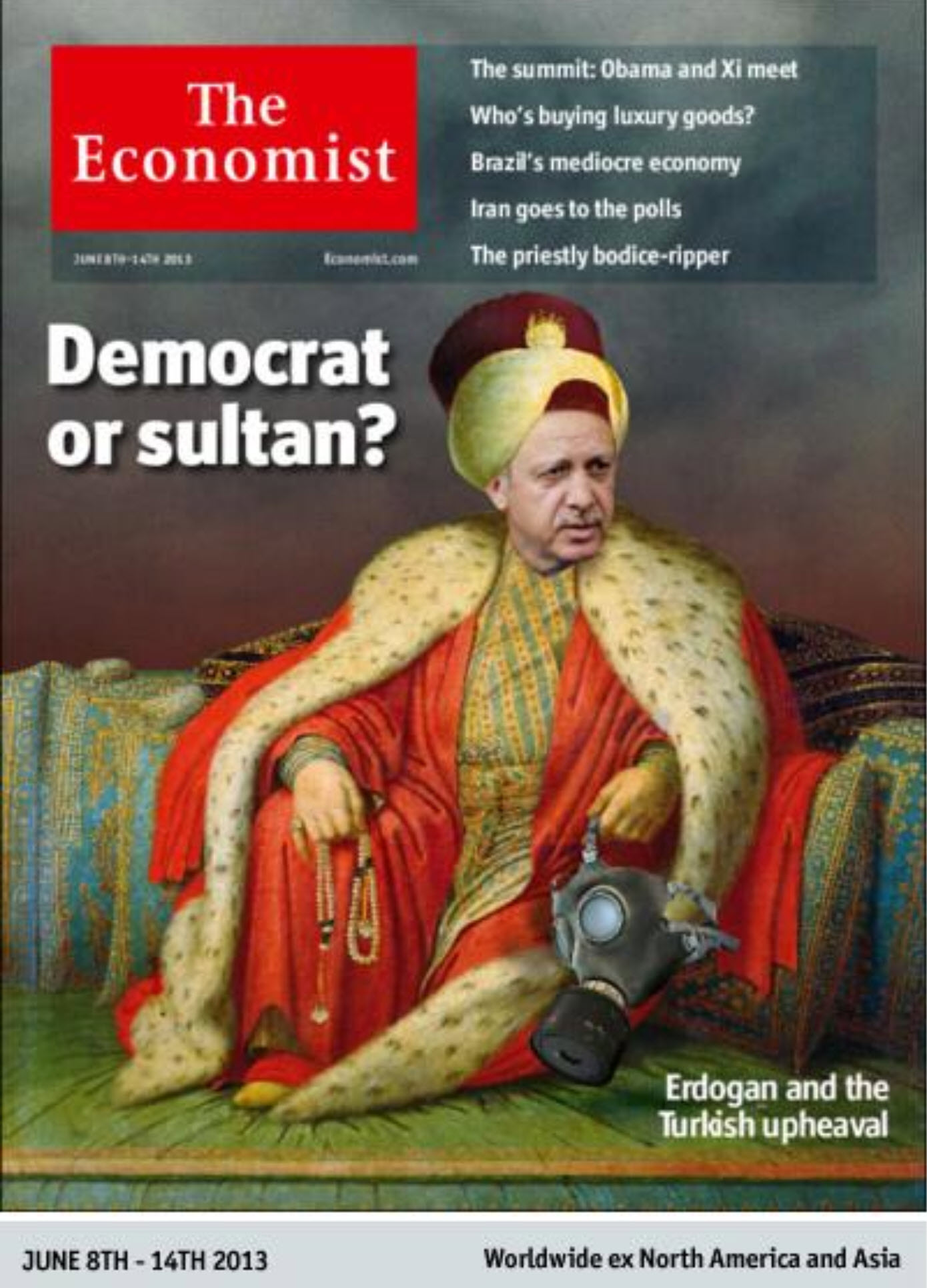
Erdoğan appears to have been agitated further when the magazine ran a cover in its June 8-14, 2013 edition that depicted Erdoğan as an Ottoman sultan with a banner reading “Democrat or sultan?” The Economist wrote that Erdoğan “should heed Turkey’s street protesters, not dismiss them.” The magazine’s coverage was presented by Erdoğan, the prime minister at the time, as evidence of an international conspiracy against his government as he tried to undermine the growing protests that originally started as a small rally to preserve a green space in Istanbul’s historic Taksim district. Locals joined by residents of other districts of Istanbul protested against Erdoğan over a development project that foresaw the construction of a shopping mall in the green space. The protest later spread to other cities across the country.
“From now on, I’m going to review international media advertising plans or whatever you have,” an angry Erdoğan told Mehmet İlker Aycı, president of the Prime Ministry Investment Support and Promotion Agency (Başbakanlık Yatırim Destek Ajansı, or ISPAT, which was later renamed the Presidency’s Investment Office). An apologetic Aycı responded by saying that he would not do anything concerning media advertising unless it was cleared by Erdoğan himself. He also said the campaign was planned before he was appointed to the agency and blamed his predecessor for giving ads to The Economist.
Transcript of the phone conversation between Erdoğan and Mehmet İlker Aycı:
In August 2013 the Taraf newspaper, an independent daily critical of the government, broke a news story based on a report by the Court of Accounts, the state auditing and accounting office, which showed that ISPAT had paid nearly $1 million to The Economist. According to the story, a draft audit report for fiscal year 2011 indicated irregularities in ISPAT expenditures and made 25 suggestions for the agency to improve what auditors criticized as questionable spending habits.
After the government intervened, 21 findings were removed from the initial draft version of the report, but Taraf obtained a copy of the draft and spoke to sources at the Court of Accounts. The daily stated that Court of Accounts auditors were extremely “disquieted” by the censorship of various reports, not just the report on ISPAT. The opposition capitalized on the Taraf coverage in an attempt to expose what it called hypocrisy on the part of Erdoğan, whose government agency poured 1.8 million Turkish lira into the British magazine at the same time that Erdoğan himself was busy bashing the publication.

In total the investment agency had spent 10.9 million Turkish lira for advertisements placed in numerous publications. The Economist received the lion’s share, amounting to 1.9 million Turkish lira. Half of the ads ran before the June 12, 2011 national elections, and the rest appeared after the polls. Critical articles that appeared in The Economist in 2011 including one that was perceived as support for the main opposition Republican People’s Party (CHP) were a major source of criticism from Erdoğan’s ruling Justice and Development Party (AKP) at the time. The magazine’s critical coverage of Erdoğan’s handling of the anti-government protests in 2013 reinforced the conspiracy theories among the AKP leadership that The Economist was involved in an international plot against the party.
At the time, Turkish Minister of EU Affairs and Chief Negotiator Egemen Bagış slammed The Economist and stated that they did not take lightly the threats and ultimatums disguised as editorials from the news magazine. In a written statement he said: “The Economist did it again. A photoshopped portrait, lots of hype and a long list of demands. … I wonder when this paper last used that many modal verbs like ‘must’ and ‘should’ in an article, while trying to dictate to Turkey and its democratically elected government.” Bagış was forced to resign in 2014 in a major corruption probe that showed him taking $1.5 million in bribes from an Iranian sanctions buster in exchange for favors. He is currently serving as the Turkish ambassador to the Czech Republic.
The secret wiretaps reveal the backstory on how Erdoğan was panicked over Court of Audit reports in general and the Taraf daily’s coverage of a specific report on ads placed in The Economist in particular. The first wiretap, recorded on July 31, 2013 at 23:03, shows a conversation between Aycı, who was in the United States at the time, and ISPAT employee Arda Ermut. Panicked over the breaking story by Taraf and a missed call from Erdoğan, whom Aycı suspected had called to ask about the advertisements in The Economist, Aycı was trying to come up with a story. He talked to his employee and tried to find out what he could tell Erdoğan when he returned his call. Aycı said he remembered ISPAT cutting off advertising for a while after the critical articles appeared in The Economist but later resumed the placement of ads in the magazine.
Transcript of the wiretap between Mehmet İlker Aycı and Arda Ermut:
“Now Beyefendi [Erdoğan] will ask, and I have to give a response — these [advertising expeses] were covered in the news story,” Aycı said. Ermut responded that he would compile all the expenditures in an Excel document and send it right away. The two briefly discussed how Taraf obtained the Court of Accounts report and what they could do. “ … God damn it, let’s work on this now.. [I will tell Erdoğan] we are working on it and will prepare something; I mean, we will submit a report to him,” Aycı added, stressing the urgency of the matter.
About 11 minutes later, Aycı returned the call from Erdoğan, who immediately started pressing the ISPAT president about the advertising given to The Economist and asked why he spent the most money with that magazine. Aycı dismissed the Taraf story as a lie and claimed that some funds were transferred to the British magazine as part of a media campaign planned by his predecessor. An outraged Erdoğan continued, reprimanding him and saying, “No, there’s something even though you deny it.” Aycı tried to lay the blame on his predecessors Alpaslan Korkmaz and Hüseyin Aslan, who headed the agency as presidents, and said the planning was done during their time and that he had to go along with it when he was appointed to head the agency. He added, however, that he did not give new ads to The Economist. Asked when the campaign had ended, Aycı said no money was given to The Economist in 2012 or 2013.
Erdoğan concluded the phone call by ordering Aycı to submit all advertising campaigns for the international media to him for clearance. Aycı said he wouldn’t place any ads unless Erdoğan had given prior approval. Erdoğan added that the campaigns would first be coordinated with his chief aide, Ibrahim Kalın, and that he would see them afterwards. Aycı emphasized that he was quite aware of the prime minister’s views on such matters and was keen to comply with them.
Aycı was appointed chairman of the board and executive committee of Turkish Airlines (THY) in April 2015, while his staff member, Ermut, was promoted to president of the investment agency in August 2018. Ermut also has a seat on the THY board.

The wiretaps were obtained by Turkish investigators and authorized by an Istanbul court on July 18, 2013 in investigation file No. 2012/656. Aycı was a major suspect in the investigation, which was looking into corruption, abuse of power and forgery involving dozens of people including Erdoğan’s son Bilal and Saudi national Yassin al-Qadi, at one time designated as an al-Qaeda financier by both the UN and the US. The investigation was hushed up by Erdoğan after he orchestrated the unlawful removal of prosecutors, judges and police chiefs from their positions.
The Taraf daily was shut down by the Erdoğan government in July 2016. Taraf Editor-in-Chief Ahmet Altan has been in jail since September 2016. Altan was convicted and sentenced to 10 years, six months in November 2019 on false terrorism charges, although the court decided to release him pending appeal. He was re-arrested several days later and remains imprisoned as of today.
The Erdoğan government has closed down nearly 200 media outlets in the last three years and seized the assets of journalists and media groups. The independent media has effectively been wiped out in Turkey. According to the Stockholm Center for Freedom (SCF), a Swedish-based rights advocacy group, 165 journalists are currently in Turkish prisons, while 167 living in exile face outstanding arrest warrants. Turkey has been named one of the world’s leading jailers of journalists in recent years.