
Abdullah Bozkurt/Stockholm
Hundreds of millions of euros earmarked by the European Union for agricultural and rural development projects in Turkey are being administered under an opaque financial reporting system that prevents the country’s public auditing institution from fully examining how the money is managed, according to official government documents and allegations raised in parliament.
The revelations come amid a history of corruption allegations, questionable grant allocations and procurement irregularities involving the Turkish government agency responsible for distributing EU agricultural assistance as well as allegations of financial misconduct at institutions overseen by Agriculture and Forestry Minister İbrahim Yumaklı, the former general manager of GÜBRETAŞ, a Turkish fertilizer producer with extensive commercial and investment ties to Iran, notably through its stake in the Razi Petrochemical Company, one of Iran’s major fertilizer and petrochemical producers.
His tenure at GÜBRETAŞ from 2016 to 2022 was marred by allegations of procurement irregularities and questionable financial transactions. Before entering the agriculture sector, Yumaklı held senior management positions in the Turkish operation of the Qatar-funded Al Jazeera news outlet between 2011 and 2015 and served as international operations director at Turkey’s state-run Anadolu news agency in 2016.
An audit report released in September 2026 by Turkey’s Court of Accounts (Sayıştay) found that the Agriculture and Rural Development Support Institution (Tarım ve Kırsal Kalkınmayı Destekleme Kurumu, or TKDK) had excluded 5.35 billion Turkish lira in assets and liabilities associated with an EU-funded program from its balance sheet, in violation of domestic financial reporting requirements.
The auditors also discovered that the budget for the EU-backed program had been implemented without obtaining legally required approval and that billions of lira in funds transactions were not accurately reflected in the agency’s financial statements.
The findings raise serious questions about accountability for European taxpayers’ money entrusted to the corrupt government of President Recep Tayyip Erdogan under a financial assistance program designed to help Turkey align its agricultural sector with EU standards.
The TKDK, which operates under the Ministry of Agriculture and Forestry, is responsible for selecting beneficiaries, awarding grants, signing contracts, authorizing payments and monitoring projects financed by the EU and the Turkish government.
The EU has allocated 430 million euros to Turkey under the third phase of the Instrument for Pre-Accession Assistance for Rural Development (IPARD III), which covers the period from 2021 to 2027.
Yet Turkey’s highest public auditing body explicitly stated that it was unable to express an opinion on the program’s assets, liabilities and financial results for 2025 because it had been unable to obtain sufficient and appropriate audit evidence.
The 2025 audit report on Turkey’s Agriculture and Rural Development Support Institution (TKDK), released by the Court of Accounts in September 2026, revealed serious financial reporting deficiencies that prevented state auditors from expressing an opinion on the accounts of an EU-funded agricultural assistance program:
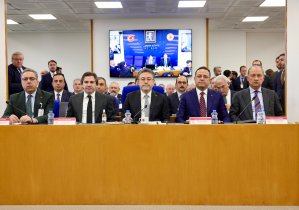
The issue resurfaced during a November 25, 2026 meeting of the Turkish Parliament’s Planning and Budget Committee, where Yumaklı presented his ministry’s budget for the coming year.
An opposition lawmaker accused the TKDK of concealing financial information involving 5.35 billion lira and demanded an explanation from the minister, citing the findings of the Court of Accounts. The lawmaker demanded that Yumaklı disclose the amount of public money involved and whether criminal or administrative investigations had been launched against those responsible. The minister did not bother responding to the question.
The TKDK itself has previously been embroiled in corruption allegations involving its senior management, raising additional concerns about the institutional safeguards governing the distribution of European financial assistance in Turkey.
In August 2023 local media reported that an Agriculture and Forestry Ministry investigation into procurement contracts awarded during the tenure of former TKDK chairman Ahmet Antalyalı had uncovered numerous irregularities. The government inspectors examined contracts awarded in 2017 for organizing agricultural fairs and promotional events in 49 provinces. The contracts were awarded to a company named Beka Medya through a negotiated procurement procedure.
The inspectors found that the agency had made inflated payments to the company for services involving provinces where the TKDK did not even maintain provincial offices. Despite the reported criminal complaint, Antalyalı was subsequently reappointed to lead the agency in 2023 after Yumaklı took office as agriculture minister.
Earlier government audits had also raised questions about whether projects receiving EU-backed agricultural assistance were consistent with the stated objectives of the rural development program.
In October 2023 local media reported findings from a 2022 Court of Accounts audit showing that grants intended to promote rural tourism had financed establishments operating as conventional city hotels, seaside hotels and wedding venues. The revelations raised concerns that agricultural development grants intended to stimulate economic activity in rural communities were being used to finance commercial enterprises whose activities did not correspond to the intended purpose of the assistance.
No effective probe into the allegations was conducted.
The latest Court of Accounts report shows that the TKDK maintained two separate accounting systems, one for its regular operating budget and another for the EU-backed agricultural development program. The financial statements submitted to the Court of Accounts did not fully incorporate the assets, liabilities and financial results associated with the latter.
As a result, a substantial portion of the agency’s financial operations remained beyond the scope of Turkey’s regular public financial audit.
According to the report the TKDK distributed 138.7 million euros in agricultural assistance in 2025 alone, of which 70.1 million euros came from the EU budget and 68.6 million euros from Turkish government co-financing.
The combined payments amounted to 6.32 billion lira. Although the agency recorded this sum as an aggregate income and expenditure entry in its financial results statement, the auditors found that the figure did not correspond to the income and expenditure recorded in the separate IPARD accounts.
The auditors also identified precisely 5,349,554,049 lira in IPARD-related assets and liabilities that had been excluded from the agency’s balance sheet. The discrepancies prevented auditors from obtaining a complete and reliable picture of the agency’s financial operations.
Perhaps more troubling is the fact that the accounting deficiencies were already known to Turkish authorities. The Court of Accounts had identified the same problem in its audit of the agency’s finances for 2024, published in September 2025.
Although the TKDK indicated in its response to the earlier audit that it would begin working to address the deficiencies, the latest report confirmed that the necessary corrective measures had not been completed.
In an annex tracking compliance with previous audit recommendations, the Court of Accounts classified the finding as not implemented, indicating that the agency had continued to operate under the same fragmented accounting arrangements despite official warnings.
An amended financing agreement between Turkey and the European Commission governing EU-funded agricultural and rural development assistance for 2021–2027, ratified by President Recep Tayyip Erdoğan on November 20, 2026, and published in Turkey’s Official Gazette the following day:
The auditors determined that the agency’s accounting practices were inconsistent with the laws that regulate the structure, responsibilities and financial operations of the TKDK.
The report further revealed that the TKDK is exempt from Turkey’s Public Financial Management and Control Law No. 5018, which establishes financial accountability and internal control requirements for public institutions.
As a result, the agency is not required under that law to prepare certain performance, activity and internal control compliance reports that would otherwise provide additional mechanisms for monitoring public expenditure.
Although the agency maintains an internal audit department and separate financial reporting procedures established under agreements with the European Commission, these arrangements have not resolved the deficiencies identified by Turkey’s state auditing institution.
The scale of the financial commitments involved makes the unresolved accounting problems particularly significant for the EU.
By the end of 2025, approximately 77.3 million euros of the EU’s 430 million euro allocation under IPARD III had been paid out. Including Turkish co-financing, cumulative payments to beneficiaries reached 153.2 million euros, while ongoing contracts envisaged a further 116.1 million euros in public contributions.
The audit report also recorded the recovery of approximately 404,000 euros in EU contributions without providing details about the circumstances that prompted the recovery of those funds.
The latest revelations raise questions about whether the European Commission was adequately informed of the persistent deficiencies identified by Turkish state auditors and what measures Brussels has taken to ensure that European taxpayers’ money reaches its intended beneficiaries.
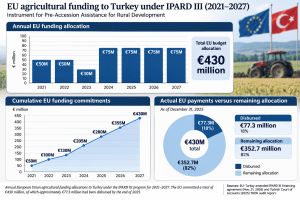
The graphs cover IPARD III agricultural assistance, not all EU financial assistance to Turkey. Annual allocations represent budget commitments rather than actual annual payments.
Under Turkey’s institutional arrangements for managing EU financial assistance, the Treasury Controllers Board within the Ministry of Treasury and Finance serves as the designated audit authority, while the Presidential State Supervisory Council (Devlet Denetleme Kurulu) is responsible for coordinating anti-fraud investigations involving EU funds.
The existence of these separate oversight mechanisms, however, has not addressed the failure to consolidate the TKDK’s financial accounts for examination by the Court of Accounts.
The history of reported procurement irregularities, questionable grant allocations and allegations of favoritism at institutions overseen by the agriculture ministry adds significance to the latest audit findings concerning the administration of European public money in Turkey.
The findings reveal a significant gap in domestic financial oversight at an institution entrusted with administering hundreds of millions of euros in European public money.
With more than 350 million euros of the EU’s IPARD III allocation still available for disbursement at the end of 2025, Turkey’s repeated failure to implement the recommendations of its own state auditing body should have raised alarm bells in Brussels, prompting demands for greater financial transparency and accountability before further funds were released.
Yet despite the unresolved financial reporting deficiencies identified by Turkish state auditors, the European Commission agreed to expand Turkey’s responsibilities in administering EU-funded agricultural assistance under an amended financing agreement published in Turkey’s Official Gazette on November 21, 2026.
The agreement, ratified by Erdogan on November 20, entrusts Turkish authorities with additional budget implementation responsibilities for investments in rural public infrastructure. It puts the overall value of the agricultural development program at just over 1 billion euros, including 430 million euros in funding from the EU budget.
The agreement also stipulates that the program will be implemented without prior verification of tenders and contracts by either the European Commission or the EU delegation, putting substantial responsibility for financial management and procurement in the hands of Turkish authorities.
The amendment was signed by Turkish Deputy Foreign Minister Mehmet Kemal Bozay in Ankara on June 19, 2026, and by Elisabeth Werner, the European Commission’s director-general for agriculture and rural development, in Brussels on July 8.
The commission concluded that Turkey’s institutional arrangements met the applicable requirements despite previously published findings by the Turkish Court of Accounts concerning deficiencies in the financial reporting of EU agricultural assistance.