
Levent Kenez/Stockholm
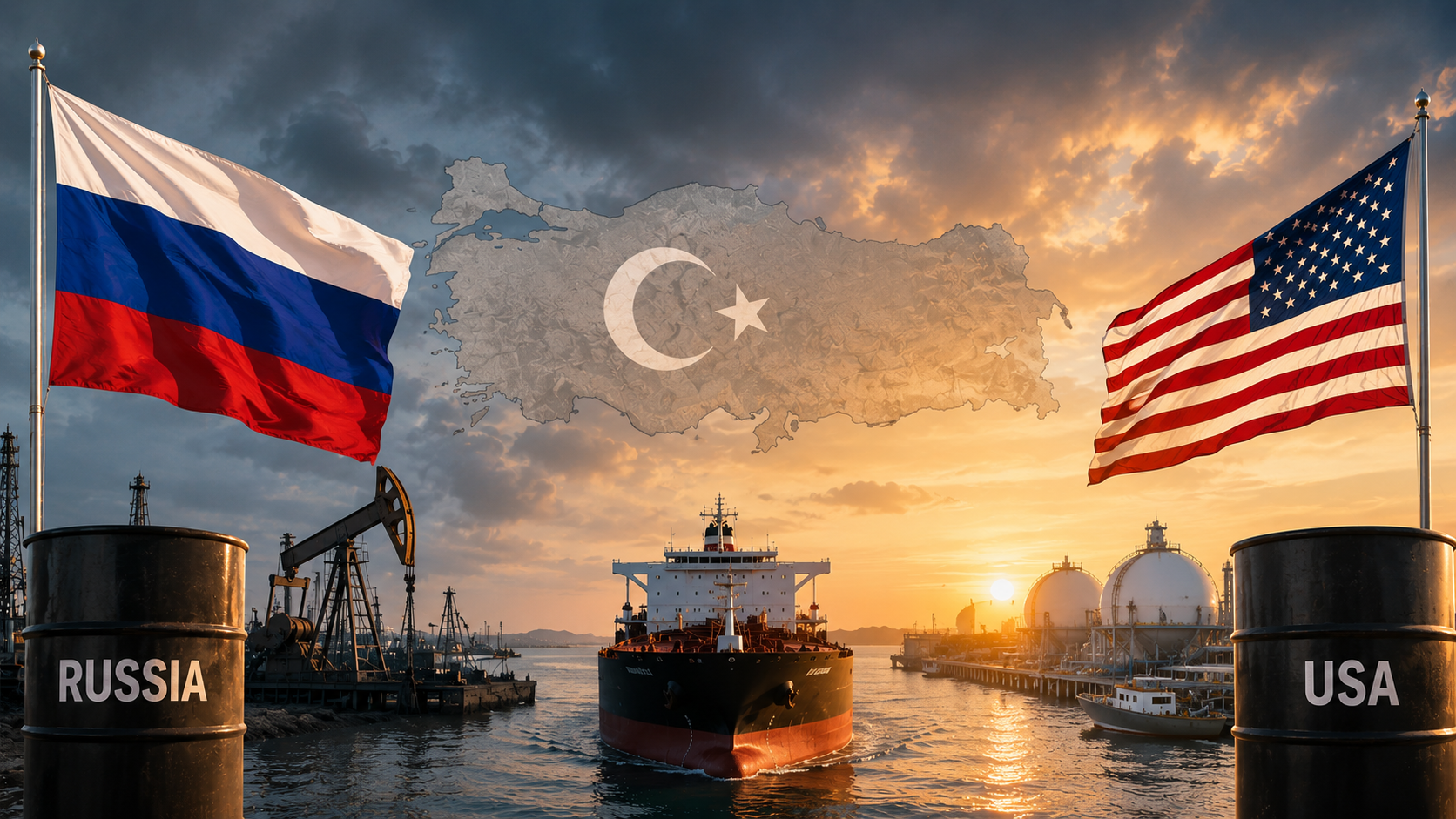
For more than three years Russia has been the unrivaled leader of Turkey’s oil market. That changed in June 2026. The United States, not Russia, became Turkey’s largest single source of crude oil imports for the month, according to official trade figures included in the Turkish petroleum market sector report.
In January 2026, Turkish customs records show, the United States did not ship a single ton of crude oil to Turkey. Five months later, in June, the United States topped Turkey’s monthly crude oil ranking for the first time on record, ahead of both Kazakhstan and longtime market leader Russia.
The two snapshots, drawn from Turkish petroleum trade data covering January through June 2026, capture one of the sharpest reversals in Turkey’s energy import mix in years and trace directly back to a regional war rather than a change in commercial appetite.
In January 2026 Russia supplied 1,005,833 tons of crude to Turkish refiners, or about 38 percent of that month’s 2,665,385 tons of total crude imports, making it by far the largest single source. Iraq followed with 518,931 tons, then Saudi Arabia with 314,525, Kazakhstan with 299,562, Norway with 237,127 and Guyana with 138,693 tons.
Counting refined products along with crude, Russia’s share of everything Turkey imported that month, including diesel, fuel oil and other fuels, reached nearly 50 percent. The United States did not appear among the roughly 20 supplying countries listed for January at all.

By June the picture had been inverted. The United States delivered 570,676 tons of crude, or about 21 percent of that month’s crude total, edging out Kazakhstan’s 463,572 tons and Russia’s 425,167 tons, which had fallen to third place and just 16 percent of the month’s crude volume. Libya, Iraq and Norway rounded out the rest of the top suppliers. Looking at combined crude and refined product imports for June, Russia still led the overall table with a 38 percent share, largely on the strength of diesel shipments, but its position in crude oil alone, the commodity at the center of Turkey’s import bill, had slipped behind both the United States and Kazakhstan.
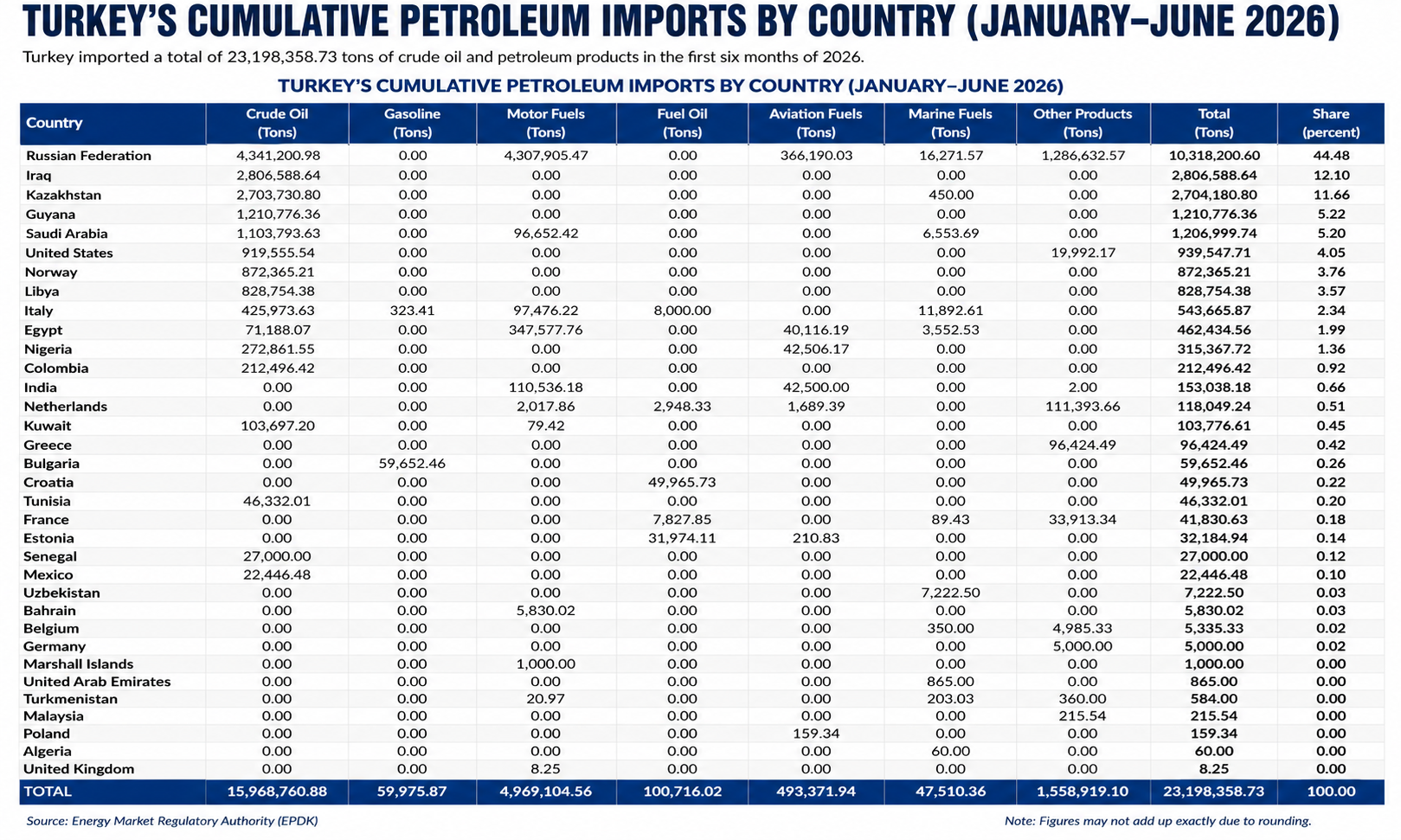
The cumulative figures for the first half of the year show why the June numbers stood out as a break rather than a trend already under way. Between January and June 2026, Russia remained Turkey’s largest crude supplier by a wide margin, with 4.34 million tons, or 27 percent of the 15.97 million tons of crude Turkey imported over the six months. Iraq was second with 2.81 million tons and Kazakhstan third with 2.70 million. The United States ranked sixth for the half year as a whole, with just 919,555 tons, less than 6 percent of the total. That means the 570,676 tons the United States shipped in June alone accounted for well over half of everything it had sold Turkey in the previous five months combined, evidence of how concentrated and sudden the jump was rather than the product of a steady climb.

The first and most direct factor is the war between Iran and the United States and Israel, which began on February 28, 2026, and has now continued for more than six months, effectively shutting down normal commercial traffic through the Strait of Hormuz. The strait is the route through which oil from Iraq, Saudi Arabia, the United Arab Emirates and Kuwait normally reaches export markets, and disruptions there have complicated deliveries to Turkish refiners TÜPRAŞ and STAR, the country’s largest crude processors, based in Aliaga.
A second factor is Washington’s own market management. The United States released crude from its Strategic Petroleum Reserve, the emergency stockpile the government draws on to steady prices, as the war pushed global Brent benchmark prices higher. That supply made West Texas Intermediate crude and cargoes loaded at Houston more competitively priced relative to global benchmarks, while American suppliers offered the shipping security and volume guarantees that buyers wanted amid the crisis.
A third factor is found on the Russian side. Moscow’s own capacity to export crude has been squeezed by wartime domestic refining needs, continued price-cap sanctions on Russian oil, greater scrutiny of the “shadow fleet” of tankers used to move it and narrower international payment channels for buyers, all of which have made Russian barrels harder to move even where demand exists.
TÜPRAŞ and STAR responded by activating forward purchase contracts with Permian Basin and West Texas Intermediate producers as the Hormuz crisis escalated, pushing monthly American crude imports to what it describes as a record level.
The same eastward-to-westward pivot is visible in natural gas, though on a longer timeline built through contracts rather than a single-month spike. Turkey’s state pipeline and gas trading company, BOTAŞ, has signed a series of long-term liquefied natural gas deals with American suppliers since 2024. In May of that year BOTAŞ signed its first long-term LNG agreement with a US energy major, a 10-year contract with ExxonMobil for roughly 3.2 billion cubic meters, or about 2.5 million tons, of LNG annually. That September, BOTAŞ signed 10-year deals with Shell for 40 billion cubic meters and TotalEnergies for 16 billion cubic meters, with much of the contracted cargo specified as loaded from the US Gulf Coast.

The largest deal came in September 2025, when BOTAŞ signed a 20-year contract with the Mercuria trading house in New York for 4 billion cubic meters of LNG of American origin annually, or 70 billion cubic meters over the life of the agreement running from 2026 through 2045. The signing took place around Turkish President Recep Tayyip Erdogan’s visit to the White House in September 2025, his first in six years, where President Donald Trump urged Turkey to cut its energy purchases from Russia, and the two governments also signed a memorandum on civil nuclear cooperation.
In December 2025 BOTAŞ added a further agreement with Australia-based Woodside Energy for 5.8 billion cubic meters of LNG from its Louisiana project, covering deliveries from 2030 through 2039.
The Mercuria contract moved from paper to delivery this year. As of September 2026 the first physical LNG cargoes under that agreement began arriving at Turkey’s Saros and Dörtyol floating storage and regasification unit terminals, which convert LNG back into pipeline gas.
Taken together, Turkish officials and trade data increasingly describe 2026 as the year long-term American energy contracts started to be implemented in practice while an unrelated crisis in the Gulf pushed spot crude purchases toward the United States as well, even as Russia continues to supply the largest overall share of Turkey’s combined petroleum products for the year to date
That picture could still change. If the war between Iran and the United States and Israel ends and the Strait of Hormuz reopens to normal traffic, or if a long-stalled pipeline agreement with Iraq is revived, the pull toward American energy could ease.

The Kirkuk-Ceyhan pipeline, which for decades carried crude from fields around Kirkuk in northern Iraq to Turkey’s Ceyhan export terminal on the Mediterranean, has sat idle since March 2023, when an arbitration panel at the International Chamber of Commerce ordered Turkey to pay Iraq roughly $1.5 billion in damages over unauthorized exports by the Kurdistan Regional Government, the autonomous administration in northern Iraq, between 2014 and 2018. Turkey formally terminated the underlying 1973 transit agreement last year with the termination taking effect on July 27, 2026, and has said it wants an entirely new deal rather than a renewal of the old terms, including a guarantee that Iraqi crude moving through Ceyhan cannot be seized there to satisfy outstanding claims against Baghdad. Iraq’s federal government and the Kurdish regional authorities agreed in mid-2025 to resume exports through the state SOMO marketing company, but a replacement pipeline agreement had not been finalized as of the day of writing, leaving one of the region’s largest crude corridors offline even as the war further south disrupted other supply routes.
Turkey’s broader push to cut its dependence on Russian energy appears likely to continue regardless of how the Gulf crisis and the Kirkuk-Ceyhan pipeline issue are resolved. That effort will carry even more weight once the Akkuyu nuclear power plant, Turkey’s first nuclear facility, built and operated by Russia’s Rosatom state nuclear company, begins generating electricity. For Ankara to remain reliant on Russia for crude oil, natural gas and nuclear fuel all at once is not the picture the government of Erdogan is likely to want as it moves closer to Washington.