
Levent Kenez/Stockholm
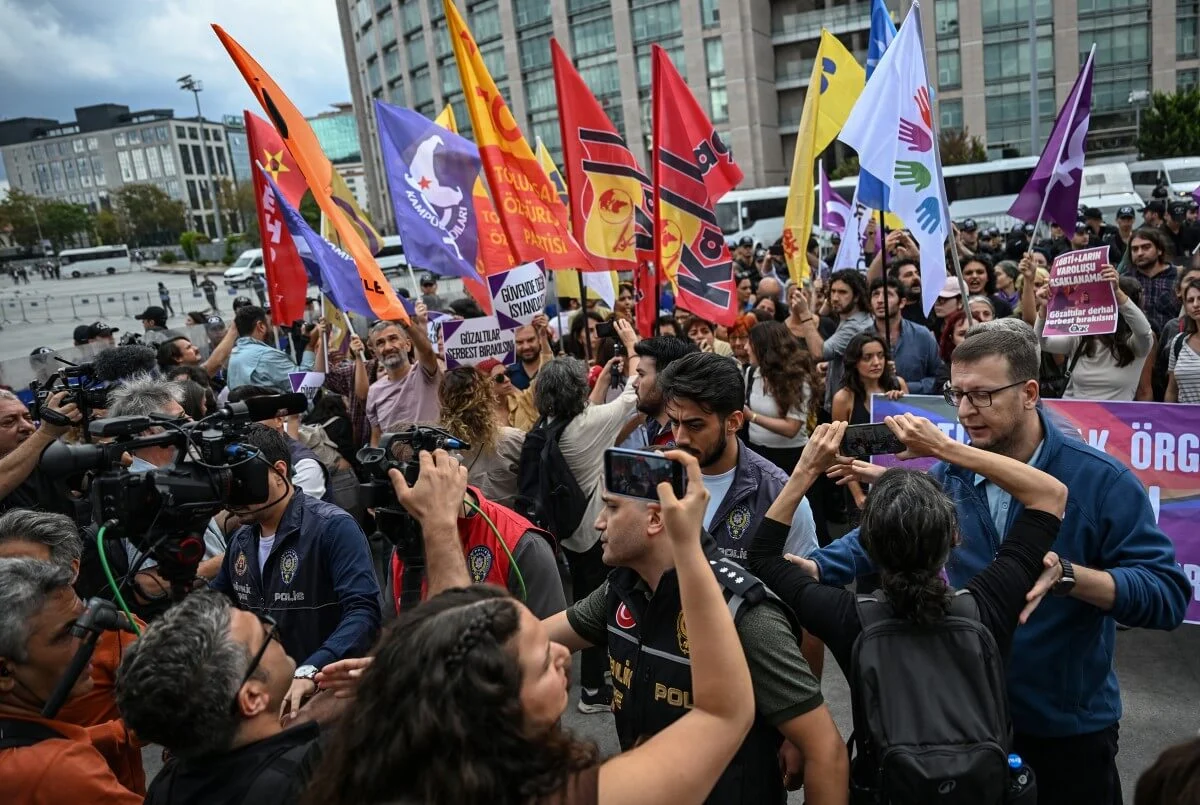
European Parliament lawmakers have sharply criticized the Turkish government over what they described as a pattern of transnational repression, political interference abroad and support for extremist and ideological networks, marking one of the strongest condemnations of Ankara’s conduct beyond its borders in recent years.
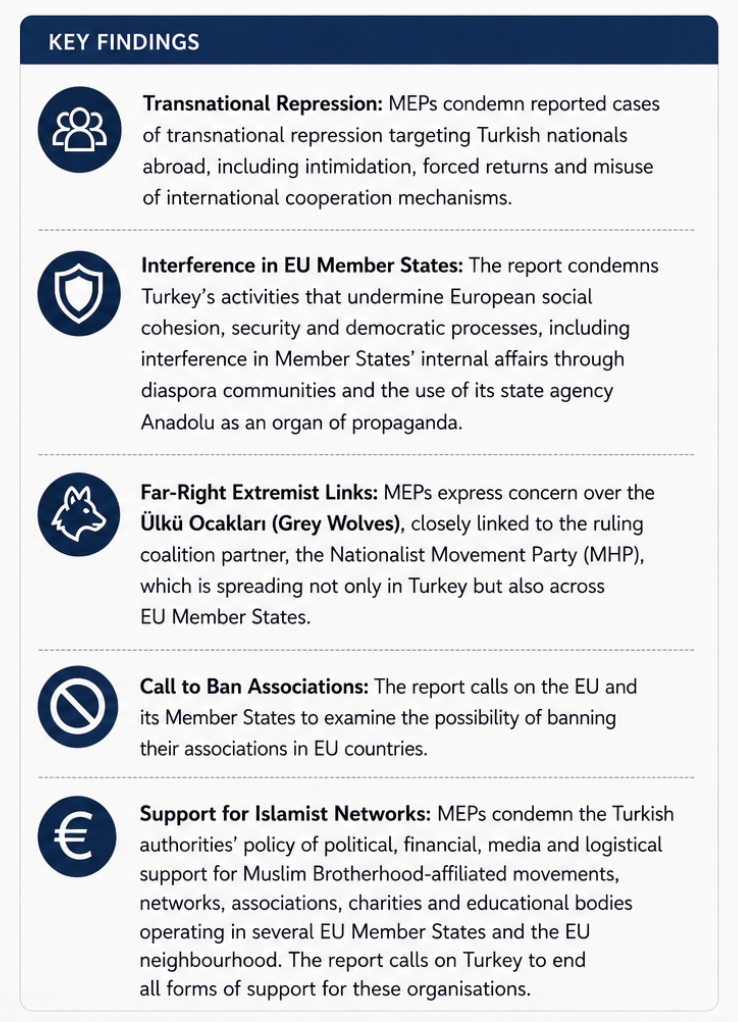
In its 2025 report on Turkey, the European Parliament condemned reported cases of intimidation, forced returns and the misuse of international cooperation mechanisms against Turkish nationals living overseas. The report also accused Ankara of undermining social cohesion, security and democratic processes in European Union member states through activities directed at diaspora communities and through the use of the state-run Anadolu news agency as an organ of propaganda.
The report reflects growing concern in Brussels that the administration of President Recep Tayyip Erdogan has extended its campaign against critics far beyond Turkey’s borders, relying on diplomatic, intelligence, legal and media tools to pursue perceived opponents abroad.
European lawmakers said they remained alarmed by reports of transnational repression targeting Turkish citizens and former Turkish residents in multiple countries. The concerns center on allegations that Turkish authorities have sought to identify, monitor, pressure and, in some cases, secure the return of individuals accused of links to groups Ankara considers terrorist organizations, particularly followers of the faith-based Gülen movement, a group critical of Erdogan.
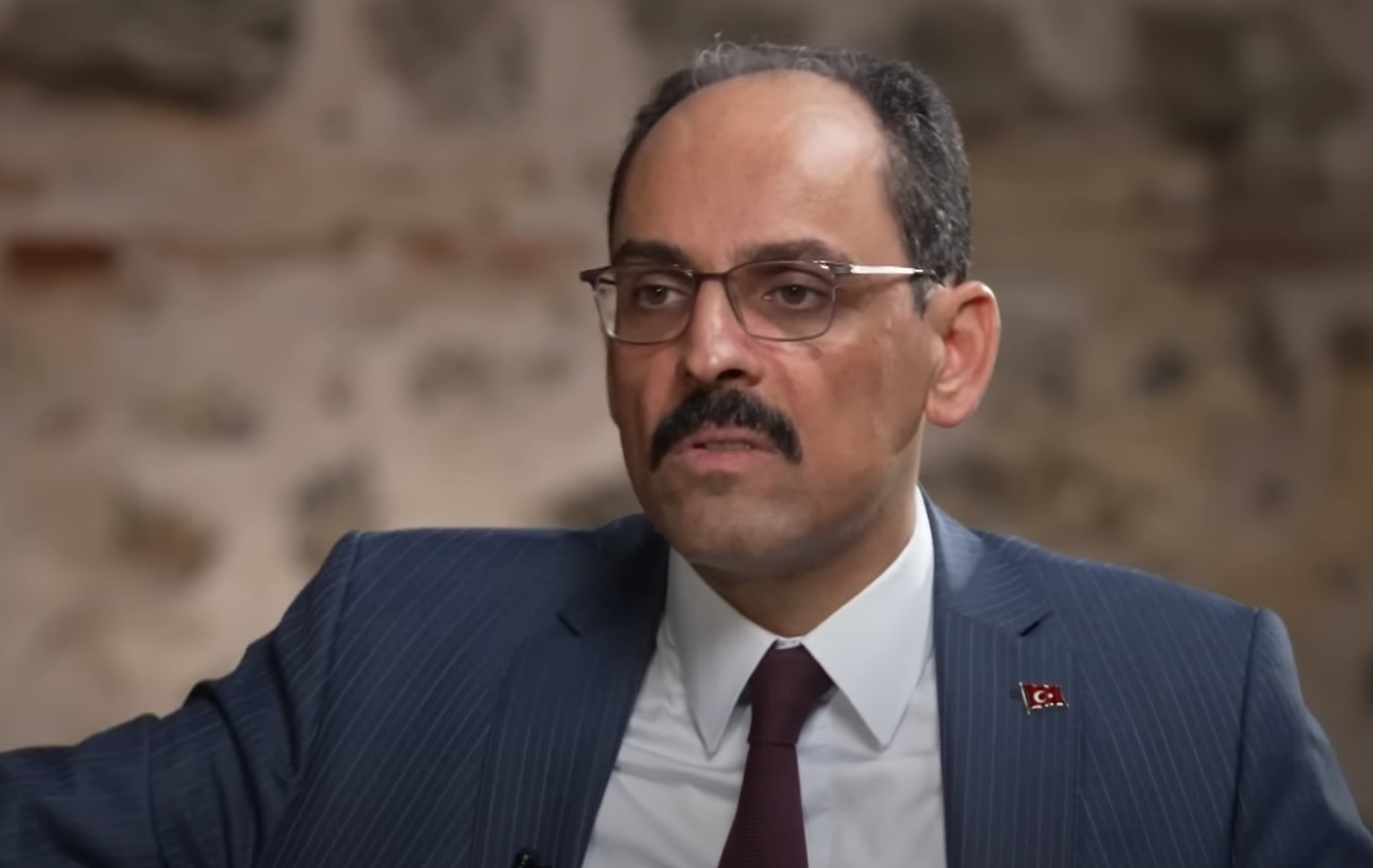
The European Parliament report’s reference to forced returns echoes concerns previously raised by international human rights organizations regarding renditions and deportations carried out from countries in Africa, Asia and the Balkans. Several cases involved individuals who were transferred to Turkey under disputed legal circumstances after being detained abroad. Turkish officials have defended such operations as legitimate counterterrorism efforts conducted in cooperation with partner governments.
Lawmakers also condemned what they described as the misuse of international cooperation mechanisms to pursue government critics abroad. The issue has drawn scrutiny for years amid allegations that Turkish authorities sought to use international law enforcement channels, including INTERPOL mechanisms, to locate, monitor or seek the return of political opponents residing outside Turkey.
Nordic Monitor has previously published documents suggesting that Turkish authorities have submitted requests through INTERPOL channels and other international police cooperation mechanisms targeting journalists, dissidents, academics and members of the Gülen movement living abroad. Human rights organizations have also raised concerns in separate reports about the potential use of such mechanisms for politically sensitive cases. Critics argue that some of these requests may be linked to political activity rather than conventional criminal conduct. Turkish authorities deny any misuse of international policing tools and say their requests are based on legitimate counterterrorism and criminal investigations.
The EP report also criticized the use of Turkey’s state-run Anadolu news agency, describing it as an organ of propaganda used to advance Ankara’s narratives abroad. European lawmakers said the agency has been used in activities that undermine democratic processes and social cohesion within EU member states. Turkish authorities deny such allegations and maintain that Anadolu operates as a professional international news organization.

The report further raised concerns about Ankara’s engagement with diaspora communities across Europe. European lawmakers accused Turkish authorities of interfering in the internal affairs of member states through political influence campaigns directed at citizens of Turkish origin. Such concerns have surfaced periodically in countries including Germany, Austria, France, the Netherlands and Belgium, where debates over integration, political loyalty and foreign influence have generated friction between European governments and Ankara.
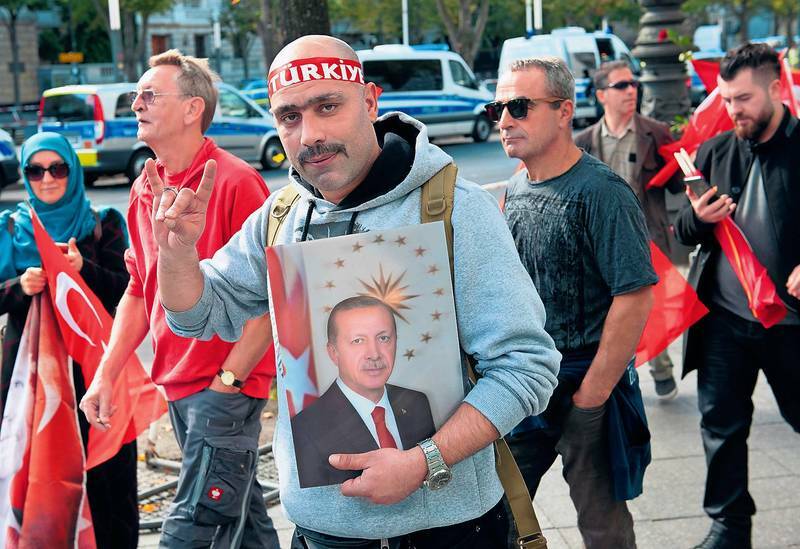
Particular attention was devoted to the Ülkü Ocakları, widely known as the Grey Wolves, an ultranationalist movement closely associated with Turkey’s Nationalist Movement Party (MHP), a key ally of Erdogan.
The European Parliament described the movement as racist and extremist and expressed concern about its growing presence not only in Turkey but also in EU member states. Lawmakers called on the European Union and national governments to examine the possibility of banning organizations affiliated with the movement.
The Grey Wolves emerged from Turkey’s nationalist movement and have long been associated with ultranationalist activism. Security officials and researchers in several European countries have warned that the movement promotes ethnic hostility and extremist ideology.
France dissolved a group linked to the Grey Wolves in 2020 following tensions involving members of the Armenian community and incidents authorities said involved hate speech and incitement to violence. Austria has prohibited the public display of the Grey Wolves hand gesture, while German security services have for years monitored organizations linked to the movement and described it as one of the country’s largest far-right extremist networks. No nationwide ban currently exists in Germany.
The report also condemned what lawmakers described as Turkey’s policy of providing political, financial, media and logistical support to Muslim Brotherhood-affiliated organizations operating in parts of Europe and the EU’s neighboring regions. According to the report, such support enables networks, associations, charities and educational institutions connected to the Muslim Brotherhood to engage in ideological influence, fundraising and recruitment activities. European lawmakers called on Turkey to end all forms of support for these organizations.
The 2025 report is part of a broader assessment of democratic governance and the rule of law in Turkey. Beyond concerns over transnational repression and foreign influence, lawmakers reiterated criticism of the state of judicial independence, restrictions on media freedom, pressure on civil society organizations, the prosecution of journalists and political figures, the treatment of opposition parties, corruption concerns and the continued failure to implement certain judgments of the European Court of Human Rights.
The report also raised concerns about Turkey’s foreign policy direction, tensions with neighboring countries and the continued stagnation of the country’s long-running bid to join the European Union.
Taken together, the findings represent one of the most comprehensive critiques issued by European Parliament lawmakers against Erdogan’s government in recent years, signaling that concerns about Turkey’s activities beyond its borders have become increasingly central to the debate over the future of EU-Turkey relations.