
Levent Kenez/Stockholm
A new report titled “Perils of Unconstrained Prosecutorial Discretion: Prosecuting Terrorism Offences in Post-Coup Turkey” by the Italian Federation for Human Rights (FIDU), an organization based in Rome that operates both nationally and internationally and is dedicated to promoting human rights, puts the spotlight on prosecutorial practices in Turkey, particularly in the wake of a failed coup that shook the country on July 15, 2016.
The 59-page study, authored by Dr. Emre Turkut, a post-doctoral researcher at the Hertie School’s Centre for Fundamental Rights in Berlin; Ali Yıldız, a practicing lawyer as a member of the Ankara and Dutch Brussels bars, and Kevin Dent, a criminal barrister at Five St. Andrew’s Hill, delves into the investigation and prosecution of terrorism offenses, with a particular focus on indictments related to the Gülen movement, a group critical of Turkish President Recep Tayyip Erdogan.
Erdogan first branded the Gülen movement as a terrorist organization in the aftermath of December 2013 corruption investigations that incriminated him, his family members and his business and political associates in an Iran sanctions-busting scheme. He accused Fethullah Gülen, who inspires the movement, of initiating the graft probes, an accusation that Gülen has strongly denied.
The Turkish government also accuses the Gülen movement of orchestrating the controversial coup attempt in 2016, although the movement denies any involvement in the abortive putsch.
Many believe that the failed coup was a false flag organized by Turkish intelligence, following which Erdogan built an authoritarian regime and assumed complete control of the judiciary and armed forces thanks to the purge of more than 150,000 civil servants and military officers.
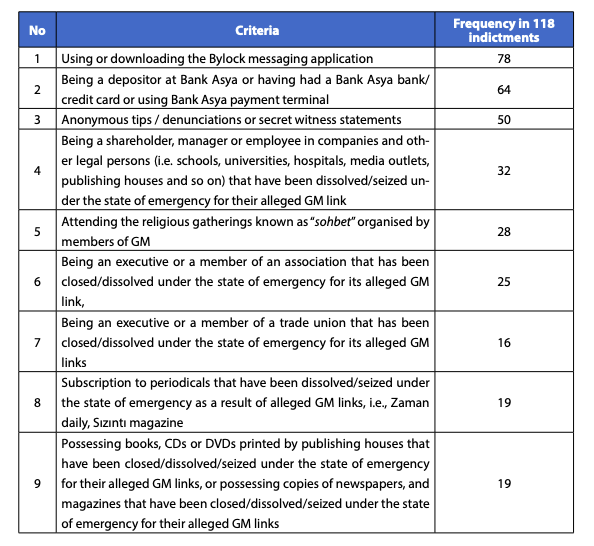
The Turkish government accepted such activities as having an account at the Gülen-affiliated Bank Asya, holding an administrative position at a Gülen movement-linked institution, subscribing to the group’s publications, being a member of a trade union or other institution linked to the Gülen movement and using the ByLock encrypted messaging application as benchmarks for identifying and arresting tens of thousands of followers of the Gülen movement on charges of membership in a terrorist organization.
The report also includes similar criteria that are used for charging people in Turkish courts.
According to the report, in January 2023 the Turkish government submitted an Action Plan to the Committee of Ministers of the Council of Europe that shows Turkish public prosecutors filed some 340,000 cases under Article 314 of the Turkish Penal Code, which concerns membership in an armed terrorist organization, from 2017 to 2021.
While the Turkish government’s Action Plan fails to mention the total number of investigations in that time period, a report by Mustafa Yeneroglu, a member of the Turkish Parliament and former chairperson of parliament’s Human Rights Committee, claimed that 1.7 million people have been investigated for membership in an armed terrorist organization since the 2016 attempted coup.
The FIDU’s examination of 118 indictments from various provinces across Turkey has revealed significant deviations from both domestic and international legal standards.
Of particular concern is the failure of prosecutors to present coherent and compelling evidence linking suspects to alleged offenses. This raises questions about the sufficiency of reasonable suspicion, as the evidence presented often falls short of meeting the threshold required to establish a solid basis for the charges. Human rights bodies, including the European Court of Human Rights and the United Nations Human Rights Committee, have consistently criticized Turkey’s post-coup practices due to the lack of adherence to fundamental human rights principles.
Nordic Monitor previously reported that the United Nations Human Rights Committee on November 15, 2022 released its decision on an application made by a teacher in Turkey who was detained and arrested over alleged terrorist links in 2018. Calling for the immediate release of the teacher, the committee recalled that the notion of “arbitrariness” must be interpreted broadly to include elements of inappropriateness, injustice, lack of predictability and due process of law as well as elements of reasonableness, necessity and proportionality.
The FIDU report also highlights the pervasive use of politically charged language and the propagation of unfounded conspiracy theories within the examined indictments. This practice not only injects bias into the prosecutorial process but also creates a veneer of ideological motives, thereby undermining the objectivity and fairness that should underpin legal proceedings. By employing complex language and jargon, prosecutors have seemingly attempted to obfuscate their ideological motivations, further eroding confidence in the integrity of the process.
Undoubtedly, the role of the Erdogan government is significant in shaping the language in this way, since it employed young, inexperienced and partisan people to replace the prosecutors and judges who were dismissed immediately after the coup attempt.
Another area of concern in the FIDU report is the reliance on unsound plots and conspiracy theories, which appear to be recycled from previous indictments. The resulting lack of reasonable suspicion and coherent links between the accused individuals and the alleged offenses exacerbates the erosion of the presumption of innocence, a cornerstone of fair trials. Consequently, the indictments analyzed in the report seem to criminalize everyday activities of those associated with the Gülen movement without presenting substantial evidence to support claims of their involvement in terrorism-related activities.
Specifically, the report calls for the use of plain and concise language in drafting indictments, enabling a clear understanding of the charges levied against the accused individuals. Furthermore, it advocates for transparent explanations of the factual and legal basis of the accusations, ensuring that logical connections are established between the evidence presented and the charges filed.
The FIDU report: