
Levent Kenez/Stockholm
Turkey has announced the development of a new air defense project called Steel Dome designed to enhance the country’s air defense capabilities. The project was approved during the latest Defense Industry Executive Committee meeting, chaired by President Recep Tayyip Erdogan on August 6. Notably, the S-400 long-range missile system purchased from Russia is not included in the project. Ankara had previously argued that it turned to Russia for these missiles after the US and EU countries refused to sell the necessary defense systems to Turkey.
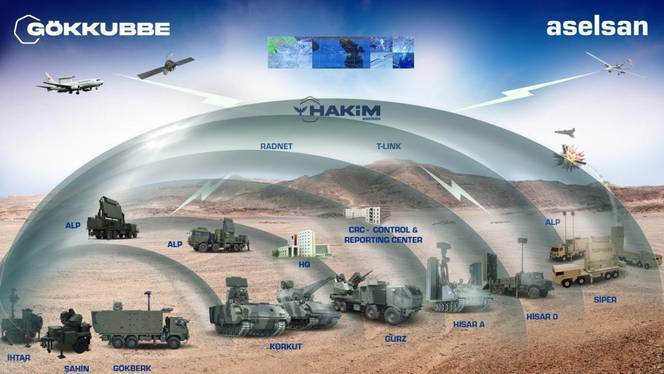
Steel Dome is described as a “system of systems” due to its integration of various indigenous air defense systems developed by leading Turkish defense companies such as Aselsan, Roketsan and MKE. The project will incorporate advanced technologies, including artificial intelligence, to create a multi-layered air defense network.
Key components of Steel Dome include Aselsan’s Korkut, Hisar-a+, Gökdemir, Göker, Gökberk, Hisar-o+ and Si̇per air defense systems. These systems will work together to provide comprehensive protection against a wide range of aerial threats, from low-altitude missiles to high-altitude aircraft.
Roketsan’s contributions to the project include several advanced defense systems. The Alka directed-energy weapon system is designed to neutralize drones and other small threats using laser technology. The Burç mobile air defense system offers protection against a wide range of aerial threats with its sophisticated sensors and defensive capabilities. The Sungur air defense missile system provides effective short-range defense against aircraft and missiles. Additionally, the Siper long-range missile defense system is intended for long-range protection, targeting high-altitude and long-range threats, including cruise missiles. Together, these systems aim to address various airborne threats, enhancing overall defense capabilities.
TÜBİTAK SAGE (Defense Industries Research and Development Institute) and MKE (Mechanical and Chemical Industry Corporation) will also play significant roles in the project. TÜBİTAK SAGE will focus on the research, development and prototyping of critical systems, while MKE will provide advanced weaponry and ammunition.
The Steel Dome project aims to create a robust air defense shield by integrating sensors, communication modules, command and control stations and AI-powered decision-making tools. This system will not only enhance Turkey’s defense capabilities but also serve as a deterrent against potential threats.
The exclusion of Turkey’s advanced S-400 missiles from its new defense project highlights the impact of previous crises with NATO and the US. The decision underscores the complex position Turkey has reached amid ongoing tensions over its acquisition of the Russian-made missile system.
In December 2017 Ankara announced that it had signed an agreement with Russia to purchase two batches of the S-400 missile system, one for immediate delivery and the other as an option. Turkish officials confirmed that a down payment had been transferred to Russia for the S-400 systems, which had a total cost of $2.5 billion. They also indicated that this cooperation could evolve into joint production of the S-500 system in the future.
The purchase of the S-400s triggered significant concern from the US. and NATO. They argued that the system could gather intelligence on NATO defense operations and aircraft, potentially sharing this data with Russia.
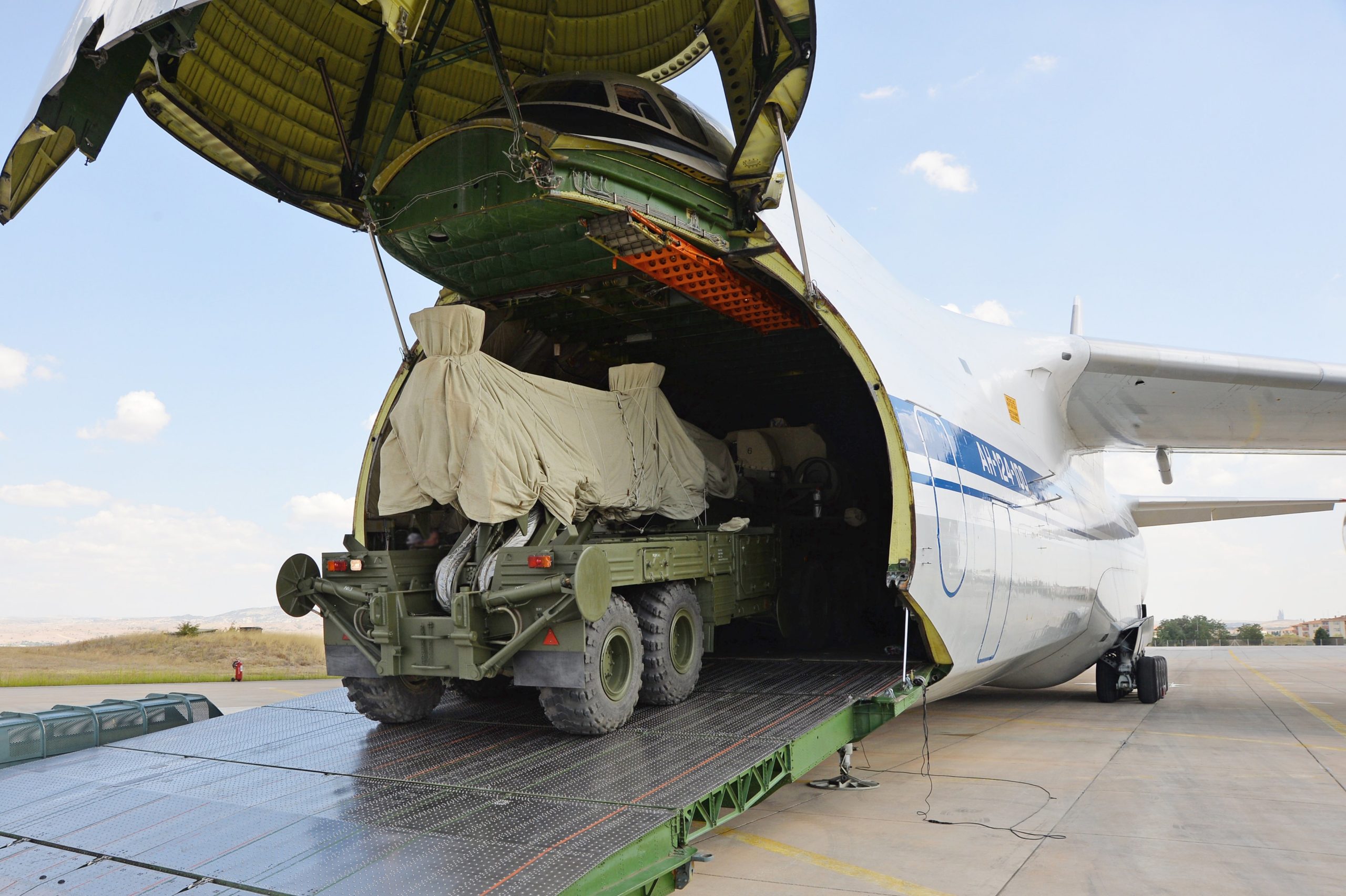
Despite these concerns, the first components of the S-400 system arrived in Turkey on July 12, 2019, as announced by the Ministry of National Defense.
In 2021 the US administration officially removed Turkey from the F-35 Joint Strike Fighter program due to Ankara’s purchase of the Russian S-400 missile system in 2017.
The US has repeatedly warned Turkey that activating the S-400 missiles or buying a second batch would trigger heavier sanctions under the Countering America’s Adversaries through Sanctions Act (CAATSA). On December 14, 2020 the US imposed sanctions on Turkey’s Presidency of the Defense Industry (Savunma Sanayii Başkanlığı, SSB) and certain of its principal officers over the S-400 procurement
During an annual meeting with journalists on December 16, 2023 in Ankara, Turkish defense minister Yaşar Güler discussed the S-400 long-range missile system purchased from Russia. Güler subtly indicated that while the S-400 system was not currently active, it would be deployed if necessary.
“This is a defense system. Don’t we use a defensive weapon when someone attacks us? No country launches an attack on another by declaring, ‘I will attack you in two hours.’ In a wartime scenario, you need to move your aircraft, operate hundreds of trains and declare mobilization, and so on. In other words, for a country to launch an airstrike on another without anyone noticing is very difficult,” Güler told journalists.
It had previously become public knowledge that Turkey did not keep the S-400 system in an active status. The revelation that the missiles are stored at an unknown location was made in a speech by former defense minister Hulusi Akar during deliberations at parliament’s Planning and Budget Committee on November 22, 2022.
Akar did not disclose the location where the missiles were stored but claimed that they were ready to be deployed in the event of a threat and once the decision was made where the air defense system would be positioned. His remarks indicated that the Turkish government has deferred plans to activate the S-400s and would not make a decision on where to deploy them any time soon.
He also talked about the time required for the S-400 system to be transported and deployed as he tried to refute the opposition’s accusations that the missiles were nothing more than useless salvage.
“The S-400 requires transport time [for deployment] and after that — 30 minutes according to the manual, but I’ll say an hour — it would be ready in the location to where it was shipped. Everything is ready, so there’s no problem there,” Akar said.
In the Turkish media, particularly on social platforms, questions have been raised about why the S-400 system was acquired if it wasn’t going to be used. In response to these concerns, reports occasionally surface claiming that the S-400 will be integrated into the Steel Dome project. However, these reports appear to be aimed at addressing public criticism rather than providing concrete plans.
In January Turkey managed to overcome some of these diplomatic and defense-related barriers by approving NATO membership for Sweden and Finland. As a result, obstacles were lifted for the sale of F-16 jets and modernization kits by the United States, and Canada recently removed restrictions on the sale of optical materials used in unmanned aerial vehicles. Given this context, Turkey is unlikely to revisit the S-400 issue and face a new crisis.
In an earlier statement in 2020 to CNN Türk, Russian Ambassador to Turkey Alexei Yerkhov said, ‘Whether [the system] is used or not is a decision for the country that owns it. Turkey purchased the product they wanted from us. The owner of this system is Turkey. It is entirely dependent on what Turkey decides. Whether you go to the beach with it, carry potatoes or mount a machine gun on it for war, keeping it in the ‘garage’ is your right.”
Meanwhile, Cavit Çağlar, a former minister and businessman known for his role in mediating the crisis between Turkey and Russia following Turkey’s downing of a Russian aircraft that allegedly violated its airspace in 2015, said in an interview with journalist Cansu Çamlıbel on August 5 that Turkey should seek to divest itself of the S-400 system. Çağlar suggested that there are potential buyers for the S-400, with India being a notable example. He indicated that Russia was unlikely to object to this move and emphasized that a resolution through dialogue remained a viable option.