

Levent Kenez /Stockholm
In a landmark decision with potentially far-reaching implications, the Grand Chamber of the European Court of Human Rights (ECtHR) ruled on Tuesday that the conviction of Yüksel Yalçınkaya, a teacher in Turkey, on terrorism charges, which included using a mobile phone app and having an account at a specific bank, was unlawful. The decision could have significant consequences for thousands of individuals facing similar charges in Turkey.
The ECtHR found that Turkey had violated three key articles of the European Convention on Human Rights (ECHR): Article 6, guaranteeing the right to a fair trial; Article 7, prohibiting punishment without law; and Article 11, protecting freedom of assembly and association.
On March 21, 2017 a Kayseri court had sentenced Yalçınkaya, who is still incarcerated, to more than six years in prison on conviction of terrorist organization membership based on his alleged use of the ByLock messaging app and having an account at Bank Asya. In 2020 he applied to the ECtHR, claiming his rights had been violated.
Yalçınkaya was alleged by the prosecutors to be affiliated with the Gülen movement, a group opposing President Recep Tayyip Erdogan. The Turkish government declared the Gülen movement a terrorist organization, but the declaration received no international support.
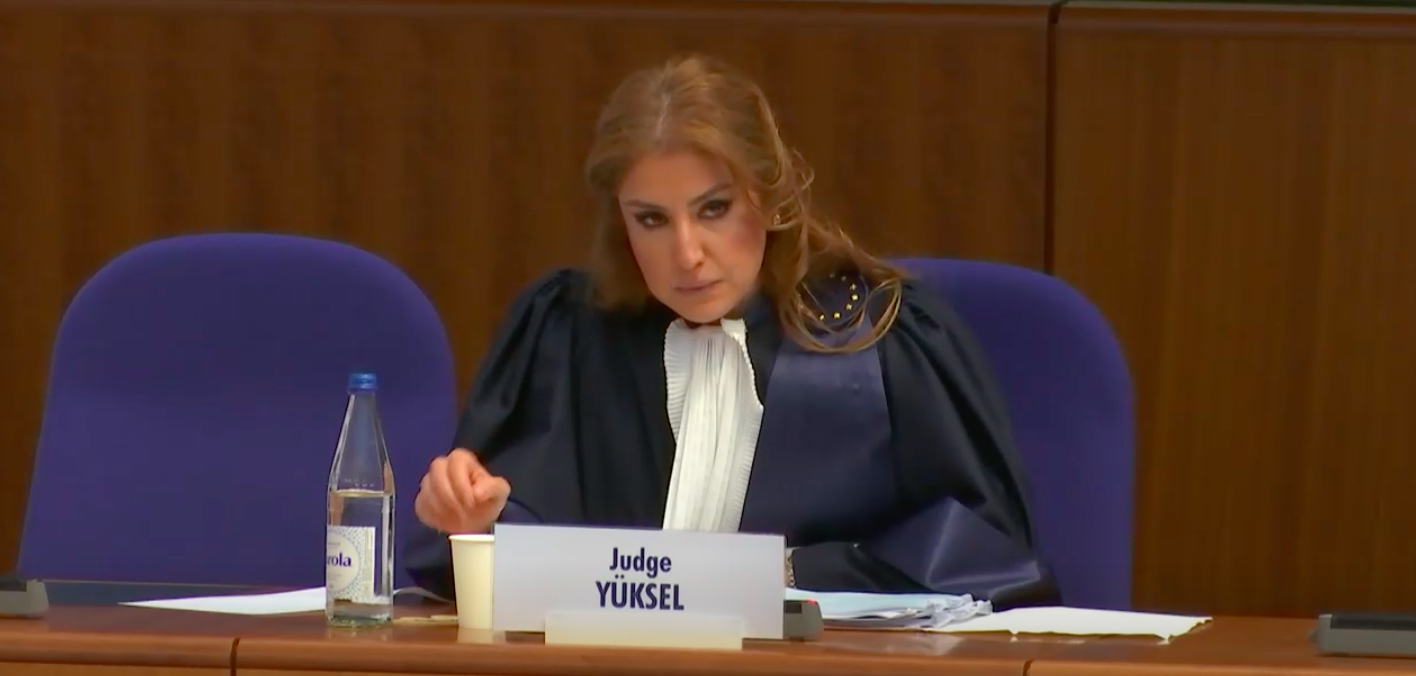
Turkish ECtHR Judge Saadet Yüksel, who consistently stands apart from the majority in human rights cases involving Turkey, continued her pattern of expressing differing opinions in that case, unsurprisingly, siding with the Turkish government.
Yüksel was the sole judge among 17 who argued that Article 6, which ensures a fair trial, had not been violated and voted in favor of Turkey in this case.
In her partly dissenting, partly concurring opinion in the verdict, Yüksel claims that the majority’s evaluation of the domestic court rulings does not align with established ECtHR case law. She argues that their focus on specific deficiencies within the domestic proceedings, without considering the case as a whole, is contrary to ECtHR jurisprudence. Yüksel also emphasizes the crucial role of raw data in the applicant’s case and questions the majority’s emphasis on the failure to disclose it. She suggests that determining data disclosure should remain within the jurisdiction of national courts, rather than the ECtHR.
Yüksel’s opinion being nearly identical to one expressed by the Turkish minister of justice after the verdict was announced is noteworthy.
During Yalçınkaya’s hearing absentia in January, Yüksel had asked his lawyers a question in line with the Turkish government’s arguments about an encrypted messaging app that the Supreme Court of Appeals ruled did not constitute sufficient evidence of a crime. Human rights defenders and lawyers described this as a scandal, demanding that Yüksel withdraw from the case.
As part of the ruling Turkey was ordered to pay Yalçınkaya 15,000 euros to cover costs and expenses.
The ECtHR criticized Turkey’s use of the encrypted messaging app ByLock as evidence, citing it as overly broad and arbitrary, lacking the necessary safeguards for a fair trial. Furthermore, the court highlighted significant procedural deficiencies in Yalçınkaya’s trial, including the denial of access to evidence and the absence of an independent examination of data.

The court also noted that Turkish authorities had used Yalçınkaya’s legitimate membership in a labor union as evidence against him, thereby violating his right to freedom of assembly and association under Article 11 of the ECHR. This ruling holds broader implications for similar cases in Turkey, emphasizing the necessity for legal proceedings to align with European human rights standards
Following Yüksel’s appointment to the top court, human rights observers expressed concern about her impartiality given the close relations between her and Turkey’s ruling Justice and Development Party (AKP). Not only was her brother Cüneyt a senior AKP lawmaker and former deputy chairman, but Yüksel herself was affiliated with Islamist foundations supported by the Erdogan government. She was also an assistant to and student of the late Burhan Kuzu, a chief aide and leading propagandist of President Erdogan. Nordic Monitor previously published a report on Yüksel’s strong ties to the government. Her brother returned to parliament in the general election held in May.
Yüksel and former ECtHR President Róbert Ragnar Spanó were at the center of harsh criticism in September 2020. Spanó was the first ECtHR president to pay an official visit to Turkey, the government of which is a party to more than 16 percent of the cases before the Strasbourg court. Spanó and Yüksel met with President Erdogan behind closed doors at his presidential palace.

Those who expected Spanó to give a strong message to top officials that Turkey must implement European court judgments and respect the rule of law were disappointed. Spanó made courtesy calls and received an honorary doctorate from Istanbul University, which has fired scores of academics in a massive crackdown since 2016, at a ceremony that students and journalists were not allowed to attend, at Spanó’s request. Spanó also went to Yüksel’s hometown of Mardin, a city in southeastern Turkey
French daily Le Monde claimed that Yüksel and Spanó are close friends, implying that their relationship is more emotional than professional.