Levent Kenez/Stockholm
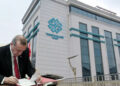
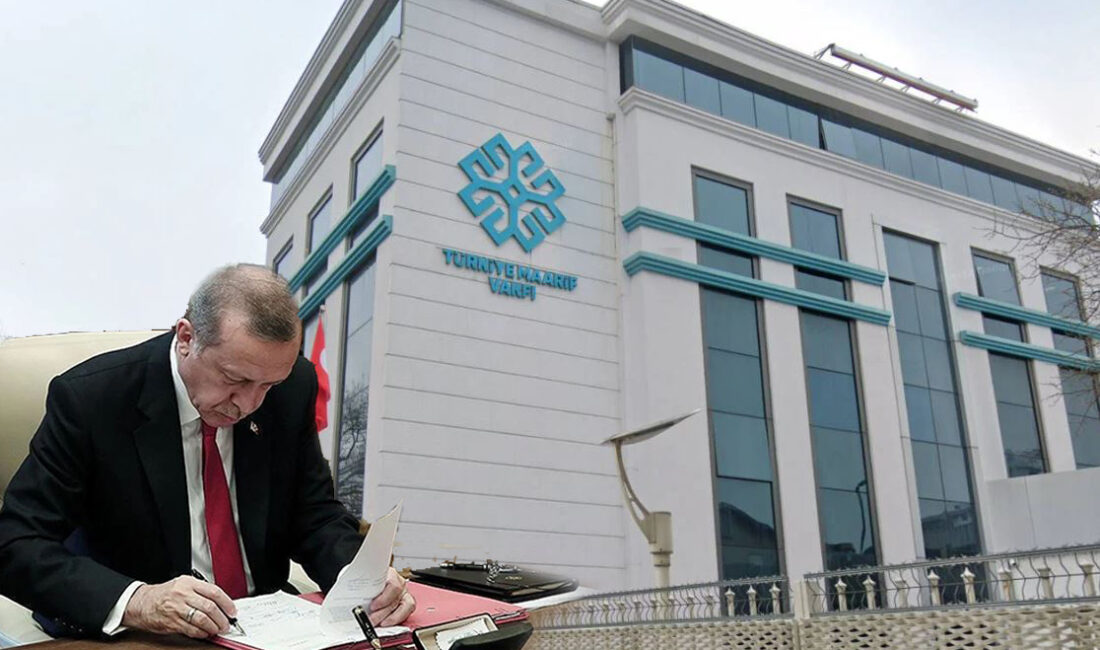
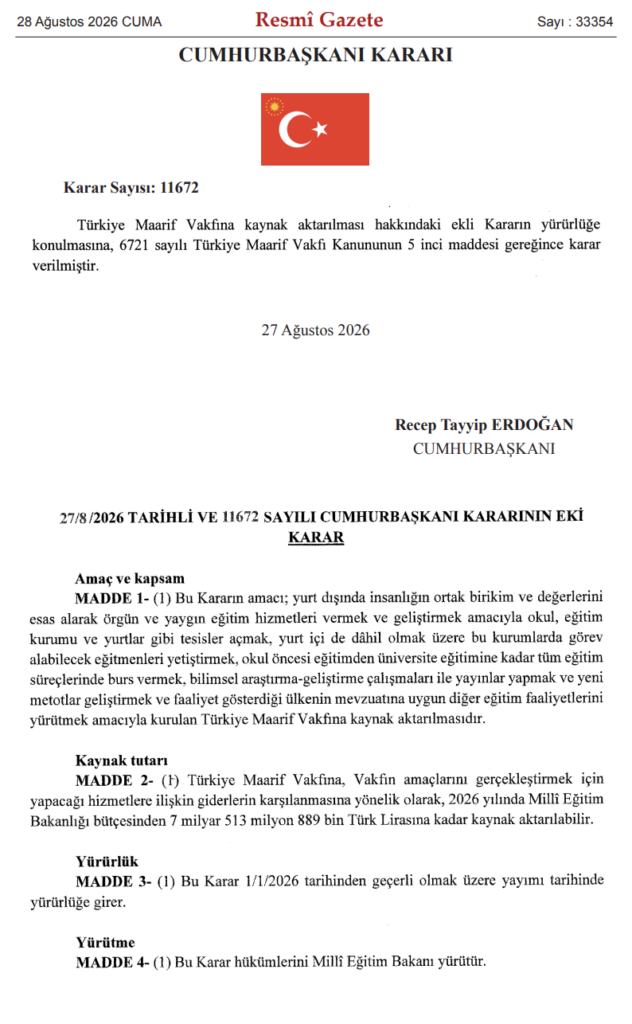
Turkish President Recep Tayyip Erdogan has signed off on a record 7.51 billion lira budget ceiling for the Islamist Maarif Foundation in 2026, the tenth consecutive annual increase for a state-funded body that critics describe as an extension of Erdogan’s influence abroad, projecting his political and ideological influence and financing pro-government messaging in dozens of countries.
The increase comes even as Turkey’s currency keeps losing value and its overall budget comes under strain, a pattern that shows how consistently the foundation has been shielded from the belt-tightening applied elsewhere.
The decision, published in the Official Gazette on August 28, sets the maximum amount the Ministry of Education can transfer to the foundation this year at 7.51 billion lira up from 6.77 billion lira in 2025. The money is earmarked for the foundation’s overseas education work, including opening new schools, awarding scholarships and funding research and development.
Under Turkish budget procedure, the general outline of the Education Ministry’s spending is debated each fall in parliament’s Planning and Budget Committee, but the exact ceiling for Maarif is fixed separately each year through a presidential decree rather than a line item voted on by lawmakers, leaving the decision entirely in Erdogan’s hands.
The foundation was created in June 2016, weeks before a failed coup that Ankara blamed on the movement led by the late cleric Fethullah Gülen, a claim the movement has denied, calling the coup attempt a staged pretext for a broader crackdown. In the years since, Maarif has expanded far beyond that original mandate, positioning itself as Turkey’s main state-funded operator of schools abroad and, according to critics, as a mechanism through which Erdogan’s government projects influence and funds narratives favorable to itself well outside Turkey’s borders.
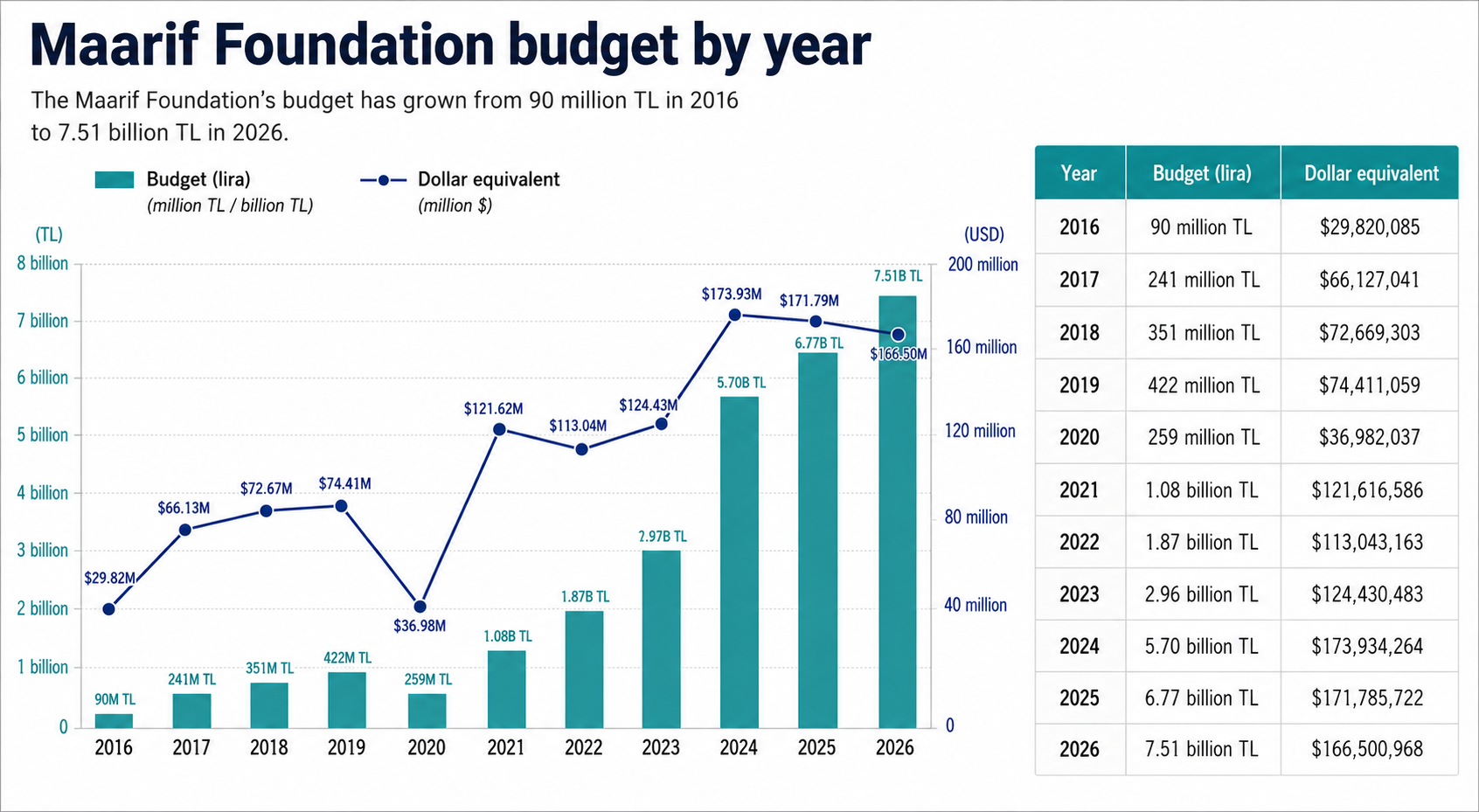
Every year since its founding, the foundation’s budget has risen, and every year it has kept rising even as the broader economic backdrop worsened. The lira has been losing value faster than the budget has been growing: Converted into dollars using each year’s own average exchange rate, Maarif’s funding actually peaked in 2024 at close to $174 million, slipped to about $172 million in 2025 and is on track to fall again this year to around $166.5 million, despite the nearly 11 percent rise in lira terms. The foundation’s share of the Education Ministry’s own budget has followed the same trajectory, falling from just over half of 1 percent in 2024 to less than half of 1 percent in 2025 and an expected 0.38 percent in 2026, as the ministry’s overall spending, dominated by salaries for more than a million teachers and staff, has grown even faster. None of that has translated into the government pulling back on Maarif itself. The lira ceiling has still gone up every single year, a pattern that critics say shows the foundation’s funding is treated as untouchable regardless of what is happening to the currency or to the rest of the public budget.
Opposition figures and critics of the government have repeatedly pointed to that consistency as the real story, arguing that in a period when ordinary households and other public institutions are absorbing the cost of inflation and currency depreciation, Maarif has never once seen its allocation cut, with the money still effectively channeled toward a network aligned with the ruling party rather than toward Turkey’s domestic education system, which they say faces its own resource shortages.
The foundation’s structure gives the Turkish presidency direct influence over its operations. Its founding law sets a 12-member board of trustees, with four members appointed by the president, three by the Council of Ministers and further seats reserved for representatives of the education, foreign affairs and finance ministries. Turkey’s Constitutional Court upheld this arrangement in a 2018 ruling, rejecting a challenge from opposition lawmakers and finding that parliament had lawfully granted the foundation public status and access to state budget funds to carry out functions on behalf of the Turkish state abroad.
That state backing has been central to Maarif’s growth into a global schools operator. According to an investigative report from the Brussels-based rights group Solidarity with Others in July 2026, Maarif has pursued the closure, confiscation or forced handover of at least 162 schools linked to the Gülen movement across 29 countries since 2016, a process that disrupted the employment of about 7,800 administrators, teachers and support staff and left the foundation in direct control of 131 of those institutions.
The report describes a pattern in which Ankara used diplomatic pressure, investment pledges, security cooperation agreements and bilateral leverage to persuade host governments to hand over schools, often outside normal legal channels. It cites cases including Mali, where an emergency decree revoked licenses for schools tied to the Collège Horizon network in 2017; Niger, where the transfer of schools to Maarif went ahead despite an earlier domestic court ruling against them; Afghanistan, where raids and arrests accompanied a two-year handover process; and Venezuela, Zambia and Liberia, where property seizures, deportations or the confiscation of administrators’ passports preceded the schools’ transfer to Maarif.
The report argues that the cumulative conduct of Turkish authorities and cooperating governments could meet the legal threshold for the crime against humanity of persecution under Article 7 of the Rome Statute of the International Criminal Court, pointing to what it describes as the systematic, politically motivated denial of property rights, professional licenses and access to legal remedy for people tied to the Gülen movement.
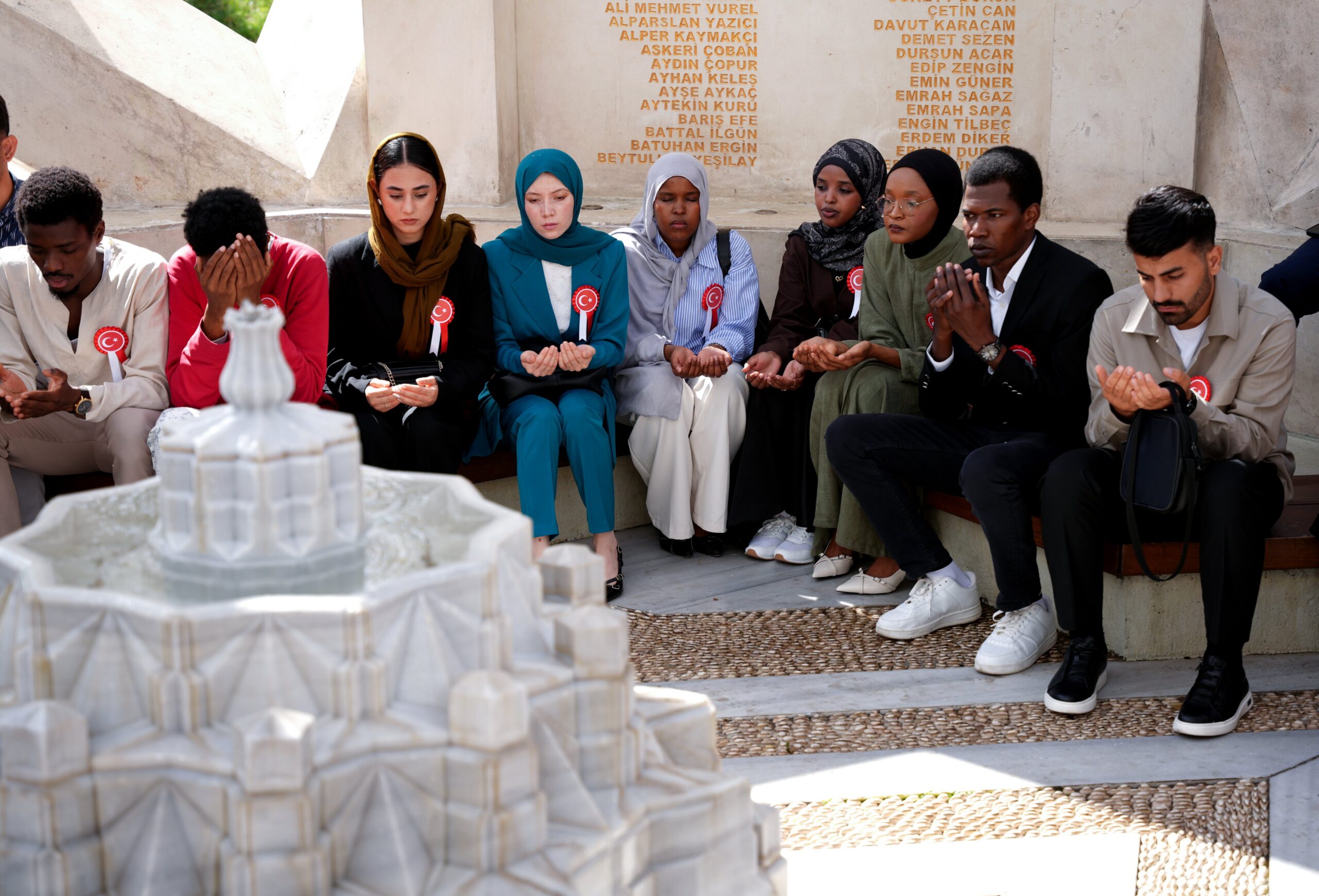
The foundation’s reach does not stop at seizing schools. It also shapes activities at the schools it operates, increasingly involving international students in state-organized events that promote the government’s account of the July 15, 2016, coup attempt. Students from Maarif schools abroad and from programs run inside Turkey have taken part in these events, which are organized in cooperation with Turkey’s diaspora agency, the Presidency for Turks Abroad and Related Communities. This year’s July 15 commemorations included Maarif students visiting a coup memorial museum in Istanbul, an occasion the foundation described as a way to pass on national memory to a new generation, and a separate gathering where more than 100 foreign students studying in Turkey heard from a pro-government commentator about the same events.
Maarif’s approach mirrors a broader shift in which Ankara treats scholarships, foreign students and diaspora outreach as tools of influence abroad rather than as neutral educational exchange. An article published in Communication and Diplomacy, a journal run by the Turkish presidency’s communications directorate, has gone as far as describing overseas scholarship recipients as citizen diplomats representing the state. Presenting foreign students with a single official narrative of contested political events, delivered through institutions the state itself funds and directs, blurs the line between education and ideological messaging.