Abdullah Bozkurt/Stockholm
Turkey’s powerful, multi-billion dollar religious authority, the Diyanet İşleri Başkanlığı, has crafted a sophisticated and long-term strategy to blunt mounting European restrictions on its overseas operations. The plan centers on shifting away from state-dispatched clerics toward locally trained personnel while simultaneously expanding a vast global network of religious, educational and social influence, according to a detailed parliamentary debate reviewed by Nordic Monitor.
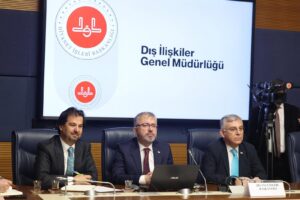
The strategy was presented during a closed-door session on April 2, 2026, of the Subcommittee on Turks Abroad and Related Communities under the Turkish Parliament’s Foreign Affairs Committee. During the session senior Diyanet officials provided lawmakers with an unusually candid briefing on the institution’s global footprint, staffing structure and long-term plans for maintaining and expanding influence among diaspora communities.
Facing tightening legal constraints across Europe — including investigations into espionage, influence operations and other illicit activities linked to Turkish state institutions — the Diyanet is deliberately moving away from sending imams directly from Turkey. Instead, it is investing in a long-term localization strategy designed to circumvent legal and political barriers imposed by European governments.
Officials described the International Theology Program (Uluslararası İlahiyat Programı, UIP) as a cornerstone of this strategic shift. The program is designed to recruit young individuals from Turkish diaspora communities, train them in Turkey and then redeploy them back to their countries of residence as religious functionaries embedded within local systems.
“This is actually one of the most important projects developed as an alternative to imam assignments in continental Europe,” Ensari Yentürk, director general of external relations at the Diyanet, told lawmakers during the session.
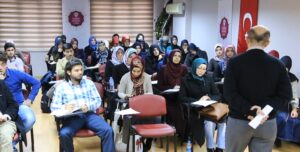
Graduates of the program are employed under local contracts rather than formal state postings, allowing the Diyanet to maintain operational continuity while navigating increasingly restrictive legal frameworks in Europe. The model also helps bypass accreditation and vetting problems that have intensified in recent years due to concerns over the political and ideological profiles of imams sent directly by Ankara.
The program has already produced more than 1,200 graduates from 15 countries, with hundreds more currently enrolled, signaling a steady pipeline of locally embedded personnel aligned with Ankara’s religious and political outlook.
Despite this strategic pivot, the scale of the Diyanet’s global presence remains extensive. Figures presented during the parliamentary briefing show that the institution operates through a multi-layered international structure combining diplomatic postings, contractual staff and locally embedded operatives.
According to the data shared with lawmakers, the Diyanet currently maintains 77 religious affairs counselors and 54 attachés assigned to Turkish embassies worldwide, along with 1,510 long-term religious officials deployed abroad. These are supplemented by approximately 290 short-term clerics and around 500 locally recruited staff, many of whom have been trained through Diyanet-run programs that, according to multiple sources, include confidential briefings coordinated with Turkey’s intelligence agency, the National Intelligence Organization (MIT).
Officials acknowledged that even this sizable workforce is sometimes insufficient, necessitating temporary placements funded directly by local mosque associations aligned with Ankara.
A key component of the Diyanet’s strategy involves financial structuring designed to evade scrutiny. Officials repeatedly stressed that a significant portion of overseas activities is not financed directly through the state budget but rather through the Türkiye Diyanet Vakfı (TDV), a government-controlled, multi-billion dollar foundation, as well as contributions from diaspora communities.
“The financial aspect of these services is carried out not through the Presidency’s budget but through the foundation and donations from our citizens,” Yentürk said.
This indirect funding mechanism allows Ankara to maintain operational control while reducing exposure to European regulations targeting foreign state financing of religious institutions. It also obscures the true scale of expenditures from public oversight, both domestically and abroad.
The parliamentary briefing underscored that the Diyanet’s overseas activities extend far beyond traditional religious services. Officials described mosques abroad as central nodes of community life that provide not only religious guidance but also social, cultural and even informal welfare services, thereby deepening institutional dependence on Ankara-linked structures.
The Diyanet’s influence strategy also includes an expansive network of educational and humanitarian initiatives. Programs such as the International Imam-Hatip High Schools Program (Uluslararası İmam-Hatip Lisesi Programı, UIHP), which spans the fifth to the 12th grades, currently host nearly 2,000 foreign students from more than 110 countries and have graduated 3,655 students to date.
At the university level, the UIP continues to expand, targeting both foreign nationals and members of the Turkish diaspora. The program has produced 1,243 graduates from 15 countries so far, further reinforcing the pipeline of ideologically aligned religious personnel.
Yentürk emphasized that the UIP is explicitly designed to counter European policies aimed at reducing the number of Turkish state-affiliated religious officials abroad.
“This is in fact one of the most important projects of our directorate in the field of education, and it is an educational program developed as an alternative to policies aimed at reducing the number of religious officials in continental Europe,” he said.
Beyond Turkish communities, the Diyanet has broadened its reach to non-Turkish Muslim populations in 72 countries, providing religious training to nearly 1,000 students at the undergraduate and graduate levels in Turkey. These initiatives are largely funded by the Diyanet Foundation, further insulating them from direct governmental accountability.
Youth outreach programs form another critical pillar of this strategy. Under the Values Education and Virtuous Youth Program (Değerler Eğitimi ve Erdemli Gençlik Programı), thousands of diaspora youths aged 13 to 25 are brought to Turkey for religious and cultural training. Over the past six years, 5,346 young people have taken part in these programs, which are funded entirely by Diyanet-affiliated mosques and entities operating abroad.
Officials stressed that these initiatives are designed to preserve religious and cultural identity among younger generations, a goal that aligns closely with Ankara’s broader political agenda of maintaining influence over diaspora populations.
At the same time, the Diyanet operates extensive humanitarian aid programs in up to 140 countries, including food distribution, water well construction and religious outreach. During the parliamentary session, officials cited anecdotal evidence to illustrate the perceived effectiveness of these efforts, including a claim that humanitarian assistance in a Christian village in Senegal led to mass conversion to Islam.
“Within two months, we received information that the entire village had become Muslim due to this gesture,” Yentürk said.

In addition to religious and humanitarian activities, the Diyanet functions as a de facto political outreach and lobbying arm for the government of President Recep Tayyip Erdogan. It seeks to cultivate influence among foreign religious leaders through high-profile international summits and conferences targeting regions such as Africa, Asia and Latin America.
These include gatherings such as the African Muslim Religious Leaders Summit, the International Latin American Muslim Religious Leaders Summit and the Asia-Pacific Muslim Religious Leaders Summit. Erdogan has personally delivered keynote addresses at many of these events, underscoring their political significance.
The global Muslim Brotherhood network has reportedly played a facilitating role in mobilizing participation from foreign religious figures, further embedding the Diyanet within transnational Islamist networks.
The parliamentary discussion also revealed explicit political directives tied to these activities. Lawmaker Zafer Sırakaya, a senior figure in Erdogan’s ruling Justice and Development Party (AKP) and former head of the Germany-based Union of International Democrats (UID), urged the Diyanet to intensify its engagement with diaspora youth and to reframe its discourse on Islamophobia.
Sırakaya argued that the term “Islamophobia” should be replaced with “hostility against Islam” and called for revisions to existing reports produced jointly by the Diyanet and the government-linked SETA Foundation. These reports have drawn on data from various state institutions, including MIT, to map diaspora communities across Europe.
He also emphasized the need to counter the influence of the faith-based Gülen movement within diaspora communities, describing it as a priority for ideological confrontation. The movement has been a vocal critic of Erdogan’s government, particularly regarding the politicization of religion, alleged support for jihadist groups and systemic corruption.
Sırakaya further highlighted concerns about European child welfare systems, claiming that Turkish children placed in foster care are often assigned to non-Muslim families. Drawing on his experience in Germany, particularly in North Rhine-Westphalia, he noted that many guardianship organizations are affiliated with Christian institutions, with little to no Muslim representation.
He called on the Diyanet to encourage greater participation by Turkish families in foster care systems to preserve cultural and religious continuity.
Expressing concern about fragmentation, declining institutional control and generational shifts within diaspora communities, Sırakaya warned that European restrictions on Diyanet activities are already producing tangible effects. He cited his recent observations in Norway as evidence of tightening constraints and pledged parliamentary support to overcome these challenges.
Notably, support for expanding the Diyanet’s overseas role is not limited to the ruling party. Opposition lawmakers also signaled willingness to assist. Utku Çakırözer of the main opposition Republican People’s Party (CHP), whose family resides in Germany, asked Diyanet officials what obstacles they face abroad and offered support in addressing them.
“What difficulties are you facing abroad? Are there areas we need to look at ourselves?” Çakırözer said, indicating a rare cross-party consensus on maintaining Turkey’s influence over diaspora communities.

During the session lawmakers pointed to a range of restrictive measures adopted by European governments, including bans on foreign imams, tighter controls on mosque financing and policies aimed at severing institutional ties with Ankara. These developments have heightened concerns among Turkish policymakers about the erosion of influence abroad.
The parliamentary briefing makes clear that the Diyanet is not retreating in the face of these challenges but rather adapting its methods. By localizing personnel, diversifying funding channels and embedding itself more deeply within diaspora communities, Ankara is seeking to preserve — and in some cases expand — its influence under increasingly restrictive conditions.
At the same time the Diyanet’s growing global footprint through education, humanitarian aid and partnerships with transnational networks such as the Muslim Brotherhood signals a broader ambition: to position itself as a central actor in international religious affairs and to serve as a proxy instrument for Ankara’s influence campaigns abroad.
Taken together, the developments point to a strategic transformation that allows Turkey to maintain and even extend its reach while avoiding direct confrontation with European regulatory frameworks, reshaping how state-linked religious influence is projected across Europe and beyond.