
Levent Kenez/Stockholm
More than 1.5 million websites and domain names had been blocked in Turkey by the end of 2025, according to a new report that documents a dramatic expansion of government control over the digital sphere and describes the emergence of a system in which online censorship has become a routine instrument of political management.
The report, published by the Freedom of Expression Association (İFÖD), found that Turkish authorities had restricted access to 1,505,484 websites and domain names through more than 1.28 million separate decisions issued by hundreds of courts and state institutions. For years the government of President Recep Tayyip Erdogan has consolidated control over much of Turkey’s television and newspaper sectors through regulatory pressure, ownership changes and the dominance of pro-government media groups. As a result social media platforms have become one of the few remaining channels where opposition politicians, independent journalists, activists and ordinary citizens can reach large audiences without passing through traditional gatekeepers.
The growing importance of those platforms has coincided with an intensifying campaign to regulate and restrict them. The findings come amid broader efforts by Ankara to expand oversight of online activity. Earlier this year Nordic Monitor reported that the government was preparing legislation requiring social media users to verify their identities with national identification numbers, a measure Justice Minister Akın Gürlek said had received support from major platforms. The proposal would eliminate a significant degree of online anonymity in a country where social media users have frequently faced investigations, detentions and prosecutions over their posts.

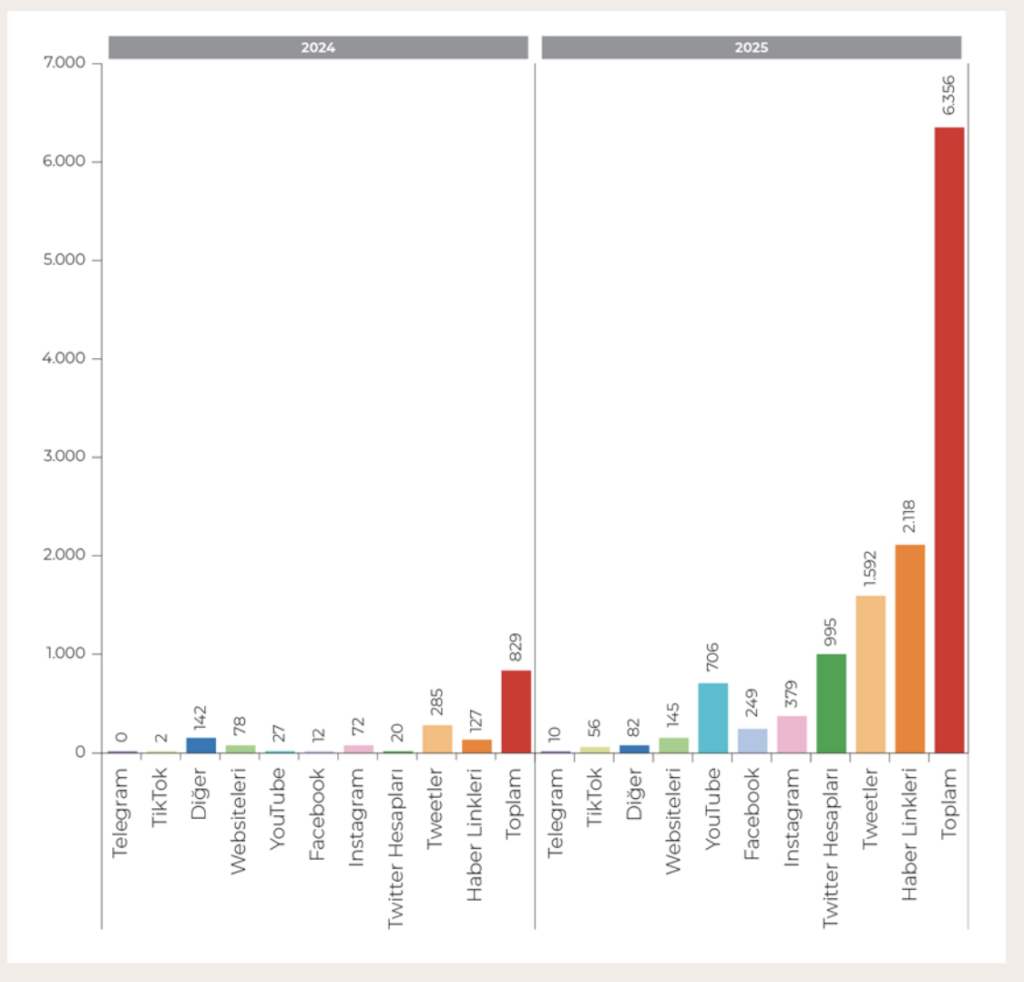
The İFÖD report suggests that such initiatives are part of a larger transformation in how Turkish authorities manage the digital space. One of the most significant developments documented in the report followed the March 2025 detention and later imprisonment of Istanbul Mayor Ekrem İmamoğlu, Erdogan’s strongest political rival. During the ensuing political crisis, access to major platforms including X, YouTube, Instagram and WhatsApp was severely disrupted through bandwidth restrictions that slowed services nationwide.
The restrictions coincided with mass demonstrations and were followed by measures targeting accounts linked to student groups, women’s organizations, journalists, human rights advocates, artists and opposition figures. The report portrays the episode as a revealing example of how digital restrictions are deployed during periods of political tension when information circulates outside official channels.
A second wave of restrictions emerged later in the year after police surrounded the Istanbul headquarters of the main opposition Republican People’s Party (CHP). This time, the measures extended beyond social media platforms and affected encrypted communication services, raising concerns about interference not only with access to information but also with private communications.
The report argues that Turkey’s censorship system has evolved far beyond the removal of individual pieces of content. Instead, it describes a structure capable of restricting access at multiple levels simultaneously, from social media posts and news articles to communications services and internet infrastructure.
Particular attention is given to Article 8/A of Turkey’s internet law, a provision originally introduced for situations involving national security and public order. According to the report the article increasingly served as the legal basis for blocking journalism, protest-related information and content involving politically sensitive allegations.
The report contends that the provision was used against material concerning corruption claims, favoritism allegations and other reporting involving politically connected individuals. Rather than being limited to exceptional circumstances, the mechanism increasingly functioned as a standard administrative tool during politically sensitive periods.
The scale of intervention documented by the report extends beyond content moderation practices commonly seen in democratic countries. Turkish authorities have increasingly targeted technical services that support the internet itself, including digital infrastructure providers, archiving tools, eSIM services and domain management systems.
Measures affecting services such as Netlify, archive.today, Duck DNS and Amazon IVS infrastructure illustrate a shift toward restrictions that can affect large numbers of users and websites simultaneously. Such actions often reach far beyond the original target, disrupting legitimate services that happen to rely on the same technical architecture.
The report also raises concerns about transparency and due process. Many blocking orders were reportedly issued using nearly identical language and without detailed legal justification. In numerous cases, publishers and users learned about restrictions only after content had already become inaccessible.
The lack of transparency has been compounded by the role of social media companies responding to government requests. According to the report accounts were frequently rendered inaccessible from within Turkey following official demands, while affected users often received little information about the legal basis for the restrictions. The result is a system in which content can disappear from public view with limited opportunity for meaningful legal challenge.
Another significant finding involves the implementation of Constitutional Court decisions. Turkey’s highest court has issued rulings finding that some content-blocking measures violated freedom of expression. Yet the report documents numerous instances in which lower courts failed to remove restrictions despite those rulings.
That failure has implications extending beyond individual cases. News reports, investigations and public-interest information often remain inaccessible years after courts have questioned the legality of restrictions. The cumulative effect is the gradual disappearance of parts of the public record from Turkey’s digital landscape.
The report characterizes this process as the erosion of digital memory, where information remains formally published but effectively unreachable for readers inside the country. For journalists, researchers and historians the long-term consequences extend beyond current political debate and affect the preservation of documentary evidence.
The findings arrive as international attention increasingly focuses on the relationship between technology platforms and governments seeking greater authority over online speech. Turkey has become an important case study because of the breadth of its regulatory framework and the frequency with which restrictions are imposed during politically sensitive events.
Unlike many countries where online regulation is primarily justified as a response to harmful content, the Turkish model increasingly combines court orders, administrative decisions, bandwidth restrictions, content removals and platform compliance into a single system capable of rapidly limiting the circulation of information.
The report concludes that censorship in Turkey can no longer be understood through a single law, institution or enforcement mechanism. Instead it describes a multilayered structure that operates across courts, regulators, internet service providers and global technology companies.
For Erdogan’s government, the challenge is clear. Traditional media are no longer the main battleground for political debate because much of the television and newspaper sectors are already aligned with or influenced by the government. Social media remains the most difficult space to control, particularly during elections, corruption scandals, protests and moments of political crisis.
The data collected by İFÖD indicate that Turkey’s response has been to expand the tools available for managing that space. With more than 1.5 million websites blocked and new identity-verification requirements under discussion, the country is moving toward one of the most extensive systems of digital control in the democratic world.
The government is also preparing new regulations targeting virtual private networks (VPNs), services that encrypt internet traffic and allow users to bypass access restrictions. Under the proposal VPN providers would be required to obtain licenses and comply with state-defined obligations, with authorities expected to block services that fail to do so. VPN use has become widespread during periods of censorship, particularly when access to social media platforms and news websites is restricted. The move indicates that government is no longer focused solely on controlling online content itself but is increasingly seeking to regulate the channels citizens use to access information beyond government-imposed barriers.