Levent Kenez/Stockholm
Turkey has unveiled a sweeping 10-year national water strategy that will shape how rivers flowing into the Middle East are managed, as Ankara moves to reduce domestic consumption while strengthening control over water resources that originate within its borders.
The National Water Plan for 2026 to 2035 entered into force after being approved by presidential decree and published in the Official Gazette on March 14. Prepared by the Ministry of Agriculture and Forestry, the plan sets out a long-term framework for managing the country’s rivers, reservoirs and water infrastructure.
Under the strategy, losses in drinking water networks are expected to fall to 25 percent by 2030 and to 10 percent by 2050. Daily water consumption per person is targeted to drop to 120 liters by 2030 and 100 liters by 2050.
Industry will also be expected to reuse more water. The plan aims to increase industrial water recovery to 30 percent by 2030 and 50 percent by 2050. Agriculture remains the largest consumer of water in Turkey. The strategy seeks to raise irrigation efficiency to 60 percent by 2030 and 65 percent by 2050 as part of a broader effort to reduce water losses while maintaining agricultural production.
The plan also calls for stronger wastewater treatment systems, digital monitoring of water resources and measures to improve resilience to climate change. The significance of Turkey’s water policy extends beyond its borders. Several major rivers originate in Turkey before flowing into neighboring countries, making water management an increasingly sensitive issue across parts of the Middle East and southeastern Europe.
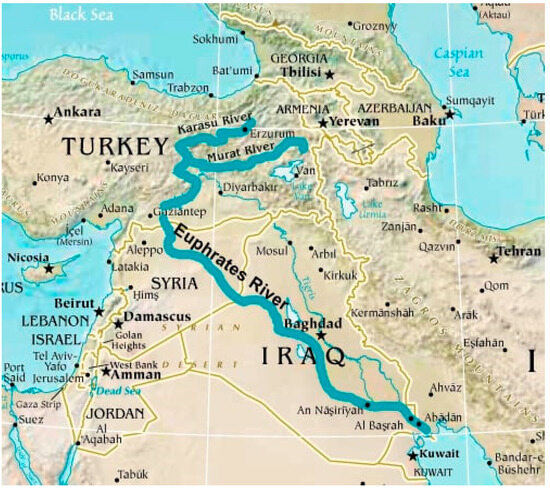
Two of the most important rivers in the region, the Tigris and the Euphrates, originate in the mountains of eastern Turkey before flowing south into Syria and Iraq.
Text of action plan outlining Turkey’s 10-year water strategy:
Together the two rivers form the core freshwater system of the northern Middle East. The Euphrates stretches roughly 2,800 kilometers from Turkey through Syria and into Iraq. The Tigris also begins in Turkey and flows southeast into Iraq, where the two rivers eventually merge before reaching the Persian Gulf.
Turkey sits at the upstream end of the basin and supplies much of the water feeding the system. Research estimates that about 90 percent of the Euphrates’ annual flow originates in Turkey, while the Tigris receives roughly 40 to 50 percent of its water from Turkish territory.
Because both rivers begin in Turkey, decisions about dams, reservoirs and water allocation upstream can directly affect water levels downstream.
Water has therefore been a recurring issue in relations between Turkey and its southern neighbors for decades. Since the 1970s Turkey has built a series of large dams under the Southeastern Anatolia Project, a major development program designed to generate hydroelectric power and expand irrigation in the country’s southeast.
The project includes 22 dams and 19 hydroelectric plants and has transformed large parts of the region into an important agricultural zone. At the same time it has raised concerns in Syria and Iraq about the potential impact of upstream water storage on river flows. Water shortages have become particularly severe in Iraq, where the Euphrates and Tigris provide most of the freshwater used for agriculture, drinking water and electricity generation.
About 70 percent of Iraq’s water resources originate outside the country, mainly from the two rivers flowing from Turkey. Declining rainfall and rising temperatures have added to the pressure.

The Middle East is already one of the regions most vulnerable to climate driven water scarcity. Scientists warn that increasing drought and higher evaporation rates could reduce water availability across the basin in the coming decades.
Water management has therefore become an increasingly important diplomatic issue. Turkey, Iraq and Syria have periodically negotiated agreements on water releases and technical cooperation. However the basin still lacks a comprehensive international treaty governing water sharing.
The diplomatic dimension of water policy is also visible on Turkey’s western borders. In northwestern Turkey the Meriç River, known as the Evros in Greece, forms part of the border between the two countries after flowing south from Bulgaria.
Flooding along the river has periodically strained relations among the three countries, especially when heavy rainfall in Bulgaria raises water levels downstream in Turkey and Greece. Since the river crosses several national borders, flood control and water management require coordination between all three countries.
Turkey’s National Water Plan does not set international water quotas or treaties. Instead it establishes the domestic framework through which the country intends to manage the rivers that originate within its territory in the coming decade.
For countries downstream, those policies will continue to shape the flow of rivers that remain essential for agriculture, cities and energy production across the Middle East.
Turkey’s National Water Plan has also faced criticism from the opposition. Dr. Baran Bozoğlu, deputy chair of local governments for the main opposition Republican People’s Party (CHP) and an environmental engineer, described the 2026–2035 plan as a “wish list” that fails to address Turkey’s water crisis. Bozoğlu argued that digitalization and smart grid initiatives mentioned in the plan remain superficial without a nationwide infrastructure overhaul or governance reform. He mentioned three key shortcomings: unclear financing for municipalities, the absence of a radical reform to curb agricultural water waste and fragmented water management between ministries and local authorities. “The plan identifies problems but remains a bureaucratic text at the level of wishes. Water is not an engineering issue to be solved by Supervisory Control and Data Acquisition (SCADA) systems or digital data, it is a matter of political will and a basic right to life,” Bozoğlu said. He pointed to international examples, including Tokyo, where pipelines were fully modernized to reduce losses, and Singapore, where advanced wastewater treatment transforms sewage into potable water as models showing that effective solutions require action rather than intentions.