Abdullah Bozkurt/Stockholm
The Islamist government of Turkish President Recep Tayyip Erdogan has adopted a strategic approach toward Iran that prioritizes the survival of the clerical regime in Tehran. Should that objective fail, Ankara appears determined to shape any political transition in a way that prevents the emergence of a pro-Western or Israel-aligned government.
Recent developments reveal that Turkey’s Iran policy is not driven merely by regional diplomacy but by a deeper geopolitical calculation: maintaining an ideological and strategic axis that counters Western influence in the Middle East while protecting Erdogan’s own political positioning at home and abroad.
While the Erdogan government, joined by much of the co-opted opposition in Turkey, has ratcheted up anti-Israel rhetoric in the aftermath of attacks on Iran, it has deliberately downplayed the Iranian mullah regime’s unprovoked missile launch against Turkish territory. Government propagandists have even gone so far as to blame the incident on Israel, portraying it as a supposed false-flag operation despite offering no evidence to support the claim.
For Ankara, Iran’s stability is viewed as a national security interest. Turkish policymakers increasingly interpret attempts to take down terrorism-sponsoring mullah regime as part of a broader geopolitical struggle involving the United States and Israel. They frequently frame protests or internal unrest in Iran as movements influenced by foreign powers, echoing narratives long promoted by Iranian leaders themselves.
At the same time Turkish leaders carefully avoid condemning Iran for its decades-long record of terror activity on Turkish territory. They routinely turn a blind eye to Iranian intelligence and espionage operations targeting Western interests and have helped the clerical regime circumvent Western sanctions by allowing it to tap into Turkey’s financial, corporate and industrial sectors.
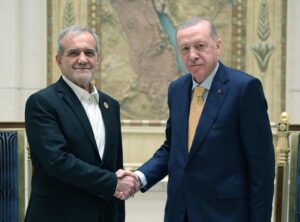
This posture may not come as a surprise given that President Erdogan has described Iran as his “second home” and has filled key Turkish government posts with pro-Iranian Islamist figures. Among them are intelligence chief İbrahim Kalın, Foreign Minister Hakan Fidan and Middle East adviser Sefer Turan.
From Turkey’s perspective, a sudden collapse of the Iranian regime could unleash unpredictable consequences for Erdogan’s government. One scenario Ankara appears particularly concerned about is the emergence of a pro-Western government in Tehran, one that could strengthen Israel’s strategic position in the Middle East, diminish Turkey’s influence within the transatlantic alliance and leave Erdogan as the region’s lone political Islamist leader openly confronting Israel.
Maintaining a stable but pressured Iran has also proven advantageous for Erdogan and his political and business associates. They have enriched themselves through sanctions-busting schemes, profiting from trade routes, financial channels and energy deals that operate in the gray zones of international sanctions regimes. While they have been milking Iranian funds through such arrangements, their ideological zealotry and entrenched antisemitic posture have blinded them to the risks such policies pose to Turkish national security and to Turkey’s standing within the transatlantic alliance.
As tensions between Israel and Iran escalate, Ankara has increasingly adopted rhetoric portraying Israeli actions as destabilizing while emphasizing Iran’s right to defend itself. This narrative aligns with Turkey’s broader effort to challenge Western dominance in Middle Eastern geopolitics.
The Erdogan government’s primary goal is to prevent a geopolitical outcome in which Iran becomes either a failed state or a Western-aligned government that would strengthen Israel and reshape the regional balance of power to Turkey’s disadvantage.

Turkey’s policy toward Iran, therefore, rests on what can best be described as “strategic ambiguity.” Ankara publicly supports diplomacy and regional stability while quietly working to ensure that evolving regional dynamics do not produce outcomes that undermine its geopolitical interests.
In practice this means that Ankara prefers the survival of Iran’s current regime. If that proves impossible, Turkey’s fallback position appears to be ensuring that any successor government remains resistant to Western or Israeli influence.
For Turkey’s leadership, the stakes are high. Erdogan appears to believe that his own political future is tied to Iran’s trajectory, whether under the current clerical establishment or under a new political order. He is deeply concerned that once Iran’s regime is removed from the geopolitical equation, international attention may turn more intensely toward his own increasingly autocratic rule.
That calculation may help explain why the Erdogan government has been laying the rhetorical and psychological groundwork for a potential confrontation with Israel, not through a formal declaration of war but through a steady drumbeat of anti-Israel messaging amplified by a tightly controlled media landscape, the film industry and segments of academia.
Over the past several months, pro-government columnists, television commentators and political operatives have increasingly framed Israel as an existential threat to Turkey. The narrative is no longer confined to criticism of Israeli policy in Gaza. It has expanded into claims that Israel ultimately intends to target Turkey itself, positioning Ankara as the “last obstacle” to Israeli regional ambitions.

This messaging shift is not accidental. It reflects a well-honed political strategy: preparing public opinion before policy escalates. A series of highly publicized operations by Turkey’s intelligence agency, the National Intelligence Organization, targeting alleged Mossad spy rings, assets and operatives in Turkey, along with the arrest and imprisonment of individuals accused of working for Mossad, appear to form part of a broader, orchestrated effort to reinforce public hostility toward Israel and shape domestic perception of an external threat.
In Turkey’s pro-government press, Israel is routinely portrayed as the hidden architect behind past domestic crises. Such claims deflect criticism from the Erdogan government’s own failures while portraying opponents and critics as supposed agents of Israel or operatives of Mossad. The implication is clear: Turkey has long been under attack, and open confrontation would merely formalize an existing conflict.
This siege narrative serves multiple political purposes. First, it reframes internal dissent and criticism as collaboration with foreign enemies. Second, it fuses nationalism and religious sentiment into a unified political identity centered on resistance. Third, it legitimizes further consolidation of executive power in the hands of Erdogan in the name of national survival.
Erdogan’s ability to shape this narrative rests on near-total dominance over Turkey’s mainstream media. Since 2015 hundreds of independent outlets have been shuttered, seized or forced into government-aligned ownership structures. Most critical journalists have been forced into exile, while others who remained in the country have been imprisoned or face prosecution under broadly defined counterterrorism and disinformation laws.
Television stations that command mass audiences now largely echo official talking points. Headlines frequently warn that “Turkey is next” after regional escalation. Commentators openly discuss the possibility of an inevitable showdown with Israel, framing it as defensive and morally justified.

For example, government propagandist Turgay Güler — who frequently accompanies presidential delegations on foreign trips — argued in a March 3, 2026, column published in the government-controlled Akşam newspaper that claims about Israel targeting Turkey are not speculative but part of an ongoing confrontation.
He wrote that “after Iran, it will be Turkey’s turn” and asserted that “for Israel, the only real threat is Turkey.” According to Güler, Turkey’s expanding defense capabilities including drones and missile platforms have made Israel fearful of Ankara’s rising military power.
He went even further, claiming that “Israel is the mother of all terrorist organizations, evils and treacheries.” Güler concluded by predicting a direct confrontation, writing that “Turkey and Israel will face each other in the not-too-distant future.” He added that such a conflict would be brief and predicted a Turkish victory.
Güler is far from alone in promoting such views. Dozens of pro-government commentators tasked with echoing and amplifying official messaging have expressed similar arguments in recent months. Together they help shape public perception by framing Israel as an existential adversary, portraying past Turkish political and security crises as externally orchestrated attempts to weaken the country and predicting an imminent confrontation.
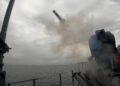
Another pillar of this war-preparation narrative is Turkey’s rapidly expanding domestic defense industry. Armed drones, missile systems and fighter jet prototypes are showcased in media spectacles that blend technological pride with geopolitical messaging.
Weapons systems such as the Bayraktar drones, the AKINCI unmanned aerial vehicle, the TAYFUN missile and the KAAN fighter jet are presented not only as deterrents but as symbols of national destiny. Public rallies and televised defense expos reinforce the idea that Turkey is militarily ready to confront any adversary including Israel.

This fusion of defense modernization with civilizational rhetoric conditions the public to view conflict as both feasible and winnable.
The danger of such sustained rhetoric lies in its self-fulfilling potential. When media ecosystems consistently predict confrontation, public expectations shift accordingly. Even reasonable opposition figures, already rare in Turkey’s oppressive political climate and under constant risk of imprisonment, may find themselves boxed in by these narratives and unable to distance themselves politically.
For Europe and Turkey’s NATO allies, the messaging also raises serious concerns. Turkey remains a member of NATO with significant strategic leverage across the Black Sea, the eastern Mediterranean and the Middle East. A rhetorical drift, potentially reinforced by policy actions, toward open hostility with Israel, a key Western partner, complicates alliance cohesion.
There has been no formal declaration of war nor immediate evidence of military mobilization for direct conflict with Israel. Yet through coordinated media narratives, symbolic militarization and nationalist-religious framing, Erdogan’s government appears to be psychologically conditioning the Turkish public for that possibility.
It may still be too early to determine whether this preparation is intended primarily as deterrence, bargaining leverage or genuine strategic intent — perhaps a combination of all three. What is clear, however, is that in a media environment where dissent is muted and propaganda amplified, the line between political theater and geopolitical reality can quickly blur.
Once a society internalizes the inevitability of war, stepping back becomes far more difficult than stepping forward.
In the end, Turkey’s policy toward Iran reflects a deeper strategic alignment shaped by ideology, political survival and geopolitical ambition. For Erdogan and the political elite surrounding him, Iran’s clerical regime functions as both a regional partner and a strategic shield against the expansion of Western influence in the Middle East.
A collapse of Iran’s ruling establishment would not simply alter the regional balance of power. It could also expose Ankara to increased scrutiny from Western allies, weaken Turkey’s leverage within NATO and potentially isolate Erdogan as the last major political Islamist leader confronting Israel and the West.
That possibility helps explain why Ankara’s messaging has increasingly blurred the line between regional diplomacy and ideological confrontation. By portraying Israel and Western powers as destabilizing forces while defending Iran’s strategic position, the Erdogan government is signaling that it views the survival of the current geopolitical order with Tehran as a central pillar essential to its own political future.
In that sense, Turkey’s Iran policy is not merely about preserving a neighboring regime. It is about preserving a regional balance of power that Erdogan believes protects both his government and the political Islamist ideological project.