Levent Kenez/Stockholm
A Turkish government-backed Islamist NGO that has faced longstanding allegations of transporting weapons to jihadist groups is preparing to send humanitarian aid to Iran, according to statements from the organization and pro-government figures, attracting renewed scrutiny over its past activities and political backing.
The Foundation for Human Rights and Freedoms and Humanitarian Relief (İHH) announced that it has initiated contacts and preparations to deliver aid to civilians affected by the war in Iran, positioning the effort as part of its broader humanitarian operations across conflict zones.
The move comes as attention refocuses on a previously suppressed criminal investigation in Turkey that directly implicated the organization and its leadership in alleged links to Iranian-backed networks.
Between 2011 and 2014, Turkish authorities conducted a confidential investigation into the activities of Iran’s Islamic Revolutionary Guard Corps Quds Force inside Turkey. According to investigation files, the İHH and its president, Bulent Yildirim, were identified as part of a network suspected of maintaining ties with Iranian-backed groups including the Palestinian Islamic Jihad.
Investigators treated Yildirim as a suspect in the case and documented alleged coordination between individuals linked to İHH and operatives associated with Iran’s external operations wing, according to officials familiar with the investigation.
The case never reached court. In February 2014 the government of President Recep Tayyip Erdogan intervened to shut down the investigation. The prosecutor handling the case was removed before filing indictments, and the inquiry was effectively buried. Suspects, including those linked to the İHH, avoided prosecution as a result of the intervention.
The closure of the case marked a turning point, after which multiple investigations into jihadist networks and their logistical support structures in Turkey were also halted, with police officials reassigned or dismissed.
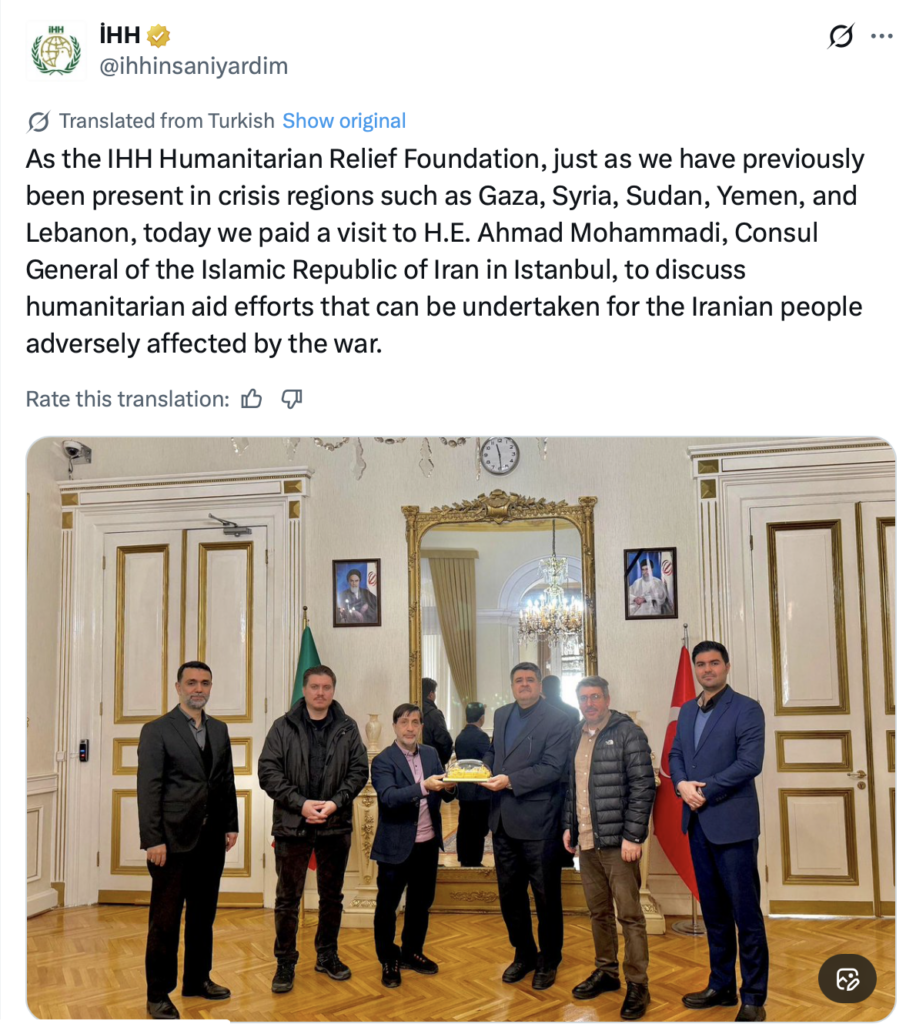
Days before announcing its Iran initiative, the İHH said its representatives had met with Ahmad Mohammadi, Iran’s consul general in Istanbul, to discuss potential humanitarian operations.
“As the İHH Humanitarian Relief Foundation, just as we have previously been present in crisis regions such as Gaza, Syria, Sudan, Yemen and Lebanon, we visited the Consul General of the Islamic Republic of Iran in Istanbul to discuss humanitarian assistance efforts for the Iranian people affected by the war,” the organization said in a statement.
Additional details were provided by pro-government journalist Kemal Özturk, who said on March 24 that İHH Chairman Yildirim had completed preparations to send medical aid to Iran and that trucks carrying supplies would soon depart.
The İHH operates in Turkey with extensive government backing. The organization benefits from a full tax exemption and has a special authorization allowing it to conduct fundraising activities without prior approval, under a cabinet decree issued during Erdogan’s tenure. It also secures foreign funding, including support from Qatar-based charities.
At the same time, the group has been repeatedly cited in intelligence reports and criminal investigations over alleged involvement in supporting militant networks.
In a 2016 court statement former police intelligence official Ali Fuat Yilmazer said İHH campaigns were structured to assist jihadist groups worldwide by providing logistics, funding, medical aid and human resources.
Russian intelligence documents submitted to the United Nations Security Council in February 2016 identified the İHH as an organization involved in smuggling weapons to al-Qaeda-affiliated groups in Syria. The documents included details such as truck license plate numbers allegedly linked to shipments carrying arms and supplies to the Nusra Front.
A separate investigation launched in Turkey in 2014 pointed to the İHH’s involvement in transferring funds and materials to militants in Syria. Prosecutors in the eastern province of Van cited wiretaps and surveillance indicating that branches in Kayseri and Kilis were involved in sending aid to jihadist fighters.
According to those findings, the network was linked to a Turkish al-Qaeda cell led by Ibrahim Sen, a former Guantanamo detainee. Authorities alleged that the operation functioned with logistical support from Turkey’s National Intelligence Organization (MIT), with the İHH acting as a facilitator.
That investigation was also halted before reaching the courts, with officials removed from their posts. The allegations surrounding the İHH echo the 2014 MIT trucks incident, in which Turkish authorities intercepted trucks reportedly carrying weapons to armed groups in Syria. The case triggered a political crisis, with the government maintaining that the shipments were part of intelligence operations. The prosecutors and journalists who exposed the situation were later prosecuted and jailed.
Reports based on leaked government documents have suggested that the İHH has worked in coordination with Turkish intelligence in overseas operations, particularly in Syria, where Ankara has backed opposition factions.
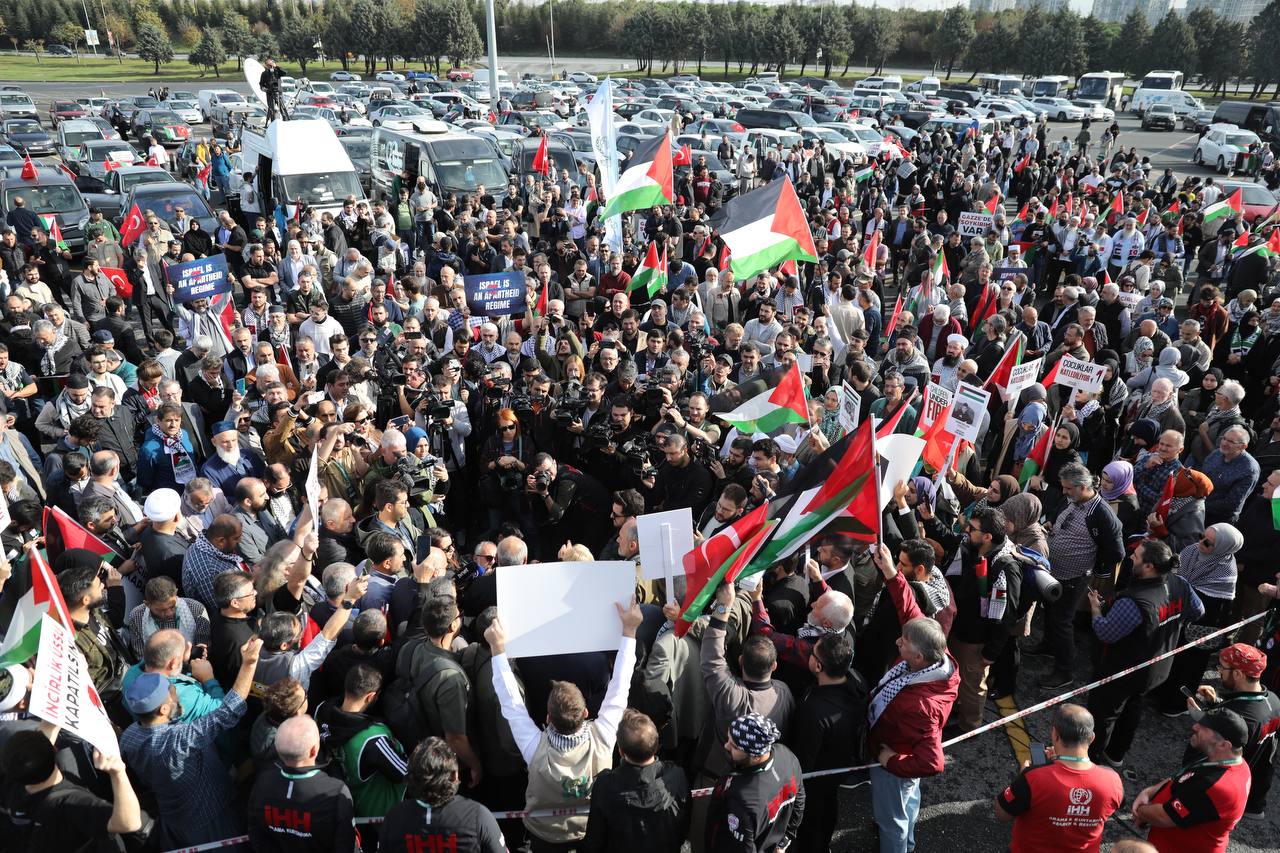
The organization has also played a role in politically charged mobilization efforts inside Turkey. In November the İHH organized a convoy and protest targeting Incirlik Air Base in southern Turkey, which hosts US Air Force personnel.
During the demonstration, İHH Chairman Yildirim delivered speeches accusing the United States of hostile intentions and called for mass mobilization. Participants were urged to converge on the base as part of a nationwide action.
According to reporting based on intelligence-linked sources, the protest aligned with broader government efforts to create leverage in relations with Washington.
The İHH has also expanded its activities in northern Syria, particularly in areas captured by Turkey-backed armed groups. The organization delivered aid in locations such as Tal Rifaat and parts of Aleppo shortly after these areas changed hands.
Video footage released by the İHH shows convoys entering these areas, indicating coordinated access to territory under the control of armed factions.
Past investigations by Turkish authorities alleged that the organization was involved in transporting wounded fighters in Syria to Turkey and facilitating the cross-border movement of supplies and personnel. Some reports claimed ambulances were used in such operations.
Despite these allegations, the Turkish government has continued to support the İHH, intervening in legal processes and providing political backing.
The İHH first gained international prominence during the 2010 Mavi Marmara flotilla, which sought to break the Israeli blockade of Gaza. The operation ended in a deadly confrontation with Israeli forces and triggered a diplomatic crisis between Turkey and Israel.