
Levent Kenez/Stockholm
Turkey remained the most complained-about country before the European Court of Human Rights (ECtHR) in 2025, despite a decline in the total number of applications compared with the previous year, according to the court’s Annual Report released in Strasbourg.
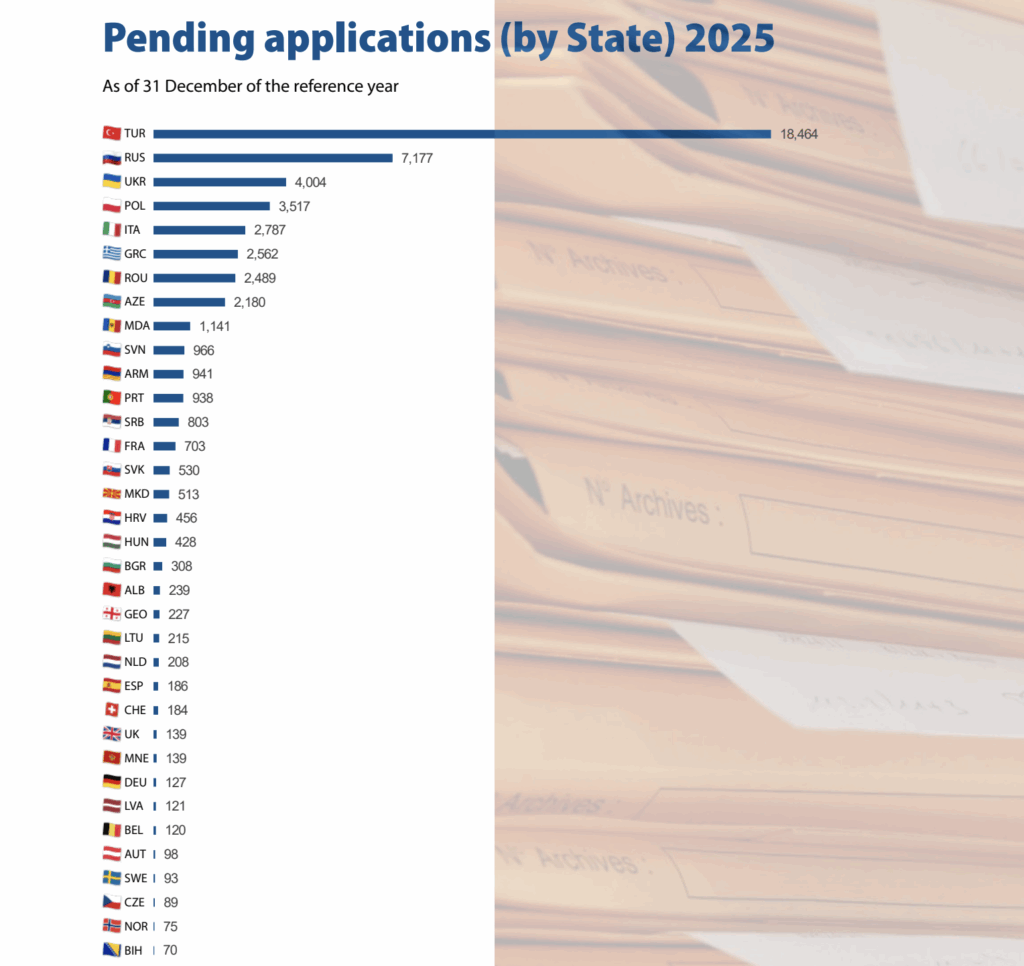
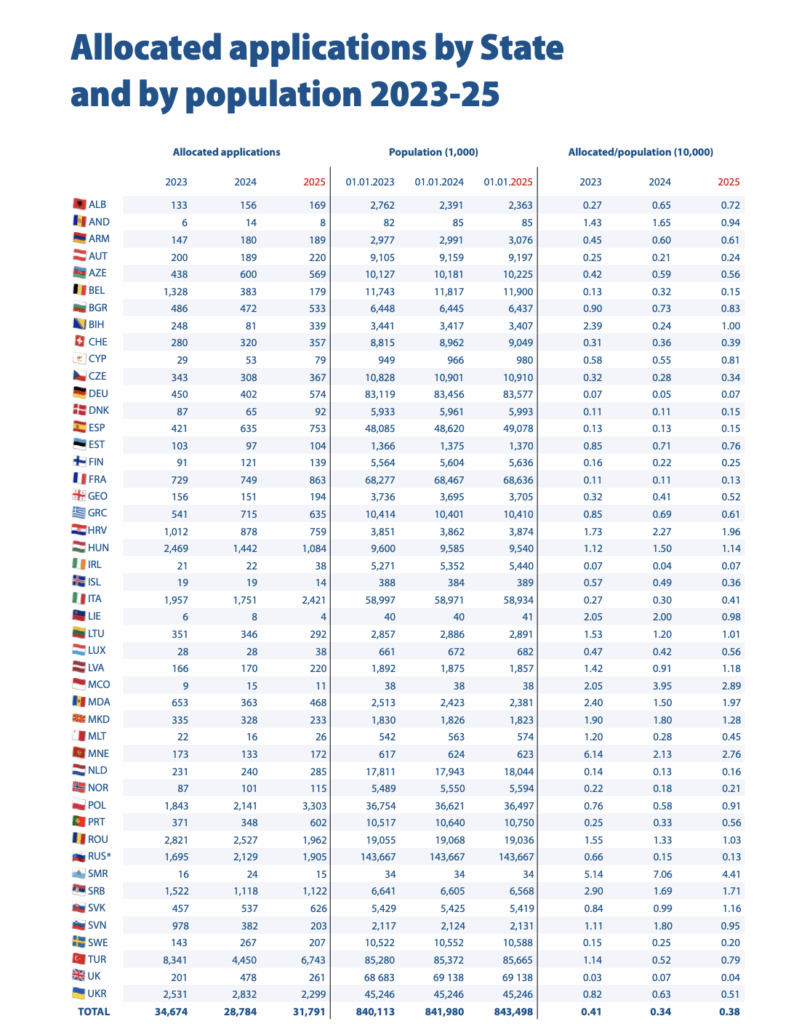
The report shows that 6,743 new applications against Turkey were registered in 2025, up from 4,450 in 2024 but down from 8,341 in 2023. Turkey ranked first among the 46 Council of Europe member states in the number of pending applications before the ECtHR. As of December 31, 2025, there were 18,464 applications pending against Turkey, far exceeding those against Russia (7,177), Ukraine (4,004) and Poland (3,517). Although the court’s overall caseload declined by 11 percent in 2025 to 53,450 pending cases, applications concerning Turkey still accounted for more than one-third of the total, underscoring the country’s disproportionately large share
The Annual Report attributes more than 80 percent of applications from Turkey to measures taken after a coup attempt on July 15, 2016, including arrests, pretrial detention, criminal prosecutions and dismissals from public service. The court notes that many of these cases raise similar legal questions and have therefore been grouped for examination, a procedural approach that significantly understates the number of individuals affected by the violations identified in individual judgments.
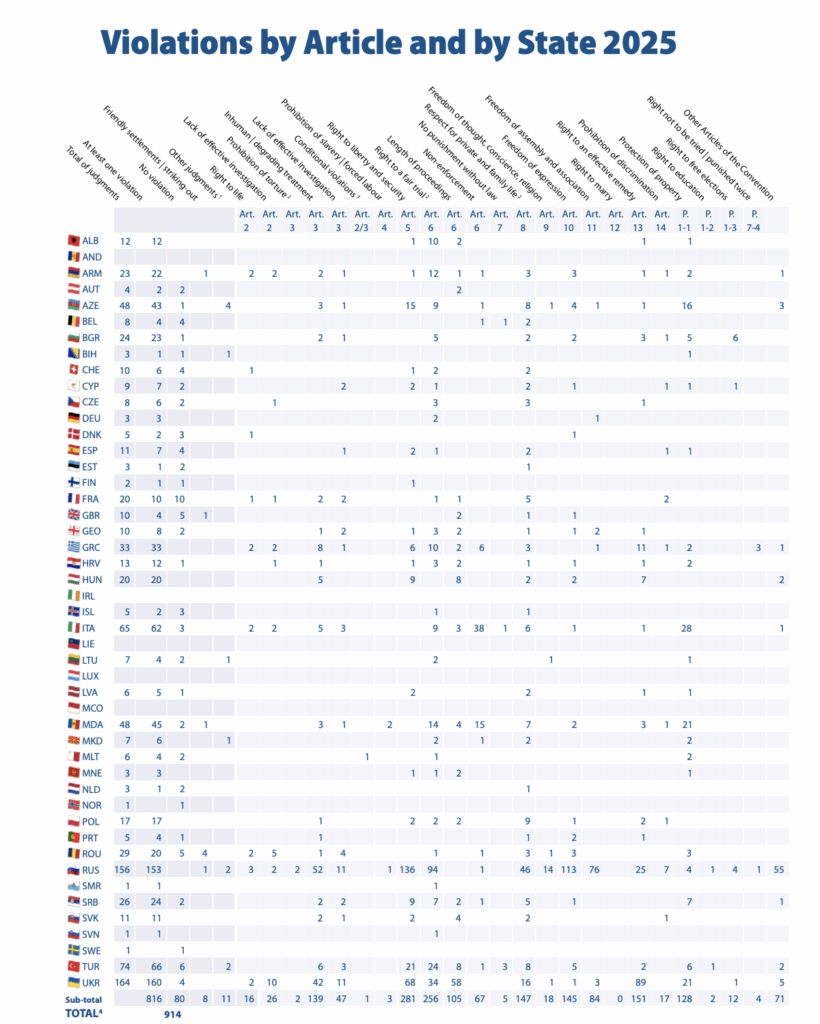
In 2025 the court delivered 74 judgments concerning Turkey, either on individual or grouped applications. In 66 of those judgments, the court found at least one violation of the European Convention on Human Rights. Six judgments found no violation, while two cases were resolved by other procedural means.
The most frequent violations concerned Article 6 of the convention, which guarantees the right to a fair trial. The court found violations of Article 6 in 24 cases involving Turkey. Article 5, which protects the right to liberty and security, followed closely with 21 judgments finding violations related to unlawful detention or insufficient judicial review.
Among the violations recorded in 2025, violations of Article 7 of the convention, the prohibition of punishment without law, carried particular legal weight. Article 7 codifies the principle of legality in criminal law, requiring that criminal offenses and penalties be clearly defined by law and foreseeable at the time the act is committed. The provision bars the extension of criminal liability through judicial interpretation to the detriment of the accused and prohibits retroactive criminal punishment. Under the convention system, Article 7 is absolute in nature and allows no derogation, including during states of emergency.
The court’s statistical tables show that violations of Article 7 were found five times across all member states in 2025. Three of those findings concerned Turkey. In each of those cases, the court held that domestic courts had relied on interpretations of criminal law that did not meet the convention’s requirements of accessibility, precision and foreseeability. The judgments found that the applicants could not reasonably have foreseen, at the time of the alleged conduct, that their actions would give rise to criminal liability under the relevant provisions of Turkish law.
The Article 7 violations identified in Turkish cases were not limited to isolated individual circumstances. The court examined hundreds of the applications in grouped proceedings, a procedural mechanism used when applications arise from the same factual background and raise identical legal questions. As a result, the three Article 7 violation judgments corresponded to large groups of applicants convicted on the basis of the same legal reasoning. The Annual Report notes that grouping significantly reduces the number of judgments delivered while leaving unchanged the number of individuals affected by the violation.
In its reasoning, the court reiterated that the principle of legality requires more than the formal existence of a statutory provision. Criminal liability must be based on a legal norm that is sufficiently clear in its scope and interpretation at the time of the alleged offense. The court further stressed that evidentiary shortcuts or presumptions that effectively replace individualized proof of criminal conduct are incompatible with Article 7 when they lead to punishment based on conduct that was not criminalized in a clear and foreseeable manner.
Across the Council of Europe, Article 7 violations remained exceptional in 2025. The vast majority of member states recorded no findings under this provision. The concentration of Article 7 violations in Turkish cases, as reflected in the court’s annual statistics, placed Turkey among the very few states where the court identified systemic shortcomings in the application of the principle of legality during the year.
The court also reported a steady flow of new applications from Turkey in early 2026, with approximately 650 new cases registered in the first weeks of the year. The majority of these applications were lodged by individuals dismissed from the civil service following the 2016 coup attempt.
Anticipating a new wave of mass applications involving identical or closely related complaints, the court introduced special administrative measures effective January 1, 2026. These include mandatory cover sheets, standardized electronic application forms and individual submission requirements for each applicant, aimed at managing large-scale cases more efficiently.
The Annual Report also highlights a rise in applications from Turkish sports clubs, particularly those challenging the independence of the Turkish Football Federation’s Arbitration Committee. Approximately 60 such applications were pending at the end of 2025. In a judgment delivered earlier this year, the court ruled that the Arbitration Committee did not meet the requirements of independence under the convention.