
Abdullah Bozkurt/Stockholm
A Turkish man who pleaded guilty to alien smuggling in a US federal court has exposed the growing reach of Turkish-run syndicates moving migrants into the United States through both the Mexican and Canadian borders.
The criminal complaint against Serkan Gökce, a Turkish national with prior US immigration violations, reveals a structured network relying on handlers in Canada, digital coordination via WhatsApp and prearranged pick-ups along remote border roads in upstate New York.
According to the complaint filed in the Northern District of New York, US Border Patrol agents detected movement near the Canadian border shortly before 3 a.m. on April 18, 2025. Remote sensor imagery captured several individuals walking through the woods toward the intersection of Scriver and Bush Road in Mooers Forks, an isolated crossing point known for frequent smuggling activity.
When agents arrived, they found three Turkish nationals who immediately admitted they had crossed into the US without legal documents. All three were taken into custody.
As the migrants were being processed, an agent observed a dark sedan behaving suspiciously near the same intersection. The vehicle slowed as if anticipating a rendezvous, then sped away. Agents followed and stopped the driver, identified as Gökce, who claimed he was trying to get to Plattsburgh, a statement inconsistent with his location, which matched the migrants’ description of the planned pick-up point.
The criminal complaint filed against a Turkish national for smuggling migrants into the United States:
At the Border Patrol station, one of the migrants, identified as D.C., agreed to a search of his phone. WhatsApp messages revealed he shared live GPS coordinates with Gökce throughout the crossing. D.C. also identified a Canada-based facilitator named T.Y., who arranged the smuggling operation and instructed migrants to look for a waiting Honda Civic, the same model Gökce was driving.
The three men apprehended with Gökce were not newcomers to illegal border crossings. Homeland Security records showed that all had previously been arrested for entering the United States illegally, two in Tecate, California, after crossing from Mexico in 2023, and one in El Paso, Texas, who later moved to Canada before attempting re-entry.
D.C. admitted he had earlier entered the US illegally from Mexico, lived there, then moved to Canada, from which he sought to re-enter the United States through an organized smuggling route run by Turkish nationals in Montreal and across the Quebec–New York border. He told investigators he paid $1,500 to T.Y. in Canada, and another $1,500 was to be paid to Gökce after the successful pick-up.
The arrangement mirrors patterns US authorities have increasingly documented since 2023: Turkish migrants paying large sums to well-organized cross-border facilitators who exploit the relative openness of the US–Canada frontier and the heavily trafficked Mexico routes.
Gökce himself had a known history with US immigration authorities. He was previously arrested in El Paso in 2022 and issued a Notice to Appear after entering the United States unlawfully. The new complaint shows he later became involved in transporting migrants, serving as a driver instructed to retrieve border crossers based on real-time digital location updates.
The case, signed by US Magistrate Judge Gary L. Favro and sworn by Border Patrol Agent Chase D. Beatty, offers a rare inside look at how Turkish smuggling networks operate with logistical hubs in Mexico, Canada and Turkey and use US borderlands as staging grounds for coordinated, technology-enabled crossings.
Gökce pleaded guilty to federal alien-smuggling charges, a felony that carries significant prison time. His cooperation, according to sources familiar with similar cases, may assist investigators in mapping a broader transnational smuggling structure that has moved thousands of Turkish nationals into the United States in recent years.
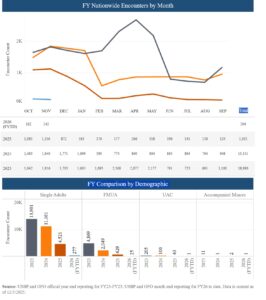
US immigration enforcement data reveal a dramatic rise in the number of Turkish nationals entering the United States over the past five years. The shift reflects a fundamental change in Turkey’s outward migration patterns, driven by political repression, economic instability and the rapid expansion of transcontinental smuggling pipelines stretching from Istanbul to Mexico and Central America.
US Customs and Border Protection data show that encounters with Turkish nationals at US borders surged to 18,986 in fiscal year (FY) 2023, which runs from October 2022 to September 2023, before easing to 13,311 in FY 2024 and then falling further to 5,192 in FY 2025. In FY 2026 encounters with Turks stood at 304 so far.
In fiscal year 2024, according to official data, US Immigration and Customs Enforcement arrested 37 Turkish nationals on criminal convictions, pending criminal charges or other immigration violations. The figure for fiscal year 2025 stands at 10 so far. Detentions involving Turkish nationals totaled 707 in FY 2024 and rose to 1,198 in FY 2025. In terms of removals, ICE deported 547 Turkish nationals in FY 2024, compared with 151 removals recorded in FY 2025.
The trajectory points to a sharp spike in irregular migration by Turkish citizens in 2023, followed by a marked decline over the subsequent two years, a shift that coincides with tighter border controls, changing smuggling routes and evolving US enforcement practices, while still leaving Turkish nationals as a visible component of non-traditional migration flows at the border.
Meanwhile, the Turkish government’s crackdown on human smugglers under President Recep Tayyip Erdogan has remained largely ineffective. Most investigations have ended in dismissals, acquittals or the release of suspects, including individuals who profit from migrant smuggling in partnership with international criminal syndicates, underscoring the persistent failure to hold key actors accountable.
Publicly, Turkish authorities continue to boast about the number of detentions, prosecutions and court cases involving migrant smuggling. In practice, however, convictions remain rare, and the criminal justice system appears to have failed to stem the flow of illegal migration.

According to Interior Minister Ali Yerlikaya, who briefed lawmakers in parliament on November 17, 2025, 3,627 migrant smugglers were arrested in 2025. In 2024 Yerlikaya announced a comparable figure, stating that 3,924 individuals were arrested in connection with migrant smuggling. The near-identical arrest numbers from one year to the next suggest that the government’s strategy of targeting organizers has failed to produce any meaningful deterrent effect.
Rather than declining, the caseload in Turkey’s judicial system continues to expand. According to the latest available data from the Justice Ministry, 26,314 prosecutions related to migrant and human smuggling were underway nationwide, involving 45,976 suspects. In 2024 alone prosecutors launched 13,140 new investigations, targeting 19,735 suspects.
Of these cases, 15,424 were brought before criminal courts, charging 32,538 suspects, while 7,776 new cases were filed in criminal courts in 2024 alone. At the appellate level, the dysfunction is even more apparent: More than 700 convictions were overturned by the Supreme Court of Appeals in the same year, further weakening the judicial response.
Taken together, the figures underscore a systemic failure under the government of President Erdogan. Despite thousands of arrests and a growing prosecutorial backlog, migrant-smuggling networks, often operating in coordination with international criminal syndicates, continue to function with near impunity, highlighting the gap between official rhetoric and meaningful enforcement.