

Levent Kenez/Stockholm
A military framework agreement between Turkey and Serbia, signed in 2019, is under consideration for ratification by the Turkish Parliament. The opposition objected to a number of the articles in the agreement, which was first discussed in the Foreign Affairs Committee. The government claims it is a routine agreement, similar to those signed with other countries; however, opposition lawmakers say it contains elements that will trouble Turkey’s allies and disturb its interests in the Balkans.
Serbia ratified the treaty in 2020.
The military agreement, signed by the defense ministers of both countries, allows for the organization of and participation in military exercises. According to documents obtained from the committee meeting on November 30, Deputy Minister of Foreign Affairs Yavuz Selim Kıran defended the agreement, stating that it was more comprehensive than one signed in 2004 and that it included joint exercises and training.
“The agreement aims to develop the sharing of knowledge and experience between our military education and training institutions, to exchange guest personnel and troops and to participate in exercises and training. We also aim to increase contacts and visits and to develop our cooperation in the defense industry and in logistics. Unlike the agreement signed in 2004, we allow joint exercises and training,” said Kıran.
Ahmet Ünal Çeviköz, a lawmaker from the main opposition Republican People’s Party (CHP) and a former ambassador, opposed the expansion of the agreement in this way, claiming it would create problems between Turkey and its partners in the Balkans.
“I wonder which other country in the Balkans did we have military exercises with before? I’m very curious about this. Against whom will we carry out the military exercises? Are we planning to conduct them against Greece or Bosnia and Herzegovina? What kind of doubt will it create in Kosovo?” Çeviköz asked.
“In other words, are we aware of what kind of an agreement we signed, what kind of path we took, what kind of a country image we created,” he added.
Lawmaker Gülüstan Kılıç Koçyiğit stated that Turkey’s conduct of drills with Serbia will end Turkey’s mediator role in future crises. “We are engaged in military cooperation, so we will conduct military exercises. When a possible problem arises tomorrow, how will you intervene, how will you contribute to peace in the region? With this agreement, peace in the region is under threat,” she added.
The representative of the Defense Ministry at the meeting, Brig. Gen. Esat Mahmut Yılmaz, in a way corrected Kıran’s presentation of the fact that the military cooperation agreement signed with Serbia in 2004 was made more effective with the addition of exercises and joint training. He said the purpose of military framework agreements was to determine the legal infrastructure and principles of cooperation of other low-level agreements in the future. He claimed the framework agreement with Serbia is not legally binding and carries no obligations; therefore, it does not involve a specific exercise or operation. However, the general tacitly agreed that military exercises between Turkey and Serbia could be conducted by referring to this agreement.
The opposition deputies also noted the uncertainty about the security of military documents and their sharing with third parties, unlike similar agreements in the past, criticizing the fact that it was not specified that military personnel and students who visit Turkey would not enjoy diplomatic immunity.
Kıran also did not specify what was meant by cooperation in the defense industry with Serbia in region where Turkey is a strategic partner with Bosnia and Herzegovina, Montenegro and Kosovo. It is not possible for these countries, which have serious problems with Serbia, not to react adversely to the development of Serbia’s military and defense capabilities with Turkey’s contributions.
Serbian President Aleksandar Vučić previously revealed their interest in purchasing weapons, equipment and arms from Turkey. “Our experts expressed their interest in purchasing certain weapons, equipment and arms from Turkey, and we have concurrently expressed our wish to participate in technology transfer and the establishment of joint defense industry companies,” Vučić stated in his address at the official signing ceremony of several agreements including the military framework in 2019.
Moreover, in 2020 Vucic confirmed that Serbia was very interested in the procurement of the Turkish-made Bayraktar TB2 unmanned aerial vehicle. “We are very interested in UAV systems and will definitely secure more in the future. We’ll see if we can reach an agreement with Turkey. In any case, these are very good UAVs. I must commend the Turkish manufacturers,” he said.
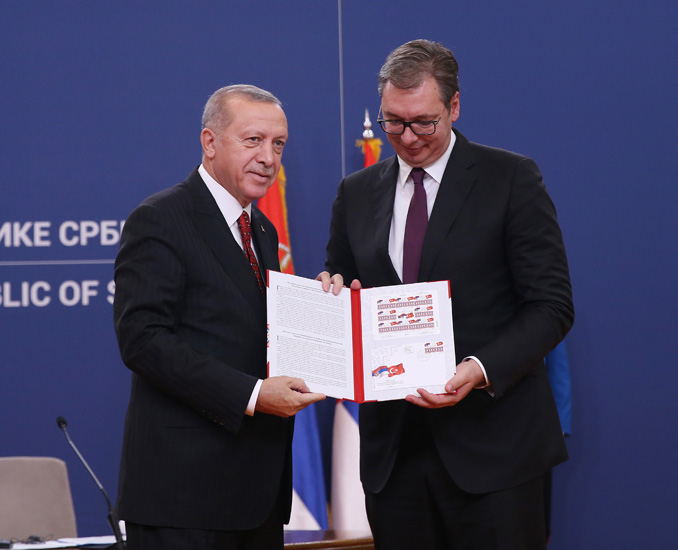
It is no secret that Turkish President Recep Tayyip Erdoğan, his family members and his business associates benefit immensely from defense industry and military goods sales. Turkey’s military drones, which have made a name for themselves in recent years in several battle zones such as Libya, Syria and Nagorno-Karabakh, are also produced by Erdoğan’s son-in-law, Selçuk Bayraktar. Bayraktar and his company not only take advantage of all state facilities but also earn high profits in the local and international market with the sale of weapons, for which the only decision-maker is his father-in-law.
An important reason for choosing Turkish drones is that Turkey does not have a long export approval process. unlike the US and the European Union.