Abdullah Bozkurt/Stockholm
A US federal judge has found Turkey liable for a violent 2017 attack carried out by President Recep Tayyip Erdogan’s security detail on protesters outside the Turkish ambassador’s residence in Washington, D.C.
On October 7, 2025, after the Turkish government abruptly abandoned the case and chose to no longer participate in proceedings it was certain to lose, the court entered a sweeping default judgment against Ankara.
US District Judge Colleen Kollar-Kotelly issued the ruling after formally adopting a detailed report and recommendation prepared by Magistrate Judge Matthew J. Sharbaugh. The judgment holds Turkey liable for multiple civil torts and for violating the District of Columbia’s hate-crime statute in connection with the brutal assault on Kurdish and anti-Erdogan demonstrators at Sheridan Circle on May 16, 2017.
Turkey had previously fought a multi-year legal battle over sovereign immunity but lost at every stage, including before the D.C. Circuit. Rather than continue defending the case, Turkish authorities instructed their US counsel to withdraw, and the government ceased participation altogether, leaving the plaintiffs’ evidence uncontested.
The attack unfolded shortly after Erdogan’s official meeting with then-president Donald Trump at the White House. Kurdish and anti-Erdogan activists gathered peacefully on a sidewalk opposite the Turkish ambassador’s residence.
Across the street, a larger pro-Erdogan crowd assembled, consisting of civilians, members of Erdogan’s official security detail and Turkish national police. US law-enforcement agencies including the Metropolitan Police Department, Secret Service and Diplomatic Security Service established a barrier between the two groups.
Recommendation for summary judgment issued by United States Magistrate Judge Matthew J. Sharbaugh in the Sheridan Circle case involving an attack on protesters by President Erdogan’s bodyguards:
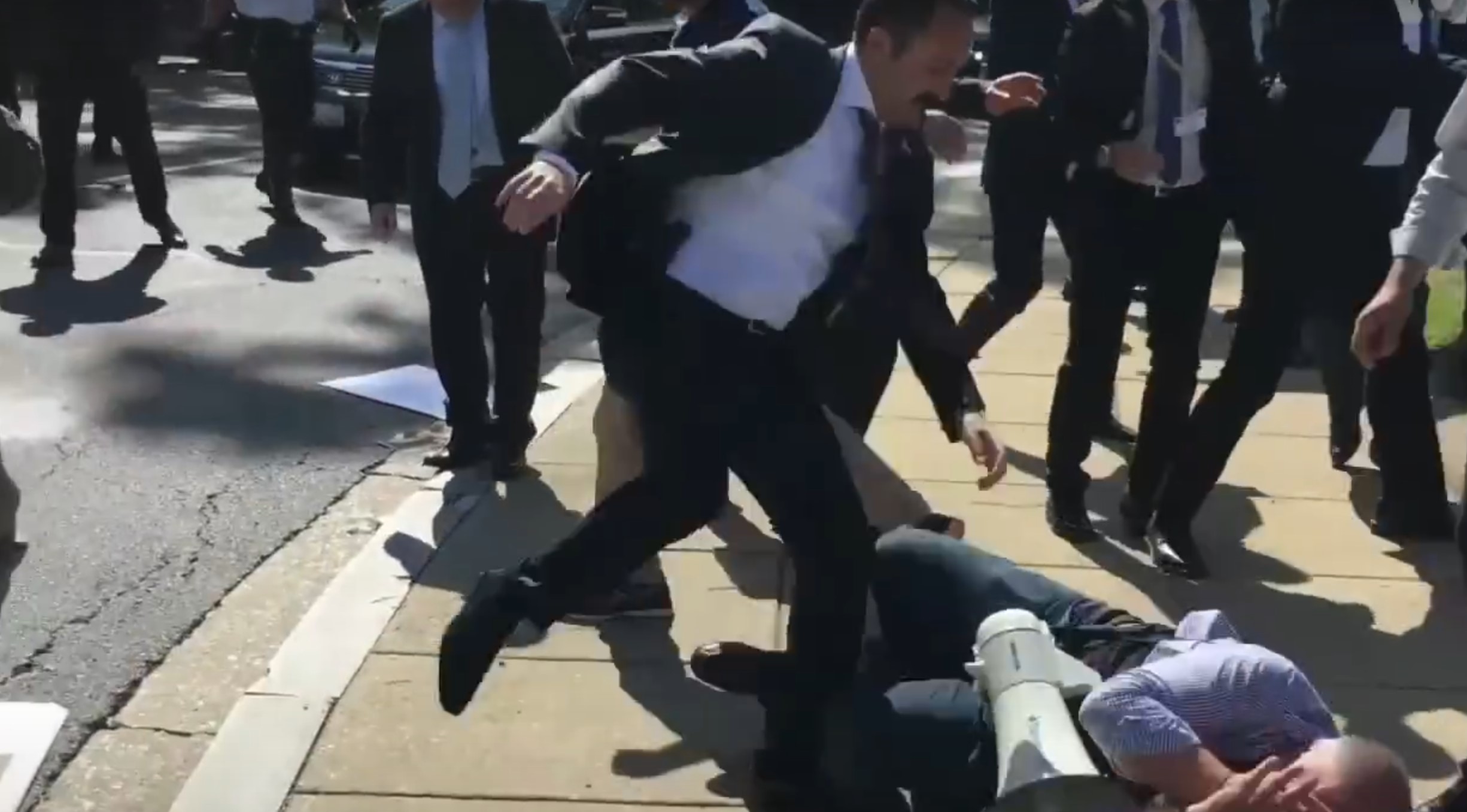
A brief scuffle broke out earlier in the afternoon, but police separated the two sides. The violence escalated dramatically when Erdogan’s motorcade arrived. Video footage shows the Turkish president pausing in his vehicle and speaking with his security chief. Moments later, members of the Turkish presidential security detail and aligned civilians burst through the police cordon, sprinted across the street and launched a coordinated assault on the protesters.
Many victims were standing behind police barricades or attempting to flee. The attackers punched, kicked and stomped on people on the ground and chased others around Sheridan Circle. Several protesters required hospitalization. Turkish security officers never attempted to detain or question anyone; the violence, the court said, served no protective purpose and was clearly intended to punish dissenters.
Fourteen plaintiffs brought suit, and their sworn accounts, corroborated by extensive video evidence, describe the severity of the attacks. Stephen Arthur was kicked and punched as he ran. Heewa Arya, knocked down and beaten, had moments earlier tried to shield his terrified 7-year-old daughter.
Abbas Azizi was repeatedly struck during both phases of the violence. Ceren Borazan was chased across the roundabout, pulled from a car as she tried to escape, put in a chokehold, threatened with death, thrown down and kicked. Hulya Kartal was dragged by the hair, punched unconscious and kicked repeatedly as she lay inert, filmed by circling agents.

Jane Doe I was grabbed so hard that her necklace snapped and was beaten as a man displayed his firearm to intimidate her. Elif Genc was knocked to the ground, kicked repeatedly and threatened. Jalal Kheirabadi was punched, knocked down and attacked again even in the presence of a US police officer.
Kasim Kurd was threatened and punched by agents who openly displayed guns. Mehmet Özgen was kicked and forced to flee. Mehmet Tankan was surrounded, beaten and told he would be killed. Murat Yasa was knocked down, kicked in the head and left fearing for his life.
Judge Kollar-Kotelly reaffirmed earlier findings that Turkey cannot claim sovereign immunity because the case falls under the Foreign Sovereign Immunities Act’s “tortious acts” exception, which applies when personal injuries in the United States are caused by agents of a foreign state acting within the scope of their duties.
Turkey was properly served through diplomatic channels, giving the court personal jurisdiction. The D.C. Circuit had already upheld these rulings, and the US Supreme Court declined to intervene. With Turkey absent from the litigation, the court proceeded under the FSIA’s requirement that plaintiffs prove their claims with “evidence satisfactory to the court,” a standard the judge found easily met.
The court held Turkey liable for civil assault because its agents intentionally created a reasonable fear of imminent harm. It found liability for civil battery because nearly every plaintiff experienced intentional, harmful physical contact. Turkey was also held liable for false imprisonment in the case of Borazan, whose movements were forcibly restricted when a Turkish agent dragged her from a vehicle and restrained her.
Eleven plaintiffs were found to have suffered severe emotional trauma including nightmares, depression, panic attacks, hyper-vigilance, loss of concentration and PTSD constituting intentional infliction of emotional distress.
A central component of the ruling was the judge’s determination that the attack constituted a bias-motivated hate crime. Protesters had displayed Kurdish flags, colors and slogans denouncing Turkey’s treatment of Kurds.
Turkish security officers and pro-Erdogan supporters responded with ethnic slurs and targeted threats aimed specifically at Kurds. The court concluded that anti-Kurdish prejudice was a but-for cause of the assault and that Turkey bears civil liability under the D.C. Bias-Related Crime Act for the resulting injuries.
The ruling determines Turkey’s liability but does not yet resolve the question of damages. Plaintiffs are expected to seek compensation for medical costs, psychological harm, lost income and other damages. The judgment applies solely to Turkey; several private individuals accused of taking part in the violence continue to contest the allegations and remain in active litigation.
For years, Erdogan’s security detail has been at the center of repeated allegations of violence, intimidation and disregard for local law, both in Turkey and abroad. Erdoğan’s protective team, whose exact size and composition remain classified, has expanded significantly over the past decade, with government spending on his personal protection reaching record levels.
Many of the men assigned to his detail are long-time loyalists and hard-core Islamists, some with backgrounds in intelligence operations, and several have been linked to past incidents involving force against journalists, protesters and even foreign security officials.
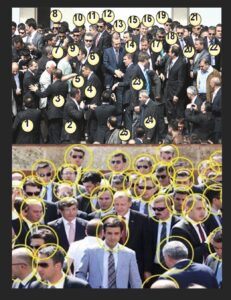
Long before the 2017 Sheridan Circle attack in Washington, Erdogan’s bodyguards had developed a reputation for aggressive conduct during overseas visits. In 2014 members of his security team assaulted journalists in New York during his appearance at the United Nations.
The following year in Brussels, his guards clashed with Belgian security personnel after refusing to follow protocol at an official event. In 2016 in Quito, Ecuador, Erdoğan’s detail forcibly removed women protesting Turkey’s policies and broke the nose of an Ecuadorean legislator.
Similar scenes unfolded in South Africa in 2018, where protesters reported being kicked and beaten outside the Turkish Embassy. In 2019 in Sarajevo the bodyguards confronted local police at the airport after declining to surrender their weapons as required under Bosnian law.
The pattern has been equally pronounced within Turkey. In one widely reported case, a man who criticized Erdogan during a public appearance in Trabzon in 2007 was beaten by presidential bodyguards, an incident the European Court of Human Rights later classified as torture and degrading treatment.
A decade later a lawyer in Istanbul who complained about the presidential motorcade blocking traffic was abducted by security personnel, beaten for hours and forced to sign a false statement implicating himself in insulting the president.
Several members of the protective detail who were implicated in past abuses have continued to advance within the Turkish state apparatus. Nordic Monitor has reported that at least one officer indicted in the United States for his role in the 2017 attack was later appointed to a diplomatic-level security post abroad, underscoring a culture of impunity surrounding Erdogan’s bodyguards.
Against this backdrop, the assault on Kurdish and anti-Erdogan protesters in Washington fits into a broader, well-documented pattern in which Erdogan’s security team behaves as an extension of domestic repression, often carrying out politically motivated violence far beyond Turkey’s borders.
Judge Kollar-Kotelly’s October 7, 2025, order represents a rare moment in which a US court has held a foreign government, especially a NATO ally, responsible for exporting political violence onto American soil. It stands as one of the most direct judicial condemnations to date of Ankara’s attempts to suppress dissent beyond its borders.