
Nordic Monitor/Stockholm
Turkey’s evolving mafia-style governance, shaped by President Recep Tayyip Erdogan’s Islamist administration and reinforced by his far-right ally Devlet Bahçeli, has created an environment where organized crime thrives so openly that hitmen, smugglers and violent enforcers now advertise their services on social media.
On Telegram, one of the world’s largest encrypted messaging platforms, criminal figures openly promote contract killings, assaults, human trafficking and drug-running as if they were ordinary commercial services.
Once confined to whispered deals in the underworld, Turkey’s criminal networks have migrated to digital marketplaces. Research, court files and verified open-source material reviewed for this article show that encrypted Telegram groups have evolved into hubs where murder-for-hire, extortion, drug-trafficking, protection services and identity fraud are bought and sold in plain sight.
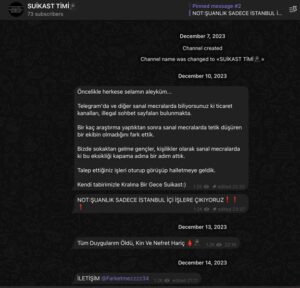
Dozens of Telegram groups — with names such as “Tetikçi Mekanı” (Hitman’s Place), “Istanbul Hitman,” “Suikast Timi” (Assassination Team) and “The Daltons” — openly advertise violent services. In these channels, messages like “Urgently need a hitman in Istanbul — DM [Direct Messaging]” or “Shooting available anywhere, payment half upfront, half after completion” circulate with alarming regularity. Screenshots reviewed by Nordic Monitor show contract killings being offered in Istanbul for sums ranging between 2 and 3 million Turkish lira, posted as casually as classified ads.
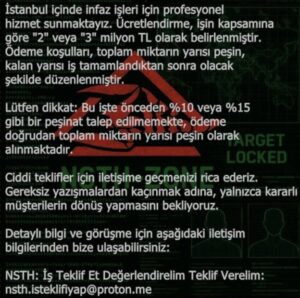
The listings go far beyond murder. Some channels promote shooting assignments or arson attacks in Istanbul, while others offer drug-courier work under the euphemism “courier services.”
Cross-border migrant smuggling also appears frequently, with one message advertising a guaranteed Bulgarian border crossing for 3,000 euros. There were several preliminary reports in Turkish media that first highlighted these groups, but the scope has since expanded dramatically. In one group police data indicated that nearly 600 users had access to these listings, with prices for killings starting at 200,000 lira, about $7,000, and rising into the millions. Several channels even advertised installment plans, normalizing murder and violence as consumer products.
A Telegram channel titled “Tetikçi NSTH #Istanbul Birimi,” created in November 2024, promoted a combination of hitman services and “protection work,” operating as a digital storefront for organized crime. Most groups are now closed communities requiring admin approval to join, adding layers of secrecy that make law-enforcement monitoring or investigative journalists’ work ever more difficult.
The violence advertised online has direct real-world consequences. One notable case involved 21-year-old Görkem Mete, who testified that he accepted a contract shooting job through Telegram for 250,000 lira. On May 11, 2025, Mete traveled to northern Cyprus, fired multiple shots at a car parked in the garden of a home in Çatalköy using an unregistered Glock pistol and escaped by taxi.
Police captured him within 40 minutes and recovered the discarded weapon and clothing. Investigators determined that he had coordinated the job through Telegram with individuals based in Turkey. The motive remains unclear, but the case illustrates how online offers translate into actual acts of violence.
Court files and police reports have uncovered numerous similar offers: arson attacks priced at 10,000 lira (about $330–$350), shootings targeting businesses for 40,000 lira ($1,300–$1,400) and murder contracts ranging from 200,000 to 300,000 lira ($6,700–$10,000). These transactions rely heavily on the anonymity and encryption that Telegram provides, allowing perpetrators to disappear or abandon accounts after collecting payment
Experts warn that these criminal networks increasingly recruit minors, exploiting provisions in Turkey’s Penal Code that reduce sentences for offenders under 18 by up to 75 percent. Gangs often lure teenagers with images of wealth, status and power, using displays of luxury cars, cash, weapons and designer clothing to portray crime as a fast track to prestige.
Many groups adopt cartoon-inspired names like “The Daltons” or “Caspers” to appeal to younger audiences. Some members even boast about being under house arrest, receiving suspended sentences or serving jail time, treating their criminal past as a form of digital “street credibility.”

Turkey’s youth unemployment rate, approximately 15.1 percent in March 2025 (for ages 15-24) according to Turkish Statistical Institute (TurkStat) data, further deepens young people’s vulnerability to criminal recruitment. With nearly 13 million young people (aged 15-24) accounting for about 14.9 percent of the total population, Turkey’s youth cohort remains substantial.
Economic desperation, widespread corruption under the government of Recep Tayyip Erdogan including the practice of selecting candidates more on party affiliation than merit and a lack of opportunities in the corporate sector create fertile ground for organized-crime networks to attract recruits via online propaganda disguised as lifestyle aspiration.
Telegram has also become a key platform for human smuggling networks connecting Turkey to Europe and the United States. One group examined contained 3,375 members openly seeking assistance to flee the country. Smugglers offered journeys to Germany, Belgium or Italy for 3,000 to 4,500 euros per person, while individuals under judicial travel bans were quoted significantly higher prices, ranging from 9,000 to 10,500 euros. Many smugglers promise clients that they will avoid detection and claim they will be “welcomed” upon arrival in Europe.
This surge in digital smuggling coincides with a sharp rise in emigration from Turkey. TurkStat recorded 466,914 departures in 2022, a 62.3 percent increase from the previous year, including 139,531 Turkish citizens. The trend continued into 2023 and 2024, with migration researchers noting that Turkey has now become one of the top three source countries of asylum applicants in Europe.

Germany’s Federal Office for Migration and Refugees (BAMF) documented a 203 percent increase in asylum applications from Turkish citizens in the first seven months of 2023, reaching 23,486 cases. By the end of that year, Turkish nationals filed just over 61,000 asylum applications across the EU, a record high and an increase of more than 80 percent compared with 2022, according to the European Union Agency for Asylum (EUAA).
In the United Kingdom there were 3,636 asylum applications from Turkish nationals in 2023, an increase of 87 percent compared to 2022.
Meanwhile, Voice of America reported that approximately 33,000 Turkish nationals crossed into the United States via the Mexican border between early 2022 and mid-2023, many allegedly connected to Telegram-organized smuggling networks. US Customs and Border Protection figures show the trend continued into 2024, with Turkish encounters at the southern border rising further and nearly doubling over a two-year period.
Although the numbers dropped significantly in 2024 and 2025 due to stricter immigration policies implemented across Europe and North America, the exodus of Turkish citizens continues. Many now resort to illegal border crossings, paying substantial sums to smugglers to escape the country.
The online criminal economy on Telegram extends far beyond contract killings and smuggling. Pages are filled with offers of unlicensed firearms, counterfeit currency, fake identity documents and packages containing stolen personal data. Some groups advertise money laundering operations and bulk drug shipments concealed within legitimate courier networks. The sophistication of these services reflects a parallel underground economy structured around encrypted communication and Turkey’s inability, or rather unwillingness, to intervene.

Recent data underscore a deepening crisis in public security across Turkey. Official statistics show a dramatic long-term escalation: Crime rates have surged by 108 percent over the past decade, while the country’s prison population had ballooned to over 403,000 inmates as of April 2025, one of the highest incarceration figures in Europe.
The profile of offenders is also shifting. TurkStat data for 2024 show a 13 percent rise in minors suspected of crime, confirming that youth involvement in violence, theft, drug distribution and organized criminal activity is accelerating.
Human trafficking cases also indicate systemic enforcement gaps: In 2024 authorities launched 170 trafficking investigations involving 965 suspects, yet secured only 25 convictions, reflecting a persistent disconnect between police operations and judicial outcomes. Taken together these figures reveal not only an expanding criminal landscape but a state apparatus increasingly unable or unwilling to confront it, allowing organized crime and digitally enabled violence to grow with alarming speed
Turkey’s political dynamics play a critical role in sustaining this criminal environment. The far-right Nationalist Movement Party (MHP), Erdogan’s indispensable partner in governance, has long been accused of exerting influence within the judiciary, police and intelligence agencies. The recent arrest of notorious mob boss Selahattin Yılmaz, known for his ties to MHP leader Bahçeli, revived scrutiny of these networks. Bahçeli dismissed the charges against Yılmaz as political smears and publicly referred to him as a “comrade,” reinforcing concerns that political protection and ideological loyalty shield criminal elements from accountability.
Critics argue that this politicized immunity enables organized crime groups to evolve, shift into encrypted platforms and operate with near impunity.
The threat extends beyond Telegram to other online platforms. The October 2024 murders of two women, İkbal Uzuner and Ayşenur Halil, in Istanbul — committed by 19-year-old Semih Çelik, who later died by suicide — highlighted how chat applications like Discord, commonly used among gamers, can become hosts for extremist, misogynistic or violent subcultures.
The murder-suicide shocked the nation and triggered renewed protests over Turkey’s femicide crisis, prompting digital safety experts to warn that loosely moderated servers can serve as incubators for violent ideologies.
Criminologists say the spread of these encrypted criminal markets represents not merely a failure of law enforcement but also a deeper signal of social and institutional collapse. When murder is advertised like a service and smuggling becomes a customer transaction, crime ceases to be an underground activity and instead becomes a normalized career path. With no known major police operations targeting these Telegram-based criminal markets, encrypted networks continue to harbor thousands of users who openly buy, sell and facilitate serious crimes.
Turkey’s digital underworld has become a reflection of a broader societal decay, one fueled by economic desperation, weakened institutions and political alliances that elevate impunity into a governing principle.
This surge in violence is not only a threat to Turkey’s internal security but also poses a growing danger beyond its borders. Turkish criminal groups increasingly operate in tandem with international syndicates, exporting their conflicts and turf wars abroad. Deadly incidents in Greece, Spain and several other European countries demonstrate that this is no longer a distant possibility but an unfolding reality, as Turkish gangs and their foreign partners bring armed clashes onto the streets of Europe.