

Levent Kenez/Stockholm
Although the European Union agreed on Friday, the first anniversary of Russia’s invasion of Ukraine, to impose new sanctions on Russia, expected to exceed 11 billion euros, it’s no secret that there are also a few countries in Europe that profit from the Western sanctions thanks to making good use of the opportunity to continue trade with Russia. NATO member and EU candidate Turkey previously announced that it would not participate in the sanctions imposed on Moscow by the United States and European Union due to its dependence on Russia for natural gas and also because Turkey is a favorite destination of millions of Russian tourists.
Foreign trade statistics since the beginning of the war, however, show that Turkey’s trade with Russia increased considerably in 2022. According to Turkish Statistical Institute (TUIK) data, trade volume with Russia, which was $34.73 billion in 2021, doubled to $68.19 billion in 2022, with imports from Russia accounting for a significant part of the increase.
Imports from Russia, which stood at $28.96 billion in 2021, rose to $58.85 billion in 2022. Russia has become Turkey’s largest trading partner, leaving China behind. Turkey’s share of Russia’s exports increased from 2 to 7 percent.
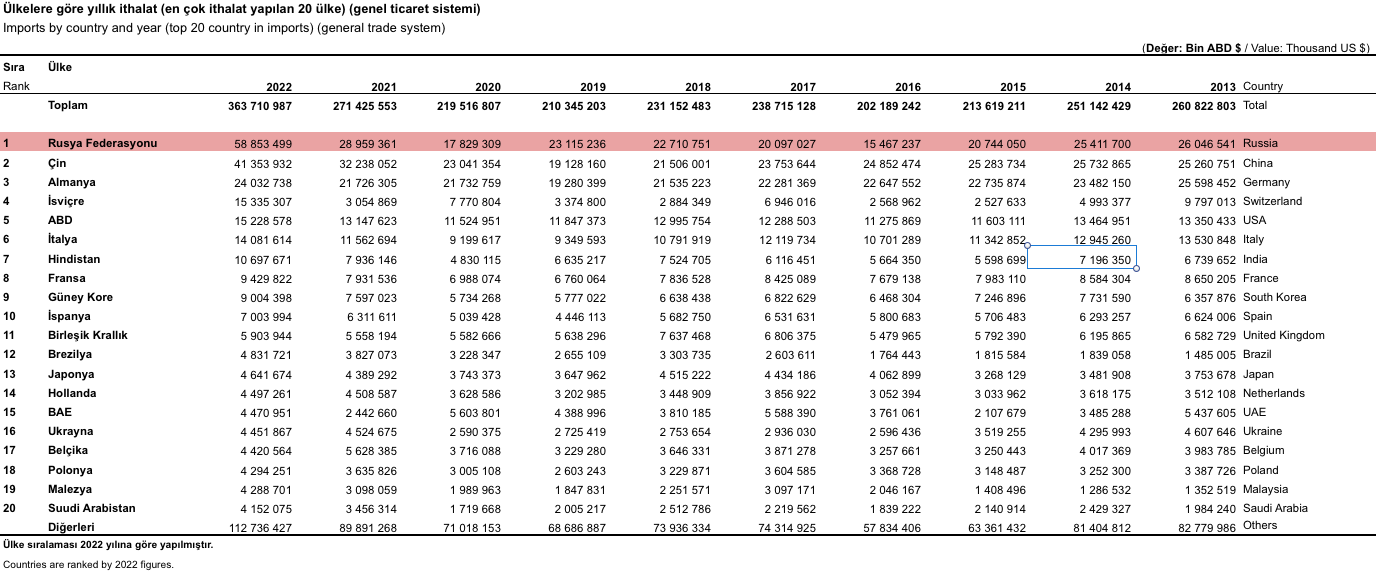
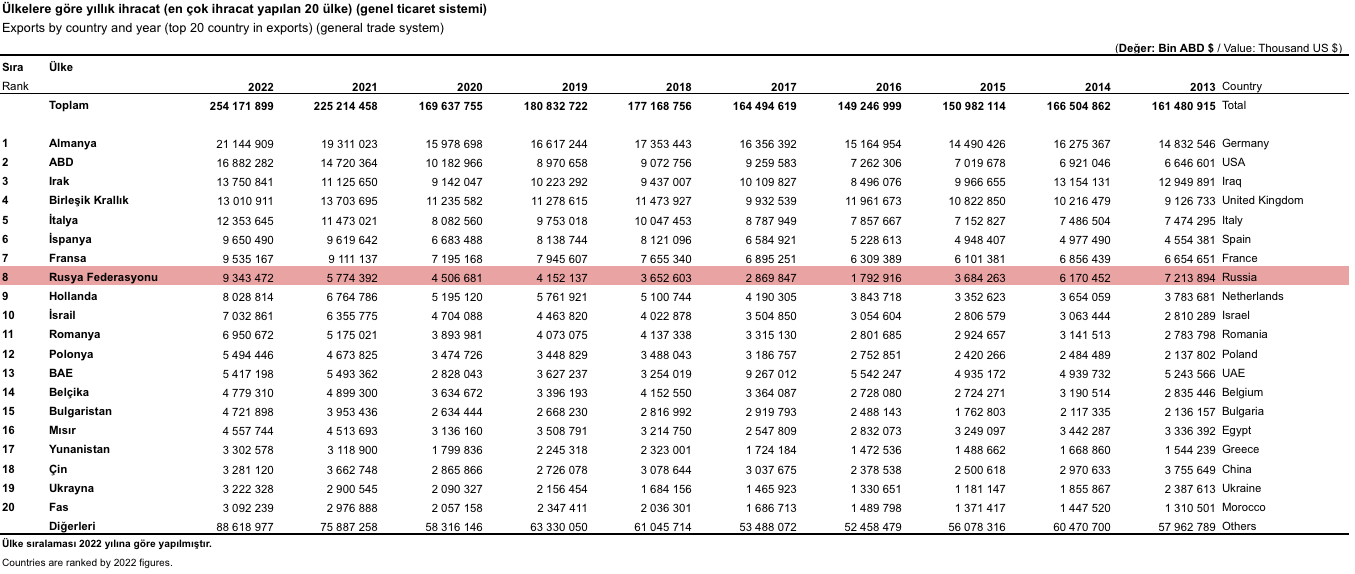
Likewise, Turkish exports to Russia almost doubled from $5.77 billion in 2021 to $9.34 billion in 2022.
As expected, oil accounted for the highest increase in Turkey’s imports from Russia. Moscow, which had difficulties in marketing the crude oil it produced after the imposition of Western sanctions, gave special discounts to China, India and Turkey, offering win-win contracts. According to news stories in the Turkish media, Urals oil, which was traded at 60.12 USD/bbl (bbl=one barrel) at the time the invasion started, was bought at $37.80 by Turkey. This also resulted in Turkey reducing the amount of crude oil it previously bought from Iraq, Norway and West Africa.
That’s why Turkey’s crude oil imports from Russia doubled in 2022. According to the latest report by Turkey’s Energy Market Regulatory Authority (EPDK), Turkey’s oil imports from Russia, which totaled 1.1 million tons in October 2021, increased to 2.2 million tons in October 2022. The share of Russian oil in Turkey’s imports, which was 26.6 percent in October 2021, rose to 51.7 percent in October 2022.
In 2022 Turkey’s total energy imports increased by 91.6 percent over 2021 and reached $97.1 billion, indicating that Turkey not only imports Russian oil to meet its energy needs but also exports it.
Since Turkey, not a part of the Western bloc against Russia, was rewarded by Moscow, it saved oil expenditures and earned some money from cheap Russian oil in times of a currency crisis due to a deteriorating economy as the Turkish lira depreciated more than 28 percent against the dollar in 2022.
Russian leader Vladimir Putin’s favor to his Turkish counterpart, Recep Tayyip Erdoğan, for refusing to participate in Western sanctions was not limited to oil. Russia postponed an approximately $20 billion natural gas debt incurred by Turkish public company BOTAŞ until after 2023.
Putin told Erdoğan that Turkey had become the most reliable route for gas shipments to Europe and offered to create a European gas hub in Turkey, during a meeting in October on the sidelines of the sixth summit of the Conference on Interaction and Confidence-building Measures in Asia (CICA) in the Kazakh capital of Astana. Erdoğan suggested they move forward on Turkey’s second nuclear power plant, the construction of which is planned for Sinop on the southern coast of the Black Sea.
In March President Erdoğan made a controversial statement concerning Russian oligarchs to pro-government journalists on the way back from the NATO summit in Brussels, saying: “… if there are certain capital groups that want to come to our country and ‘park’ their facilities with us, of course, we won’t keep our doors closed to them. Our door is open to them as well.”
Erdoğan’s call must have been heeded by Russian businesspeople since Russians ranked first by country in the number of foreign joint ventures established in Turkey in 2022, with 1,363 companies set up with Russian partners. Of these, 140 were joint stock companies and 1,223 were limited liability companies. In 2021 only 177 companies were founded with Russian capital. Russians invested primarily in real estate and investment advisory companies.
The number of Russian trucks that transported goods to Russia had increased to 10,956 as of November 30, 2022, as opposed to some 2-3,000 on average in previous years. Between January 1 and November 30, 2022, 18,804 Turkish trucks made trips to Russia, carrying various exported goods.
Similarly, 13,648 Turkish trucks carried imported goods to Turkey from Russia, while the number of Russian trucks on that route was 7,445 in the same period.
The spike in the number of both Russian and Turkish trucks that transported goods to and from Russia came after a protocol signed between Turkish and Russian delegations on May 16, 2022, less than two months after Russia invaded Ukrainian territories.
The meeting, held under the Joint Commission on Land Transportation, saw a sharp change in the Russian position on maximum transit quotas awarded to Turkish truckers. Russian representatives agreed to increase the annual truck quota for the Turkish side from 8,000 to 20,000 for transportation that is destined to end in Russia and from 6,000 to 35,000 for transit transportation to third countries via Russia.
Erdoğan repeatedly states that Russian grain and fertilizer can be delivered to third countries via Turkey and that they are open to all kinds of cooperation including exporting Russian grain to poor countries.
Nordic Monitor previously reported that Russians were the largest group of foreigners living in Turkey with residence permits in 2022, up from sixth place in 2021. Turkey is a safe haven for wealthy Russians in particular who had to leave Western countries due to sanctions imposed after Russia invaded Ukraine. Likewise, Russians fleeing the war seem to prefer Turkey. The fact that the Turkish government has insistently and repeatedly declared that it will not participate in the Western sanctions on Russia has played an important role in the growing number of residence permits issued to Russians.
According to official statistics obtained by Nordic Monitor, there were a total of 1,349,559 foreigners with residence permits in Turkey in 2022, compared to 1,314,181 in 2020. The most common type of residence permit was a short-term permit granted to 941,290 people. Foreigners who own real estate in Turkey and tourists who extended their stay most frequently applied for short-term residence permits. There are 143,346 people in Turkey with student residence permits. Foreign nationals who are married to Turkish citizens or have children with them benefit from a family residence permit, which was issued to 100,398 people in 2022.
Meanwhile, Erdoğan spoke with Putin on the phone on Friday about the shipment of Russian energy resources and the 2023 launch of the first reactor at the Akkuyu nuclear power plant built by Russia in southern Turkey. Experts speculate that the two leaders also discussed a reduction in the price of natural gas demanded by Turkey and the continuation of cheap Russian oil shipments. Erdoğan is expected to visit Putin prior to the general election in 2023.